
BuddhistCatholicContemplativeEvangelicalGeneral ChristianHinduJewishLatter-day SaintMuslimNew VisionsProgressive Christian
Beliefs
- Buddhist
- Catholic
- Contemplative
- Evangelical
- General Christian
- Hindu
- Jewish
- Latter-day Saint
- More Voices
- Muslim
- New Visions
- Pagan
- Progressive Christian
Topics
- Religion News
- Food and Religion
- Sports and Religion
- Religious Art
- Religious Music and Entertainment
- Religious Events
- History and Religion
- Style and Religion
- Politics and Religion
- Women in Religion
- Recreation Outdoors and Religion
- Business Finance and Religion
- Careers Workplace and Religion
- Education and Religion
- Family Parenting and Religion
- Health Fitness and Religion
- Home and Religion
- Relationships and Religion
- Technology and Religion
- Travel and Religion
Columnists
- Buddhist Columnists
- Business Finance and Religion Columnists
- Careers Workplace and Religion Columnists
- Catholic Columnists
- Contemplative Columnists
- Education and Religion Columnists
- Evangelists Columnists
- Family Parenting and Religion Columnists
- General Christian Columnists
- Health Fitness and Religion Columnists
- Hindu Columnists
- History and Religion Columnists
- Home and Religion Columnists
- Jewish Columnists
- More Voices Columnists
- Latter Day Columnists
- Muslim Columnists
- New Visions Columnists
- Nonreligious Columnists
- Pagan Columnists
- Politics and Religion Columnists
- Progressive Columnists
- Recreation Outdoors and Religion Columnists
- Relationships and Religion Columnists
- Religion News Columnists
- Religious Art Columnists
- Religious Events Columnists
- Religious Music and Entertainment Columnists
- Sports and Religion Columnists
- Style and Religion Columnists
- Technology and Religion Columnists
- Travel and Religion Columnists
- Women in Religion Columnists
Resource Library
- 2026 Calendar
- Library of World Religions
- The 100 Most Holy Places on Earth
- Patheos Answers
- Podcasts
- Videos
- Faith Leaders Database
- Anglican Episcopalian
- Bahai
- Baptist
- Buddhism
- Christianity
- Confucianism
- Eastern Orthodoxy
- Hinduism
- Holiness and Pentecostal
- ISKCON
- Islam
- Judaism
- Lutheran
- Methodist
- The Church of Jesus Christ of Latter-day Saints
- New Age
- Paganism
- Presbytarian and Reformed
- Protestantism
- Religion Behind the Scenes
- Roman Catholic
- Scientology
- Shia Islam
- Sikhism
- Sufism
- Sunni Islam
- Taoism
- Zen
- See all religions
Research Tools
 Ad-Free & Subscriber Log-In Subscription Support
Ad-Free & Subscriber Log-In Subscription Support
Follow Patheos 

- Trending:
- Forgiveness
- |
- Marriage
- |
- Consciousness
- |
- Death Penalty
- |
- Election
- |
- Halloween

- Home
- Latter-day Saint
- Travel and Religion
- For Thanksgiving Week
For Thanksgiving Week
Last updated on: November 25, 2024 at 3:31 pm by Dan Peterson
For Thanksgiving Week 2024-11-25T15:31:29-07:00 Dan Peterson
Patheos Explore the world's faith through different perspectives on religion and spirituality! Patheos has the views of the prevalent religions and spiritualities of the world.
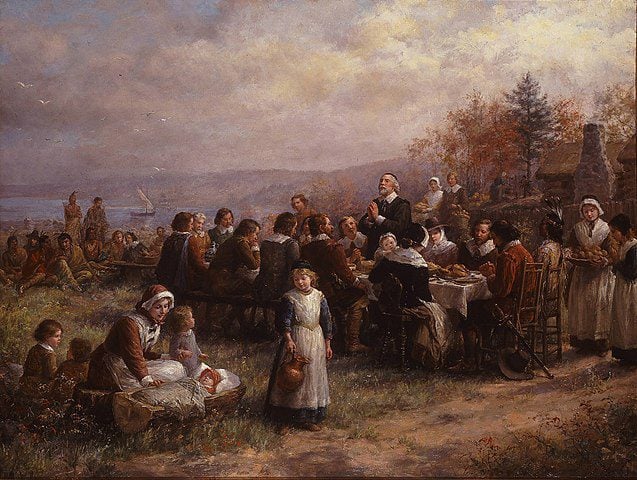
“Thanksgiving at Plymouth,” by Jennie Augusta Brownscombe (1925)
Wikimedia Commons public domain image
I’ve long felt that American Thanksgiving tends to be a somewhat forlorn and relatively neglected holiday. Falling between the fun of the costumes and candies and houses of horror associated with the entirely desacralized holiday of Halloween and the weeks of carols and festivities (and unrelenting commercialism) of the partially desacralized Christmas, it tends to be reduced to something of a poor relation — a day, merely, of family get-togethers and good traditional foods. Both of which, I hasten to say, are good things. But gratitude and actual thanks-giving can sometimes be lost among the bustle and the travel and the meal preparation. And I’m not just pointing the finger of reproach at others. I myself am often guilty of precisely such neglect.
In an attempt to improve things just a bit — at least in my own case — I intend to repost here some of the columns that I’ve written for Thanksgiving in past years, accompanied by hymns that are appropriate to the holiday.
The first of the hymns that I’ve chosen was probably inspired by Psalm 23:6 and Psalm 150:
1. Praise to the Lord, the Almighty, the King of creation! O my soul, praise him, for he is thy health and salvation! Join the great throng, Psaltery, organ and song, Sounding in glad adoration!
2. Praise to the Lord! Over all things he gloriously reigneth. Borne as on eagle wings, safely his Saints he sustaineth. Hast thou not seen How all thou needest hath been Granted in what he ordaineth?
3. Praise to the Lord, who doth prosper thy way and defend thee. Surely his goodness and mercy shall ever attend thee. Ponder anew What the Almighty can do, Who with his love doth befriend thee.
4. Praise to the Lord! Oh, let all that is in me adore him! All that hath breath, join with Abraham’s seed to adore him! Let the “amen”. Sum all our praises again, Now as we worship before him.
Text: Joachim Neander, 1650–1680; trans. by Catherine Winkworth, 1829–1878. Music: From Stralsund Gesangbuch, 1665; arr. by William S. Bennett, 1816–1875, and Otto Goldschmidt, 1829–1907

Tiffany glass windows (1905) featuring a sunrise in a forest in springtime and an autumn sunset (1905), in the collection of the Brooklyn Museum
(Wikimedia Commons public domain)
Here is a piece that I published with my late friend Bill Hamblin back in 2013:
American traditions of Thanksgiving are generally associated with Puritan harvest feasts in early colonial times, and particularly with the one in October 1621, when Chief Massasoit and about 90 other Native American men joined slightly more than 50 European immigrants at Plymouth Colony, in today’s Massachusetts, for a communal meal.
Abraham Lincoln’s formal proclamation of a late-November “Day of Thanksgiving and Praise” came just 150 years ago, in 1863. However, religious festivals of thanksgiving associated with the agricultural cycle, thanking God for a bounteous harvest — essential to life through the winter — are much more ancient and universal, and can be found in most religious traditions of the world.
In ancient agrarian societies, where survival ultimately depended on rain and on the fertility cycles of local plants and animals, a failed harvest could swiftly bring widespread disaster and death. Accordingly, a bountiful harvest was received with gratitude.
The sacrifices and festivals of ancient Israel were likewise fundamentally linked to the annual seasons of planting and reaping. One of their sacrifices was actually called the “thanksgiving” (Hebrew “todah”). As described in Leviticus 7:11-15, the thanksgiving offering was an entire meal, including fried cakes, bread and meat. Furthermore, it was commanded that “the flesh of the sacrifice of the peace offerings for thanksgiving shall be eaten the same day that it is offered.” That is, the ancient Israelite thanksgiving sacrifice was a sacred feast, a meal in which the food offerings were symbolically shared with God but were literally eaten by the sacrificer. In ancient Israel, such a “holiday feast” — as we now describe it — was actually a “holy-day feast.”
One of the fundamental psalms sung by the Levite choir each day at the temple was “O give thanks unto the Lord, for he is good, and his mercy endures forever” (Psalms 106, 107, 118, 136, 138; 1 Chronicles 16:7, 34, 23:30; 2 Chronicles 5:13, 7:6; Nehemiah 12:8). One could enter the Israelite temple only if one “entered the gates with thanksgiving” (Psalms 100:4, 95:2). Psalm 50 describes the characteristics of the “thanksgiving sacrifice” (50:15): “he who offers thanksgiving (Hebrew “todah”) glorifies me” (50:23; cf. Psalm 116:17).
When Jeremiah prophesied of the future restoration of Jerusalem and its temple, which was to come following the Babylonian captivity, he predicted that the returning Jews would “bring thank offerings to the house of the Lord” (Jeremiah 17:26) and singing “songs of thanksgiving” (Jeremiah 30:19). Jeremiah likewise prophesied that in Jerusalem should again be heard “the voice of joy and the voice of gladness, the voice of the bridegroom and the voice of the bride . . . as they bring the thanksgiving sacrifice (Hebrew “todah”) into the House of the Lord” (Jeremiah 33:11).
In the New Testament, Jesus Christ is twice described as giving thanks in the context of a sacred meal. At the feeding of the 5,000, he took the loaves and fish and, “having given thanks, he broke them and gave them to the disciples, and the disciples gave them to the crowds” (Matthew 15:36; Mark 8:6; John 6:11).
In the old Israelite thanksgiving sacrifice, the people were to bring food to the temple and give it to the priests, who would then offer it to God. Now, in a paradoxical reversal of the old order, Christ, as God incarnate, brings the food, offers thanks and gives it to his apostle-priests who then offer it to the people. The old order of the thanksgiving offering is thus reversed.
The same reversal of roles is found at the Last Supper, where, at the Passover dinner, Jesus gives thanks and shares a sacred meal with his apostles (Matthew 26:37; Mark 14:23; Luke 22:17, 19; 1 Corinthians 11:24). Christ’s atoning sacrifice has thus become a “thanksgiving offering.”
Although in Latter-day Saint tradition we tend to call our commemoration of the Last Supper the “sacrament,” in ancient Christianity it was referred to as the Eucharist — the “thanksgiving.” This is because Christ is described as having “given thanks” at the Last Supper — in Greek, “eucharistesas.” (Still today, the modern Greek equivalent of “thank you” is “efkharisto.”) Thus, for Latter-day Saint Christians, the sacrament is our commemoration of the archetypal thanksgiving sacrifice and meal of ancient Israel, of which our modern Thanksgiving holiday is only a pale shadow.
Appropriately, too, for many Americans, Thanksgiving kicks off the serious holiday season that culminates in Christmas, which recalls God’s greatest gift to us, his Son.
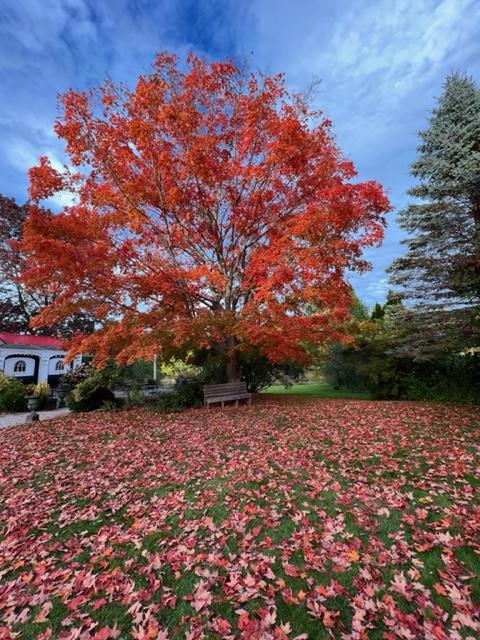
My wife snapped this photo in Kennebunkport, Maine, a couple of years ago. We walked by this tree, and she couldn’t resist.
My wife and I participated in a small private screening of Six Days in August up in Salt Lake City yesterday evening. It was the first time that I had seen the movie in several weeks, and I was reminded yet again of how good and solid a film it is. I’m proud of what we were able to accomplish, and I look forward now to seeing the remainder of the project take shape.

Fall foliage in Utah’s Little Cottonwood Canyon, near Salt Lake City
(Wikimedia Commons photo by Scott Catron)
But it’s crying time again: I’m going to leave you. You can see that Hitchens File look in my eyes. You can tell by the horrors you see coming that it won’t be long before it’s crying time. So here are a few of my latest gleanings from the Christopher Hitchens Memorial “How Religion Poisons Everything” File™:
- “Church’s Role in Improving Global Nutrition Highlighted at International Conference: Church presents work at World Food Prize Borlaug International Dialogue, an annual conference in Des Moines, Iowa”
- “BYU Students and Grads Are Saving Newborns and COVID Victims, One Breath at a Time”
- “Giving Machines Spread Christmas Cheer at North Pole”
Travel and Religion
History and Religion
Previous Post

November 24, 2024
Tragedy and Triumph and Hope
Next Post

November 26, 2024 Gratitude for Air and Dirt
Recent Comments
"DP: “But Mr. Sutherland worries about the fact that our time, when we can communicate ..."
Learning more about a region of ..."
"Another class of memories are of individuals who previously lived. Some of these remembered individuals ..."
"Sutherland's lecture sounds interesting. He seems to restate the Washington consensus that trade brings peace ..."
Learning more about a region of ..."
"In a meeting today, I learned another important reason why accurate (or at least as ..."
From Serbia’s “White City,” Belgrade
Browse Our Archives
Select a Category Uncategorized
Select a Month October 2026 September 2026 August 2026 July 2026 June 2026 May 2026 April 2026 March 2026 February 2026 January 2026 December 2025 November 2025 October 2025 September 2025 August 2025 July 2025 June 2025 May 2025 April 2025 March 2025 February 2025 January 2025 December 2024 November 2024 October 2024 September 2024 August 2024 July 2024 June 2024 May 2024 April 2024 March 2024 February 2024 January 2024 December 2023 November 2023 October 2023 September 2023 August 2023 July 2023 June 2023 May 2023 April 2023 March 2023 February 2023 January 2023 December 2022 November 2022 October 2022 September 2022 August 2022 July 2022 June 2022 May 2022 April 2022 March 2022 February 2022 January 2022 December 2021 November 2021 October 2021 September 2021 August 2021 July 2021 June 2021 May 2021 April 2021 March 2021 February 2021 January 2021 December 2020 November 2020 October 2020 September 2020 August 2020 July 2020 June 2020 May 2020 April 2020 March 2020 February 2020 January 2020 December 2019 November 2019 October 2019 September 2019 August 2019 July 2019 June 2019 May 2019 April 2019 March 2019 February 2019 January 2019 December 2018 November 2018 October 2018 September 2018 August 2018 July 2018 June 2018 May 2018 April 2018 March 2018 February 2018 January 2018 December 2017 November 2017 October 2017 September 2017 August 2017 July 2017 June 2017 May 2017 April 2017 March 2017 February 2017 January 2017 December 2016 November 2016 October 2016 September 2016 August 2016 July 2016 June 2016 May 2016 April 2016 March 2016 February 2016 January 2016 December 2015 November 2015 October 2015 September 2015 August 2015 July 2015 June 2015 May 2015 April 2015 March 2015 February 2015 January 2015 December 2014 November 2014 March 2014 August 2013 February 2012
Follow Us!
TAKE THE
Religious Wisdom Quiz
What did God create on the second day?
Select your answer to see how you score.
Trees Sun Fish Sky
Related posts from Sic et Non

Some notes on the archaeology of the Bible
Mandatory Bible reading in Texas public schools?

The Book of Mormon on the composition of...

TRENDING AT PATHEOS Latter-day Saint

The First Eucharistic Controversy: Christ’s Real Presence
For Catholics, the Eucharist is the source and summit of the Christian...

How to Make a Decision When You Can't...
Main point: It’s much more valuable to stay close to God so...

Archdiocese Hosts Military Marriage Retreat in Germany
RASTATT, Germany — The transient military lifestyle, with its frequent deployments and...

Nearly every morning, I make the drive to Detroit with my high-school-age...

The Real AI Story Is Adoption Without Trust
Artificial intelligence has crossed a political threshold. It is no longer a...

A new article, written by Jeff Lindsay and Gale L. Pooley,...
view all Latter-day Saint blogs
What Are Your Thoughts?leave a comment
Ad-Free & Subscriber Log-In Subscription Support
- About Us
- 2026 Calendar
- Videos
- Podcasts
- Library of World Religions
- Faith In Media Tracker
- Advertise With Us
- Write for Us
- Privacy Policy
- Terms of Service
- Do Not Sell My Data
- Contact Us
- Radiant Digital
- Manage Newsletter Subscriptions
- Unsubscribe From Notifications
- Sitemap
Copyright 2008-2026, Patheos. All rights reserved.
Subscription Support Ad-Free & Subscriber Log-In
Follow Patheos