
BuddhistCatholicContemplativeEvangelicalGeneral ChristianHinduJewishLatter-day SaintMuslimNew VisionsProgressive Christian
Beliefs
- Buddhist
- Catholic
- Contemplative
- Evangelical
- General Christian
- Hindu
- Jewish
- Latter-day Saint
- More Voices
- Muslim
- New Visions
- Pagan
- Progressive Christian
Topics
- Religion News
- Food and Religion
- Sports and Religion
- Religious Art
- Religious Music and Entertainment
- Religious Events
- History and Religion
- Style and Religion
- Politics and Religion
- Women in Religion
- Recreation Outdoors and Religion
- Business Finance and Religion
- Careers Workplace and Religion
- Education and Religion
- Family Parenting and Religion
- Health Fitness and Religion
- Home and Religion
- Relationships and Religion
- Technology and Religion
- Travel and Religion
Columnists
- Buddhist Columnists
- Business Finance and Religion Columnists
- Careers Workplace and Religion Columnists
- Catholic Columnists
- Contemplative Columnists
- Education and Religion Columnists
- Evangelists Columnists
- Family Parenting and Religion Columnists
- General Christian Columnists
- Health Fitness and Religion Columnists
- Hindu Columnists
- History and Religion Columnists
- Home and Religion Columnists
- Jewish Columnists
- More Voices Columnists
- Latter Day Columnists
- Muslim Columnists
- New Visions Columnists
- Nonreligious Columnists
- Pagan Columnists
- Politics and Religion Columnists
- Progressive Columnists
- Recreation Outdoors and Religion Columnists
- Relationships and Religion Columnists
- Religion News Columnists
- Religious Art Columnists
- Religious Events Columnists
- Religious Music and Entertainment Columnists
- Sports and Religion Columnists
- Style and Religion Columnists
- Technology and Religion Columnists
- Travel and Religion Columnists
- Women in Religion Columnists
Resource Library
- 2026 Calendar
- Library of World Religions
- The 100 Most Holy Places on Earth
- Patheos Answers
- Podcasts
- Videos
- Faith Leaders Database
- Anglican Episcopalian
- Bahai
- Baptist
- Buddhism
- Christianity
- Confucianism
- Eastern Orthodoxy
- Hinduism
- Holiness and Pentecostal
- ISKCON
- Islam
- Judaism
- Lutheran
- Methodist
- The Church of Jesus Christ of Latter-day Saints
- New Age
- Paganism
- Presbytarian and Reformed
- Protestantism
- Religion Behind the Scenes
- Roman Catholic
- Scientology
- Shia Islam
- Sikhism
- Sufism
- Sunni Islam
- Taoism
- Zen
- See all religions
Research Tools
 Ad-Free & Subscriber Log-In Subscription Support
Ad-Free & Subscriber Log-In Subscription Support
Follow Patheos 

- Trending:
- Forgiveness
- |
- Marriage
- |
- Consciousness
- |
- Death Penalty
- |
- Election
- |
- Halloween

- Home
- Latter-day Saint
- History and Religion
- On the River Sidon, at the northern entrance to Gondor
On the River Sidon, at the northern entrance to Gondor
Last updated on: October 29, 2024 at 11:48 pm by Dan Peterson
On the River Sidon, at the northern entrance to Gondor 2024-10-29T23:48:38-06:00 Dan Peterson
Patheos Explore the world's faith through different perspectives on religion and spirituality! Patheos has the views of the prevalent religions and spiritualities of the world.
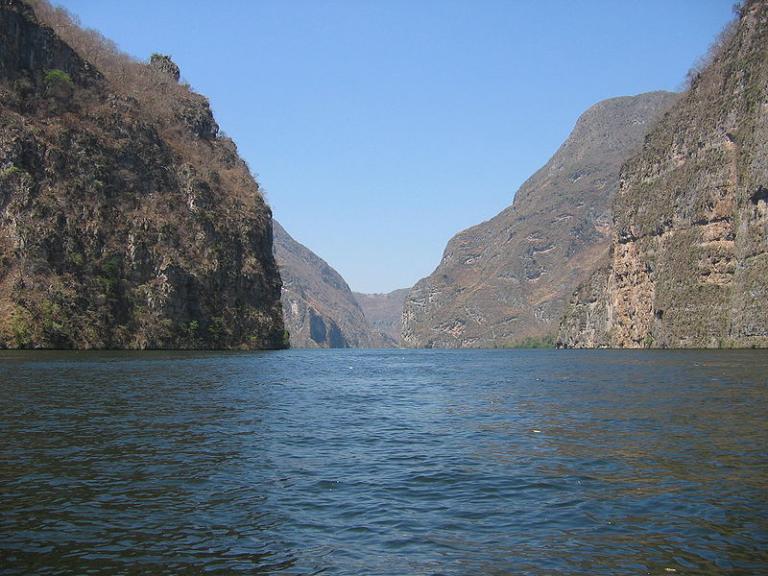
The Cañón del Sumidero of the Grijalva River. Is this the Book of Mormon’s “River Sidon”?
(Wikimedia Commons public domain image)
I’m going to make a serious effort to catch up on my reporting from this Interpreter Foundation educational tour in Guatemala and Mexico. I’m several days behind because of the mysterious computer malfunction that crippled me from Wednesday night until last night, Monday night. But I think that I can compensate for that, more or less.
We arrived on Sunday night in Tapachula, a city that is located in the far southeast of the state of Chiapas, México, near the Pacific Ocean and the Guatemalan border, and that several scholars have suggested as a likely candidate for the land of Lehi’s “first inheritance.” On Monday morning, we spent some time at two locations within the archaeological site of Izapa, which is famous among Latter-day Saints (at least of my generation) for its “Izapa Stela 5,” the so-called “Tree of Life stone” that some (starting with the late M. Wells Jakeman and continuing with, among others, the late V. Garth Norman) have identified with Lehi’s vision in 1 Nephi 8. (Other equally faithful Latter-day Saint authorities vigorously challenge that identification, although it seems that there is consensus agreement on its being some sort of representation of “the tree of life.”). It dates to about 300 BC.
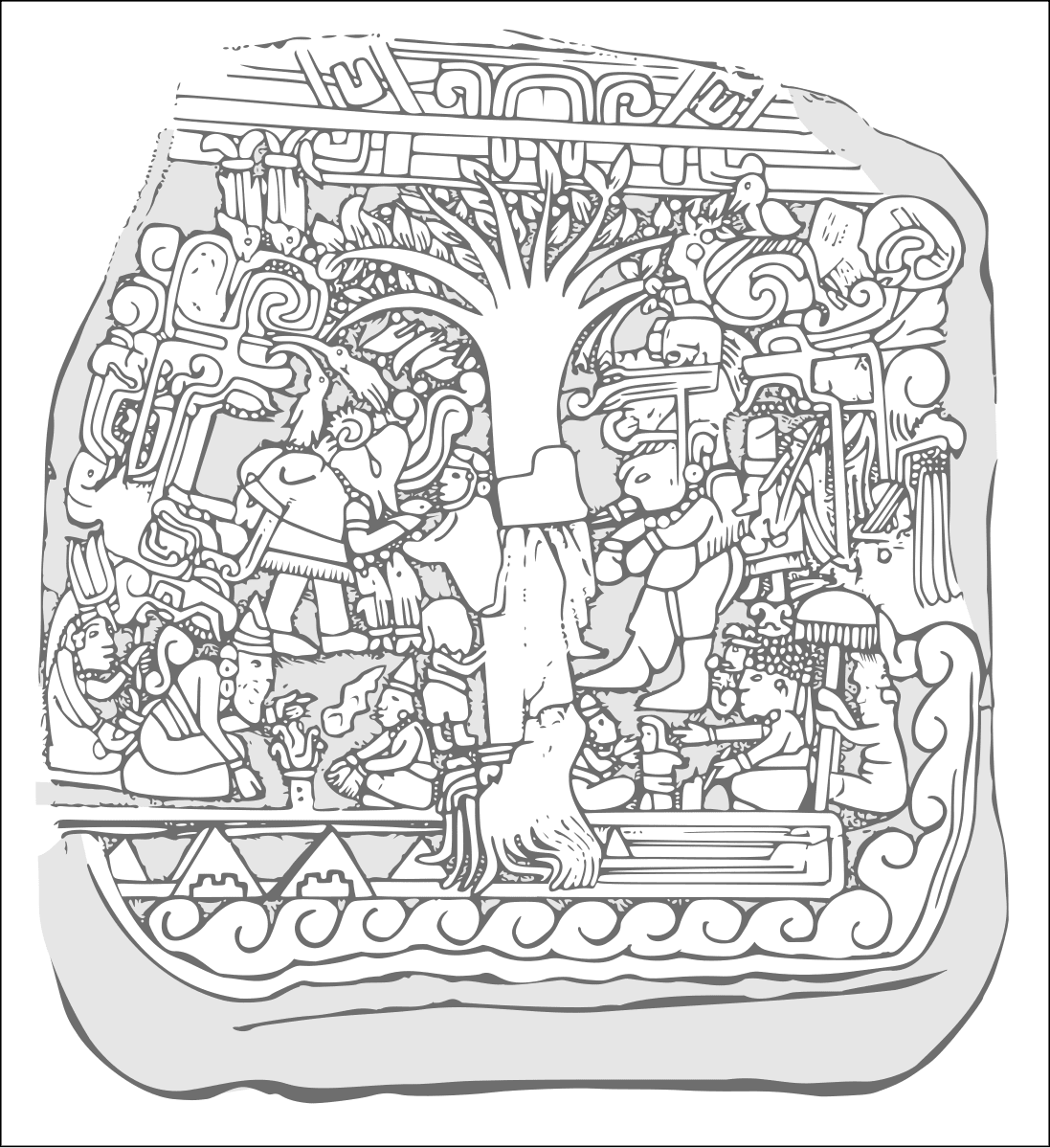
A 2001 drawing of Izapa Stela 5 based on several drawings, photographs, and replicas, with particular attention given to Garth Norman’s early drawing.
We drove along the Pacific coast and actually stopped to stick a few toes in the ocean. It is likely that Lehi and his party made landfall somewhat further to the south, in what is now Guatemala, but along a coastline very much like the one that we saw. This is the area of what Blake Allen (our tour operator and overall guide) and his late father, Joseph Allen, believe to be the location of the famous “day and a half’s journey”:
And now, it was only the distance of a day and a half’s journey for a Nephite, on the line Bountiful and the land Desolation, from the east to the west sea; and thus the land of Nephi and the land of Zarahemla were nearly surrounded by water, there being a small neck of land between the land northward and the land southward. (Alma 22:32)
It is also the area of the infamous city of Ammonihah. We were traveling to the valley or depression of Chiapas, which has been proposed as the Land of Zarahemla and which was the heartland of the Nephites for more than half a millennium, commencing about two centuries before Christ:
13 And it came to pass that he did according as the Lord had commanded him. And they departed out of the land into the wilderness, as many as would hearken unto the voice of the Lord; and they were led by many preachings and prophesyings. And they were admonished continually by the word of God; and they were led by the power of his arm, through the wilderness until they came down into the land which is called the land of Zarahemla.
14 And they discovered a people, who were called the people of Zarahemla. Now, there was great rejoicing among the people of Zarahemla; and also Zarahemla did rejoice exceedingly, because the Lord had sent the people of Mosiah with the plates of brass, which contained the record of the Jews.
15 Behold, it came to pass that Mosiah discovered that the people of Zarahemla came out from Jerusalem at the time that Zedekiah, king of Judah, was carried away captive into Babylon. (Omni 1:13-15)
In the middle of the fourth century after Christ, just a few decades before the final collapse of Nephite civilization and the Nephite polity, things changed:
28 And the three hundred and forty and ninth year had passed away. And in the three hundred and fiftieth year we made a treaty with the Lamanites and the robbers of Gadianton, in which we did get the lands of our inheritance divided.
29 And the Lamanites did give unto us the land northward, yea, even to the narrow passage which led into the land southward. And we did give unto the Lamanites all the land southward. (Mormon 2:28-29)
We spent last evening in Tuxtla Gutiérrez, the capital of Chiapas. Starting fairly early this morning, though, we headed out to Chiapa de Corzo, which various Mesoamericanist students of the Book of Mormon have proposed as the site of the Nephite city of Sidom.
1 And it came to pass that Alma and Amulek were commanded to depart out of that city; and they departed, and came out even into the land of Sidom; and behold, there they found all the people who had departed out of the land of Ammonihah, who had been cast out and stoned, because they believed in the words of Alma.
2 And they related unto them all that had happened unto their wives and children, and also concerning themselves, and of their power of deliverance.
3 And also Zeezrom lay sick at Sidom, with a burning fever, which was caused by the great tribulations of his mind on account of his wickedness, for he supposed that Alma and Amulek were no more; and he supposed that they had been slain because of his iniquity. And this great sin, and his many other sins, did harrow up his mind until it did become exceedingly sore, having no deliverance; therefore he began to be scorched with a burning heat.
4 Now, when he heard that Alma and Amulek were in the land of Sidom, his heart began to take courage; and he sent a message immediately unto them, desiring them to come unto him.
5 And it came to pass that they went immediately, obeying the message which he had sent unto them; and they went in unto the house unto Zeezrom; and they found him upon his bed, sick, being very low with a burning fever; and his mind also was exceedingly sore because of his iniquities; and when he saw them he stretched forth his hand, and besought them that they would heal him.
6 And it came to pass that Alma said unto him, taking him by the hand: Believest thou in the power of Christ unto salvation?
7 And he answered and said: Yea, I believe all the words that thou hast taught.
8 And Alma said: If thou believest in the redemption of Christ thou canst be healed.
It’s a comparatively simple site, which is appropriate. Why? Brant Gardner, who is along with us as an Interpreter Mesoamerican expert, quipped onsite today that, for many years, the Latter-day Saint rule for distinguishing purportedly Nephite archaeological ruins from purportedly Lamanite ruins boiled down to this principle: Beautiful or spectacular ruins were Nephite, while ugly or unimpressive sites were Lamanite. But this, he suggested, is probably the exact opposite of the truth. Any archaeological ruins left behind by the relatively simple, unstratified, and aniconic Nephite civilization would likely be far less spectacular than those remaining from the idolatrous Lamanites. And he pointed around us to the restrained monuments remaining from Chiapa de Corzo (Sidom?) as an illustration of that difference.
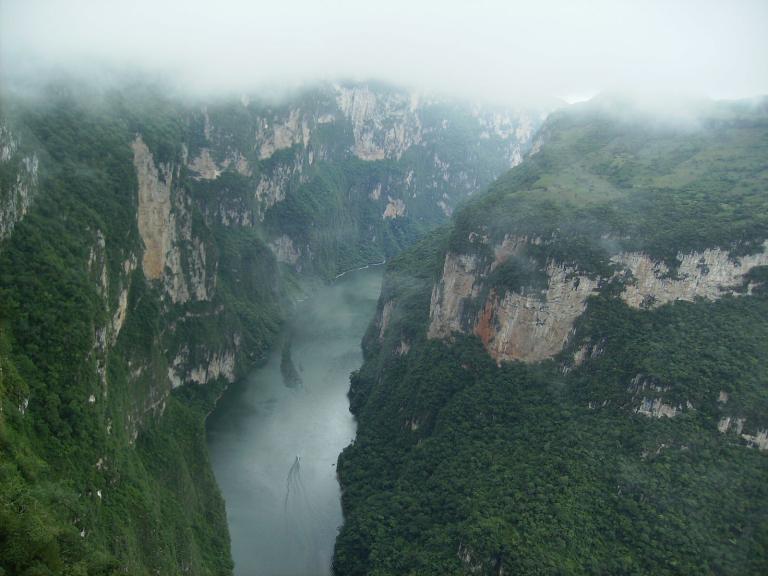
A 2007 Wikimedia Commons public domain photo of Sumidero Canyon from above the cliffs.
After Chiapa de Corzo, we spent approximately two hours on a boat cruising along the Rio Grijalva, which John Sorenson and (I think) most contemporary adherents to Mesoamerican models of Book of Mormon geography identify with the Nephites’ vitally important River Sidon. It was a very pleasant boat ride through the spectacular Sumidero Canyon, which forcibly brings to mind the River Anduin at the northern border of Gondor in Lord of the Rings. I almost expected to see the enormous stone figures of the kings Isildur and Anárion standing on either side of the river at the Gates of Argonath with hands upraised in warning. (I wasn’t the only person who thought of that image; at least two others mentioned it to me.)
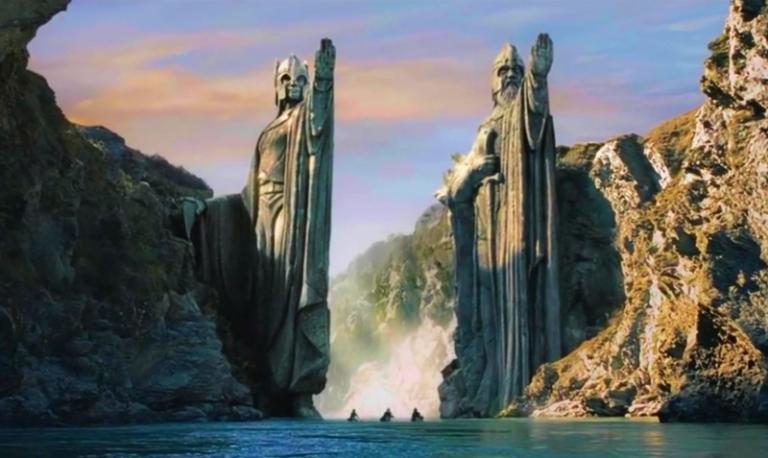
The Gates of Argonath (Wikimedia Commons)
We saw innumerable white herons and gray herons and pelicans and other waterfowl, we watched a juvenile crocodile haul itself out of the water and onto the river’s bank, and we observed two spider monkeys cavorting in trees right beside the river. We did not, however, notice any mechanical hippopotami wiggling their ears in artificial irritation. The driver of our boat didn’t fire his pistol to frighten any such hippopotami away. Nor did we pass behind Schweitzer Falls in order to see the other side of water. Nor did we encounter a shrunken-head salesman offering two of his for one of ours.
The limestone cliffs of Sumidero Canyon rise up several thousand feet on either side of the Grijalva. They reminded me of the sheer vertical cliffs that loom over Lauterbrunnen, in Switzerland’s Berner Oberland. But the latter, of course, were carved out by glaciation, whereas Sumidero appears to have been created by the Grijalva.

The temple in Villahermosa (Wikimedia Commons public domain image)
After lunch back in Tuxtla Gutiérrez, we drove – partly along the Grijalva — to Villahermosa, the capital and largest city of the state of Tabasco (which, to my surprise, apparently has no connection with the famous sauce). We’re spending tonight and tomorrow night in Villahermosa. According to a number of folks who have studied the matter, the city likely represents the western edge of “the land among many waters” that is described in Mosiah 8:8:
And they were lost in the wilderness for the space of many days, yet they were diligent, and found not the land of Zarahemla but returned to this land, having traveled in a land among many waters, having discovered a land which was covered with bones of men, and of beasts, and was also covered with ruins of buildings of every kind, having discovered a land which had been peopled with a people who were as numerous as the hosts of Israel.
Posted from Villahermosa, Tabasco, México
History and Religion
Travel and Religion
Previous Post
October 29, 2024
I'm back! (For the moment, anyway.)
Next Post
October 30, 2024 "And they did preserve the land southward for a wilderness."
Recent Comments
"About 10 of the BYU medical school faculty are women. One of tgese women gave ..."
The Iron Gates and the Lion ..."
"The BYU School of medicine alreasy has some female faculty members. Having done a complete ..."
The Iron Gates and the Lion ..."
"“Enough and to Spare”I love their closing statement:“Joseph’s revelations related to the issues of scarcity ..."
"Thanks John. You always have so many interesting facts. I could listen to you read ..."
Browse Our Archives
Select a Category Uncategorized
Select a Month October 2026 September 2026 August 2026 July 2026 June 2026 May 2026 April 2026 March 2026 February 2026 January 2026 December 2025 November 2025 October 2025 September 2025 August 2025 July 2025 June 2025 May 2025 April 2025 March 2025 February 2025 January 2025 December 2024 November 2024 October 2024 September 2024 August 2024 July 2024 June 2024 May 2024 April 2024 March 2024 February 2024 January 2024 December 2023 November 2023 October 2023 September 2023 August 2023 July 2023 June 2023 May 2023 April 2023 March 2023 February 2023 January 2023 December 2022 November 2022 October 2022 September 2022 August 2022 July 2022 June 2022 May 2022 April 2022 March 2022 February 2022 January 2022 December 2021 November 2021 October 2021 September 2021 August 2021 July 2021 June 2021 May 2021 April 2021 March 2021 February 2021 January 2021 December 2020 November 2020 October 2020 September 2020 August 2020 July 2020 June 2020 May 2020 April 2020 March 2020 February 2020 January 2020 December 2019 November 2019 October 2019 September 2019 August 2019 July 2019 June 2019 May 2019 April 2019 March 2019 February 2019 January 2019 December 2018 November 2018 October 2018 September 2018 August 2018 July 2018 June 2018 May 2018 April 2018 March 2018 February 2018 January 2018 December 2017 November 2017 October 2017 September 2017 August 2017 July 2017 June 2017 May 2017 April 2017 March 2017 February 2017 January 2017 December 2016 November 2016 October 2016 September 2016 August 2016 July 2016 June 2016 May 2016 April 2016 March 2016 February 2016 January 2016 December 2015 November 2015 October 2015 September 2015 August 2015 July 2015 June 2015 May 2015 April 2015 March 2015 February 2015 January 2015 December 2014 November 2014 March 2014 August 2013 February 2012
Follow Us!
TAKE THE
Religious Wisdom Quiz
What did God use to speak to Moses in the wilderness?
Select your answer to see how you score.
A burning bush A pillar of fire A thunderstorm A mighty wind
Related posts from Sic et Non


Some notes on the archaeology of the Bible


TRENDING AT PATHEOS Latter-day Saint

The Pillar of the Boatmen: the Ancient Monument...
The Pillar of the Boatmen is a Romano-Gaulish sculpture that dates from...

In one sense walking into Westminster Abbey is like walking down the...

'Super Scam Me' Exposes AI Jon Bon Jovi...
Leslie Pickett believed she was in a relationship with Jon Bon Jovi....

The Brazilian Remake of Kendricks' 'Flywheel' Opens in...
“Flywheel,” the story that launched the Kendrick Brothers’ filmmaking career is getting...

The Dangers of Gradual Accommodation (Winking at Sin)
Recently, the “law of gradualness” resurfaced during the opening of a weeklong,...

The Iron Gates and the Lion of the...
Yesterday, I didn't finish my report about, well, yesterday. So I'll...
view all Latter-day Saint blogs
What Are Your Thoughts?leave a comment
Ad-Free & Subscriber Log-In Subscription Support
- About Us
- 2026 Calendar
- Videos
- Podcasts
- Library of World Religions
- Faith In Media Tracker
- Advertise With Us
- Write for Us
- Privacy Policy
- Terms of Service
- Do Not Sell My Data
- Contact Us
- Radiant Digital
- Manage Newsletter Subscriptions
- Unsubscribe From Notifications
- Sitemap
Copyright 2008-2026, Patheos. All rights reserved.
Subscription Support Ad-Free & Subscriber Log-In
Follow Patheos