
BuddhistCatholicContemplativeEvangelicalGeneral ChristianHinduJewishLatter-day SaintMuslimNew VisionsProgressive Christian
Beliefs
- Buddhist
- Catholic
- Contemplative
- Evangelical
- General Christian
- Hindu
- Jewish
- Latter-day Saint
- More Voices
- Muslim
- New Visions
- Pagan
- Progressive Christian
Topics
- Religion News
- Food and Religion
- Sports and Religion
- Religious Art
- Religious Music and Entertainment
- Religious Events
- History and Religion
- Style and Religion
- Politics and Religion
- Women in Religion
- Recreation Outdoors and Religion
- Business Finance and Religion
- Careers Workplace and Religion
- Education and Religion
- Family Parenting and Religion
- Health Fitness and Religion
- Home and Religion
- Relationships and Religion
- Technology and Religion
- Travel and Religion
Columnists
- Buddhist Columnists
- Business Finance and Religion Columnists
- Careers Workplace and Religion Columnists
- Catholic Columnists
- Contemplative Columnists
- Education and Religion Columnists
- Evangelists Columnists
- Family Parenting and Religion Columnists
- General Christian Columnists
- Health Fitness and Religion Columnists
- Hindu Columnists
- History and Religion Columnists
- Home and Religion Columnists
- Jewish Columnists
- More Voices Columnists
- Latter Day Columnists
- Muslim Columnists
- New Visions Columnists
- Nonreligious Columnists
- Pagan Columnists
- Politics and Religion Columnists
- Progressive Columnists
- Recreation Outdoors and Religion Columnists
- Relationships and Religion Columnists
- Religion News Columnists
- Religious Art Columnists
- Religious Events Columnists
- Religious Music and Entertainment Columnists
- Sports and Religion Columnists
- Style and Religion Columnists
- Technology and Religion Columnists
- Travel and Religion Columnists
- Women in Religion Columnists
Resource Library
- 2026 Calendar
- Library of World Religions
- The 100 Most Holy Places on Earth
- Patheos Answers
- Podcasts
- Videos
- Faith Leaders Database
- Anglican Episcopalian
- Bahai
- Baptist
- Buddhism
- Christianity
- Confucianism
- Eastern Orthodoxy
- Hinduism
- Holiness and Pentecostal
- ISKCON
- Islam
- Judaism
- Lutheran
- Methodist
- The Church of Jesus Christ of Latter-day Saints
- New Age
- Paganism
- Presbytarian and Reformed
- Protestantism
- Religion Behind the Scenes
- Roman Catholic
- Scientology
- Shia Islam
- Sikhism
- Sufism
- Sunni Islam
- Taoism
- Zen
- See all religions
Research Tools
 Ad-Free & Subscriber Log-In Subscription Support
Ad-Free & Subscriber Log-In Subscription Support
Follow Patheos 

- Trending:
- Forgiveness
- |
- Marriage
- |
- Consciousness
- |
- Death Penalty
- |
- Election
- |
- Halloween

- Home
- Latter-day Saint
- History and Religion
- From the morning sessions of today’s superb conference
From the morning sessions of today’s superb conference
Last updated on: September 28, 2024 at 6:14 pm by Dan Peterson
From the morning sessions of today’s superb conference 2024-09-28T18:14:54-06:00 Dan Peterson
Patheos Explore the world's faith through different perspectives on religion and spirituality! Patheos has the views of the prevalent religions and spiritualities of the world.
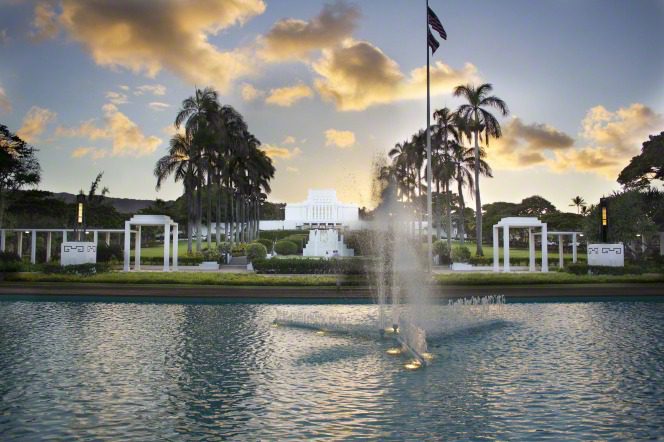
The Laie Hawaii Temple (LDS Media Library)
Today, I attended the Seventh Interpreter Matthew B. Brown Memorial Conference. The overall theme of these conferences, as befits Matt Brown’s interests, is “The Temple on Mount Zion.” The theme of this particular 2024 iteration of the conference was “Seership, Craftsmanship, and Fellowship.”
The conference was not live-streamed, but it was recorded, and I presume that the conference videos will eventually be made public. In the end, too, the proceedings of the conference, perhaps including (in at least some cases) longer versions of the papers delivered, will be issued as an Interpreter Foundation book. I’m looking forward to it.
The conference’s first speaker was Don Bradley, and the title of his presentation was “Acquiring an All-Seeing Eye: Joseph Smith’s First Vision as Seer Initiation and Deification Ritual.”
Don’s paper argued an interesting thesis, that, although other claims to visions that were superficially comparable to Joseph Smith’s First Vision can be found from roughly the same period — he explicitly referred to the case of the famous Protestant evangelist Charles Grandison Finney — the theology implicit in Joseph Smith’s First Vision is not that of the revivalists of the Second Great Awakening. Alhough it clearly parallels a good deal of their doctrine, including conviction for sin, divine mercy, and the redemptive role of Jesus Christ, it rejects the ontological gulf between the human being and God. Even the traditional Latter-day Saint understanding that the vision reveals a God who is like human beings, Don contends, understates its theological radicalism. The First Vision is not only the revelation of an anthropomorphic God, but also of theomorphic man. For Joseph Smith, the visitation of God did not reveal human beings as hopelessly “other” from him, nor as creatures who must shatter in his presence, but as fit vessels for his power and attributes, to be filled up with divinity.
The second presentation of the morning, given by David Calabro, was titled “Abraham on the Bishop’s Throne: Egyptian Christianity and the Book of Abraham”:
David’s paper is part of his larger project to investigate the historical and ritual context of the Book of Abraham. Several elements of the Book of Abraham, including its occasional use of New Testament phraseology and concepts (Abraham 2:9-11; 3:21-28), point to an early Christian hand in what may have been a complex textual history. At the same time, he says, the Book of Abraham shows evidence of being oriented to a ritual context, possibly one having to do with priesthood initiation (after all, Abraham’s obtaining of the priesthood is a major theme of the book). The paper focused on comparisons between the Book of Abraham and the Coptic enthronement rite of the Patriarch of Alexandria as it is described in liturgical books. Dr. Calabro argued for the thesis that a text like the Book of Abraham probably influenced the Coptic rite. The evidence discussed in the paper, he said, may also suggest that the Book of Abraham functioned liturgically in an early Egyptian Christian enthronement ritual, although — as he expressly mentioned in the paper’s conclusion — other explanations are possible.
The third speaker was Jeffrey M. Bradshaw, who addressed the subject of “The Abrahamic Covenant: Then and Now.”
Jeff gave a very lucid exposition of the Abrahamic covenant, asserting that the wealth of insights that ancient and modern scholarship can shed on the relevant scriptural accounts is generally underappreciated. He argued, too, that Abraham’s spiritual journey of covenant-making and covenant-keeping provides the backbone of his story in both the biblical book of Genesis and the Book of Abraham.
Fourth in the line-up of speakers was John S. Thompson, under the title of “Oracles Against the Nations and Prophetic Imitation of Temple Liturgy.”
The Major Prophets, Brother Thompson explained, have a segment of their writings that prophesy the demise of several foreign nations. The Egyptians and other ancient societies also have texts containing curses against foreign nations or enemies and art depicting the demise of those enemies or nations. Strikingly, however, these often appear in the context of temple/tomb rituals. Prompted by the temple context for the smiting or destruction of enemies in antiquity, Brother Thompson explored the question of whether the oracles against the nations found in the prophetic books are part of a larger temple structure in the text as a whole.
Breck England was the fifth speaker of the morning. His topic was “The Bright and Morning Star: The Book of Revelation through the Lens of the Temple.”
A wave of interest in a ritual reading of the Apocalypse or the Revelation of John appears to have been gaining strength over the past few years. Some scholars argue that “heavenly liturgies” mirroring the rites and ordinances of the ancient temple make up the framework of the book. Such scholars non-Latter-day Saint commentators as Leonard Thompson, Allan T. Georgia, Richard Herbert Wilkinson, and Margaret Barker seek, in Georgia’s words, to make explicit “the implicit importance of temple ritual for conceptualizing the practices, expositions, and narratives” of Revelation — which might understandably catch the interest of Latter-day Saints.
In his project The Bright and Morning Star: Finding and Following Jesus Through the Book of Revelation, Breck England has tried to combine the insights of these and other scholars with ancient and modern temple theology and apocryphal materials in order to “recuperate” the Apocalypse as a ritual text. In his presentation today, Brother England outlined very clearly how the Revelation of John depicts the sacred drama of the temple, from the initiatory stage through the primordial heavenly council, through the “great tribulation” of mortality to the “unveiling” (apokalypsis) of the divine presence. He showed — persuasively, I thought — how redemptive temple ordinances mark the progress of the pilgrim John along the path to the idealized Holy of Holies that is the New Jerusalem.
There. That takes the program up to the break for lunch. This was a rich, rich day. And it didn’t hurt at all that BYU defeated Baylor, at Baylor, during our conference. There was real meat in these presentations and, when the book appears, it will be well worth purchasing. I’ll return to the remainder of the conference presentations in tomorrow’s blog entry.
History and Religion
Travel and Religion
Previous Post
September 27, 2024
"Alma" as a Semitic Name, and Reaching Irreantum
Next Post
September 29, 2024 Temples, Ancient and Modern
Recent Comments
"DP: “But Mr. Sutherland worries about the fact that our time, when we can communicate ..."
Learning more about a region of ..."
"Another class of memories are of individuals who previously lived. Some of these remembered individuals ..."
"Sutherland's lecture sounds interesting. He seems to restate the Washington consensus that trade brings peace ..."
Learning more about a region of ..."
"In a meeting today, I learned another important reason why accurate (or at least as ..."
From Serbia’s “White City,” Belgrade
Browse Our Archives
Select a Category Uncategorized
Select a Month October 2026 September 2026 August 2026 July 2026 June 2026 May 2026 April 2026 March 2026 February 2026 January 2026 December 2025 November 2025 October 2025 September 2025 August 2025 July 2025 June 2025 May 2025 April 2025 March 2025 February 2025 January 2025 December 2024 November 2024 October 2024 September 2024 August 2024 July 2024 June 2024 May 2024 April 2024 March 2024 February 2024 January 2024 December 2023 November 2023 October 2023 September 2023 August 2023 July 2023 June 2023 May 2023 April 2023 March 2023 February 2023 January 2023 December 2022 November 2022 October 2022 September 2022 August 2022 July 2022 June 2022 May 2022 April 2022 March 2022 February 2022 January 2022 December 2021 November 2021 October 2021 September 2021 August 2021 July 2021 June 2021 May 2021 April 2021 March 2021 February 2021 January 2021 December 2020 November 2020 October 2020 September 2020 August 2020 July 2020 June 2020 May 2020 April 2020 March 2020 February 2020 January 2020 December 2019 November 2019 October 2019 September 2019 August 2019 July 2019 June 2019 May 2019 April 2019 March 2019 February 2019 January 2019 December 2018 November 2018 October 2018 September 2018 August 2018 July 2018 June 2018 May 2018 April 2018 March 2018 February 2018 January 2018 December 2017 November 2017 October 2017 September 2017 August 2017 July 2017 June 2017 May 2017 April 2017 March 2017 February 2017 January 2017 December 2016 November 2016 October 2016 September 2016 August 2016 July 2016 June 2016 May 2016 April 2016 March 2016 February 2016 January 2016 December 2015 November 2015 October 2015 September 2015 August 2015 July 2015 June 2015 May 2015 April 2015 March 2015 February 2015 January 2015 December 2014 November 2014 March 2014 August 2013 February 2012
Follow Us!
TAKE THE
Religious Wisdom Quiz
Who was Isaac's wife?
Select your answer to see how you score.
Sarah Rebekah Rachel Leah
Related posts from Sic et Non


Notes on Women, Priesthood, and General Conference

"The Book of Moses as a Temple Text"

TRENDING AT PATHEOS Latter-day Saint

How to Make a Decision When You Can't...
Main point: It’s much more valuable to stay close to God so...

Archdiocese Hosts Military Marriage Retreat in Germany
RASTATT, Germany — The transient military lifestyle, with its frequent deployments and...

Nearly every morning, I make the drive to Detroit with my high-school-age...

The Real AI Story Is Adoption Without Trust
Artificial intelligence has crossed a political threshold. It is no longer a...

A new article, written by Jeff Lindsay and Gale L. Pooley,...

Swimfan: Forgotten Aughts Pleasures
This is a recovery effort. In 2002, My Big Fat Greek Wedding...
view all Latter-day Saint blogs
What Are Your Thoughts?leave a comment
Ad-Free & Subscriber Log-In Subscription Support
- About Us
- 2026 Calendar
- Videos
- Podcasts
- Library of World Religions
- Faith In Media Tracker
- Advertise With Us
- Write for Us
- Privacy Policy
- Terms of Service
- Do Not Sell My Data
- Contact Us
- Radiant Digital
- Manage Newsletter Subscriptions
- Unsubscribe From Notifications
- Sitemap
Copyright 2008-2026, Patheos. All rights reserved.
Subscription Support Ad-Free & Subscriber Log-In
Follow Patheos