
BuddhistCatholicContemplativeEvangelicalGeneral ChristianHinduJewishLatter-day SaintMuslimNew VisionsProgressive Christian
Beliefs
- Buddhist
- Catholic
- Contemplative
- Evangelical
- General Christian
- Hindu
- Jewish
- Latter-day Saint
- More Voices
- Muslim
- New Visions
- Pagan
- Progressive Christian
Topics
- Religion News
- Food and Religion
- Sports and Religion
- Religious Art
- Religious Music and Entertainment
- Religious Events
- History and Religion
- Style and Religion
- Politics and Religion
- Women in Religion
- Recreation Outdoors and Religion
- Business Finance and Religion
- Careers Workplace and Religion
- Education and Religion
- Family Parenting and Religion
- Health Fitness and Religion
- Home and Religion
- Relationships and Religion
- Technology and Religion
- Travel and Religion
Columnists
- Buddhist Columnists
- Business Finance and Religion Columnists
- Careers Workplace and Religion Columnists
- Catholic Columnists
- Contemplative Columnists
- Education and Religion Columnists
- Evangelists Columnists
- Family Parenting and Religion Columnists
- General Christian Columnists
- Health Fitness and Religion Columnists
- Hindu Columnists
- History and Religion Columnists
- Home and Religion Columnists
- Jewish Columnists
- More Voices Columnists
- Latter Day Columnists
- Muslim Columnists
- New Visions Columnists
- Nonreligious Columnists
- Pagan Columnists
- Politics and Religion Columnists
- Progressive Columnists
- Recreation Outdoors and Religion Columnists
- Relationships and Religion Columnists
- Religion News Columnists
- Religious Art Columnists
- Religious Events Columnists
- Religious Music and Entertainment Columnists
- Sports and Religion Columnists
- Style and Religion Columnists
- Technology and Religion Columnists
- Travel and Religion Columnists
- Women in Religion Columnists
Resource Library
- 2026 Calendar
- Library of World Religions
- The 100 Most Holy Places on Earth
- Patheos Answers
- Podcasts
- Videos
- Faith Leaders Database
- Anglican Episcopalian
- Bahai
- Baptist
- Buddhism
- Christianity
- Confucianism
- Eastern Orthodoxy
- Hinduism
- Holiness and Pentecostal
- ISKCON
- Islam
- Judaism
- Lutheran
- Methodist
- The Church of Jesus Christ of Latter-day Saints
- New Age
- Paganism
- Presbytarian and Reformed
- Protestantism
- Religion Behind the Scenes
- Roman Catholic
- Scientology
- Shia Islam
- Sikhism
- Sufism
- Sunni Islam
- Taoism
- Zen
- See all religions
Research Tools
 Ad-Free & Subscriber Log-In Subscription Support
Ad-Free & Subscriber Log-In Subscription Support
Follow Patheos 

- Trending:
- Forgiveness
- |
- Marriage
- |
- Consciousness
- |
- Death Penalty
- |
- Election
- |
- Halloween

- Home
- Latter-day Saint
- History and Religion
- “A Frere ther was, a wantowne and a merye”
“A Frere ther was, a wantowne and a merye”
Last updated on: September 18, 2024 at 11:39 am by Dan Peterson
“A Frere ther was, a wantowne and a merye” 2024-09-18T11:39:13-06:00 Dan Peterson
Patheos Explore the world's faith through different perspectives on religion and spirituality! Patheos has the views of the prevalent religions and spiritualities of the world.
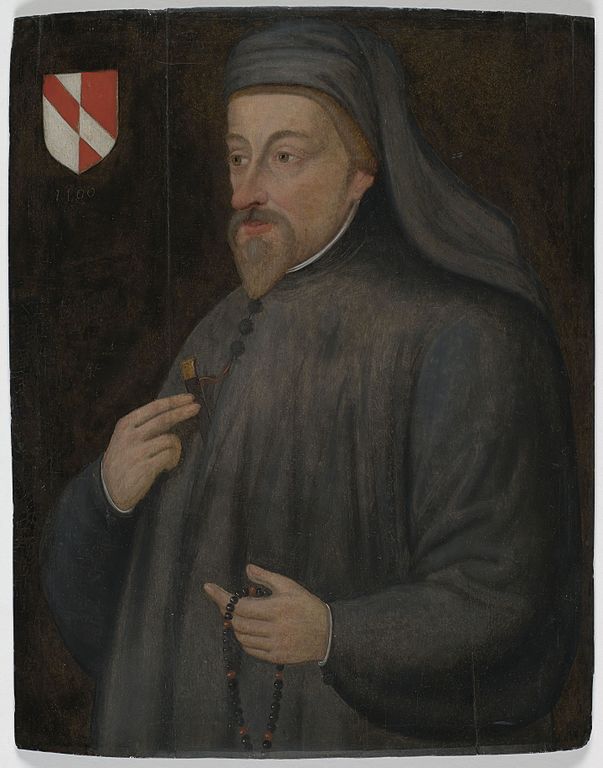
Geoffrey Chaucer (ca. 1340-1400), in an image from the early seventeenth century
(Wikimedia Commons public domain)
I’ve just undertaken a project to slog gradually through Geoffrey Chaucer’s Canterbury Tales in the original Middle English. I’ve always intended to do it and, finally, I’ve made a start. I was really struck by a passage in the Prologue describing a rather worldly frere or friar that, I would guess, was modeled on actual fourteenth-century friars known to Chaucer, who was an acute observer of the social world around him. I won’t generalize, of course, to say that all of the friars of his day were similar, but the type must have been recognizable to Chaucer’s audience.
First, though, a small handful of notes that might help:
- A frere or “friar” was a member of one of the four mendicant orders of late medieval Catholicism (the Augustinians, Carmelites, Dominicans, and Franciscans).
- A lymytour or “limiter” was an itinerant and begging friar employed by a convent to travel within certain geographical limits in order to collect its dues and promote its temporal interests.
- To shrive was to hear the confession of, to assign penance to, and to absolve (someone).
- A frankelyn or “franklin” was a prosperous but non-noble landowner.
- In the Latin Vulgate translation of the Bible, the opening words of the Gospel of John and of Genesis are in principio (“in the beginning”).
So here is Chaucer’s original verse, lines 208-269 of the Prologue:
A Frere ther was, a wantowne and a merye,
A lymytour, a ful solémpne man.
In alle the ordres foure is noon that kan
So muchel of daliaunce and fair langage.
He hadde maad ful many a mariage
Of yonge wommen at his owene cost.
Unto his ordre he was a noble post.
Ful wel biloved and famulier was he
With frankeleyns over al in his contree,
And eek with worthy wommen of the toun;
For he hadde power of confessioun,
As seyde hym-self, moore than a curát,
For of his ordre he was licenciat.
Ful swetely herde he confessioun,
And plesaunt was his absolucioun.
He was an esy man to yeve penaunce
There as he wiste to have a good pitaunce;
For unto a povre ordre for to yive
Is signe that a man is wel y-shryve;
For, if he yaf, he dorste make avaunt
He wiste that a man was répentaunt;
For many a man so hard is of his herte
He may nat wepe al-thogh hym soore smerte.
Therfore in stede of wepynge and preyéres
Men moote yeve silver to the povre freres.
His typet was ay farsed full of knyves
And pynnes, for to yeven faire wyves.
And certeinly he hadde a murye note:
Wel koude he synge and pleyen on a rote;
Of yeddynges he baar outrely the pris.
His nekke whit was as the flour-de-lys;
Ther-to he strong was as a champioun.
He knew the tavernes wel in every toun,
And everich hostiler and tappestere
Bet than a lazar or a beggestere;
For unto swich a worthy man as he
Acorded nat, as by his facultee,
To have with sike lazars aqueyntaunce;
It is nat honest, it may nat avaunce
Fór to deelen with no swich poraille,
But al with riche and selleres of vitaille.
And over-al, ther as profit sholde arise,
Curteis he was and lowely of servyse.
Ther nas no man nowher so vertuous.
He was the beste beggere in his hous;
[And yaf a certeyn ferme for the graunt,
Noon of his brethren cam ther in his haunt;]
For thogh a wydwe hadde noght a sho,
So plesaunt was his In principio,
Yet wolde he have a ferthyng er he wente:
His purchas was wel bettre than his rente.
And rage he koude, as it were right a whelpe.
In love-dayes ther koude he muchel helpe,
For there he was nat lyk a cloysterer
With a thredbare cope, as is a povre scolér,
But he was lyk a maister, or a pope;
Of double worstede was his semycope,
That rounded as a belle, out of the presse.
Somwhat he lipsed for his wantownesse,
To make his Englissh sweete upon his tonge;
And in his harpyng, whan that he hadde songe,
His eyen twynkled in his heed aryght
As doon the sterres in the frosty nyght.
This worthy lymytour was cleped Hubérd.
And here is a translation into modern English of those same verses, published by A. S. Kline in 2007:
A FRIAR there was, a wanton one and merry,
A Limiter, a very jovial man.
In all the friars’ four orders none that can
Lead a discussion in fairer language.
And he had arranged many a marriage
Of young women, granting each a dower.
He was a noble pillar of his Order.
Well-beloved and intimate was he
With Franklins within his boundary,
And also worthy women of the town;
Had power to confess coat and gown –
As he said himself – more than a curate,
Having licence from his bishop to do it.
Full sweetly he would hear confessions,
And very pleasant were his absolutions.
He was an easy man at granting penance
From which he made more than a pittance.
When to a poor Order alms are given
It is a token that a man’s well-shriven;
Since he dared claim that from the intent,
Of giving, then the man was penitent.
For many a man is so hard of heart
He cannot weep, though he feels the smart.
Therefore instead of weeping and prayer,
Better to give the poor friars silverware.
His sleeve’s end was stuffed with pocket-knives
And gilded pins, to give to pretty wives.
He could hold a note for sure; could sing
And play quite sweetly on the tuneful string.
Such competitions he won easily.
His neck was white as the fleur-de-lis;
And he was as strong as any champion.
He knew the taverns well in every town,
And all the barmaids and innkeepers,
Rather than the lepers and the beggars
Since such a worthy man as he
It suited not his calling or degree,
With such lepers to maintain acquaintance.
It is not seemly – helps no man advance –
To have dealings with such poor people,
Only with the rich, sellers of victuals.
And everywhere a profit might arise,
He wore a courteous and humble guise;
There was no man half so virtuous.
He was the finest beggar of his house
– and paid a fixed fee for the right;
None of his brethren poached in his sight.
For though a widow lacked a shoe
So pleasant was his ‘In principio’,
He yet would gain a farthing as he went.
His income was far greater than his rent,
And he romped around, like any whelp.
In settling disputes he could help,
Not like a friar from a cloister,
With threadbare cloak, like needy scholar,
But he was like a doctor or a pope;
Of double worsted was his demi-cloak,
A bell shaped from the mould, its fashion.
He lisped a little out of affectation,
To sound his English sweet upon the tongue;
And in his harping, whenever he had sung,
His eyes would twinkle in his head aright
As do the stars on high in frosty night.
Hubert his name, this worthy Limiter.
And it seems that Friar Hubert was prospering by means of his ecclesiastical functions. Chaucer’s description of him, which is plainly more amused than indignant, is a contemporary snapshot of at least one facet of fourteenth-century Christendom.
I can’t help but think of a passage in the Book of Mormon: “Priestcrafts,” says 2 Nephi 26:29, “are that men preach and set themselves up for a light unto the world, that they may get gain and praise of the world; but they seek not the welfare of Zion.”
History and Religion
Travel and Religion
Previous Post

September 17, 2024
Prediction is difficult. Especially about the future.
Next Post

September 19, 2024 Sneak Peeks Coming
Recent Comments
"In a meeting today, I learned another important reason why accurate (or at least as ..."
From Serbia’s “White City,” Belgrade
"PL: "Let's hope he doesn't have your address..."I have to frankly confess that a few ..."
From Serbia’s “White City,” Belgrade
"Let's hope he doesn't have your address..."
From Serbia’s “White City,” Belgrade
"PL: "The layers are peeling back."He appears to be suffering under an odd but powerful ..."
From Serbia’s “White City,” Belgrade
Browse Our Archives
Select a Category Uncategorized
Select a Month October 2026 September 2026 August 2026 July 2026 June 2026 May 2026 April 2026 March 2026 February 2026 January 2026 December 2025 November 2025 October 2025 September 2025 August 2025 July 2025 June 2025 May 2025 April 2025 March 2025 February 2025 January 2025 December 2024 November 2024 October 2024 September 2024 August 2024 July 2024 June 2024 May 2024 April 2024 March 2024 February 2024 January 2024 December 2023 November 2023 October 2023 September 2023 August 2023 July 2023 June 2023 May 2023 April 2023 March 2023 February 2023 January 2023 December 2022 November 2022 October 2022 September 2022 August 2022 July 2022 June 2022 May 2022 April 2022 March 2022 February 2022 January 2022 December 2021 November 2021 October 2021 September 2021 August 2021 July 2021 June 2021 May 2021 April 2021 March 2021 February 2021 January 2021 December 2020 November 2020 October 2020 September 2020 August 2020 July 2020 June 2020 May 2020 April 2020 March 2020 February 2020 January 2020 December 2019 November 2019 October 2019 September 2019 August 2019 July 2019 June 2019 May 2019 April 2019 March 2019 February 2019 January 2019 December 2018 November 2018 October 2018 September 2018 August 2018 July 2018 June 2018 May 2018 April 2018 March 2018 February 2018 January 2018 December 2017 November 2017 October 2017 September 2017 August 2017 July 2017 June 2017 May 2017 April 2017 March 2017 February 2017 January 2017 December 2016 November 2016 October 2016 September 2016 August 2016 July 2016 June 2016 May 2016 April 2016 March 2016 February 2016 January 2016 December 2015 November 2015 October 2015 September 2015 August 2015 July 2015 June 2015 May 2015 April 2015 March 2015 February 2015 January 2015 December 2014 November 2014 March 2014 August 2013 February 2012
Follow Us!
TAKE THE
Religious Wisdom Quiz
What root attitude does Paul say is the "root of all kinds of evil"?
Select your answer to see how you score.
Love of wisdom Love of animals Love of music Love of money
Related posts from Sic et Non


Some notes on the archaeology of the Bible


TRENDING AT PATHEOS Latter-day Saint

The Sermon on the Mount, Part I: Matthew...
The Sermon on the Mount, Part I (Matthew 4:12-5:12) St. Matthew moves...

What's up from Crossway: Reviewing some of their latest A few weeks...

Janie Learns the Way of the Cross: A...
Teaching children about Jesus' Passion can be challenging. Many parents and educators...

Looking For Good Catholic Writing - October 2026
He alone extends the heavens, and he walks upon the waves of...

In "Irreplaceable," our book on vocation and technology, Trevor Sutton and I...

I was strolling through the top floor of the brand new Parthenon...
view all Latter-day Saint blogs
What Are Your Thoughts?leave a comment
Ad-Free & Subscriber Log-In Subscription Support
- About Us
- 2026 Calendar
- Videos
- Podcasts
- Library of World Religions
- Faith In Media Tracker
- Advertise With Us
- Write for Us
- Privacy Policy
- Terms of Service
- Do Not Sell My Data
- Contact Us
- Radiant Digital
- Manage Newsletter Subscriptions
- Unsubscribe From Notifications
- Sitemap
Copyright 2008-2026, Patheos. All rights reserved.
Subscription Support Ad-Free & Subscriber Log-In
Follow Patheos