
BuddhistCatholicContemplativeEvangelicalGeneral ChristianHinduJewishLatter-day SaintMuslimNew VisionsProgressive Christian
Beliefs
- Buddhist
- Catholic
- Contemplative
- Evangelical
- General Christian
- Hindu
- Jewish
- Latter-day Saint
- More Voices
- Muslim
- New Visions
- Pagan
- Progressive Christian
Topics
- Religion News
- Food and Religion
- Sports and Religion
- Religious Art
- Religious Music and Entertainment
- Religious Events
- History and Religion
- Style and Religion
- Politics and Religion
- Women in Religion
- Recreation Outdoors and Religion
- Business Finance and Religion
- Careers Workplace and Religion
- Education and Religion
- Family Parenting and Religion
- Health Fitness and Religion
- Home and Religion
- Relationships and Religion
- Technology and Religion
- Travel and Religion
Columnists
- Buddhist Columnists
- Business Finance and Religion Columnists
- Careers Workplace and Religion Columnists
- Catholic Columnists
- Contemplative Columnists
- Education and Religion Columnists
- Evangelists Columnists
- Family Parenting and Religion Columnists
- General Christian Columnists
- Health Fitness and Religion Columnists
- Hindu Columnists
- History and Religion Columnists
- Home and Religion Columnists
- Jewish Columnists
- More Voices Columnists
- Latter Day Columnists
- Muslim Columnists
- New Visions Columnists
- Nonreligious Columnists
- Pagan Columnists
- Politics and Religion Columnists
- Progressive Columnists
- Recreation Outdoors and Religion Columnists
- Relationships and Religion Columnists
- Religion News Columnists
- Religious Art Columnists
- Religious Events Columnists
- Religious Music and Entertainment Columnists
- Sports and Religion Columnists
- Style and Religion Columnists
- Technology and Religion Columnists
- Travel and Religion Columnists
- Women in Religion Columnists
Resource Library
- 2026 Calendar
- Library of World Religions
- The 100 Most Holy Places on Earth
- Patheos Answers
- Podcasts
- Videos
- Faith Leaders Database
- Anglican Episcopalian
- Bahai
- Baptist
- Buddhism
- Christianity
- Confucianism
- Eastern Orthodoxy
- Hinduism
- Holiness and Pentecostal
- ISKCON
- Islam
- Judaism
- Lutheran
- Methodist
- The Church of Jesus Christ of Latter-day Saints
- New Age
- Paganism
- Presbytarian and Reformed
- Protestantism
- Religion Behind the Scenes
- Roman Catholic
- Scientology
- Shia Islam
- Sikhism
- Sufism
- Sunni Islam
- Taoism
- Zen
- See all religions
Research Tools
 Ad-Free & Subscriber Log-In Subscription Support
Ad-Free & Subscriber Log-In Subscription Support
Follow Patheos 

- Trending:
- Forgiveness
- |
- Marriage
- |
- Consciousness
- |
- Death Penalty
- |
- Election
- |
- Halloween

- Home
- Latter-day Saint
- Travel and Religion
- Music! Again!
Music! Again!
Last updated on: June 13, 2024 at 4:04 pm by Dan Peterson
Music! Again! 2024-06-13T16:04:30-06:00 Dan Peterson
Patheos Explore the world's faith through different perspectives on religion and spirituality! Patheos has the views of the prevalent religions and spiritualities of the world.
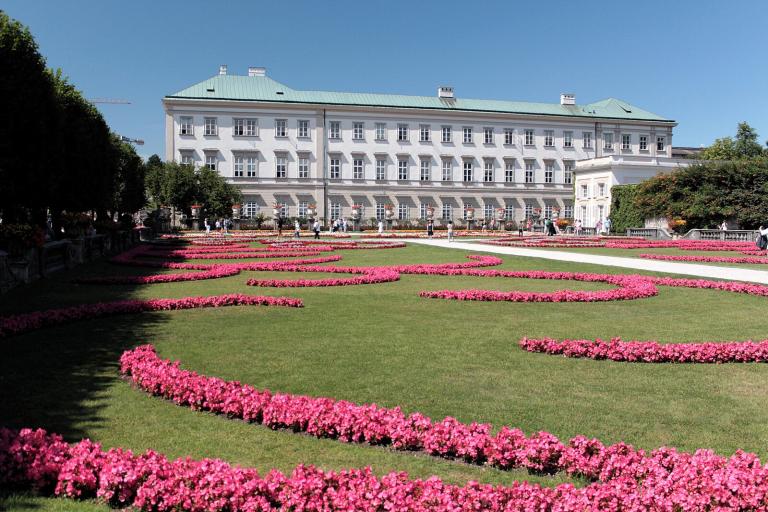
At the Mirabell Palace,in Salzburg
(Wikimedia Commons public domain image)
Last night, we attended a performance by a string quintet (occasionally joined by a French horn) at the Schloss Mirabell in Salzburg. The palace, which stands with its gardens on the shore of the Salzach River north of the medieval city walls, was built about 1606 by Prince-Archbishop Wolf Dietrich Raitenau as a pleasure palace for him and his mistress, Salome Alt. Not only did he live in the humble manner appropriate to a man of the cloth, but he was amazingly fertile for a priest who had taken a vow of celibacy: According to last night’s program, she bore him either fifteen children (English text) or seventeen (German text).
The night began with a piece by Joseph Haydn, and then the rest was Mozart — culminating in his “Eine kleine Nachtmusik.” The quintet was very good, and they received a deservedly enthusiastic ovation, which they answered with a horn-accompanied rendition of Ennio Morricone’s haunting theme from The Mission. (I liked their version better than this one , which was conducted by Morricone himself.)
With that concert in mind, and still in the spirit of Mozartstadt Salzburg, I think that I’ll post my last entry for now on the question of whether, as the late Christopher Hitchens claimed, religion poisons classical music. The three previous entries may be reviewed here and here and here:
The English composer Sir Edward Elgar (d. 1934) “chose to set to music virtually the whole of the New Testament.”[1] “Few artists in all of history have spent so many years of their life using their gift to enhance the Scriptures, particularly with his huge compositions entitled, The Apostles and The Kingdom.”[2] He wrote a song entitled Chariots of the Lord and oratorios entitled Lux Christi (“Light of Christ”) and Scenes from the Saga of King Olaf, about the epochal conversion of the King of Norway to Christianity, as well as a choral work, The Dream of Gerontius, about the experience of a Christian traveling from this world to the next life. The great Polish pianist (and eventual Polish prime minister) Ignaz Paderewski was once asked “Who is Elgar and where did he study? Was he at any conservatory?” Paderewski said that he was not. “But who was his teacher?” came the next question. “Le Bon Dieu,” replied the pianist.[3]
His principal biographer says that the “church-going self” of the radical American composer Charles Ives (d. 1954) was “conservative to the point of fundamentalism. He was almost in a state of ‘Give me that old-time religion, it’s good enough for me.’”[4] (He even composed a piece called The Revival Service, and another, General William Booth Enters into Heaven, about the founder of the Salvation Army.) “Most of the forward movements of life in general and of pioneers in most of the great activities,” Ives himself remarked as if responding prophetically to Christopher Hitchens, “have been the work of essentially religious-minded men.”[5] He happily anticipated a life beyond death, saying that he wanted to “see and talk to my father.”[6] More than fifty different Christian hymn tunes are quoted in his compositions, and he set several of the biblical psalms to music.
The great modern British composer Ralph Vaughan Williams (d. 1958) was also a deeply religious man. One participant in a choir that he led later recalled the tears running down Vaughan Williams’s cheeks as he conducted the portions of Bach’s St. Matthew Passion that recount Peter’s denial and Christ’s crucifixion.[7] Vaughan Williams became editor of the English Hymnbook in 1904, and edited Songs of Praise in 1925. His opera The Pilgrim’s Progress (based on the famous Christian allegorical tale by John Bunyan), the Christmas cantata Hodie (“This Day”), and the orchestral suite Job—A Masque for Dancing have been collectively dubbed his “affirmations of belief” by one his biographers.[8] But they don’t stand alone. He set texts from the English Christian poet George Herbert to music as Five Mystical Songs, composed a Te Deum for the installation of a new archbishop of Canterbury, wrote a Mass in G Minor, created a motet entitled The Souls of the Righteous, and wrote many smaller choral works such as O Taste and See, Dona Nobis Pacem (“Grant Us Peace”), and O Clap Your Hands.
“The more one separates oneself from the canons of the Christian church,” said Igor Stravinsky (d. 1971), “the further one distances oneself from the truth.”[9] “Music comes to reveal itself as a form of communion with our fellow man—and with the Supreme Being.”[10] Among his works are Three Sacred Choruses, written for the Orthodox liturgy, and a Catholic mass, as well as a Symphony of Psalms, The Flood, The Tower of Babel, Abraham and Isaac, Requiem Canticles, Sermon, Prayer, Canticum Sacrum, Credo, an Ave Maria, and a Pater Noster (“Our Father”).
Olivier Messiaen (d. 1992) “was one of the most outspoken Christian composers of all time.”[11] “What impressions do you want to communicate to your listeners?” his biographer Claude Samuel once asked him. Messiaen replied that “The first idea that I wished to express—and the most important, because it stands above them all—is the existence of the truths of the Catholic faith.”[12] His compositions for secular concert halls were just as religiously significant to him as anything he wrote directly for the church. “I wished to accomplish a liturgical act—that is to say, to transfer a kind of divine office, a kind of communal praise to the concert hall.”[13] His Couleurs de la Cite celeste (“Colors of the Celestial City”) is a meditation on the biblical book of Revelation, as is The Quartet for the End of Time, which he composed and premiered in a Nazi prison camp in 1941. His fervent Christian faith is also manifest in his Trois Petites Liturgies de la Presense Divine, his organ work La Nativite de Seigneur (“The Nativity of the Lord”), an orchestral piece entitled Et exspecto resurrectionem mortuorum, and a piece for organ called Meditations on the Mystery of the Sacred Trinity.
[I didn’t actually finish this little examination of Mr. Hitchens’s dramatic claim that religion poisons everything, but if I ever do so I will be certain to mention Sir John Tavener (1944-2013), a convert to Orthodox Christianity who is known for his extensive output of choral religious works. And I will certainly discuss Arvo Pärt (1935- ), an Estonian who has been called “the world’s greatest living composer and who, like Tavener, is a convert to Eastern Orthodoxy. Wikipedia says of him that “Unlike many of his fellow Estonian composers, Pärt never found inspiration in the country’s epic poem, Kalevipoeg, even in his early works. Pärt said, ‘My Kalevipoeg is Jesus Christ.'” Even the slightest glance at Arvo Pärt’s musical oeuvre will suggest the prominence of religious themes in his compositions. And I will probably include John Coltrane (1926-1967), whose A Love Supreme would be enough, alone and by itself, to qualify him for my list. And here’s a personal favorite: I love the oratorio The Redeemer, by our late friend Robert Cundick (1926-2016). Consider, for example, this part of that oratorio: “He is the Root and the Offspring of David.” The very first Interpreter Foundation venture into filmmaking was a half-hour piece entitled Robert Cundick: A Sacred Service of Music.]
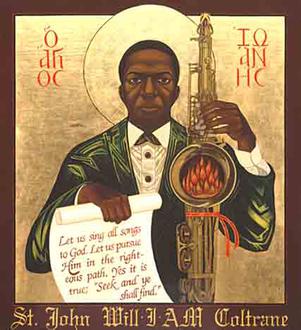
“St. John Coltrane” as an, umm, icon (Wikimedia CC public domain image)
[1] Percy M. Young, Elgar, O. M., A Study of a Musician (London: Collins St. James Place, 1955), 319.
[2] Kavanaugh, Spiritual Lives of the Great Composers, 162.
[3] Ibid., 165
[4] Ibid., 183.
[5] Ibid., 182-3.
[6] Ibid., 183.
[7] Ibid., 172.
[8] Ibid., 174.
[9] Ibid., 189.
[10] Ibid., 191-29.
[11] Ibid., 196.
[12] Claude Samuel, Conversations with Olivier Messiaen (London: Stainer and Bell, 1976), 2.
[13] Robert Sherlaw Johnson, Messiaen (London: M. Dent and Sons Ltd., 1975), 43.
Posted from Göteborg, Sweden
Travel and Religion
History and Religion
Previous Post

June 12, 2024
A Global Effort on Behalf of Women and Children
Next Post
June 14, 2024 In Beowulf Territory
Recent Comments
"I have cpnsidered in my mond if the 4 volume Saints could be made into ..."
From Serbia’s “White City,” Belgrade
"Another class of memories are of individuals who previously lived. Some of these remembered individuals ..."
"Sutherland's lecture sounds interesting. He seems to restate the Washington consensus that trade brings peace ..."
Learning more about a region of ..."
"In a meeting today, I learned another important reason why accurate (or at least as ..."
From Serbia’s “White City,” Belgrade
Browse Our Archives
Select a Category Uncategorized
Select a Month October 2026 September 2026 August 2026 July 2026 June 2026 May 2026 April 2026 March 2026 February 2026 January 2026 December 2025 November 2025 October 2025 September 2025 August 2025 July 2025 June 2025 May 2025 April 2025 March 2025 February 2025 January 2025 December 2024 November 2024 October 2024 September 2024 August 2024 July 2024 June 2024 May 2024 April 2024 March 2024 February 2024 January 2024 December 2023 November 2023 October 2023 September 2023 August 2023 July 2023 June 2023 May 2023 April 2023 March 2023 February 2023 January 2023 December 2022 November 2022 October 2022 September 2022 August 2022 July 2022 June 2022 May 2022 April 2022 March 2022 February 2022 January 2022 December 2021 November 2021 October 2021 September 2021 August 2021 July 2021 June 2021 May 2021 April 2021 March 2021 February 2021 January 2021 December 2020 November 2020 October 2020 September 2020 August 2020 July 2020 June 2020 May 2020 April 2020 March 2020 February 2020 January 2020 December 2019 November 2019 October 2019 September 2019 August 2019 July 2019 June 2019 May 2019 April 2019 March 2019 February 2019 January 2019 December 2018 November 2018 October 2018 September 2018 August 2018 July 2018 June 2018 May 2018 April 2018 March 2018 February 2018 January 2018 December 2017 November 2017 October 2017 September 2017 August 2017 July 2017 June 2017 May 2017 April 2017 March 2017 February 2017 January 2017 December 2016 November 2016 October 2016 September 2016 August 2016 July 2016 June 2016 May 2016 April 2016 March 2016 February 2016 January 2016 December 2015 November 2015 October 2015 September 2015 August 2015 July 2015 June 2015 May 2015 April 2015 March 2015 February 2015 January 2015 December 2014 November 2014 March 2014 August 2013 February 2012
Follow Us!
TAKE THE
Religious Wisdom Quiz
What is the Hebrew name for the first five books of the Bible?
Select your answer to see how you score.
Apocrypha Mishnah Tanakh Torah
Related posts from Sic et Non

A Global Effort on Behalf of Women and...

"A fortuitous meeting of the chordal atoms"?


Christopher Hitchens and the Great Composers
TRENDING AT PATHEOS Latter-day Saint

57th Dove Awards Honor Dolly Parton, Crown New...
On gospel music’s biggest night, the 57th annual GMA Dove Awards honored...

The First Eucharistic Controversy: Christ’s Real Presence
For Catholics, the Eucharist is the source and summit of the Christian...

What a Stop Sign Can Teach Us About...
How to Make a Decision When You Can't Hear God Main point:...

Archdiocese Hosts Military Marriage Retreat in Germany
RASTATT, Germany — The transient military lifestyle, with its frequent deployments and...

Nearly every morning, I make the drive to Detroit with my high-school-age...

The Real AI Story Is Adoption Without Trust
Artificial intelligence has crossed a political threshold. It is no longer a...
view all Latter-day Saint blogs
What Are Your Thoughts?leave a comment
Ad-Free & Subscriber Log-In Subscription Support
- About Us
- 2026 Calendar
- Videos
- Podcasts
- Library of World Religions
- Faith In Media Tracker
- Advertise With Us
- Write for Us
- Privacy Policy
- Terms of Service
- Do Not Sell My Data
- Contact Us
- Radiant Digital
- Manage Newsletter Subscriptions
- Unsubscribe From Notifications
- Sitemap
Copyright 2008-2026, Patheos. All rights reserved.
Subscription Support Ad-Free & Subscriber Log-In
Follow Patheos