
BuddhistCatholicContemplativeEvangelicalGeneral ChristianHinduJewishLatter-day SaintMuslimNew VisionsProgressive Christian
Beliefs
- Buddhist
- Catholic
- Contemplative
- Evangelical
- General Christian
- Hindu
- Jewish
- Latter-day Saint
- More Voices
- Muslim
- New Visions
- Pagan
- Progressive Christian
Topics
- Religion News
- Food and Religion
- Sports and Religion
- Religious Art
- Religious Music and Entertainment
- Religious Events
- History and Religion
- Style and Religion
- Politics and Religion
- Women in Religion
- Recreation Outdoors and Religion
- Business Finance and Religion
- Careers Workplace and Religion
- Education and Religion
- Family Parenting and Religion
- Health Fitness and Religion
- Home and Religion
- Relationships and Religion
- Technology and Religion
- Travel and Religion
Columnists
- Buddhist Columnists
- Business Finance and Religion Columnists
- Careers Workplace and Religion Columnists
- Catholic Columnists
- Contemplative Columnists
- Education and Religion Columnists
- Evangelists Columnists
- Family Parenting and Religion Columnists
- General Christian Columnists
- Health Fitness and Religion Columnists
- Hindu Columnists
- History and Religion Columnists
- Home and Religion Columnists
- Jewish Columnists
- More Voices Columnists
- Latter Day Columnists
- Muslim Columnists
- New Visions Columnists
- Nonreligious Columnists
- Pagan Columnists
- Politics and Religion Columnists
- Progressive Columnists
- Recreation Outdoors and Religion Columnists
- Relationships and Religion Columnists
- Religion News Columnists
- Religious Art Columnists
- Religious Events Columnists
- Religious Music and Entertainment Columnists
- Sports and Religion Columnists
- Style and Religion Columnists
- Technology and Religion Columnists
- Travel and Religion Columnists
- Women in Religion Columnists
Resource Library
- 2026 Calendar
- Library of World Religions
- The 100 Most Holy Places on Earth
- Patheos Answers
- Podcasts
- Videos
- Faith Leaders Database
- Anglican Episcopalian
- Bahai
- Baptist
- Buddhism
- Christianity
- Confucianism
- Eastern Orthodoxy
- Hinduism
- Holiness and Pentecostal
- ISKCON
- Islam
- Judaism
- Lutheran
- Methodist
- The Church of Jesus Christ of Latter-day Saints
- New Age
- Paganism
- Presbytarian and Reformed
- Protestantism
- Religion Behind the Scenes
- Roman Catholic
- Scientology
- Shia Islam
- Sikhism
- Sufism
- Sunni Islam
- Taoism
- Zen
- See all religions
Research Tools
 Ad-Free & Subscriber Log-In Subscription Support
Ad-Free & Subscriber Log-In Subscription Support
Follow Patheos 

- Trending:
- Forgiveness
- |
- Marriage
- |
- Consciousness
- |
- Death Penalty
- |
- Election
- |
- Halloween

- Home
- Latter-day Saint
- Travel and Religion
- Christopher Hitchens and the Great Composers
Christopher Hitchens and the Great Composers
Last updated on: June 7, 2024 at 2:19 pm by Dan Peterson
Christopher Hitchens and the Great Composers 2024-06-07T14:19:48-06:00 Dan Peterson
Patheos Explore the world's faith through different perspectives on religion and spirituality! Patheos has the views of the prevalent religions and spiritualities of the world.

A Wikimedia Commons public domain photograph of Salzburg by Jorge Franganillo
Two new items appeared today on the website of the Interpreter Foundation:
““Armed with Righteousness and with the Power of God”: Allusions to Priestly Clothing, Priesthood, and Temple in 1 Nephi 14:14,” written by Matthew L. Bowen
Abstract: Nephi saw in vision that in the latter-days “the saints of the church of the Lamb” and “covenant people of the Lord” who, though scattered across the earth, “were armed with righteousness and with the power of God in great glory” (1 Nephi 14:14). Nephi’s prophetic statement is loaded with meaning. This study explores how “armed with righteousness” means “clothed with righteousness” (Psalm 132:9) not merely in a martial, but also in a priestly sense (compare 1 Samuel 17:5; Isaiah 59:17). This concept relates to the latter-day temple and its ordinances, which enable the Lord’s people to “go forth” from the temple “armed with [the Lord’s] power” with his “name . . . upon them, and [his] glory be round about them” (Doctrine and Covenants 109:22). When we consider the spiritual power and protection associated with being “armed” or “clothed with righteousness,” we can better appreciate the value of temple ordinances that involve clothing or investiture. These ordinances help us “put on the Lord Jesus Christ”—investing the recipients with the priestly power of Christ’s Atonement, which authorizes them to do his work, enables them to withstand temptation, and enables them to stand in the spiritual battles of mortal life.
“Interpreting Interpreter: Armed with Righteous Cloth,” written by Kyler Rasmussen
This post is a summary of the article ““‘Armed with Righteousness and with the Power of God’: Allusions to Priestly Clothing, Priesthood, and Temple in 1 Nephi 14:14” by Matthew L. Bowen in Volume 61 of Interpreter: A Journal of Latter-day Saint Faith and Scholarship. All of the Interpreting Interpreter articles may be seen at https://interpreterfoundation.org/category/summaries/. An introduction to the Interpreting Interpreter series is available at https://interpreterfoundation.org/interpreting-interpreter-on-abstracting-thought/.
The Takeaway: Bowen argues that the phrase “armed with righteousness” in 1 Nephi 14:14 relies on the same Hebrew idiom as a similar phrase, “clothed with righteousness” that appears elsewhere in scripture. This shared idiom helps us better appreciate the power and purpose of temple ordinances that involve clothing or investiture, as they help us “put on” the priestly power of the Lord Jesus Christ.

A view of the city of Salzburg (Wikimedia Commons public domain image). I’ve always found this a difficult place to like — the city is so lacking in charm and the landscape is so flat, featureless, and desolate.
We were on trains much of the day today, though we started off with a long boat ride, on a “water bus,” from our island hotel to the train station in Venice. From there, we traveled to Villach, in Austria, where we had to change trains very, very quickly, and from Villach we traveled to Salzburg.

A nighttime view of the city (Wikimedia Commons public domain photo)
About a week before we left on this trip, I read an interesting article entitled “The profound religiosity of Franz Joseph Haydn.”
Doing so unavoidably reminded me of something that I had written in partial response to god is Not Great: How Religion Poisons Everything, a onetime bestselling book by the late Christopher Hitchens. Since I never published the piece — though who knows what the future might hold for it? — I think that I’ll share it here, in installments. The birthplace of Wolfgang Amadeus Mozart and the home of the annual Salzburger Festspiele (or Salzburg Festival) is always an appropriate place to think about music. And you are free to consider this an extended extract from the Christopher Hitchens Memorial “How Religion Poisons Everything” File™:
Christopher Hitchens declares that “religion poisons everything,” and suggests that the world would be better off without it. If we consider the history of music, though, it isn’t at all obvious that religion poisoned Gregorian chant, or the Shaker hymn Simple Gifts, or the works of Palestrina (d. 1594), or the Gloria of the Venetian priest-composer Antonio Vivaldi (d. 1741), or the great Requiem of Wolfgang Amadeus Mozart (d. 1791), or his Ave Verum Corpus. And it would be difficult to argue that the world would be better off without them. A cursory survey of some of the leading lights in the history of music will provide a few hints as to what we might have lost if Hitchens’s dream for our future had dominated our past.
Among the numerous religiously-inspired compositions of Johann Sebastian Bach (d. 1750) are The Passion According to St. Matthew, the Mass in B Minor, the Magnificat, Christmas and Easter oratorios, and various church cantatas such as “Ein’ feste Burg ist unser Gott” (“A Mighty Fortress is Our God”). The composer Felix Mendelssohn regarded Bach’s works as “the greatest Christian music in the world.”[1] “Music’s only purpose,” Bach said, “should be for the glory of God and the recreation of the human spirit.”[2] When he sat down to compose, he often marked his blank manuscript with the initials J. J., for Jesu Juva (“Help me, Jesus”), or I. N. J., for In Nomine Jesu (“In the name of Jesus”). And, when he was finished, he would typically write the letters S.D.G., for Soli Deo Gloria (“To God alone the glory”).[3] The Orgelbüchlein (“Little Organ Book”), a collection of small chorale preludes that he composed, bears the dedication
Dem höchsten Gott allein zu Ehren,
Dem Nächsten draus sich zu belehren.
(“For the glory of the most high God,
and for the instruction of my neighbor.”)[4]
Such expressions are “for him no formulas, but the Credo that runs through all his work,” says his illustrious student and biographer, the great Christian theologian, musician, and medical missionary Albert Schweitzer (d. 1965):
Music is an act of worship with Bach. His artistic activity and his personality are both based on his piety. If he is to be understood from any standpoint at all, it is from this. For him, art was religion, and so had no concern with the world or with worldly success. It was an end in itself. Bach includes religion in the definition of art in general. All great art, even secular, is in itself religious in his eyes; for him the tones do not perish, but ascend to God like praise too deep for utterance.[5]
“The focus of his emotional life was undoubtedly in religion, and in the service of religion through music.”[6] His entire life was centered on his faith.[7] Did religion poison Johann Sebastian Bach? Scarcely.
Nor does it seem to have poisoned his contemporary, G. W. F. Händel (d. 1759), whose oratorio Messiah “has probably done more,” said one writer, “to convince thousands of mankind that there is a God about us than all the theological works ever written.”[8] (Other Händel oratorios based on biblical and Israelite history include Israel in Egypt,Judas Maccabaeus, and Esther.) Händel completed the 260 manuscript pages of Messiah in twenty-four days, scarcely leaving his room, barely taking time to eat. “Considering the immensity of the work, and the short time involved,” writes one of his biographers,
it will remain, perhaps for ever, the greatest feat in the whole history of music composition…It was the achievement of a giant inspired – …he dwelt – or believed he dwelt – in the pastures of God…After finalizing Part II with the “Hallelujah Chorus” his servant found him at the table, tears streaming from his eyes. “Idid think I did see all Heaven before me, and the great God himself!”[9]
Afterwards, attempting to express what had happened, Händel referred to the apostle Paul’s comment about his ascent to the third heaven, as it is recorded in 2 Corinthians 12:1-5: “Whether I was in the body or out of my body when I wrote it I know not.”[10]
[1] Herbert Kuperberg, The Mendelssohns: Three Generations of Genius (New York: Charles Scribner’s Sons, 1972), 130.
[2] Robert W.S. Mendl, The Divine Quest in Music (New York: Philosophical Library, 1957), 59.
[3] Patrick Kavanaugh, Spiritual Lives of the Great Composers, rev. and exp. (Grand Rapids: Zondervan, 1996), 19-20. Kavanaugh’s book is a treasure trove of relevant material and helpful references.
[4] Cited in Albert Schweitzer, J. S. Bach, 2 vols., trans. Ernest Newman (New York: Dover, 1966), 1:167.
[5] Schweitzer, J. S. Bach, 1:167.
[6] Hans Theodore David and Arthur Mendel, The Bach Reader: A Life of Johann Sebastian Bach in Letters and Documents (New York: W.W. Norton & Co., 1966), 24.
[7] Kavanaugh, Spiritual Lives of the Great Composers, 20.
[8] Robert Mason Myers, Handel’s Messiah, A Touchstone of Taste (New York: McMillan Company, 1948), 238.
[9] Newman Flower, Handel, His Personality and His Times (London: Panther Books Limited, 1972), 272.
[10] Kavanaugh, Spiritual Lives of the Great Composers, 30.
(to be continued)
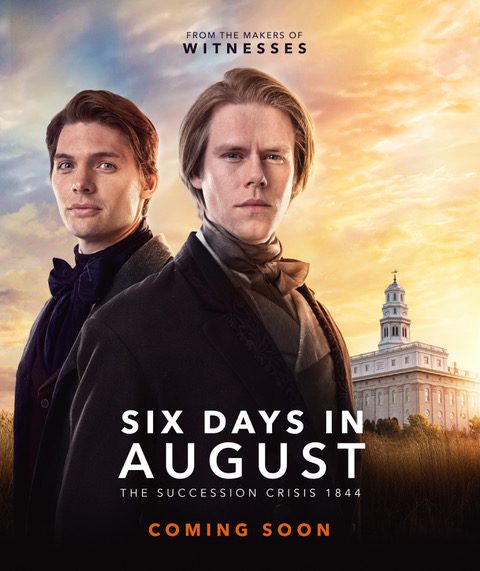
This is a preliminary version of a “teaser” for the Interpreter Foundation’s forthcoming film.
We had dinner tonight with two other couples — one of them Austrian, from Vienna — who are here in Salzburg to participate in Saturday’s FAIR conference. Then my wife and I broke away for a Zoom meeting with our producer, our director, and the person whom we have retained to manage the marketing and distribution of the Interpreter Foundation’s forthcoming film, Six Days in August. We were pleased with the discussion. And the work goes on.
Posted from Salzburg, Austria
Travel and Religion
History and Religion
Previous Post
June 6, 2024
La Serenissima
Next Post

June 8, 2024 Two simple stories
Recent Comments
"Sutherland's lecture sounds interesting. He seems to restate the Washington consensus that trade brings peace ..."
Learning more about a region of ..."
"In a meeting today, I learned another important reason why accurate (or at least as ..."
From Serbia’s “White City,” Belgrade
"I've been watching a lot of video interviews of NDErs and researchers. I think in ..."
"PL: "Let's hope he doesn't have your address..."I have to frankly confess that a few ..."
From Serbia’s “White City,” Belgrade
Browse Our Archives
Select a Category Uncategorized
Select a Month October 2026 September 2026 August 2026 July 2026 June 2026 May 2026 April 2026 March 2026 February 2026 January 2026 December 2025 November 2025 October 2025 September 2025 August 2025 July 2025 June 2025 May 2025 April 2025 March 2025 February 2025 January 2025 December 2024 November 2024 October 2024 September 2024 August 2024 July 2024 June 2024 May 2024 April 2024 March 2024 February 2024 January 2024 December 2023 November 2023 October 2023 September 2023 August 2023 July 2023 June 2023 May 2023 April 2023 March 2023 February 2023 January 2023 December 2022 November 2022 October 2022 September 2022 August 2022 July 2022 June 2022 May 2022 April 2022 March 2022 February 2022 January 2022 December 2021 November 2021 October 2021 September 2021 August 2021 July 2021 June 2021 May 2021 April 2021 March 2021 February 2021 January 2021 December 2020 November 2020 October 2020 September 2020 August 2020 July 2020 June 2020 May 2020 April 2020 March 2020 February 2020 January 2020 December 2019 November 2019 October 2019 September 2019 August 2019 July 2019 June 2019 May 2019 April 2019 March 2019 February 2019 January 2019 December 2018 November 2018 October 2018 September 2018 August 2018 July 2018 June 2018 May 2018 April 2018 March 2018 February 2018 January 2018 December 2017 November 2017 October 2017 September 2017 August 2017 July 2017 June 2017 May 2017 April 2017 March 2017 February 2017 January 2017 December 2016 November 2016 October 2016 September 2016 August 2016 July 2016 June 2016 May 2016 April 2016 March 2016 February 2016 January 2016 December 2015 November 2015 October 2015 September 2015 August 2015 July 2015 June 2015 May 2015 April 2015 March 2015 February 2015 January 2015 December 2014 November 2014 March 2014 August 2013 February 2012
Follow Us!
TAKE THE
Religious Wisdom Quiz
In this Gospel, Jesus' first miracle is not recorded, and the narrative begins with a voice crying in the wilderness. Which Gospel starts with John the Baptist's ministry?
Select your answer to see how you score.
Luke John Matthew Mark
Related posts from Sic et Non

Notes on Women, Priesthood, and General Conference

"The Book of Moses as a Temple Text"

TRENDING AT PATHEOS Latter-day Saint

In "Irreplaceable," our book on vocation and technology, Trevor Sutton and I...

I was strolling through the top floor of the brand new Parthenon...

What Does Gêvâh Mean For Kimberley Guifoyle &...
This week, a lot of the news is focused on Kimberly Guilfoyle....

INNER CIRCLE: Profound Mystery (Of Christ In All...
Ephesians 5:31-32 “For this reason, a man will leave his father and...

Do Not Rejoice When Your Enemy Falls: The...
Turning an execution into a public spectacle is a disturbing expression of...

'The Chosen' S6 Trailer: The Passion Gets Very...
Not many watching 'The Chosen' worry about spoilers, but just because they...
view all Latter-day Saint blogs
What Are Your Thoughts?leave a comment
Ad-Free & Subscriber Log-In Subscription Support
- About Us
- 2026 Calendar
- Videos
- Podcasts
- Library of World Religions
- Faith In Media Tracker
- Advertise With Us
- Write for Us
- Privacy Policy
- Terms of Service
- Do Not Sell My Data
- Contact Us
- Radiant Digital
- Manage Newsletter Subscriptions
- Unsubscribe From Notifications
- Sitemap
Copyright 2008-2026, Patheos. All rights reserved.
Subscription Support Ad-Free & Subscriber Log-In
Follow Patheos