
BuddhistCatholicContemplativeEvangelicalGeneral ChristianHinduJewishLatter-day SaintMuslimNew VisionsProgressive Christian
Beliefs
- Buddhist
- Catholic
- Contemplative
- Evangelical
- General Christian
- Hindu
- Jewish
- Latter-day Saint
- More Voices
- Muslim
- New Visions
- Pagan
- Progressive Christian
Topics
- Religion News
- Food and Religion
- Sports and Religion
- Religious Art
- Religious Music and Entertainment
- Religious Events
- History and Religion
- Style and Religion
- Politics and Religion
- Women in Religion
- Recreation Outdoors and Religion
- Business Finance and Religion
- Careers Workplace and Religion
- Education and Religion
- Family Parenting and Religion
- Health Fitness and Religion
- Home and Religion
- Relationships and Religion
- Technology and Religion
- Travel and Religion
Columnists
- Buddhist Columnists
- Business Finance and Religion Columnists
- Careers Workplace and Religion Columnists
- Catholic Columnists
- Contemplative Columnists
- Education and Religion Columnists
- Evangelists Columnists
- Family Parenting and Religion Columnists
- General Christian Columnists
- Health Fitness and Religion Columnists
- Hindu Columnists
- History and Religion Columnists
- Home and Religion Columnists
- Jewish Columnists
- More Voices Columnists
- Latter Day Columnists
- Muslim Columnists
- New Visions Columnists
- Nonreligious Columnists
- Pagan Columnists
- Politics and Religion Columnists
- Progressive Columnists
- Recreation Outdoors and Religion Columnists
- Relationships and Religion Columnists
- Religion News Columnists
- Religious Art Columnists
- Religious Events Columnists
- Religious Music and Entertainment Columnists
- Sports and Religion Columnists
- Style and Religion Columnists
- Technology and Religion Columnists
- Travel and Religion Columnists
- Women in Religion Columnists
Resource Library
- 2026 Calendar
- Library of World Religions
- The 100 Most Holy Places on Earth
- Patheos Answers
- Podcasts
- Videos
- Faith Leaders Database
- Anglican Episcopalian
- Bahai
- Baptist
- Buddhism
- Christianity
- Confucianism
- Eastern Orthodoxy
- Hinduism
- Holiness and Pentecostal
- ISKCON
- Islam
- Judaism
- Lutheran
- Methodist
- The Church of Jesus Christ of Latter-day Saints
- New Age
- Paganism
- Presbytarian and Reformed
- Protestantism
- Religion Behind the Scenes
- Roman Catholic
- Scientology
- Shia Islam
- Sikhism
- Sufism
- Sunni Islam
- Taoism
- Zen
- See all religions
Research Tools
 Ad-Free & Subscriber Log-In Subscription Support
Ad-Free & Subscriber Log-In Subscription Support
Follow Patheos 

- Trending:
- Forgiveness
- |
- Marriage
- |
- Consciousness
- |
- Death Penalty
- |
- Election
- |
- Halloween

- Home
- Latter-day Saint
- Travel and Religion
- A Global Effort on Behalf of Women and Children
A Global Effort on Behalf of Women and Children
Last updated on: June 12, 2024 at 4:02 pm by Dan Peterson
A Global Effort on Behalf of Women and Children 2024-06-12T16:02:53-06:00 Dan Peterson
Patheos Explore the world's faith through different perspectives on religion and spirituality! Patheos has the views of the prevalent religions and spiritualities of the world.

Another Wikimedia Commons public domain view of Salzburg (by Arne Museler)
I lead off with something that, manifestly, comes directly from the Christopher Hitchens Memorial “How Religion Poisons Everything” File™. This is pretty big news. Obviously, of course, there ought to be a law against such things — but alas, as long as theism and theist exist and are permitted free rein, these horrors will continue unabated: “Relief Society Leads Global Effort to Improve Health and Well-being of Women and Children: The Church is giving US$55.8 million to help 12 million children and 2.7 million women.”
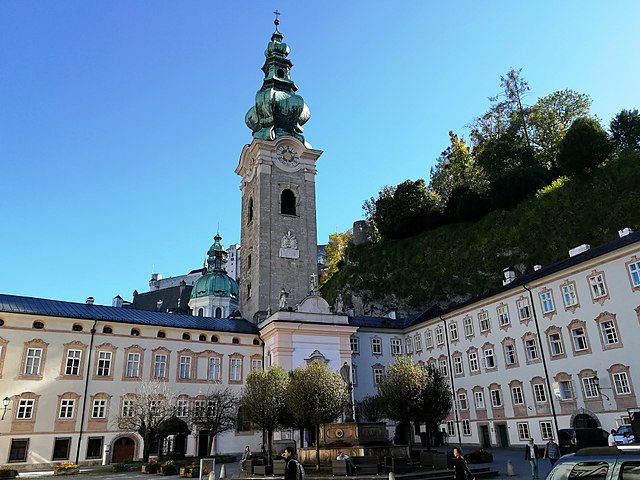
Stift Sankt Peter, in the Salzburger Altstadt (see the fortress on the hill behind it), is the oldest continuously functioning monastery in German-speaking Europe. (Wikimedia Commons public domain image)
I know that my doing so will drive certain folks over at the Peterson Obsession Board nearly frantic with impotent disdain, especially after I’ve just written about a program to reduce hunger (a global problem that my traveling and eating out probably caused in the first place), but I want to mention, nevertheless, a couple of dinners that we had here in Salzburg. We actually ate twice at Zwettler’s Wirtshaus, at Kaigasse 3. It dates back to 1863, and the food is quite good. (That’s why we went back twice.) But what I most enjoyed was the conversation that I had there on Monday evening.
The restaurant was crowded when we arrived, so we stood waiting outside. Then the waiter who had served us the night before (and with whom I had some amusing exchanges) came out and said that there was a fellow sitting alone at a table for four who had invited us to share his table with him. We sat down, and he immediately said, in halting English, that he spoke almost no English, and that he apologized for that fact. He was from Basel, Switzerland, a retired diesel mechanic who had already spent twenty-seven days cycling from Basel over to Vienna and southwards along the Hungarian border, and he was now making his way slowly back home.
We ended up having a long and freewheeling conversation — about the Swiss military and his own experiences with winter survival training and tank maintenance and hidden Swiss defensive tunnels, the Basler dialect of Swiss German, immigration, Vladimir Putin, the Swiss economy, education, and a host of other subjects. I had a good time, and so, clearly, did he. (He plainly enjoyed talking and he obviously wanted some company, and it was actually difficult to get away even after we had long since finished eating and the restaurant was beginning to close down.) The only thing that made me feel guilty — and it really did — was that my wife, who knows very little German, was sitting there without being able to participate much in the conversation. I translated (or summarized) a fair amount of what our newfound friend said, but he was a little bit like a fire hydrant, and she missed most of it. Curiously, she claims to have enjoyed the evening herself, too.
On Tuesday evening, we ate at St. Peter Stiftskulinarium, part of the overall complex of the Stift Sankt Peter (the Benedictine Abbey of St. Peter) in Salzburg’s Altstadt. It claims to be the oldest restaurant in Europe, having been mentioned in the year AD 803 by Alcuin of York. (Which means, of course, that it’s probably older still.) The food was slightly pricey, but very good. And, when we told the waiter that we wouldn’t be drinking wine or anything alcoholic, he suggested to us a dark red grape juice that had evidently arrived just that day, a product of the monks of the adjacent abbey, no less. It was some of the best grape juice that I’ve ever had.
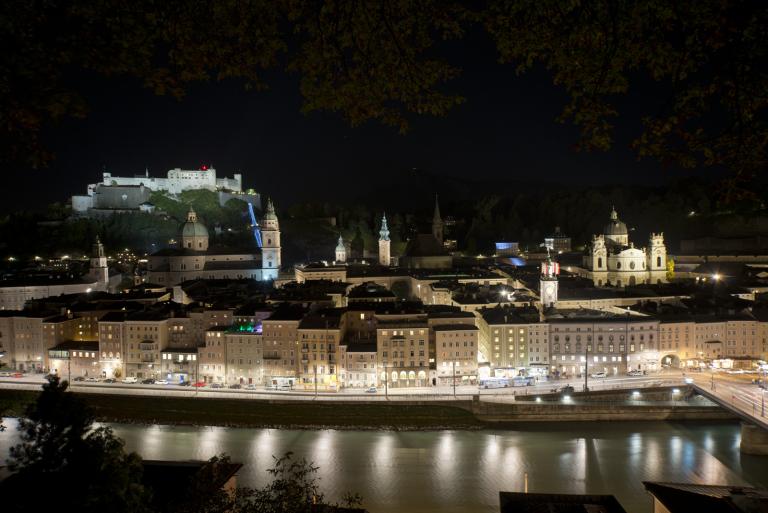
A nighttime view of Salzburg’s Altstadt from atop the Kapuzinerberg, across the Salzach River, Please notice, by the way, how the skyline of the city is blighted by churches.
We attended an organ recital at noon today in the Cathedral of Salzburg. Dr. Philipp Pelsner performed, in sequence, on all five of the cathedral’s organs. I didn’t recognize the first four pieces, but the last one, played on the main instrument of the church (on which Mozart had also played), was unmistakable: It was the Danse Macabre, by Camille Saint-Saëns.
Which suggests that I ought to continue with my musicological reflections on the question of whether, as the late Christopher Hitchens maintained, religion really does poison everything:
The Austrian composer Anton Bruckner (d. 1896) faced fierce criticism before his genius was recognized. Yet he believed his compositions divinely inspired, and he persisted. He paid attention, instead, to the “voice from within… an infallible instinct which he believed to be God himself, guided him on his way.” “Every composition he wrote was in praise of God…” “Bruckner is perhaps the only great composer of his century whose entire musical output is determined by his religious faith ”[1] “They want me to write in a different way,” he said of his critics.
I could, but I must not. Out of thousands I was given this talent by God, only I. Sometime I will have to give an account of myself. How would the Father in Heaven judge me if I followed others and not Him?[2]
He kept a record of his prayers in his journal, and never played a church organ without praying first. “Bruckner is perhaps the only great composer of his century,” wrote his biographer Hans Ferdinand Redlich, “whose entire musical output is determined by his religious faith.”[3] “Religiosity was the center of his heart,” wrote Werner Wolf. “He was seeking God in his music. God Himself was his goal.”[4] Working on his ninth symphony, which would prove to be his last, he told his fellow Austrian composer Gustav Mahler
I must at least get the Tenth finished, or I’ll cut a poor figure when I appear before the Good Lord, as I soon shall, and he says to me, “Well, my boy, why did I give you so much talent if not to sing to my honor and glory? But you’ve done far too little with it!*[*5]
Johannes Brahms (d. 1897) was a life-long student of Martin Luther’s German translation of the Bible whose familiarity with that book is apparent in his German Requiem and such other works as his Four Serious Songs, which dwell on themes from the book of Ecclesiastes and then, in the final song, celebrate the theme of love from 1 Corinthians 13. In conversation with Arthur Abell, who published his account after Brahms’s death, the composer spoke of
My method of communicating with the Infinite, for all truly inspired ideas come from God. Beethoven, who was my ideal, was well aware of this.[6]
When I feel the urge [to compose], I begin by appealing directly to my Maker and I first ask Him the three most important questions pertaining to our life here in this world—whence, wherefore, whither [woher, warum, wohin].[7]
Straightaway the ideas flow in upon me, directly from God, and not only do I see distinct themes in my mind’s eye, but they are clothed in the right forms, harmonies and orchestration.[8]
You see, the powers from which all truly great composers like Mozart, Schubert, Bach and Beethoven drew their inspirations is the same power that enabled Jesus to work His miracles. Measure by measure, the finished product is revealed to me…[9]
Brahms would presumably not agree with Hitchens that “religion poisons everything.” Indeed, quite the contrary:
I know several young composers who are atheists. I have read their scores, and I assure you . . . that they are doomed to speedy oblivion, because they are utterly lacking in inspiration. Their works are purely cerebral. The great Nazarene knew that law also, and He proclaimed in John 15:4, “The branch cannot bear fruit of itself, except it abide in the vine.” No atheist has ever been or ever will be a great composer.[10]
The great Czech composer Antonin Dvorák (d. 1904) regarded his musical ability as “the gift of God” or “God’s voice,” claiming that, in composition, his practice was to “simply do what God tells me to do.”[11] His manuscripts regularly opened with the phrase “With God” and concluded with the benediction “God be thanked.” Commenting on his Mass in D Major, he exclaimed “Faith, hope and love to God Almighty and thanks for the great gift of being enabled to bring this work in the praise of the Highest and in the honour of art to a happy conclusion.” “Do not wonder,” he continued, “that I am so religious. An artist who is not—could not produce anything like this. Have we not examples enough in Beethoven, Bach, Raphael and many others?”[12] Among his many religious works are the beautiful Stabat Mater, a Latin Requiem, the Hussite Overture (in honor of the Czech religious reformer John Hus), ten Biblical Songs, and a dramatic oratorio entitled Saint Ludmila.
[to be continued]
[1] Werner Wolff, Anton Bruckner, Rustic Genius (New York: E.P. Dutton & Co., Inc., 1942), 145. Redlich, Bruckner, Mahler, 37.
[2] Ibid, 104.
[3] Hans Ferdinand Redlich, Bruckner and Mahler (London: J.M. Dent Ltd., revised 1963), 37.
[4] Wolff, Anton Bruckner and Mahler, 150.
[5] Natalie Bauer-Lechner, Recollections of Gustav Mahler, trans. Dika Newlin (New York: Cambridge University Press, 1980), 47.
[6] Arthur M. Abell, Talks With Great Composers (New York: Citadel, 1994), 3.
[7] Ibid., 5.
[8] Ibid., 5-6.
[9] Ibid., 11.
[10] Ibid., 21.
[11] Karl Hoffmeister, Antonin Dvorak, Letters and Reminiscences (Westport, Conn.: Greenwood, 1970), 104-5. Kavanaugh, Spiritual Lives of the Great Composers, 154.
[12] Kavanaugh, Spiritual Lives of the Great Composers, 153. German in the Library
Posted from Salzburg, Austria
Travel and Religion
History and Religion
Previous Post
June 11, 2024
Some art and music from Latter-day Saints beyond America
Next Post
June 13, 2024 Music! Again!
Recent Comments
"Sutherland's lecture sounds interesting. He seems to restate the Washington consensus that trade brings peace ..."
Learning more about a region of ..."
"In a meeting today, I learned another important reason why accurate (or at least as ..."
From Serbia’s “White City,” Belgrade
"I've been watching a lot of video interviews of NDErs and researchers. I think in ..."
"PL: "Let's hope he doesn't have your address..."I have to frankly confess that a few ..."
From Serbia’s “White City,” Belgrade
Browse Our Archives
Select a Category Uncategorized
Select a Month October 2026 September 2026 August 2026 July 2026 June 2026 May 2026 April 2026 March 2026 February 2026 January 2026 December 2025 November 2025 October 2025 September 2025 August 2025 July 2025 June 2025 May 2025 April 2025 March 2025 February 2025 January 2025 December 2024 November 2024 October 2024 September 2024 August 2024 July 2024 June 2024 May 2024 April 2024 March 2024 February 2024 January 2024 December 2023 November 2023 October 2023 September 2023 August 2023 July 2023 June 2023 May 2023 April 2023 March 2023 February 2023 January 2023 December 2022 November 2022 October 2022 September 2022 August 2022 July 2022 June 2022 May 2022 April 2022 March 2022 February 2022 January 2022 December 2021 November 2021 October 2021 September 2021 August 2021 July 2021 June 2021 May 2021 April 2021 March 2021 February 2021 January 2021 December 2020 November 2020 October 2020 September 2020 August 2020 July 2020 June 2020 May 2020 April 2020 March 2020 February 2020 January 2020 December 2019 November 2019 October 2019 September 2019 August 2019 July 2019 June 2019 May 2019 April 2019 March 2019 February 2019 January 2019 December 2018 November 2018 October 2018 September 2018 August 2018 July 2018 June 2018 May 2018 April 2018 March 2018 February 2018 January 2018 December 2017 November 2017 October 2017 September 2017 August 2017 July 2017 June 2017 May 2017 April 2017 March 2017 February 2017 January 2017 December 2016 November 2016 October 2016 September 2016 August 2016 July 2016 June 2016 May 2016 April 2016 March 2016 February 2016 January 2016 December 2015 November 2015 October 2015 September 2015 August 2015 July 2015 June 2015 May 2015 April 2015 March 2015 February 2015 January 2015 December 2014 November 2014 March 2014 August 2013 February 2012
Follow Us!
TAKE THE
Religious Wisdom Quiz
Where did Elisha perform many miracles?
Select your answer to see how you score.
Samaria Jericho Shunem Bethel
Related posts from Sic et Non

Two abbeys, a cathedral, and a seventh-century English...


A great opportunity is on the way
TRENDING AT PATHEOS Latter-day Saint

In "Irreplaceable," our book on vocation and technology, Trevor Sutton and I...

I was strolling through the top floor of the brand new Parthenon...

What Does Gêvâh Mean For Kimberley Guifoyle &...
This week, a lot of the news is focused on Kimberly Guilfoyle....

INNER CIRCLE: Profound Mystery (Of Christ In All...
Ephesians 5:31-32 “For this reason, a man will leave his father and...

Do Not Rejoice When Your Enemy Falls: The...
Turning an execution into a public spectacle is a disturbing expression of...

'The Chosen' S6 Trailer: The Passion Gets Very...
Not many watching 'The Chosen' worry about spoilers, but just because they...
view all Latter-day Saint blogs
What Are Your Thoughts?leave a comment
Ad-Free & Subscriber Log-In Subscription Support
- About Us
- 2026 Calendar
- Videos
- Podcasts
- Library of World Religions
- Faith In Media Tracker
- Advertise With Us
- Write for Us
- Privacy Policy
- Terms of Service
- Do Not Sell My Data
- Contact Us
- Radiant Digital
- Manage Newsletter Subscriptions
- Unsubscribe From Notifications
- Sitemap
Copyright 2008-2026, Patheos. All rights reserved.
Subscription Support Ad-Free & Subscriber Log-In
Follow Patheos