
BuddhistCatholicContemplativeEvangelicalGeneral ChristianHinduJewishLatter-day SaintMuslimNew VisionsProgressive Christian
Beliefs
- Buddhist
- Catholic
- Contemplative
- Evangelical
- General Christian
- Hindu
- Jewish
- Latter-day Saint
- More Voices
- Muslim
- New Visions
- Pagan
- Progressive Christian
Topics
- Religion News
- Food and Religion
- Sports and Religion
- Religious Art
- Religious Music and Entertainment
- Religious Events
- History and Religion
- Style and Religion
- Politics and Religion
- Women in Religion
- Recreation Outdoors and Religion
- Business Finance and Religion
- Careers Workplace and Religion
- Education and Religion
- Family Parenting and Religion
- Health Fitness and Religion
- Home and Religion
- Relationships and Religion
- Technology and Religion
- Travel and Religion
Columnists
- Buddhist Columnists
- Business Finance and Religion Columnists
- Careers Workplace and Religion Columnists
- Catholic Columnists
- Contemplative Columnists
- Education and Religion Columnists
- Evangelists Columnists
- Family Parenting and Religion Columnists
- General Christian Columnists
- Health Fitness and Religion Columnists
- Hindu Columnists
- History and Religion Columnists
- Home and Religion Columnists
- Jewish Columnists
- More Voices Columnists
- Latter Day Columnists
- Muslim Columnists
- New Visions Columnists
- Nonreligious Columnists
- Pagan Columnists
- Politics and Religion Columnists
- Progressive Columnists
- Recreation Outdoors and Religion Columnists
- Relationships and Religion Columnists
- Religion News Columnists
- Religious Art Columnists
- Religious Events Columnists
- Religious Music and Entertainment Columnists
- Sports and Religion Columnists
- Style and Religion Columnists
- Technology and Religion Columnists
- Travel and Religion Columnists
- Women in Religion Columnists
Resource Library
- 2026 Calendar
- Library of World Religions
- The 100 Most Holy Places on Earth
- Patheos Answers
- Podcasts
- Videos
- Faith Leaders Database
- Anglican Episcopalian
- Bahai
- Baptist
- Buddhism
- Christianity
- Confucianism
- Eastern Orthodoxy
- Hinduism
- Holiness and Pentecostal
- ISKCON
- Islam
- Judaism
- Lutheran
- Methodist
- The Church of Jesus Christ of Latter-day Saints
- New Age
- Paganism
- Presbytarian and Reformed
- Protestantism
- Religion Behind the Scenes
- Roman Catholic
- Scientology
- Shia Islam
- Sikhism
- Sufism
- Sunni Islam
- Taoism
- Zen
- See all religions
Research Tools
 Ad-Free & Subscriber Log-In Subscription Support
Ad-Free & Subscriber Log-In Subscription Support
Follow Patheos 

- Trending:
- Forgiveness
- |
- Marriage
- |
- Consciousness
- |
- Death Penalty
- |
- Election
- |
- Halloween

- Home
- Latter-day Saint
- History and Religion
- “A fortuitous meeting of the chordal atoms”?
“A fortuitous meeting of the chordal atoms”?
Last updated on: June 10, 2024 at 4:12 pm by Dan Peterson
“A fortuitous meeting of the chordal atoms”? 2024-06-10T16:12:33-06:00 Dan Peterson
Patheos Explore the world's faith through different perspectives on religion and spirituality! Patheos has the views of the prevalent religions and spiritualities of the world.
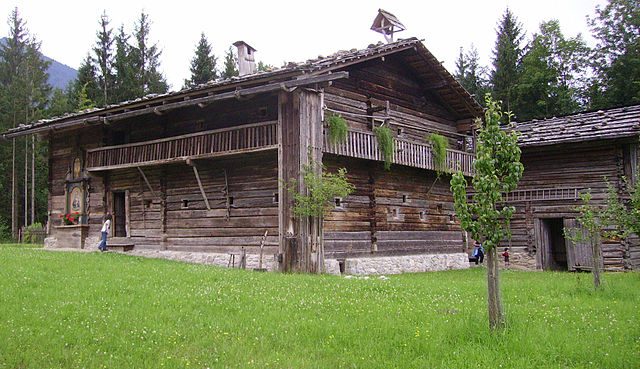
One of the large farmhouses at the Salzburger Freilichtmuseum. (Wikimedia Commons public domain image)
My wife and I went out with Scott Gordon and his wife to the Salzburger Freilichtmuseum — the open-air museum — in Großgmain, not too far outside of Salzburg. We walked around most of it, looking at the collection of traditional regional buildings (e.g., farmhouses, barns, a small chapel, and the like) that have been gathered there. At least one of those that we visited dates back to the mid-1500s. They remind me very much of the older mountain chalets and farmhouses that I saw every day in rural portions of the Berner Oberland in Switzerland, some of which were of approximately the same era.
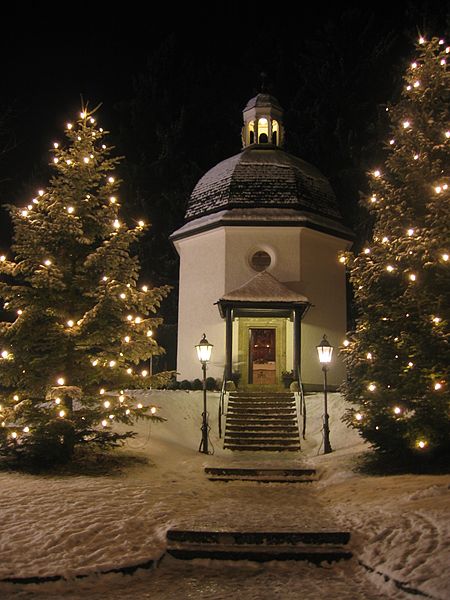
A winter view in Oberndorf, in the Austrian state of Salzburg — birthplace of the Christmas carol “Silent Night.” Shown is a historical monument to the carol’s composition. My wife and I visited Oberndorf two or three years ago; we probably won’t visit it on this trip. Mr. Hitchens’s dictum that “religion poisons everything” seems to entail the conclusion that “Silent Night” would be a better song if it had not been tainted by religion.
(Wikimedia Commons public domain image)
A few days ago, I posted an entry here under the title of “Christopher Hitchens and the Great Composers” in which I examined whether the late Mr. Hitchens’s claim that “religion poisons everything” holds true for, say, classical music. (Hint: I believe that it does not.) That was a first installment. Here is a second:
Like Bach, Franz Joseph Haydn (d. 1809) began his musical scores with In Nomine Jesu and ended them with either Laus Deo (“Praise God”) or Soli Deo Gloria. He rose early and always prayed before he commenced his composing. He would sit at his clavier and search for a musical idea. “If it soon comes without much difficulty,” he said, “it expands. But if it does not make progress, I try to find out if I have erred in some way or other, thereby forfeiting grace; and I pray for mercy until I feel that I am forgiven.”[1] In this manner, he eventually produced such works as the oratorio The Creation, The Lord Nelson Mass, the Mass in Time of War, and The Seven Last Words of Christ.[2]
“It sometimes seems to me,” remarked the great composer of art songs (Lieder) Franz Schubert (d. 1828), “as if I did not belong to this world at all.”[3] He criticized the kind of music that “rouses [people] to scornful laughter instead of lifting up their thoughts to God.”[4] In his Ave Maria and in his seven masses (including the marvelous Mass No. 2 in Gand the Mass No. 6 in E-flat Major), he made every effort to lift minds heavenward.
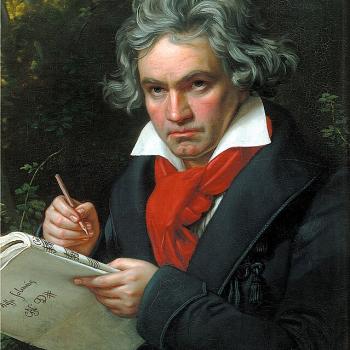
“It was not a fortuitous meeting of the chordal atoms that made the world,” said Ludwig van Beethoven (d. 1829). “If order and beauty are reflected in the constitution of the universe, then there is a God.”[5] Along with all of his other works, he produced such deeply religious choral music as the Missa Solemnis, the Mass in C, and Christ on the Mount of Olives.
Much like Bach and Haydn, Felix Mendelssohn (d. 1849) often included prayers in his musical manuscripts. Lass es gelingen Gott (“Let it succeed, God!”), he would write, or Hilf du mit (“Help thou along!”). Among his works are the oratorios Elijah and St. Paul, as well as choral settings of the biblical Psalms and Hymns of Praise.[6]
Richard Wagner (d. 1883) worked for months on the libretto for something he called Jesus of Nazareth but never finished, composed a huge work for orchestra and three choruses entitled Love Feast of the Twelve Apostles, and worked clearly Christian themes into many of his great music dramas, including Tannhäuser, Lohengren, and, most obviously, Parzival.
Franz Liszt (d. 1886) was both an incorrigible womanizer and a fervently devout Christian, who, in his fifties, finally entered the Third Order of St. Francis of Assisi in Rome. He was, says his biographer Eleanor Perenzi, “probably the nineteenth century’s greatest composer of religious music.”[7] He himself declared that music’s purpose was “to ennoble, to comfort, to purify man, to bless and praise God.”[8] His piano pieces included the Harmonies poetiques et religieuses and the Annees de pelerinage [“Years of Pilgrimage”]. He set numerous psalms to music, created a massive oratorio entitled Christus, drew on Gregorian chant for his Via Crucis (“Way of the Cross”), and wrote regarding one of his masses that he had “prayed” rather than “composed” it.[9]
Charles Gounod (d. 1893) was seriously tempted by the priesthood at various points in his early life. It is scarcely surprising that he composed several masses, including his famous Messe Solennelle and a Requiem. He also composed oratorios such as Redemption and Mors et Vita (“Death and Life”) and religious songs such as Nazareth, and combined his love for theology and opera in his great opera Faust. His most performed work, however, is unquestionably his Ave Maria.
Cesar Franck (d. 1890), organist at the church of Sainte-Clotilde in Paris for over thirty years, “did not play in order to be heard,” said his student and fellow composer Vincent D’Indy, “but to do his best for God and his conscience’ sake.”[10] Similar motives impelled him to write oratorios on The Tower of Babel and The Beatitudes, choral music on Ruth and Rebecca, and the cantata Redemption. “Franck’s purpose in writing sacred cantatas was . . . not so much to comfort the believer as to arouse the potential convert.”[11]
[1] Ibid., 39.
[2] Ibid., 37-43.
[3] Alfred Einstein, Schubert, a Musical Portrait (New York: Oxford University Press, 1951), 312-313.
[4] Otto Erich Deutsch, ed., Franz Schubert’s Letters and Other Writings (London: Faber & Gwyer, Ltd., 1928), 29.
[5] Friedrich Kerst, Beethoven, the Man and the Artist, As Revealed in His Own Words (New York: Dover, 1964), 104.
[6] Kavanaugh, Spiritual Lives of the Great Composers, 75-81.
[7] Ibid., 96.
[8] Lina Ramann, Franz Liszt, Artist and Man (London: W.H. Allen, 1882), 384.
[9] Kavanaugh, Spiritual Lives of the Great Composers, 96.
[10] Vincent d’Indy, Cesar Frank –Some Personal Reminiscences (New York: Dover, 1965), 44.
[11] Lawrence Davies, Cesar Franck and His Circle (London: Barrie and Jenkins, 1970), 97.
[to be continued]
In posting this material, I’m drawing not just from the justly world-famous Christopher Hitchens Memorial “How Religion Poisons Everything” File™ but, very specifically, from a much larger and as-yet unpublished manuscript that I wrote up (but never quite completed) a number of years ago.
Posted from Salzburg, Austria
History and Religion
Travel and Religion
Previous Post

June 9, 2024
From the international Church
Next Post
June 11, 2024 Some art and music from Latter-day Saints beyond America
Recent Comments
"Sutherland's lecture sounds interesting. He seems to restate the Washington consensus that trade brings peace ..."
Learning more about a region of ..."
"In a meeting today, I learned another important reason why accurate (or at least as ..."
From Serbia’s “White City,” Belgrade
"I've been watching a lot of video interviews of NDErs and researchers. I think in ..."
"PL: "Let's hope he doesn't have your address..."I have to frankly confess that a few ..."
From Serbia’s “White City,” Belgrade
Browse Our Archives
Select a Category Uncategorized
Select a Month October 2026 September 2026 August 2026 July 2026 June 2026 May 2026 April 2026 March 2026 February 2026 January 2026 December 2025 November 2025 October 2025 September 2025 August 2025 July 2025 June 2025 May 2025 April 2025 March 2025 February 2025 January 2025 December 2024 November 2024 October 2024 September 2024 August 2024 July 2024 June 2024 May 2024 April 2024 March 2024 February 2024 January 2024 December 2023 November 2023 October 2023 September 2023 August 2023 July 2023 June 2023 May 2023 April 2023 March 2023 February 2023 January 2023 December 2022 November 2022 October 2022 September 2022 August 2022 July 2022 June 2022 May 2022 April 2022 March 2022 February 2022 January 2022 December 2021 November 2021 October 2021 September 2021 August 2021 July 2021 June 2021 May 2021 April 2021 March 2021 February 2021 January 2021 December 2020 November 2020 October 2020 September 2020 August 2020 July 2020 June 2020 May 2020 April 2020 March 2020 February 2020 January 2020 December 2019 November 2019 October 2019 September 2019 August 2019 July 2019 June 2019 May 2019 April 2019 March 2019 February 2019 January 2019 December 2018 November 2018 October 2018 September 2018 August 2018 July 2018 June 2018 May 2018 April 2018 March 2018 February 2018 January 2018 December 2017 November 2017 October 2017 September 2017 August 2017 July 2017 June 2017 May 2017 April 2017 March 2017 February 2017 January 2017 December 2016 November 2016 October 2016 September 2016 August 2016 July 2016 June 2016 May 2016 April 2016 March 2016 February 2016 January 2016 December 2015 November 2015 October 2015 September 2015 August 2015 July 2015 June 2015 May 2015 April 2015 March 2015 February 2015 January 2015 December 2014 November 2014 March 2014 August 2013 February 2012
Follow Us!
TAKE THE
Religious Wisdom Quiz
Where did Elisha perform many miracles?
Select your answer to see how you score.
Samaria Jericho Shunem Bethel
Related posts from Sic et Non

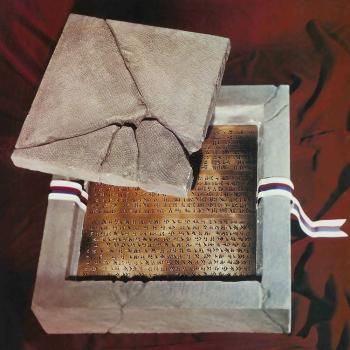
Astounding Evidence for the Book of Mormon?

A great opportunity is on the way
TRENDING AT PATHEOS Latter-day Saint

In "Irreplaceable," our book on vocation and technology, Trevor Sutton and I...

I was strolling through the top floor of the brand new Parthenon...

What Does Gêvâh Mean For Kimberley Guifoyle &...
This week, a lot of the news is focused on Kimberly Guilfoyle....

INNER CIRCLE: Profound Mystery (Of Christ In All...
Ephesians 5:31-32 “For this reason, a man will leave his father and...

Do Not Rejoice When Your Enemy Falls: The...
Turning an execution into a public spectacle is a disturbing expression of...

'The Chosen' S6 Trailer: The Passion Gets Very...
Not many watching 'The Chosen' worry about spoilers, but just because they...
view all Latter-day Saint blogs
What Are Your Thoughts?leave a comment
Ad-Free & Subscriber Log-In Subscription Support
- About Us
- 2026 Calendar
- Videos
- Podcasts
- Library of World Religions
- Faith In Media Tracker
- Advertise With Us
- Write for Us
- Privacy Policy
- Terms of Service
- Do Not Sell My Data
- Contact Us
- Radiant Digital
- Manage Newsletter Subscriptions
- Unsubscribe From Notifications
- Sitemap
Copyright 2008-2026, Patheos. All rights reserved.
Subscription Support Ad-Free & Subscriber Log-In
Follow Patheos