
BuddhistCatholicContemplativeEvangelicalGeneral ChristianHinduJewishLatter-day SaintMuslimNew VisionsProgressive Christian
Beliefs
- Buddhist
- Catholic
- Contemplative
- Evangelical
- General Christian
- Hindu
- Jewish
- Latter-day Saint
- More Voices
- Muslim
- New Visions
- Pagan
- Progressive Christian
Topics
- Religion News
- Food and Religion
- Sports and Religion
- Religious Art
- Religious Music and Entertainment
- Religious Events
- History and Religion
- Style and Religion
- Politics and Religion
- Women in Religion
- Recreation Outdoors and Religion
- Business Finance and Religion
- Careers Workplace and Religion
- Education and Religion
- Family Parenting and Religion
- Health Fitness and Religion
- Home and Religion
- Relationships and Religion
- Technology and Religion
- Travel and Religion
Columnists
- Buddhist Columnists
- Business Finance and Religion Columnists
- Careers Workplace and Religion Columnists
- Catholic Columnists
- Contemplative Columnists
- Education and Religion Columnists
- Evangelists Columnists
- Family Parenting and Religion Columnists
- General Christian Columnists
- Health Fitness and Religion Columnists
- Hindu Columnists
- History and Religion Columnists
- Home and Religion Columnists
- Jewish Columnists
- More Voices Columnists
- Latter Day Columnists
- Muslim Columnists
- New Visions Columnists
- Nonreligious Columnists
- Pagan Columnists
- Politics and Religion Columnists
- Progressive Columnists
- Recreation Outdoors and Religion Columnists
- Relationships and Religion Columnists
- Religion News Columnists
- Religious Art Columnists
- Religious Events Columnists
- Religious Music and Entertainment Columnists
- Sports and Religion Columnists
- Style and Religion Columnists
- Technology and Religion Columnists
- Travel and Religion Columnists
- Women in Religion Columnists
Resource Library
- 2026 Calendar
- Library of World Religions
- The 100 Most Holy Places on Earth
- Patheos Answers
- Podcasts
- Videos
- Faith Leaders Database
- Anglican Episcopalian
- Bahai
- Baptist
- Buddhism
- Christianity
- Confucianism
- Eastern Orthodoxy
- Hinduism
- Holiness and Pentecostal
- ISKCON
- Islam
- Judaism
- Lutheran
- Methodist
- The Church of Jesus Christ of Latter-day Saints
- New Age
- Paganism
- Presbytarian and Reformed
- Protestantism
- Religion Behind the Scenes
- Roman Catholic
- Scientology
- Shia Islam
- Sikhism
- Sufism
- Sunni Islam
- Taoism
- Zen
- See all religions
Research Tools
 Ad-Free & Subscriber Log-In Subscription Support
Ad-Free & Subscriber Log-In Subscription Support
Follow Patheos 

- Trending:
- Forgiveness
- |
- Marriage
- |
- Consciousness
- |
- Death Penalty
- |
- Election
- |
- Halloween

- Home
- Latter-day Saint
- History and Religion
- Differing cultures, seeing the world differently
Differing cultures, seeing the world differently
Last updated on: May 12, 2024 at 8:52 pm by Dan Peterson
Differing cultures, seeing the world differently 2024-05-12T20:52:28-06:00 Dan Peterson
Patheos Explore the world's faith through different perspectives on religion and spirituality! Patheos has the views of the prevalent religions and spiritualities of the world.

Political map of Africa (public domain, Central Intelligence Agency)
I’m gratified to report that Jeffrey Mark Bradshaw, the Interpreter Foundation’s Vice President for Special Projects, is headed at this very moment to Cotonou, Benin, in west Africa, where he will join with a few associates for further work on the Foundation’s Not By Bread Alone film project, on which see here and here. They will be working there in Benin and, thereafter, in Rwanda, in Kenya, and, once more, in the Democratic Republic of the Congo. There are stories from the Church in Africa that members worldwide should know.

A peak into the glamorous world of filmmaking. Here, the location in Tennessee is being prepared (two or three weeks ago) for filming the opening scene of the Interpreter Foundation’s forthcoming theatrical movie, “Six Days in August.” (Still photo by Rebecca Smith.)
I want to share a few more passages that I recently marked while reading the book How to Know a Person: The Art of Seeing Others Deeply and Being Deeply Seen, which was written by the conservative New York Times columnist David Brooks. Incidentally (and for the sake of the folks on the Peterson Obsession Board, I do not claim that these excerpts adequately represent the overall thesis of the book. I also didn’t claim that on the previous occasion when I shared quotations from How to Know a Person. My purpose in citing them isn’t to reproduce the book’s overall thesis. If that’s your interest, read the book. (I commend it to you.) Anyway, here are several passages that I noted, because I found them thought-provoking:
People who grow up in different cultures see the world differently—sometimes on the most elemental level. Let me give you some examples. Between 1997 and 2002, diplomats to the United Nations didn’t have to pay fines on any tickets they might acquire by parking illegally on New York City streets. Basically, they got free “park where you want” permission. People from low-corruption cultures, however, still refused to break the rules. Diplomats from the United Kingdom, Sweden, Canada, Australia, and a few other similar nations got a total of zero parking tickets during these five years. Meanwhile, diplomats from countries that had higher tolerance for corruption and rule breaking (You got to do what you got to do to feed your family) took full advantage of the regulation. Diplomats from Kuwait, Albania, Chad, and Bulgaria accumulated more than one hundred tickets per diplomat. They saw the situation differently, and it’s important to emphasize that it’s not because some individual diplomats were more honest or less honest than others. It’s because some were descended from people who’d grown up in places where it made sense to follow the establishment’s rules. Other diplomats’ ancestors grew up in places where perhaps there was colonialism or oppression or autocracy, and the establishment’s rules were illogical or even immoral, and so it made sense to break the rules when you could. Each person saw the world in a way that made sense according to their ancestors’ circumstances. (237)
The evolutionary biologist Joseph Henrich wrote a book called The WEIRDest People in the World. In it, he makes the point that those of us in our Western, Educated, Industrialized, Rich, and Democratic culture are complete outliers when compared to most other cultures in world history. For example, when people in our WEIRD culture get married, they tend to go off and set up their own separate household. But that is the dominant pattern in only 5 percent of the twelve hundred societies that have been studied. We often live in nuclear families. That’s the dominant family mode in only 8 percent of human societies. We have monogamous marriages. That’s predominant in only 15 percent of societies. And so on and so on. (238)
In a classic 1972 study, students from Indiana and Taiwan were given groups of three things and asked which two of the three go together. When shown pictures of a man, woman, and child, the American kids tended to put the man and woman together, because they are both adults. The Taiwanese kids tended to put the woman and child together because the mother takes care of the baby. When shown pictures of a chicken, a cow, and grass, the American kids put the chicken and cow together because they are both animals. The Taiwanese kids put the cow and the grass together because a cow eats grass. In these and many other cases, the Americans tended to sort by categories and the Taiwanese tended to sort by relationships. (239)
Research by Alberto Alesina, Paola Giuliano, and Nathan Nunn found that people who are descended from those who practiced plow-heavy agriculture tend to live in cultures that have strongly defined gender roles, because it was mostly men who drove the plow. On the other hand, people who are descended from those who did non-plow farming tend to have less defined gender roles. People descended from sheepherding cultures tend to be individualistic, because a shepherd’s job requires him to go off on his own. People descended from rice-farming cultures tend to be very interdependent, because everybody has to work together to raise and harvest rice. One researcher in China found that the divorce rate for people in historic wheat-farming regions was 50 percent higher than the divorce rate for those from historic rice-farming regions. (240)
For further illustrations of his point in this context, Brooke recommends the 1989 book Albion’s Seed: Four British Folkways in America (1989), by the retired Brandeis University historian David Hackett Fischer. I’ve long had it on my mind, though I haven’t yet read it. Fischer’s Historians’ Fallacies: Toward a Logic of Historical Thought (1970) is an absolute treasure.
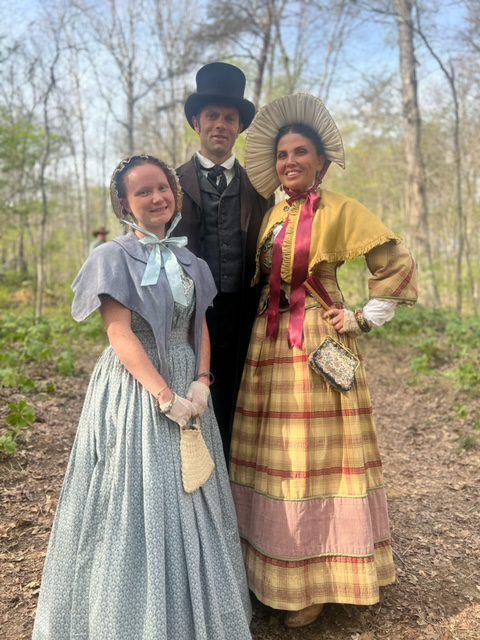
Three of the background actors on the set in Tennessee. (Photo by Rebecca Smith)
You might enjoy this new article from the Filipino magazine BusinessMirror. I did. It is based at least partially on an interview with President Dallin H. Oaks and Sister Kristin Oaks, the occasion for which was their visit to the Philippines to dedicate the new temple in Urdaneta: “Latter-day Saints new temple to serve 200,000 members around Pangasinan”
Finally, I want to wish a rather “happy Mother’s Day” to all those out there to whom the wish properly applies. My wife certainly deserves better thanks than she receives, and I’m betting that some of you do, too. I cannot begin to repay the debt that I owe to my own mother and to my wife.
History and Religion
Travel and Religion
Previous Post

May 11, 2024
An introduction to Pascal and his wager
Next Post

May 13, 2024 Contra Calvinism 1
Recent Comments
"I have cpnsidered in my mond if the 4 volume Saints could be made into ..."
From Serbia’s “White City,” Belgrade
"DP: “But Mr. Sutherland worries about the fact that our time, when we can communicate ..."
Learning more about a region of ..."
"Another class of memories are of individuals who previously lived. Some of these remembered individuals ..."
"Sutherland's lecture sounds interesting. He seems to restate the Washington consensus that trade brings peace ..."
Learning more about a region of ..."
Browse Our Archives
Select a Category Uncategorized
Select a Month October 2026 September 2026 August 2026 July 2026 June 2026 May 2026 April 2026 March 2026 February 2026 January 2026 December 2025 November 2025 October 2025 September 2025 August 2025 July 2025 June 2025 May 2025 April 2025 March 2025 February 2025 January 2025 December 2024 November 2024 October 2024 September 2024 August 2024 July 2024 June 2024 May 2024 April 2024 March 2024 February 2024 January 2024 December 2023 November 2023 October 2023 September 2023 August 2023 July 2023 June 2023 May 2023 April 2023 March 2023 February 2023 January 2023 December 2022 November 2022 October 2022 September 2022 August 2022 July 2022 June 2022 May 2022 April 2022 March 2022 February 2022 January 2022 December 2021 November 2021 October 2021 September 2021 August 2021 July 2021 June 2021 May 2021 April 2021 March 2021 February 2021 January 2021 December 2020 November 2020 October 2020 September 2020 August 2020 July 2020 June 2020 May 2020 April 2020 March 2020 February 2020 January 2020 December 2019 November 2019 October 2019 September 2019 August 2019 July 2019 June 2019 May 2019 April 2019 March 2019 February 2019 January 2019 December 2018 November 2018 October 2018 September 2018 August 2018 July 2018 June 2018 May 2018 April 2018 March 2018 February 2018 January 2018 December 2017 November 2017 October 2017 September 2017 August 2017 July 2017 June 2017 May 2017 April 2017 March 2017 February 2017 January 2017 December 2016 November 2016 October 2016 September 2016 August 2016 July 2016 June 2016 May 2016 April 2016 March 2016 February 2016 January 2016 December 2015 November 2015 October 2015 September 2015 August 2015 July 2015 June 2015 May 2015 April 2015 March 2015 February 2015 January 2015 December 2014 November 2014 March 2014 August 2013 February 2012
Follow Us!
TAKE THE
Religious Wisdom Quiz
What does "Levi" mean in Hebrew?
Select your answer to see how you score.
God is my strength Chosen Joined Set apart
Related posts from Sic et Non

In case you happen to be in Belgium...

What motivates "Becoming Brigham"? Not THIS.
The Interpreter Foundation loses a co-worker (for a...

An "apostolic interregnum," two plays, and an eatery
TRENDING AT PATHEOS Latter-day Saint

Methodist Central Hall and Westminster Abbey
Situated on the same square is Methodist Central Hall and Westminster Abbey. ...

57th Dove Awards Honor Dolly Parton, Crown New...
On gospel music’s biggest night, the 57th annual GMA Dove Awards honored...

The First Eucharistic Controversy: Christ’s Real Presence
For Catholics, the Eucharist is the source and summit of the Christian...

What a Stop Sign Can Teach Us About...
How to Make a Decision When You Can't Hear God Main point:...

Archdiocese Hosts Military Marriage Retreat in Germany
RASTATT, Germany — The transient military lifestyle, with its frequent deployments and...

Nearly every morning, I make the drive to Detroit with my high-school-age...
view all Latter-day Saint blogs
What Are Your Thoughts?leave a comment
Ad-Free & Subscriber Log-In Subscription Support
- About Us
- 2026 Calendar
- Videos
- Podcasts
- Library of World Religions
- Faith In Media Tracker
- Advertise With Us
- Write for Us
- Privacy Policy
- Terms of Service
- Do Not Sell My Data
- Contact Us
- Radiant Digital
- Manage Newsletter Subscriptions
- Unsubscribe From Notifications
- Sitemap
Copyright 2008-2026, Patheos. All rights reserved.
Subscription Support Ad-Free & Subscriber Log-In
Follow Patheos