
BuddhistCatholicContemplativeEvangelicalGeneral ChristianHinduJewishLatter-day SaintMuslimNew VisionsProgressive Christian
Beliefs
- Buddhist
- Catholic
- Contemplative
- Evangelical
- General Christian
- Hindu
- Jewish
- Latter-day Saint
- More Voices
- Muslim
- New Visions
- Pagan
- Progressive Christian
Topics
- Religion News
- Food and Religion
- Sports and Religion
- Religious Art
- Religious Music and Entertainment
- Religious Events
- History and Religion
- Style and Religion
- Politics and Religion
- Women in Religion
- Recreation Outdoors and Religion
- Business Finance and Religion
- Careers Workplace and Religion
- Education and Religion
- Family Parenting and Religion
- Health Fitness and Religion
- Home and Religion
- Relationships and Religion
- Technology and Religion
- Travel and Religion
Columnists
- Buddhist Columnists
- Business Finance and Religion Columnists
- Careers Workplace and Religion Columnists
- Catholic Columnists
- Contemplative Columnists
- Education and Religion Columnists
- Evangelists Columnists
- Family Parenting and Religion Columnists
- General Christian Columnists
- Health Fitness and Religion Columnists
- Hindu Columnists
- History and Religion Columnists
- Home and Religion Columnists
- Jewish Columnists
- More Voices Columnists
- Latter Day Columnists
- Muslim Columnists
- New Visions Columnists
- Nonreligious Columnists
- Pagan Columnists
- Politics and Religion Columnists
- Progressive Columnists
- Recreation Outdoors and Religion Columnists
- Relationships and Religion Columnists
- Religion News Columnists
- Religious Art Columnists
- Religious Events Columnists
- Religious Music and Entertainment Columnists
- Sports and Religion Columnists
- Style and Religion Columnists
- Technology and Religion Columnists
- Travel and Religion Columnists
- Women in Religion Columnists
Resource Library
- 2026 Calendar
- Library of World Religions
- The 100 Most Holy Places on Earth
- Patheos Answers
- Podcasts
- Videos
- Faith Leaders Database
- Anglican Episcopalian
- Bahai
- Baptist
- Buddhism
- Christianity
- Confucianism
- Eastern Orthodoxy
- Hinduism
- Holiness and Pentecostal
- ISKCON
- Islam
- Judaism
- Lutheran
- Methodist
- The Church of Jesus Christ of Latter-day Saints
- New Age
- Paganism
- Presbytarian and Reformed
- Protestantism
- Religion Behind the Scenes
- Roman Catholic
- Scientology
- Shia Islam
- Sikhism
- Sufism
- Sunni Islam
- Taoism
- Zen
- See all religions
Research Tools
 Ad-Free & Subscriber Log-In Subscription Support
Ad-Free & Subscriber Log-In Subscription Support
Follow Patheos 

- Trending:
- Forgiveness
- |
- Marriage
- |
- Consciousness
- |
- Death Penalty
- |
- Election
- |
- Halloween

- Home
- Latter-day Saint
- Travel and Religion
- A glorious outpost of Byzantium in the West
A glorious outpost of Byzantium in the West
Last updated on: May 28, 2024 at 1:42 pm by Dan Peterson
A glorious outpost of Byzantium in the West 2024-05-28T13:42:03-06:00 Dan Peterson
Patheos Explore the world's faith through different perspectives on religion and spirituality! Patheos has the views of the prevalent religions and spiritualities of the world.
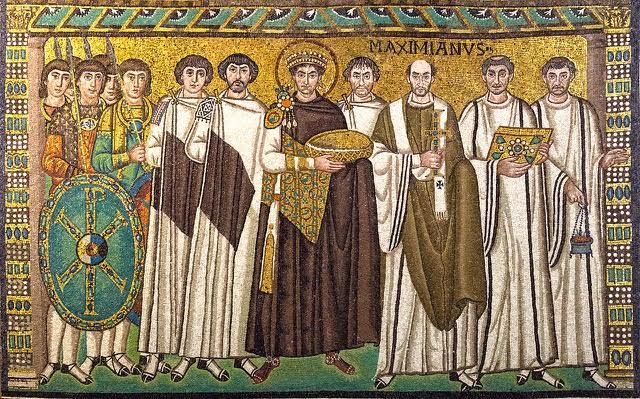
The Byzantine Emperor Justinian I (“the Great”) in the Basilica of San Vitale in Ravenna. He is shown with some of his clergy, including Maximian, the balding and bearded archbishop of Ravenna, and his courtiers. (Wikimedia Commons public domain image)
The other day, while we were driving about in Virginia, we had some very good views of a full or nearly full moon. And they reminded me of a poetic bit of science writing that I had recently re-encountered, from Dava Sobel, The Planets (New York and London: Penguin Books, 2006). Ms. Sobel begins by talking about the waxing and the waning of the moon
First to come or go is high, round Mare Crisium (the Sea of Crises), followed, as in some fantastic Latin incantation, by Lacus Timoris (the Lake of Fear), Mare Tranquillitatis (the Sea of Calm), Sinus Iridum (the Bay of Rainbows), Oceanus Procellarum (the Ocean of Storms), Palus Somni (the Marsh of Sleep).
Nothing could summon water from those dark seas of the Moon because they are, all of them, dry. Nor have the Moon’s so-called seas ever known the presence of water. Though the lunar maria hinted of a fluid interconnectedness to the first astronomers who eyed them and named them through telescopes, the first Moonwalkers to tread them retrieved the driest imaginable materials from their shores.
“Bone-dry,” the lunar samples were described, though they are much drier than bones, which form inside the Earth’s wet living systems, and retain the memory of water long after death.
Dry as dust, then? No, drier still. On Earth, even dust holds water.
Moon rocks set a new standard of dryness, distinguished by the total absence of water. Not a drop of water, not a bubble of water vapor lurks in the crystal lattice of any Moon rock among the lunar samples, and no ice ever so much as touched them. Comets, however, have probably tucked odd caches of imported water ice – perhaps ten million tons’ worth – in the shadows of unexplored craters near the lunar poles.
Lacking water as a potential ingredient limited the Moon’s creativity to a mere one hundred minerals, while the moist Earth has fabricated several thousand mineral varieties. The gems romantically or religiously associated with the Moon – pearl, quartz, opal, moonstone – could never have formed there, for each requires water in one way or another, and the Moon has none to offer.
The primal lunar scenario currently favored by planetary scientists explains the Moon’s formation and dryness in a single blow: Early in the history of the Solar System, a rogue planet on a collision course struck the infant Earth. The impact, thought to have occurred 4.5 billion years ago, melted impactor and impact site alike, and shot hot debris into space. Swarms of dust and rock fragments, lofted into orbit around the stunned Earth, eventually reunited, 4.4 billion years ago, as the Moon. Having been ejected from one common cauldron, Moon rocks chemically resemble Earth rocks, except that they have lost all their water and any other compounds capable of escape as vapors.
The furious pace of lunar assembly generated enough heat to melt the top layers of the new satellite into a global magma ocean, one hundred miles deep. Over time that ocean gradually cooled and hardened to stone. The errant rubble of the Solar System’s violent youth, still at large then, bombarded the Moon’s smooth new crust, blasting out vast impact basins and craters. Meanwhile radioactive heat trapped inside the young Moon drove more molten rock to the surface, to fill broad basins with black basalt – and paint the Moon’s facial features.
The all-encompassing ocean of magma attending the Moon’s birth was the first fluid to flow there. The rivers and pools of extruded lava were the last, and those froze up three billion years ago. At that time, the rate of cratering tapered off throughout the Solar System, and the Moon, having expended all its internal heat, solidified through and through, turning into a dry fossil generally considered “dead” by geological standards.
The parched Moon pulls at Earth’s seas as though jealous of them. (107-111)
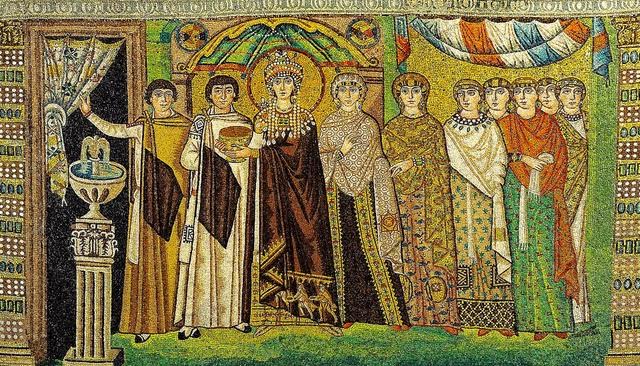
A famous mosaic showing the Byzantine Empress Theodora with some of her retainers and attendants. It is located directly opposite the equally famous mosaic of her husband, Justinian the Great.
We came in via train this morning from Milan’s Malpensa Airport to Stazione Milano Centrale. It’s a surprisingly long train ride, and our train was even a bit late — which made an already close connection even more exciting than it needed to be. From there, we took a train from Milan to Bologna, and then another train from Bologna to Ravenna.
So here we are, staying in a nice little bread-and-breakfast place called Villa Noctis. We’ve wanted to come back for a very long time, and we’ve finally had the opportunity to make it. Ravenna is a very walkable town — at least, for the most part, its historical core is very walkable — and we’ve already managed to take in the Mausoleum of Galla Placidia (which was built between AD 425 and AD 450) and the Basilica of San Vitale. (which was constructed between AD 526 and AD 547) This is an absolutely marvelous place for Byzantine mosaics, which I love.
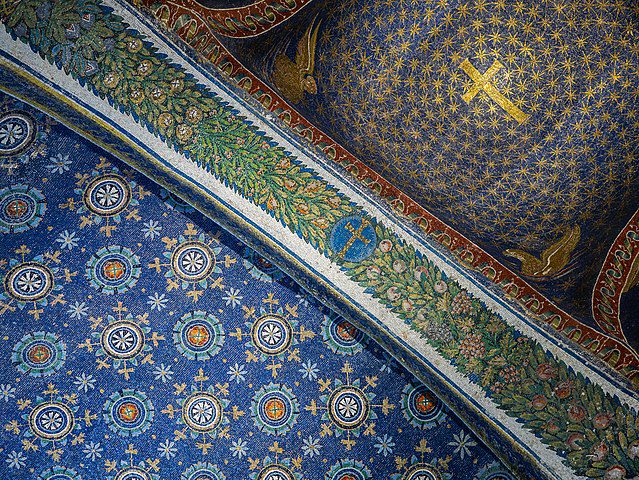
A view of the mosaic ceilings in the Mausoleum of Galla Placidia, in Ravenna
Galla Placidia’s mausoleum — it’s actually almost certainly not really hers — provides an obscure reference in the American poet Ezra Pound’s Canto XXI (and, for different reasons, in Cantos XI and XVII), where he writes
Gold fades in the gloom,
Under the blue-black roof, Placidia’s,
He is referring to the gold stars on a dark blue background that appear on the mausoleum’s ceiling, apparently intending to suggest that high cultural moments fade with the passing of time, or perhaps even that brilliant eras and brilliant persons are forgotten in the ignorance that succeeds them and the foolishness that surrounds them. If so, it’s a very Poundian sentiment (for good or for ill). Compare it to these apparently autobiographical opening lines from his poem “Hugh Selwyn Mauberley”:
For three years, out of key with his time,
He strove to resuscitate the dead art
Of poetry; to maintain “the sublime”
In the old sense. Wrong from the start—
No, hardly, but, seeing he had been born
In a half savage country, out of date;
Bent resolutely on wringing lilies from the acorn.
Pound ended up an ardent and vocal Fascist in Mussolini’s Italy, and possibly insane. During my first trip to Europe many, many years ago as a teenager, I found myself standing in front of a building in Venice where, somebody told me, Ezra Pound lived. (It was probably our expressly pro-Nazi guide — it would fit his interests and predilections — but I can’t say that for sure.) I don’t know if it was true that Ezra Pound lived in that building, but I suspect that it was. He died in Venice in 1972.
Posted from Ravenna, Italy
Travel and Religion
History and Religion
Previous Post

May 26, 2024
"Six Days in August" has its gala European premiere!
Next Post
May 28, 2024 "God's holy fire"
Recent Comments
"Sutherland's lecture sounds interesting. He seems to restate the Washington consensus that trade brings peace ..."
Learning more about a region of ..."
"In a meeting today, I learned another important reason why accurate (or at least as ..."
From Serbia’s “White City,” Belgrade
"I've been watching a lot of video interviews of NDErs and researchers. I think in ..."
"PL: "Let's hope he doesn't have your address..."I have to frankly confess that a few ..."
From Serbia’s “White City,” Belgrade
Browse Our Archives
Select a Category Uncategorized
Select a Month October 2026 September 2026 August 2026 July 2026 June 2026 May 2026 April 2026 March 2026 February 2026 January 2026 December 2025 November 2025 October 2025 September 2025 August 2025 July 2025 June 2025 May 2025 April 2025 March 2025 February 2025 January 2025 December 2024 November 2024 October 2024 September 2024 August 2024 July 2024 June 2024 May 2024 April 2024 March 2024 February 2024 January 2024 December 2023 November 2023 October 2023 September 2023 August 2023 July 2023 June 2023 May 2023 April 2023 March 2023 February 2023 January 2023 December 2022 November 2022 October 2022 September 2022 August 2022 July 2022 June 2022 May 2022 April 2022 March 2022 February 2022 January 2022 December 2021 November 2021 October 2021 September 2021 August 2021 July 2021 June 2021 May 2021 April 2021 March 2021 February 2021 January 2021 December 2020 November 2020 October 2020 September 2020 August 2020 July 2020 June 2020 May 2020 April 2020 March 2020 February 2020 January 2020 December 2019 November 2019 October 2019 September 2019 August 2019 July 2019 June 2019 May 2019 April 2019 March 2019 February 2019 January 2019 December 2018 November 2018 October 2018 September 2018 August 2018 July 2018 June 2018 May 2018 April 2018 March 2018 February 2018 January 2018 December 2017 November 2017 October 2017 September 2017 August 2017 July 2017 June 2017 May 2017 April 2017 March 2017 February 2017 January 2017 December 2016 November 2016 October 2016 September 2016 August 2016 July 2016 June 2016 May 2016 April 2016 March 2016 February 2016 January 2016 December 2015 November 2015 October 2015 September 2015 August 2015 July 2015 June 2015 May 2015 April 2015 March 2015 February 2015 January 2015 December 2014 November 2014 March 2014 August 2013 February 2012
Follow Us!
TAKE THE
Religious Wisdom Quiz
Who said, "Come, follow me, and I will make you fishers of men"?
Select your answer to see how you score.
Jesus Peter Paul John the Baptist
Related posts from Sic et Non
"Even some colors I'd never seen before"
A Revelation in the Operating Room
Hagia Sophia, Tenochtitlan, the Incas' Golden Temple, and...
TRENDING AT PATHEOS Latter-day Saint

Janie Learns the Way of the Cross: A...
Teaching children about Jesus' Passion can be challenging. Many parents and educators...

Looking For Good Catholic Writing - October 2026
He alone extends the heavens, and he walks upon the waves of...

In "Irreplaceable," our book on vocation and technology, Trevor Sutton and I...

I was strolling through the top floor of the brand new Parthenon...

What Does Gêvâh Mean For Kimberley Guifoyle &...
This week, a lot of the news is focused on Kimberly Guilfoyle....

INNER CIRCLE: Profound Mystery (Of Christ In All...
Ephesians 5:31-32 “For this reason, a man will leave his father and...
view all Latter-day Saint blogs
What Are Your Thoughts?leave a comment
Ad-Free & Subscriber Log-In Subscription Support
- About Us
- 2026 Calendar
- Videos
- Podcasts
- Library of World Religions
- Faith In Media Tracker
- Advertise With Us
- Write for Us
- Privacy Policy
- Terms of Service
- Do Not Sell My Data
- Contact Us
- Radiant Digital
- Manage Newsletter Subscriptions
- Unsubscribe From Notifications
- Sitemap
Copyright 2008-2026, Patheos. All rights reserved.
Subscription Support Ad-Free & Subscriber Log-In
Follow Patheos