
BuddhistCatholicContemplativeEvangelicalGeneral ChristianHinduJewishLatter-day SaintMuslimNew VisionsProgressive Christian
Beliefs
- Buddhist
- Catholic
- Contemplative
- Evangelical
- General Christian
- Hindu
- Jewish
- Latter-day Saint
- More Voices
- Muslim
- New Visions
- Pagan
- Progressive Christian
Topics
- Religion News
- Food and Religion
- Sports and Religion
- Religious Art
- Religious Music and Entertainment
- Religious Events
- History and Religion
- Style and Religion
- Politics and Religion
- Women in Religion
- Recreation Outdoors and Religion
- Business Finance and Religion
- Careers Workplace and Religion
- Education and Religion
- Family Parenting and Religion
- Health Fitness and Religion
- Home and Religion
- Relationships and Religion
- Technology and Religion
- Travel and Religion
Columnists
- Buddhist Columnists
- Business Finance and Religion Columnists
- Careers Workplace and Religion Columnists
- Catholic Columnists
- Contemplative Columnists
- Education and Religion Columnists
- Evangelists Columnists
- Family Parenting and Religion Columnists
- General Christian Columnists
- Health Fitness and Religion Columnists
- Hindu Columnists
- History and Religion Columnists
- Home and Religion Columnists
- Jewish Columnists
- More Voices Columnists
- Latter Day Columnists
- Muslim Columnists
- New Visions Columnists
- Nonreligious Columnists
- Pagan Columnists
- Politics and Religion Columnists
- Progressive Columnists
- Recreation Outdoors and Religion Columnists
- Relationships and Religion Columnists
- Religion News Columnists
- Religious Art Columnists
- Religious Events Columnists
- Religious Music and Entertainment Columnists
- Sports and Religion Columnists
- Style and Religion Columnists
- Technology and Religion Columnists
- Travel and Religion Columnists
- Women in Religion Columnists
Resource Library
- 2026 Calendar
- Library of World Religions
- The 100 Most Holy Places on Earth
- Patheos Answers
- Podcasts
- Videos
- Faith Leaders Database
- Anglican Episcopalian
- Bahai
- Baptist
- Buddhism
- Christianity
- Confucianism
- Eastern Orthodoxy
- Hinduism
- Holiness and Pentecostal
- ISKCON
- Islam
- Judaism
- Lutheran
- Methodist
- The Church of Jesus Christ of Latter-day Saints
- New Age
- Paganism
- Presbytarian and Reformed
- Protestantism
- Religion Behind the Scenes
- Roman Catholic
- Scientology
- Shia Islam
- Sikhism
- Sufism
- Sunni Islam
- Taoism
- Zen
- See all religions
Research Tools
 Ad-Free & Subscriber Log-In Subscription Support
Ad-Free & Subscriber Log-In Subscription Support
Follow Patheos 

- Trending:
- Forgiveness
- |
- Marriage
- |
- Consciousness
- |
- Death Penalty
- |
- Election
- |
- Halloween

- Home
- Latter-day Saint
- Travel and Religion
- What persists?
What persists?
Last updated on: April 20, 2024 at 2:59 pm by Dan Peterson
What persists? 2024-04-20T14:59:48-06:00 Dan Peterson
Patheos Explore the world's faith through different perspectives on religion and spirituality! Patheos has the views of the prevalent religions and spiritualities of the world.
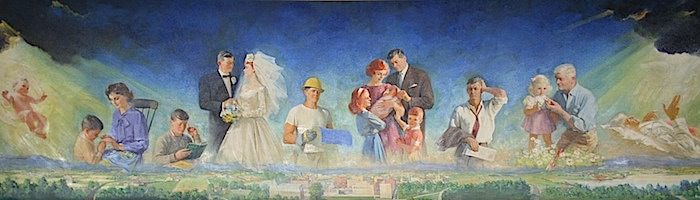
When I was much younger, this illustration was commonly used to depict the stages of the Plan of Salvation as it is conceived among Latter-day Saints (Wikimedia Commons public domain image)
This passage from somewhere came across my radar screen earlier today, and I think it worthy of sharing:
“I asked an elderly woman once what it was like to be old and to know that the majority of her life was now behind her. She told me that she has been the same age her entire life. She said the voice inside of her head had never aged. She has always just been the same girl. Her mother’s daughter. She had always wondered when she would grow up and be an old woman. She said she watched her body age and her faculties dull but the person she is inside never got tired. She never aged. She never changed. Remember, our spirits are eternal. Our souls are forever. The next time you encounter an elderly person, look at them and know they are still a child, just as you are still a child and children will always need love, attention and purpose.” (Author Unknown)
I can honestly say that it well expresses how I myself feel as I totter ever more deeply into advanced geezerhood,. My body isn’t what it was at twenty-five, to put it mildly — truth be told, though, it was never all that good at twenty-five, either — but, inwardly, it amazes me that I’m as old as I am. I never expected to turn so old so fast. Inside, I’m still about twenty-five or thirty. I still wonder what it will be like to grow up. And then we die.

Illustration of a marriage proposal from 1815 England (Wikimedia Commons public domain image)
One of the charges against the Church of Jesus Christ of Latter-day Saints that invariably surprises and puzzles me runs more or less along the following lines: “The Mormon Church separates people at death. It teaches that families won’t be together in the afterlife, and it divorces husbands and wives. But then it offers to permit spouses and families to be together again if and only if they submit to it and fork large chunks of money over to it.”
This charge surprises me because it seems to presume that the default setting in Christendom is, and has historically been, that families will continue as families in the world to come, and that marriages will continue (unless, of course, they’re somehow broken up by malign Latter-day Saint interference). Amazingly, I’ve even seen indignation on this front from atheistic naturalists — as if they themselves believed that such relationships continue beyond the grave in any meaningful way. (If, as naturalistic materialism typically insists, human consciousness and personality cease at death, it’s difficult to see how family relationships or marriage would be very likely to persist in their absence.)
I’ve encountered this charge again over just the past few days. But here are some examples of Christian (and other) marriage vows that I’ve easily located online. They demonstrate that the default assumption among Christian denominations is that marital (and, therefore, family) relationships terminate at death, if not before. I have italicized phrases that make that assumption clear:
Catholic:
I, ___, take you, ___, for my lawful wife/husband, to have and to hold from this day forward, for better, for worse, for richer, for poorer, in sickness and in health, until death do us part. I will love and honor you all the days of my life.
Episcopalian:
In the name of God, I, ___, take you, ___, to be my wife/husband, to have and to hold from this day forward, for better, for worse, for richer, for poorer, in sickness and in health, to love and to cherish, until parted by death. This is my solemn vow.
Anglican
I [Name] take you [Name] to be my wife/husband, to have and to hold from this day forward, for better, for worse, for richer, for poorer, in sickness and in health, to love and to cherish, till death us do part, according to God’s holy law.
Anglican (The Declaration of Consent from the Book of Common Prayer):
The Celebrant says to the woman
N., will you have this man to be your husband; to live
together in the covenant of marriage? Will you love him,
comfort him, honor and keep him, in sickness and in health;
and, forsaking all others, be faithful to him as long as you
both shall live?The Woman answers
I will.
The Celebrant says to the man
N., will you have this woman to be your wife; to live
together in the covenant of marriage? Will you love her,
comfort her, honor and keep her, in sickness and in health;
and, forsaking all others, be faithful to her as long as you
both shall live?The Man answers
I will.
Orthodox:
I will be with you in bad days and in good, in times of prosperity and in times of poverty, in sickness and in health, until I am separated from you by death according to the ordinance of God the most High. And I give my word in oath before God and before the congregation of the Holy Orthodox Church.
Presbyterian:
I, ___, take you, ___, to be my wife/husband, and I do promise and covenant, before God and these witnesses, to be your loving and faithful husband/wife in plenty and in want, in joy and in sorrow, in sickness and in health, as long as we both shall live.
Generic Protestant:
I, ___, take thee, ___, to be my wedded wife/husband, to have and to hold from this day forward, for better, for worse, for richer, for poorer, in sickness and in health, to love and to cherish, till death do us part, according to God’s holy ordinance; and thereto I pledge thee my faith.
Quaker:
In the presence of God and these our friends, I take thee to be my wife/husband, promising with divine assistance to be unto thee a loving and faithful husband/wife so long as we both shall live.
Interfaith:
I,___, take you, ___, to be my wife/husband. I promise to be true to you in good times and in bad, in sickness and in health. I will love and honor you all the days of my life.
Nondenominational:
___, I now take you to be my wedded wife/husband, to live together after God’s ordinance in the holy relationship of marriage. I promise to love and comfort you, honor and keep you, and forsaking all others, I will be yours alone as long as we both shall live.
And, just for interest’s sake, here is a Muslim marriage vow. In Islam, as opposed to Christianity, marriage isn’t seen as a religious sacrament. It is a this-worldly contract.
Muslim:
I, (bride’s name), offer you myself in marriage and in accordance with the instructions of the Holy Quran and the Holy Prophet, peace and blessing be upon him. I pledge, in honesty and with sincerity, to be for you an obedient and faithful wife.
The groom responds: “I, (groom’s name), in accordance with the instructions of the Holy Quran and the Holy Prophet, peace and blessing be upon him. I pledge, in honesty and sincerity, to be for you a faithful and helpful husband.”
Feel free, too, to browse through a representative sample of secular wedding vows, where you will find no shortage of phrases such as “as long as you both shall live,” “as long as the two of you live,” “all the days of our lives,” “for all the days of my life,” “all the days of our lives,” and “until death should part us.”
Latter-day Saints didn’t introduce the notion that marital and family relationships end at the grave. They introduced a cure.
Travel and Religion
History and Religion
Previous Post

April 19, 2024
Yes to Heavenly Reunions
Next Post

April 21, 2024 Two Funeral Requests
Recent Comments
"In a meeting today, I learned another important reason why accurate (or at least as ..."
From Serbia’s “White City,” Belgrade
"PL: "Let's hope he doesn't have your address..."I have to frankly confess that a few ..."
From Serbia’s “White City,” Belgrade
"Let's hope he doesn't have your address..."
From Serbia’s “White City,” Belgrade
"PL: "The layers are peeling back."He appears to be suffering under an odd but powerful ..."
From Serbia’s “White City,” Belgrade
Browse Our Archives
Select a Category Uncategorized
Select a Month October 2026 September 2026 August 2026 July 2026 June 2026 May 2026 April 2026 March 2026 February 2026 January 2026 December 2025 November 2025 October 2025 September 2025 August 2025 July 2025 June 2025 May 2025 April 2025 March 2025 February 2025 January 2025 December 2024 November 2024 October 2024 September 2024 August 2024 July 2024 June 2024 May 2024 April 2024 March 2024 February 2024 January 2024 December 2023 November 2023 October 2023 September 2023 August 2023 July 2023 June 2023 May 2023 April 2023 March 2023 February 2023 January 2023 December 2022 November 2022 October 2022 September 2022 August 2022 July 2022 June 2022 May 2022 April 2022 March 2022 February 2022 January 2022 December 2021 November 2021 October 2021 September 2021 August 2021 July 2021 June 2021 May 2021 April 2021 March 2021 February 2021 January 2021 December 2020 November 2020 October 2020 September 2020 August 2020 July 2020 June 2020 May 2020 April 2020 March 2020 February 2020 January 2020 December 2019 November 2019 October 2019 September 2019 August 2019 July 2019 June 2019 May 2019 April 2019 March 2019 February 2019 January 2019 December 2018 November 2018 October 2018 September 2018 August 2018 July 2018 June 2018 May 2018 April 2018 March 2018 February 2018 January 2018 December 2017 November 2017 October 2017 September 2017 August 2017 July 2017 June 2017 May 2017 April 2017 March 2017 February 2017 January 2017 December 2016 November 2016 October 2016 September 2016 August 2016 July 2016 June 2016 May 2016 April 2016 March 2016 February 2016 January 2016 December 2015 November 2015 October 2015 September 2015 August 2015 July 2015 June 2015 May 2015 April 2015 March 2015 February 2015 January 2015 December 2014 November 2014 March 2014 August 2013 February 2012
Follow Us!
TAKE THE
Religious Wisdom Quiz
What did the Israelites carry through the wilderness that symbolized God's presence?
Select your answer to see how you score.
Burning torch Golden Calf Scroll of Moses Ark of the Covenant
Related posts from Sic et Non


"The Book of Moses as a Temple Text"


TRENDING AT PATHEOS Latter-day Saint

The Sermon on the Mount, Part I: Matthew...
The Sermon on the Mount, Part I (Matthew 4:12-5:12) St. Matthew moves...

What's up from Crossway: Reviewing some of their latest A few weeks...

Janie Learns the Way of the Cross: A...
Teaching children about Jesus' Passion can be challenging. Many parents and educators...

Looking For Good Catholic Writing - October 2026
He alone extends the heavens, and he walks upon the waves of...

In "Irreplaceable," our book on vocation and technology, Trevor Sutton and I...

I was strolling through the top floor of the brand new Parthenon...
view all Latter-day Saint blogs
What Are Your Thoughts?leave a comment
Ad-Free & Subscriber Log-In Subscription Support
- About Us
- 2026 Calendar
- Videos
- Podcasts
- Library of World Religions
- Faith In Media Tracker
- Advertise With Us
- Write for Us
- Privacy Policy
- Terms of Service
- Do Not Sell My Data
- Contact Us
- Radiant Digital
- Manage Newsletter Subscriptions
- Unsubscribe From Notifications
- Sitemap
Copyright 2008-2026, Patheos. All rights reserved.
Subscription Support Ad-Free & Subscriber Log-In
Follow Patheos