
BuddhistCatholicContemplativeEvangelicalGeneral ChristianHinduJewishLatter-day SaintMuslimNew VisionsProgressive Christian
Beliefs
- Buddhist
- Catholic
- Contemplative
- Evangelical
- General Christian
- Hindu
- Jewish
- Latter-day Saint
- More Voices
- Muslim
- New Visions
- Pagan
- Progressive Christian
Topics
- Religion News
- Food and Religion
- Sports and Religion
- Religious Art
- Religious Music and Entertainment
- Religious Events
- History and Religion
- Style and Religion
- Politics and Religion
- Women in Religion
- Recreation Outdoors and Religion
- Business Finance and Religion
- Careers Workplace and Religion
- Education and Religion
- Family Parenting and Religion
- Health Fitness and Religion
- Home and Religion
- Relationships and Religion
- Technology and Religion
- Travel and Religion
Columnists
- Buddhist Columnists
- Business Finance and Religion Columnists
- Careers Workplace and Religion Columnists
- Catholic Columnists
- Contemplative Columnists
- Education and Religion Columnists
- Evangelists Columnists
- Family Parenting and Religion Columnists
- General Christian Columnists
- Health Fitness and Religion Columnists
- Hindu Columnists
- History and Religion Columnists
- Home and Religion Columnists
- Jewish Columnists
- More Voices Columnists
- Latter Day Columnists
- Muslim Columnists
- New Visions Columnists
- Nonreligious Columnists
- Pagan Columnists
- Politics and Religion Columnists
- Progressive Columnists
- Recreation Outdoors and Religion Columnists
- Relationships and Religion Columnists
- Religion News Columnists
- Religious Art Columnists
- Religious Events Columnists
- Religious Music and Entertainment Columnists
- Sports and Religion Columnists
- Style and Religion Columnists
- Technology and Religion Columnists
- Travel and Religion Columnists
- Women in Religion Columnists
Resource Library
- 2026 Calendar
- Library of World Religions
- The 100 Most Holy Places on Earth
- Patheos Answers
- Podcasts
- Videos
- Faith Leaders Database
- Anglican Episcopalian
- Bahai
- Baptist
- Buddhism
- Christianity
- Confucianism
- Eastern Orthodoxy
- Hinduism
- Holiness and Pentecostal
- ISKCON
- Islam
- Judaism
- Lutheran
- Methodist
- The Church of Jesus Christ of Latter-day Saints
- New Age
- Paganism
- Presbytarian and Reformed
- Protestantism
- Religion Behind the Scenes
- Roman Catholic
- Scientology
- Shia Islam
- Sikhism
- Sufism
- Sunni Islam
- Taoism
- Zen
- See all religions
Research Tools
 Ad-Free & Subscriber Log-In Subscription Support
Ad-Free & Subscriber Log-In Subscription Support
Follow Patheos 

- Trending:
- Forgiveness
- |
- Marriage
- |
- Consciousness
- |
- Death Penalty
- |
- Election
- |
- Halloween

- Home
- Latter-day Saint
- Travel and Religion
- The Earliest Kerygma
The Earliest Kerygma
Last updated on: April 3, 2024 at 8:16 am by Dan Peterson
The Earliest Kerygma 2024-04-03T08:16:33-06:00 Dan Peterson
Patheos Explore the world's faith through different perspectives on religion and spirituality! Patheos has the views of the prevalent religions and spiritualities of the world.
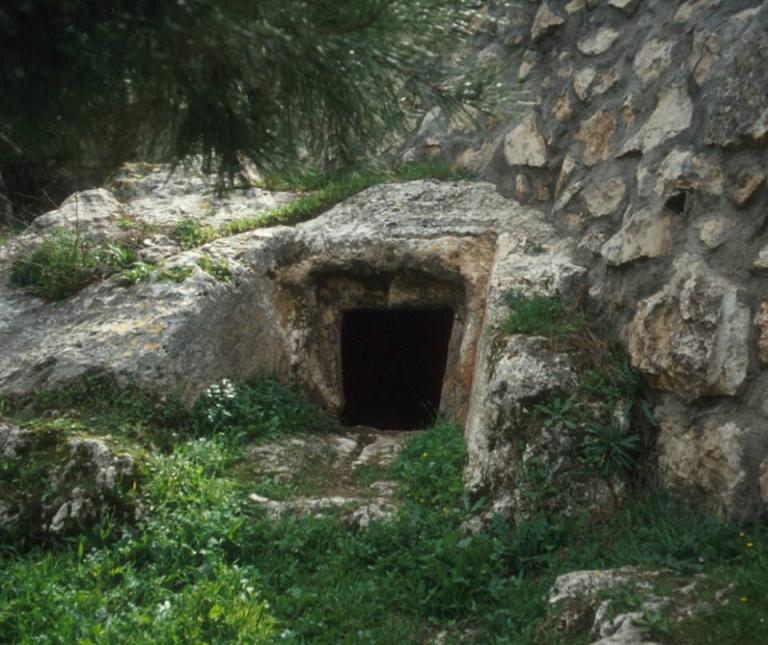
An empty tomb in Jerusalem dating to the Herodian period. The photograph was taken by my friend and colleague Dr. Jeffrey Chadwick, and I use it here with his kind permission. Neither of us believes either the Garden Tomb or the Holy Sepulcher to be the right place, so this will have to represent the as-yet unknown site of Christ’s burial and resurrection.
The Prophet Joseph Smith is well known to have declared that
The fundamental principles of our religion are the testimony of the Apostles and Prophets, concerning Jesus Christ, that He died, was buried, and rose again the third day, and ascended into heaven; and all other things which pertain to our religion are only appendages to it. (History of the Church, 3:30)
On the other hand, one claim that is often advanced by skeptics and other critics of Christianity is that belief in the resurrection of Jesus from the dead arose only relatively late — effectively, that it was either mere later folklore — generated by something like the famous “telephone game” — or an outright invention or, more charitably, that it arose out of later generations’ misunderstanding of a metaphor or a phantasm or even a sentimental memory as a literal, corporeal emergence from the tomb.
The issue can be approached from multiple and quite distinct angles. In this post, I want to follow only one of those approaches, and I have no intention of doing a complete job even on that. So I need to say, upfront, that my judgment is that the assertion that belief in Christ’s literal resurrection arose only several decades or even generations after his death is very weak, and that it poses no serious threat to the mainstream, traditional Christian belief that he rose, bodily and gloriously, from the tomb. What follows here, though, will only be a portion of one part of a much larger cumulative argument to that effect. In fact, I’ll probably set even this little part of the larger case forth in several merely preliminary installments over the next week or two (or three):
I am not a specialist New Testament scholar. But I’ve read a fair amount of New Testament scholarship from specialists. One of the intriguing things that I’ve picked up in my unsystematic reading of recent biblical scholarship is that specialists now recognize the presence in the New Testament of seemingly “creedal” or “creed-like” texts — that is, of formulaic passages that seem to preserve earlier statements of basic, essential, absolutely early Christian teaching.
Here is one of them, from the first chapter of Paul’s first letter to the saints in Corinth. The late American-Canadian New Testament scholar Gordon Fee wrote that “it is generally agreed that in vv. 3–5 Paul is repeating a very early creedal formulation that was common to the entire church.” (Gordon D. Fee, First Epistle to the Corinthians, NICNT [Grand Rapids: Eerdmans, 1987]. 718; cf. J. N. D. Kelly, Early Christian Creeds, 3rd ed. [London: Longman, 1972]16-17; David E. Garland, 1 Corinthians, BECNT [Grand Rapids: Baker Academic, 2003], 683) These are the relevant verses, quoted in the King James Version:
1 Moreover, brethren, I declare unto you the gospel which I preached unto you, which also ye have received, and wherein ye stand; 2 By which also ye are saved, if ye keep in memory what I preached unto you, unless ye have believed in vain.
3 For I delivered unto you first of all that which I also received, how that Christ died for our sins according to the scriptures; 4 And that he was buried, and that he rose again the third day according to the scriptures: 5 And that he was seen of Cephas, then of the twelve: 6 After that, he was seen of above five hundred brethren at once; of whom the greater part remain unto this present, but some are fallen asleep. 7 After that, he was seen of James; then of all the apostles. 8 And last of all he was seen of me also, as of one born out of due time. (1 Corinthians 15:1-8)
In the verses above, Paul lays out the basic tenets of the gospel that he had previously preached to the Corinthians. The strong similarity of Paul’s statement to Joseph Smith’s “fundamental principles of our religion” is undeniably obvious.
So what can we say about the date of Paul’s declaration? 1 Corinthians is variously dated to AD 53, or AD 54, or AD 57. Clearly, though, Paul had been in Corinth prior to his writing of that letter. When? Paul’s first visit to Corinth, which lasted about eighteen months, is commonly placed at AD 49, AD 50, or AD 51. (For preliminary rough and ready specification of these dates, I consulted the following chronologies: Blue Letter Bible, a handout from Western Reformed Seminary, and Catholic Resources.)
And he says in 1 Corinthians 15:3 that he delivered to the Corinthians what he himself had already “received,” presumably before his visit there. So it had to be prior to AD 51 or even prior to AD 49. (Which is to say, well under two decades after the crucifixion of Christ, and well within the range of living memory.) And what is the content of that which he had received? At its core, it was this;
3 that Christ died for our sins according to the scriptures; 4 And that he was buried, and that he rose again the third day according to the scriptures
This is clearly a reference to Christ’s death, burial, and, yes, resurrection. I freely grant that it doesn’t, by itself, establish the early teaching of a corporeal resurrection, though it also doesn’t rule out a literal, physical emergence from the tomb. That will require a separate argument — of which the distinct appearances to various individual witnesses and groups of witnesses will definitely be a component part. Gordon Fee wrote, with regard to the appearance to witnesses, that it “emphasizes the objective reality of the Resurrection” [Fee, First Epistle to the Corinthians, 728].)
Both verse 3 and verse 4 conclude with the phrase “according to the scriptures,” which surely seems to entail that Christ’s death, his burial, and, yes, his resurrection were divinely foreordained events.
Here’s another way of looking at 1 Corinthians 15:3-4: Four elements are mentioned: (1) Christ’s death, (2) his burial, (3) his resurrection, and (4) his appearances. Item (2) supports (1). Item (4) confirms (3). Or, as Gordon Fee put it, referring to what he described as the balanced structure of the passage, “as line 2 functions to warrant line 1, so this line [4] warrants line 3” (Fee, First Epistle to the Corinthians, 728). The late Joseph Fitzmyer also noted the parallelism, labeling the various elements a a’ b b’ (Joseph A. Fitzmyer, First Corinthians: A New Translation with Introduction and Commentary, AB 28 [New York: Doubleday, 1981], 541).
The four assertions cohere very well — death and burial, resurrection and appearance — and together they constitute what New Testament scholars often call the kerygma (“proclamation,” “preaching”) of the primitive Christian church. (The Greek term κήρυγμα [kḗrugma] is derived from such passages as Matthew 3:1, Luke 4:18-19, and Romans 10:14.) One might even say that they represent a very early form of Christian apologetics: We know that Jesus died because he was buried. However, we know that he rose again because he was seen.
Commenting on 1 Corinthians 15:3-4, Father Fitzmyer observed that “Paul repeats the basic Christian kērygma, ‘proclamation,’ which eventually developed into the gospel tradition and gave us the four canonical Gospels” (Fitzmyer, First Corinthians, 541). And he does so quite early.
Travel and Religion
History and Religion
Previous Post

April 1, 2024
Thanks for Disney
Next Post

April 3, 2024 Not by bread alone but, still, bread
Recent Comments
"DP: “But Mr. Sutherland worries about the fact that our time, when we can communicate ..."
Learning more about a region of ..."
"Sutherland's lecture sounds interesting. He seems to restate the Washington consensus that trade brings peace ..."
Learning more about a region of ..."
"In a meeting today, I learned another important reason why accurate (or at least as ..."
From Serbia’s “White City,” Belgrade
"I've been watching a lot of video interviews of NDErs and researchers. I think in ..."
Browse Our Archives
Select a Category Uncategorized
Select a Month October 2026 September 2026 August 2026 July 2026 June 2026 May 2026 April 2026 March 2026 February 2026 January 2026 December 2025 November 2025 October 2025 September 2025 August 2025 July 2025 June 2025 May 2025 April 2025 March 2025 February 2025 January 2025 December 2024 November 2024 October 2024 September 2024 August 2024 July 2024 June 2024 May 2024 April 2024 March 2024 February 2024 January 2024 December 2023 November 2023 October 2023 September 2023 August 2023 July 2023 June 2023 May 2023 April 2023 March 2023 February 2023 January 2023 December 2022 November 2022 October 2022 September 2022 August 2022 July 2022 June 2022 May 2022 April 2022 March 2022 February 2022 January 2022 December 2021 November 2021 October 2021 September 2021 August 2021 July 2021 June 2021 May 2021 April 2021 March 2021 February 2021 January 2021 December 2020 November 2020 October 2020 September 2020 August 2020 July 2020 June 2020 May 2020 April 2020 March 2020 February 2020 January 2020 December 2019 November 2019 October 2019 September 2019 August 2019 July 2019 June 2019 May 2019 April 2019 March 2019 February 2019 January 2019 December 2018 November 2018 October 2018 September 2018 August 2018 July 2018 June 2018 May 2018 April 2018 March 2018 February 2018 January 2018 December 2017 November 2017 October 2017 September 2017 August 2017 July 2017 June 2017 May 2017 April 2017 March 2017 February 2017 January 2017 December 2016 November 2016 October 2016 September 2016 August 2016 July 2016 June 2016 May 2016 April 2016 March 2016 February 2016 January 2016 December 2015 November 2015 October 2015 September 2015 August 2015 July 2015 June 2015 May 2015 April 2015 March 2015 February 2015 January 2015 December 2014 November 2014 March 2014 August 2013 February 2012
Follow Us!
TAKE THE
Religious Wisdom Quiz
Who was the prophet that confronted King David about his sin with Bathsheba?
Select your answer to see how you score.
Samuel Elijah Nathan Isaiah
Related posts from Sic et Non

An action movie and some vacuous theology

"The World's Sixteen Crucified Saviors"?

We definitely didn't elect a mere choirboy.
How fundamental is Christ's resurrection?
TRENDING AT PATHEOS Latter-day Saint

The Sermon on the Mount, Part I: Matthew...
The Sermon on the Mount, Part I (Matthew 4:12-5:12) St. Matthew moves...

What's up from Crossway: Reviewing some of their latest A few weeks...

Janie Learns the Way of the Cross: A...
Teaching children about Jesus' Passion can be challenging. Many parents and educators...

Looking For Good Catholic Writing - October 2026
He alone extends the heavens, and he walks upon the waves of...

In "Irreplaceable," our book on vocation and technology, Trevor Sutton and I...

I was strolling through the top floor of the brand new Parthenon...
view all Latter-day Saint blogs
What Are Your Thoughts?leave a comment
Ad-Free & Subscriber Log-In Subscription Support
- About Us
- 2026 Calendar
- Videos
- Podcasts
- Library of World Religions
- Faith In Media Tracker
- Advertise With Us
- Write for Us
- Privacy Policy
- Terms of Service
- Do Not Sell My Data
- Contact Us
- Radiant Digital
- Manage Newsletter Subscriptions
- Unsubscribe From Notifications
- Sitemap
Copyright 2008-2026, Patheos. All rights reserved.
Subscription Support Ad-Free & Subscriber Log-In
Follow Patheos