
BuddhistCatholicContemplativeEvangelicalGeneral ChristianHinduJewishLatter-day SaintMuslimNew VisionsProgressive Christian
Beliefs
- Buddhist
- Catholic
- Contemplative
- Evangelical
- General Christian
- Hindu
- Jewish
- Latter-day Saint
- More Voices
- Muslim
- New Visions
- Pagan
- Progressive Christian
Topics
- Religion News
- Food and Religion
- Sports and Religion
- Religious Art
- Religious Music and Entertainment
- Religious Events
- History and Religion
- Style and Religion
- Politics and Religion
- Women in Religion
- Recreation Outdoors and Religion
- Business Finance and Religion
- Careers Workplace and Religion
- Education and Religion
- Family Parenting and Religion
- Health Fitness and Religion
- Home and Religion
- Relationships and Religion
- Technology and Religion
- Travel and Religion
Columnists
- Buddhist Columnists
- Business Finance and Religion Columnists
- Careers Workplace and Religion Columnists
- Catholic Columnists
- Contemplative Columnists
- Education and Religion Columnists
- Evangelists Columnists
- Family Parenting and Religion Columnists
- General Christian Columnists
- Health Fitness and Religion Columnists
- Hindu Columnists
- History and Religion Columnists
- Home and Religion Columnists
- Jewish Columnists
- More Voices Columnists
- Latter Day Columnists
- Muslim Columnists
- New Visions Columnists
- Nonreligious Columnists
- Pagan Columnists
- Politics and Religion Columnists
- Progressive Columnists
- Recreation Outdoors and Religion Columnists
- Relationships and Religion Columnists
- Religion News Columnists
- Religious Art Columnists
- Religious Events Columnists
- Religious Music and Entertainment Columnists
- Sports and Religion Columnists
- Style and Religion Columnists
- Technology and Religion Columnists
- Travel and Religion Columnists
- Women in Religion Columnists
Resource Library
- 2026 Calendar
- Library of World Religions
- The 100 Most Holy Places on Earth
- Patheos Answers
- Podcasts
- Videos
- Faith Leaders Database
- Anglican Episcopalian
- Bahai
- Baptist
- Buddhism
- Christianity
- Confucianism
- Eastern Orthodoxy
- Hinduism
- Holiness and Pentecostal
- ISKCON
- Islam
- Judaism
- Lutheran
- Methodist
- The Church of Jesus Christ of Latter-day Saints
- New Age
- Paganism
- Presbytarian and Reformed
- Protestantism
- Religion Behind the Scenes
- Roman Catholic
- Scientology
- Shia Islam
- Sikhism
- Sufism
- Sunni Islam
- Taoism
- Zen
- See all religions
Research Tools
 Ad-Free & Subscriber Log-In Subscription Support
Ad-Free & Subscriber Log-In Subscription Support
Follow Patheos 

- Trending:
- Forgiveness
- |
- Marriage
- |
- Consciousness
- |
- Death Penalty
- |
- Election
- |
- Halloween

- Home
- Latter-day Saint
- Travel and Religion
- Once more: Brigham Young, early Utah, race, and servitude
Once more: Brigham Young, early Utah, race, and servitude
Last updated on: April 16, 2024 at 7:03 pm by Dan Peterson
Once more: Brigham Young, early Utah, race, and servitude 2024-04-16T19:03:44-06:00 Dan Peterson
Patheos Explore the world's faith through different perspectives on religion and spirituality! Patheos has the views of the prevalent religions and spiritualities of the world.
An early classic in the field
“A conservative is someone who stands athwart history, yelling Stop, at a time when no one is inclined to do so, or to have much patience with those who so urge it.” (William F. Buckley, Jr.)
I was powerfully reminded of that famous early quotation from the late William F. Buckley while reading the following two articles:
- Deseret News: “What the U.K.’s explosive Cass Review means for gender medicine in the U.S.: The report is a gauntlet thrown down to the Biden administration and organizations supporting controversial treatments for children”
- National Review: “A Damning Indictment of Gender ‘Affirmation’: A new NHS report concludes that youth gender treatments are ‘built on shaky foundations.’”
Apropos of the great Mr. Buckley, by the way, and in view of a vigorous recent exchange between me and one of the commenters here — which, you may trust me on this, was (as it always is) a dispute between Truth (me) and Error (the Other) — I call your attention to a 2017 article that I came across, a few days ago and by sheerest chance, on Politico: “How William F. Buckley, Jr., Changed His Mind on Civil Rights: The man who boasted he purged the conservative movement of ‘kooks’ and bigots was once a strong defender of racial discrimination—even violence. What changed?”
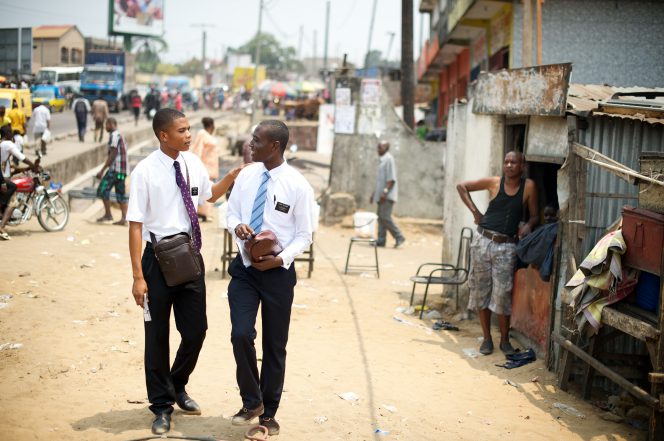
Two Latter-day Saint missionaries walking down a street in Africa (LDS Media Library)
On the time-honored principle that I rush in where angels fear to tread, I will now post yet again — see my previous efforts here and here — on the question of Brigham Young, racism, Latter-day Saints, and “slavery” in early Utah Territory. As a result of my prior two posts on the subject, my attention has been called to an excellent article: Christopher B. Rich, Jr., “The True Policy for Utah: Servitude; Slavery; and ‘An Act in Relation to Service,’” Utah Historical Quarterly, 80/1 (Winter 2012): 54-74. I was pleased to see that Christopher Rich’s well-informed and balanced essay reaches conclusions that I had intuited already and, thus, provides support for my position. Here, I share four quotations from it:
Over the years, many historians have asserted that after receiving this new authority, the Utah Legislature drafted “An Act in Relation to Service” in order to legalize slavery in the territory.2 However, the reality is far more complicated. In fact, if one carefully examines the text of the statute in its proper context, it becomes clear that this legislation did not legalize chattel slavery as it has been alleged. Rather, the act was an attempt to find a practical compromise between three contradictory goals. The first of these goals was to abolish the status of “slave,” meaning a human being who is legally reduced to a chattel, or a piece of personal property. However, the second goal was to honor the property rights of a small number of Southern slaveholders who brought their slaves into Utah while also ensuring that these bondsmen would be subject to the influence and authority of the community at large. Finally, the third goal was to uphold the appearance of neutrality towards slavery in order to strengthen a bid for statehood. In order to accommodate these goals, the law instituted a scheme of quasi-indentured servitude and gradual emancipation for African slaves who immigrated to the territory with their masters. In fashioning this system, the Utah legislature was hardly treading new ground. State legislatures in the northern United States had wrestled with the problem of abolishing chattel slavery while also defending property rights for more than sixty years, and had come up with similar solutions. Indeed, it is evident that the provisions of “An Act in Relation to Service” were largely based upon these northern statutes, particularly those of Indiana and Illinois. Like the practices that developed in these states, Utah’s indenture system was almost certainly a form of “involuntary servitude” despite the legislature’s requirement that African American servants give nominal consent to the arrangement and receive compensation.3 Nevertheless, it remained distinct from chattel slavery and a step forward in the gradual emancipation model. . . .
[T]he very essence of chattel slavery [is] the premise that in most instances, an African slave was legally equivalent to livestock or a piece of furniture and therefore could not lay claim to any particular set of rights.
One critic of the Church and of Brigham Young, commenting here, has suggested that, to the extent that the 1852 “Act in Relation to Service” appears not to have agreed with the critic’s view, which is that Brigham Young favored chattel slavery, it was passed against Brigham’s wishes. But this appears not to be the case:
At the end of 1852, Governor Young declared himself perfectly satisfied with “An Act in Relation to Service,” and added that if similar measures were adopted around the country, it could alleviate the growing national divide over the question of slavery. He assured the territorial legislature that:
not until the subject of servitude and the relation existing between Master and Servant shall be understood and acted upon, and carried out by all parties on a righteous principle, may we expect quiet in our Nation’s councils. When southern Statesmen shall learn that Africa’s sons and daughters are not goods and chattels, and will attach unto them, that humanity and moral accountability to which they are entitled…and northern fanaticism learn to know that “Canaan” shall be servant of servants unto his brethren . . . If [abolitionists] wish to do [slaves] a kindness . . . let them purchase them into freedom, and place them in their own household, where they can partake of their kindness, wisdom, and intelligence. . . . Happily for Utah, this question has been wisely left open for the decision of her citizens, and the law of the last session, so far proves a very salutary measure, as it has nearly freed the Territory of the colored population; also enabling the people to control all who see proper to remain, and cast their lot among us.
And, finally, here is a brief discussion of the one court case that arose out of the 1852 Act:
On June 16, 1856, Edwin D. Woolley filed a complaint before Judge Elias Smith against another Mormon named Williams Camp. Woolley was a prominent local businessman, a confidant of both Joseph Smith and Brigham Young, a Mormon bishop, and finally a member of the territorial legislature which had drafted “An Act in Relation to Service.” He had also been raised a Quaker in Pennsylvania before joining the LDS church, and presumably had grown up with a deep abhorrence of slavery. Woolley contended that Camp and several associates had kidnapped a “negro named Dan” . . .
Several points of interest arise out of the trial. To begin with, it is evident that some members of the Mormon community (largely of Southern extraction) had begun to rely on “An Act in Relation to Service” in order to protect their interests in the labor of African American servants. Others, including Edwin Woolley and Brigham Young, used the law as a means to defend those same servants from abuse by their masters.
And yesterday, by sheer chance (?) while looking for something completely unrelated, I ran across the following:
May 1998, just days before the 20th anniversary of the 1978 revelation, I was in Ghana and then South Africa gathering stories with Dale LeBaron, who was mission president in South Africa in 1978. Since then, Dale had made it his life’s work to gather the stories of as many of the early African pioneers as possible before they died. I was with him on this last trip to record some important stories on video. My first day in Ghana happened to be the wedding of William Billy Johnson’s son who is named Brigham Young Johnson. Billy Johnson is the man featured in the old seminary video showing him tuning into the BBC and hearing the announcement on the Priesthood revelation in 1978. When he learned that I was a descendant of Brigham Young, he could hardly contain his excitement that I was brought to Africa on the day of his son’s wedding. Billy took us on a tour of the old Cocoa Shed “church” in Ghana where they held their first meetings long before the missionaries got there. At one point he stopped and said that it was here that Brigham Young appeared to him during a very hard period of trials and persecution and said to him something like . . .” Buck up Johnson, help is coming. Buck up.”
Marian (Marcy) Brown
2nd great granddaughter of Brigham Young
To which Mary Ellen Elggren, who was at the time the Chairman of the Board of Directors of the Brigham Young Family Association, responded, “May 2018, Brother Brigham undoubtedly is still on the job.”
I had already written here earlier about the incident involving Billy Johnson:
Young’s descendants, including Elggren, believe their prophet was prophesying a “temporary ban, and could foresee the future when it would be removed.”
“Brigham said the day would come when black members would receive all the blessings they were denied,” Elggren says, “ — ‘and more.’”
So when LDS Church President Spencer W. Kimball reported receiving a “revelation” on June 1, 1978, ending the priesthood prohibition (it was announced a week later), Young’s descendants were not surprised. After all, June 1 was their ancestor’s birthday.
At least one descendant believes Young was working for the change from, well, heaven.
Some years ago, Marcy May Brown, who is a great-great-granddaughter of one of Young’s wives, went to Africa to film a documentary about the history of black Mormons.
In Ghana, Brown met some LDS converts who joined the Utah-based faith even before 1978. One of them, Billy Johnson, told the filmmaker the pioneer leader came to him in a vision and said, “Buck up, Billy. Help is coming.”
The African Latter-day Saint even named his first son “Brigham Young Johnson.”
Now, I realize that unbelievers and critics of the Church will accord absolutely no weight or credibility to the story of Billy Johnson. Believers, on the other hand, may find it helpful as they contend with Brigham Young’s now thoroughly-unfashionable views on race.
Travel and Religion
History and Religion
Previous Post

April 14, 2024
When Joseph Smith is attacked
Next Post

April 16, 2024 Islamic "fitra" and "the light of Christ"
Recent Comments
"I have cpnsidered in my mond if the 4 volume Saints could be made into ..."
From Serbia’s “White City,” Belgrade
"DP: “But Mr. Sutherland worries about the fact that our time, when we can communicate ..."
Learning more about a region of ..."
"Another class of memories are of individuals who previously lived. Some of these remembered individuals ..."
"Sutherland's lecture sounds interesting. He seems to restate the Washington consensus that trade brings peace ..."
Learning more about a region of ..."
Browse Our Archives
Select a Category Uncategorized
Select a Month October 2026 September 2026 August 2026 July 2026 June 2026 May 2026 April 2026 March 2026 February 2026 January 2026 December 2025 November 2025 October 2025 September 2025 August 2025 July 2025 June 2025 May 2025 April 2025 March 2025 February 2025 January 2025 December 2024 November 2024 October 2024 September 2024 August 2024 July 2024 June 2024 May 2024 April 2024 March 2024 February 2024 January 2024 December 2023 November 2023 October 2023 September 2023 August 2023 July 2023 June 2023 May 2023 April 2023 March 2023 February 2023 January 2023 December 2022 November 2022 October 2022 September 2022 August 2022 July 2022 June 2022 May 2022 April 2022 March 2022 February 2022 January 2022 December 2021 November 2021 October 2021 September 2021 August 2021 July 2021 June 2021 May 2021 April 2021 March 2021 February 2021 January 2021 December 2020 November 2020 October 2020 September 2020 August 2020 July 2020 June 2020 May 2020 April 2020 March 2020 February 2020 January 2020 December 2019 November 2019 October 2019 September 2019 August 2019 July 2019 June 2019 May 2019 April 2019 March 2019 February 2019 January 2019 December 2018 November 2018 October 2018 September 2018 August 2018 July 2018 June 2018 May 2018 April 2018 March 2018 February 2018 January 2018 December 2017 November 2017 October 2017 September 2017 August 2017 July 2017 June 2017 May 2017 April 2017 March 2017 February 2017 January 2017 December 2016 November 2016 October 2016 September 2016 August 2016 July 2016 June 2016 May 2016 April 2016 March 2016 February 2016 January 2016 December 2015 November 2015 October 2015 September 2015 August 2015 July 2015 June 2015 May 2015 April 2015 March 2015 February 2015 January 2015 December 2014 November 2014 March 2014 August 2013 February 2012
Follow Us!
TAKE THE
Religious Wisdom Quiz
What was the main language spoken by Jews during Jesus’ time?
Select your answer to see how you score.
Hebrew Greek Aramaic Latin
Related posts from Sic et Non

“Once more unto the breach, dear friends, once...
How many divine beings appeared in Joseph's First...


TRENDING AT PATHEOS Latter-day Saint

When Halloween Unmasks Married Hearts
Written by Dr. David K. Ewen from Eternal Truth Bible College Behind...

Aristotle. He’s been called the father of logic, the father of the...

Methodist Central Hall and Westminster Abbey
Situated on the same square is Methodist Central Hall and Westminster Abbey. ...

57th Dove Awards Honor Dolly Parton, Crown New...
On gospel music’s biggest night, the 57th annual GMA Dove Awards honored...

The First Eucharistic Controversy: Christ’s Real Presence
For Catholics, the Eucharist is the source and summit of the Christian...

What a Stop Sign Can Teach Us About...
How to Make a Decision When You Can't Hear God Main point:...
view all Latter-day Saint blogs
What Are Your Thoughts?leave a comment
Ad-Free & Subscriber Log-In Subscription Support
- About Us
- 2026 Calendar
- Videos
- Podcasts
- Library of World Religions
- Faith In Media Tracker
- Advertise With Us
- Write for Us
- Privacy Policy
- Terms of Service
- Do Not Sell My Data
- Contact Us
- Radiant Digital
- Manage Newsletter Subscriptions
- Unsubscribe From Notifications
- Sitemap
Copyright 2008-2026, Patheos. All rights reserved.
Subscription Support Ad-Free & Subscriber Log-In
Follow Patheos