
BuddhistCatholicContemplativeEvangelicalGeneral ChristianHinduJewishLatter-day SaintMuslimNew VisionsProgressive Christian
Beliefs
- Buddhist
- Catholic
- Contemplative
- Evangelical
- General Christian
- Hindu
- Jewish
- Latter-day Saint
- More Voices
- Muslim
- New Visions
- Pagan
- Progressive Christian
Topics
- Religion News
- Food and Religion
- Sports and Religion
- Religious Art
- Religious Music and Entertainment
- Religious Events
- History and Religion
- Style and Religion
- Politics and Religion
- Women in Religion
- Recreation Outdoors and Religion
- Business Finance and Religion
- Careers Workplace and Religion
- Education and Religion
- Family Parenting and Religion
- Health Fitness and Religion
- Home and Religion
- Relationships and Religion
- Technology and Religion
- Travel and Religion
Columnists
- Buddhist Columnists
- Business Finance and Religion Columnists
- Careers Workplace and Religion Columnists
- Catholic Columnists
- Contemplative Columnists
- Education and Religion Columnists
- Evangelists Columnists
- Family Parenting and Religion Columnists
- General Christian Columnists
- Health Fitness and Religion Columnists
- Hindu Columnists
- History and Religion Columnists
- Home and Religion Columnists
- Jewish Columnists
- More Voices Columnists
- Latter Day Columnists
- Muslim Columnists
- New Visions Columnists
- Nonreligious Columnists
- Pagan Columnists
- Politics and Religion Columnists
- Progressive Columnists
- Recreation Outdoors and Religion Columnists
- Relationships and Religion Columnists
- Religion News Columnists
- Religious Art Columnists
- Religious Events Columnists
- Religious Music and Entertainment Columnists
- Sports and Religion Columnists
- Style and Religion Columnists
- Technology and Religion Columnists
- Travel and Religion Columnists
- Women in Religion Columnists
Resource Library
- 2026 Calendar
- Library of World Religions
- The 100 Most Holy Places on Earth
- Patheos Answers
- Podcasts
- Videos
- Faith Leaders Database
- Anglican Episcopalian
- Bahai
- Baptist
- Buddhism
- Christianity
- Confucianism
- Eastern Orthodoxy
- Hinduism
- Holiness and Pentecostal
- ISKCON
- Islam
- Judaism
- Lutheran
- Methodist
- The Church of Jesus Christ of Latter-day Saints
- New Age
- Paganism
- Presbytarian and Reformed
- Protestantism
- Religion Behind the Scenes
- Roman Catholic
- Scientology
- Shia Islam
- Sikhism
- Sufism
- Sunni Islam
- Taoism
- Zen
- See all religions
Research Tools
 Ad-Free & Subscriber Log-In Subscription Support
Follow Patheos 

- Trending:
- Advent
- |
- Forgiveness
- |
- Thanksgiving
- |
- Election
- |
- Seasonal Holidays
- |
- Marriage

- Home
- Latter-day Saint
- Travel and Religion
- On not looking beyond the mark
On not looking beyond the mark
Last updated on: April 6, 2024 at 12:48 pm by Dan Peterson
On not looking beyond the mark 2024-04-06T12:48:11-06:00 Dan Peterson
Patheos Explore the world's faith through different perspectives on religion and spirituality! Patheos has the views of the prevalent religions and spiritualities of the world.
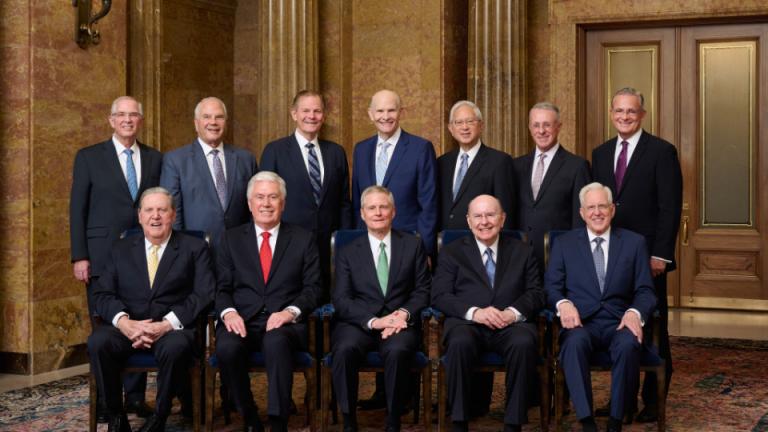
The Quorum of the Twelve Apostles on February 6, 2024. Front row, left to right: President Jeffrey R. Holland, Elder Dieter F. Uchtdorf, Elder David A. Bednar, Elder Quentin L. Cook, and Elder D. Todd Christofferson. Back row, left to right: Elder Neil L. Andersen, Elder Ronald A. Rasband, Elder Gary E. Stevenson, Elder Dale G. Renlund, Elder Gerrit W. Gong, Elder Ulisses Soares, and Elder Patrick Kearon. (Fair Use, I hope.)
I expect that I am not the only person today who was impressed by the powerful and remarkable testimony of President Jeffrey R. Holland. I’m so very grateful that he is still with us.
There was also a passage in President Henry B. Eyring’s remarks in the morning session that really hit me. I’ll have something more to say about it later.
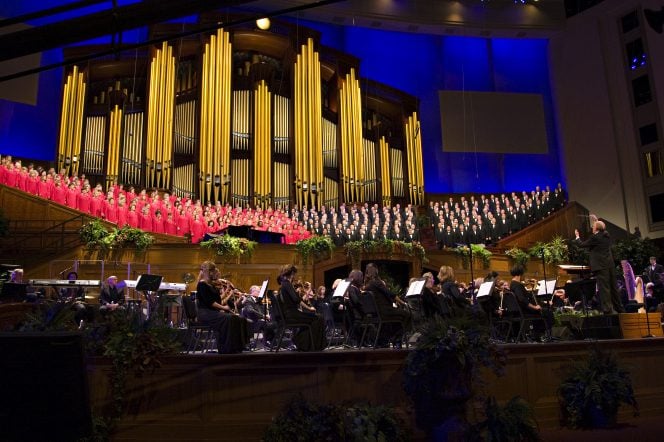
The Tabernacle Choir and the Orchestra at Temple Square, seated at the base of the Conference Center organ in Salt Lake City, Utah. (LDS.org)
Some like to complain about what they see (or claim to see) as the shallowness of the speeches given at General Conference and, indeed, of the Church itself and its teachings. The complaint has never made much sense to me; I find more than enough in every session of Conference to challenge me. Nevertheless, with that complaint in mind I want to revisit something that I posted here about six years ago:
Quite a while back now, I was surprised and saddened by a gratuitous insult to my faith in Thomas Cahill’s otherwise interesting book How the Irish Saved Civilization. While discussing the ancient Iranian-born religion of Manichaeism, now long gone but once (for a few centuries) a serious rival to Christianity, Cahill suddenly, out of the blue, compared it to “Mormonism” and to the doctrine of Jehovah’s Witnesses. All are, he said, shallow and superficial faiths, “full of assertions . . . but yield[ing] no intellectual system to nourish a great intellect.”
I thought this remarkably unfair. While Jehovah’s Witnesses have been noted over many decades for their disdain for higher education, the Church of Jesus Christ of Latter-day Saints has, to put it mildly, not been so known. Indeed, as far back, at least, as Kenneth R. Hardy’s “Social Origins of American Scientists and Scholars,” Science 185 (9 August 1974): 497-506, it’s been recognized that Latter-day Saints are disproportionately represented in scholarship and the sciences. (See also this article, by sociologists Stan Albrecht and Tim Heaton.) There exists, so far as I’m aware, no Jehovah’s Witness analogue to, say, the Association for Mormon Letters, the Association of Mormon Counselors and Psychotherapists, the Mormon History Association, the Academy for Temple Studies, Mormon Scholars in the Humanities, the Mormon Social Science Association, the Society for Mormon Philosophy and Theology, The Interpreter Foundation, nor even, for that matter, to Brigham Young University (in its three campuses at Provo, Rexburg, and Laie) or Ensign College or Southern Virginia University or the multitude of schools, seminaries, and Institutes of Religion that are sponsored by the Church.
Inspired by Elder M. Russell Ballard’s 2007 call to use the Internet more effectively to spread the Gospel, I had already been intending to someday seriously think about perhaps getting around to eventually maybe launching something like Latter-day Saint Scholars Testify. It was, though, Thomas Cahill’s unexpected slur that finally impelled me to act. (And perhaps that reflects poorly on me: Irritation motivated me where apostolic admonition had not.)
I would, of course, agree with Mr. Cahill that the Restoration hasn’t yet produced its equivalent of St. Thomas Aquinas’s Summa Theologica. However, mainstream Christianity took twelve centuries to produce St. Thomas — he died in March 1274; it’s not coincidental, by the way, that one of my sons, born on the anniversary of his death, bears his name — and the Restored Church, not yet two centuries old, doesn’t seem to me to be doing dramatically worse on the intellectual front than the early Christians were at roughly AD 218.
I’m fond of several aphorisms from the eighteenth-century German physicist and satirist Georg Christoph Lichtenberg. Two of them remind me of the reactions of certain critics to the Book of Mormon: “A book is a mirror: if an ape looks into it an apostle is hardly likely to look out.” (Ein Buch ist Spiegel, aus dem kein Apostel herausgucken kann, wenn ein Affe hineinguckt.) “When a book and a head collide and a hollow sound is heard, must it always have come from the book?” (Wenn ein Buch und ein Kopf zusammenstoßen und es klingt hohl, ist das allemal im Buch?) But it seems to me that precisely the same things can validly be said about the reaction of certain critics to the Restoration as a whole.
Moreover, for various reasons, I’m not convinced that the Church should generate its own Summa Theologica. And St. Thomas himself might agree with me on that. The famous story is told of some sort of revelation given to him on 6 December 1273, roughly four months prior to his death, during his celebration of a mass in the Dominican monastery at Naples. Although his works are voluminous, St. Thomas never wrote another line thereafter. He dictated nothing more to his socius, Reginald of Piperno. When Reginald begged him to continue with his work, Thomas replied “Reginald, I cannot, because all that I have written seems like straw to me [mihi videtur ut palea].”
Failure to produce a Summa is not, in my judgment, tantamount to shallow superficiality. There is, I’m convinced, great depth in the Gospel — whether or not we Latter-day Saints have done enough thus far to explore that depth.
But the Church and the Gospel aren’t intended solely or even primarily for Thomist philosophers or Hegelians. Our services and Sunday school classes aren’t academic seminars in historiography or systematic theology. Like every other broad demographic group, the Saints are mostly people who don’t spend hours each day worrying about ontology, epistemology, counterfactual conditionals, or Angst in the works of Sartre. And the saving message of the Gospel is for them, every bit as much as it is for intellectuals and artistes.
I’m convinced that people will find depth in the Restored Gospel commensurate with their own, if they put the requisite thought and effort into studying and reflecting on it. But, just as the exclamation “Fire!” doesn’t have to be philosophically deep in order to bear life-saving meaning, so too the theological depths of the Gospel don’t have to be fully charted before it can lead us to life-saving repentance. It would be a fool, and very likely soon a dead one, who refused to budge while the flames drew nearer simply because the person who had warned him to flee had shown insufficient intellectual or literary sophistication while doing it.
A well-known story is told about the prominent Swiss thinker Karl Barth (d. 1968; author of, among other important things, the massive and famous thirteen-volume Church Dogmatics), who is generally considered the greatest Protestant theologian of the twentieth century: After a lecture at the University of Chicago’s Rockefeller Chapel — or, perhaps, at Union Theological Seminary in Richmond, Virginia, or perhaps in both places (see here) — a student supposedly rose during the question-and-answer period to ask Barth whether his entire life’s work could be summarized in a single sentence. Yes indeed, Barth is said to have responded. “In the words of a song I learned at my mother’s knee: ‘Jesus loves me, this I know, for the Bible tells me so.'”
Simple, yes. But, if true, profound. Profoundly important. And very richly meaningful.
“Es ärgert den Menschen,” the illustrious German poet and philosopher Johann Wolfgang von Goethe once wrote, “daß die Wahrheit so einfach ist.” “It irritates people that the truth is so simple.” We must learn not to look beyond the mark.
Travel and Religion
History and Religion
How the Irish Saved Civilization
Previous Post
April 5, 2024
Apostleship and Stewardship
Next Post
April 7, 2024 Initial thoughts at the end of Conference
Recent Comments
"Funny you mention Sir Thomas More. I was just thinking of his speech from Shakespeare's ..."
"Thanks! I'll copy this and use it as a note when doing AI information searches."
"Another problem is recursive contamination, where AI uses previous AI generated content (correct or incorrect) ..."
"the Problem "one of the concerns that I am seeing"That is deeply concerning. AI needs ..."
Browse Our Archives
Select a Category Uncategorized
Select a Month November 2026 October 2026 September 2026 August 2026 July 2026 June 2026 May 2026 April 2026 March 2026 February 2026 January 2026 December 2025 November 2025 October 2025 September 2025 August 2025 July 2025 June 2025 May 2025 April 2025 March 2025 February 2025 January 2025 December 2024 November 2024 October 2024 September 2024 August 2024 July 2024 June 2024 May 2024 April 2024 March 2024 February 2024 January 2024 December 2023 November 2023 October 2023 September 2023 August 2023 July 2023 June 2023 May 2023 April 2023 March 2023 February 2023 January 2023 December 2022 November 2022 October 2022 September 2022 August 2022 July 2022 June 2022 May 2022 April 2022 March 2022 February 2022 January 2022 December 2021 November 2021 October 2021 September 2021 August 2021 July 2021 June 2021 May 2021 April 2021 March 2021 February 2021 January 2021 December 2020 November 2020 October 2020 September 2020 August 2020 July 2020 June 2020 May 2020 April 2020 March 2020 February 2020 January 2020 December 2019 November 2019 October 2019 September 2019 August 2019 July 2019 June 2019 May 2019 April 2019 March 2019 February 2019 January 2019 December 2018 November 2018 October 2018 September 2018 August 2018 July 2018 June 2018 May 2018 April 2018 March 2018 February 2018 January 2018 December 2017 November 2017 October 2017 September 2017 August 2017 July 2017 June 2017 May 2017 April 2017 March 2017 February 2017 January 2017 December 2016 November 2016 October 2016 September 2016 August 2016 July 2016 June 2016 May 2016 April 2016 March 2016 February 2016 January 2016 December 2015 November 2015 October 2015 September 2015 August 2015 July 2015 June 2015 May 2015 April 2015 March 2015 February 2015 January 2015 December 2014 November 2014 March 2014 August 2013 February 2012
Follow Us!
TAKE THE
Religious Wisdom Quiz
Who built an ark for the animals?
Select your answer to see how you score.
David Solomon Noah Hezekiah
Related posts from Sic et Non
We shouldn't act as if WE'RE in the...

This coming Sunday in Santa Barbara
More on the 1978 Priesthood Revelation
TRENDING AT PATHEOS Latter-day Saint

The resilience of the Christian faith in the english speaking world of...

An Advent Calendar, and a Tree full of...
I've spent the weekend deeply invested in internet drama about a $150...

How to Have Financial Transparency in Marriage
Despite the fact that financial issues and money problems are the number...
The Healing Power of Forgiveness in Marriage
Learning how to give and accept apologies are essential ingredients of a...

The West's Christian Moral Inheritance: A Legacy Denied
Whether we like it or not, our environment matters, shaping us both...

How Does Tôḏâ Connect Florida & Thanksgiving?
The big news this weekend has been about the continued flooding on...
view all Latter-day Saint blogs
What Are Your Thoughts?leave a comment
Ad-Free & Subscriber Log-In Subscription Support
- About Us
- 2026 Calendar
- Videos
- Podcasts
- Library of World Religions
- Faith In Media Tracker
- Advertise With Us
- Write for Us
- Privacy Policy
- Terms of Service
- Do Not Sell My Data
- Contact Us
- Radiant Digital
- Manage Newsletter Subscriptions
- Unsubscribe From Notifications
- Sitemap
Copyright 2008-2026, Patheos. All rights reserved.
Subscription Support Ad-Free & Subscriber Log-In
Follow Patheos