
BuddhistCatholicContemplativeEvangelicalGeneral ChristianHinduJewishLatter-day SaintMuslimNew VisionsProgressive Christian
Beliefs
- Buddhist
- Catholic
- Contemplative
- Evangelical
- General Christian
- Hindu
- Jewish
- Latter-day Saint
- More Voices
- Muslim
- New Visions
- Pagan
- Progressive Christian
Topics
- Religion News
- Food and Religion
- Sports and Religion
- Religious Art
- Religious Music and Entertainment
- Religious Events
- History and Religion
- Style and Religion
- Politics and Religion
- Women in Religion
- Recreation Outdoors and Religion
- Business Finance and Religion
- Careers Workplace and Religion
- Education and Religion
- Family Parenting and Religion
- Health Fitness and Religion
- Home and Religion
- Relationships and Religion
- Technology and Religion
- Travel and Religion
Columnists
- Buddhist Columnists
- Business Finance and Religion Columnists
- Careers Workplace and Religion Columnists
- Catholic Columnists
- Contemplative Columnists
- Education and Religion Columnists
- Evangelists Columnists
- Family Parenting and Religion Columnists
- General Christian Columnists
- Health Fitness and Religion Columnists
- Hindu Columnists
- History and Religion Columnists
- Home and Religion Columnists
- Jewish Columnists
- More Voices Columnists
- Latter Day Columnists
- Muslim Columnists
- New Visions Columnists
- Nonreligious Columnists
- Pagan Columnists
- Politics and Religion Columnists
- Progressive Columnists
- Recreation Outdoors and Religion Columnists
- Relationships and Religion Columnists
- Religion News Columnists
- Religious Art Columnists
- Religious Events Columnists
- Religious Music and Entertainment Columnists
- Sports and Religion Columnists
- Style and Religion Columnists
- Technology and Religion Columnists
- Travel and Religion Columnists
- Women in Religion Columnists
Resource Library
- 2026 Calendar
- Library of World Religions
- The 100 Most Holy Places on Earth
- Patheos Answers
- Podcasts
- Videos
- Faith Leaders Database
- Anglican Episcopalian
- Bahai
- Baptist
- Buddhism
- Christianity
- Confucianism
- Eastern Orthodoxy
- Hinduism
- Holiness and Pentecostal
- ISKCON
- Islam
- Judaism
- Lutheran
- Methodist
- The Church of Jesus Christ of Latter-day Saints
- New Age
- Paganism
- Presbytarian and Reformed
- Protestantism
- Religion Behind the Scenes
- Roman Catholic
- Scientology
- Shia Islam
- Sikhism
- Sufism
- Sunni Islam
- Taoism
- Zen
- See all religions
Research Tools
 Ad-Free & Subscriber Log-In Subscription Support
Follow Patheos 

- Trending:
- Advent
- |
- Forgiveness
- |
- Thanksgiving
- |
- Election
- |
- Seasonal Holidays
- |
- Marriage

- Home
- Latter-day Saint
- Travel and Religion
- More on race and slavery among the early Utah pioneers
More on race and slavery among the early Utah pioneers
Last updated on: April 10, 2024 at 1:16 pm by Dan Peterson
More on race and slavery among the early Utah pioneers 2024-04-10T13:16:49-06:00 Dan Peterson
Patheos Explore the world's faith through different perspectives on religion and spirituality! Patheos has the views of the prevalent religions and spiritualities of the world.
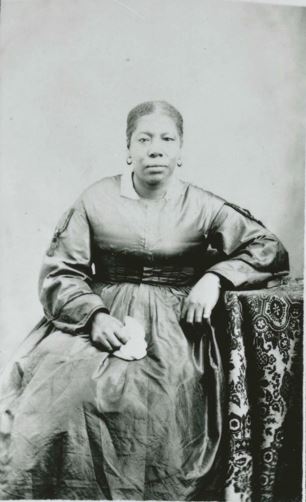
Jane Manning James, early Latter-day Saint pioneer (Wikimedia Commons public domain photograph)
I want to share a few more passages that I marked during my recent reading of Amy Tanner Thiriot, Slavery in Zion: A Documentary and Genealogical History of Black Lives and Black Servitude in Utah Territory, 1847-1862 (Salt Lake City: University of Utah Press, 2022).
It seems that the Saints in Utah were, by and large, unsympathetic to slavery
The presence of the enslaved in the Latter-day Saint settlements had caused discussion and dissent, but only fragments of the settlers’ reactions remain in the historical record. (87)
Frances [sic] and Margaret Lockhart McKown left for Utah Territory with two enslaved people, but Margaret died on the way, and after Francis discovered the extent of antislavery sentiment in the territory, he returned to Mississippi. (59)
[W]ithin a few years, most Mississippi enslavers left for California or returned to the South. (61)
They [the extended Greer family, from Texas] planned to take the four enslaved members of the Camp household with them, but one of them, Daniel, did not want to return to slavery in the South. He ran away, and an ad hoc slave patrol hunted him down. Among those who were shocked at this evidence of Southern slavery was Bishop Edwin D. Woolley, a former Quaker from Pennsylvania. He had the four Southerners arrested and charged with kidnapping. The judge eventually threw out the case for lack of evidence, but Daniel remained in Utah. (26)
In 1859, Horace Greeley, the famous editor of the New York Daily Tribune, visited Utah Territory and interviewed Brigham Young. In the course of the interview, Greeley asked whether Utah planned to be a slave state. “No,” Brigham replied, “she will be a Free State.” He proceeded to explain that “Slavery here would prove useless and unprofitable. I regard it generally as a curse to the masters. . . . Utah is not adapted to Slave Labor.” (26)
It may or may not be relevant to note that some of the enslavers – notably Thomas S. Williams – “change[d] from devout Latter-day Saints to outspoken opponents of Brigham Young’s control over the economics and politics of Utah Territory.” (89)
And there are other indicators of attitudes toward Blacks and toward slavery on the part of Latter-day Saint leaders and future leaders:
Scottish immigrant and later Presiding Bishop of the Church of Jesus Christ of Latter-day Saints Charles W. Nibley worked for Bankhead after he arrived in America. He recalled that his employers were the wealthiest in the area. “Among other property, they owned two men negroes, Nate and Sam.” He explained, “It seems like harking a long way back to the days of slavery, but negro slavery was actually the law of the land and practiced to a small extent in 1860 and 1861 and 1862 in Cache Valley.” Nibley continued, “I felt quite elated when I could sleep with big Nate, the big black negro that Bankhead owned. Old Sam used to ask me if I had read any news of ‘de wah,’ and I can remember very well him saying at one time, ‘My God, I hope de Souf get licked.’” He concluded, “Only once did I see the old man Bankhead get angry at his slaves, and at that time he tore around pretty lively and threatened to horsewhip them to death if they didn’t mend their ways.” A violent threat almost too ordinary to be mentioned in Southern memoirs was still memorable to Nibley seventy years later. (94)
In 1855, Latter-day Saint apostle Orson Hyde traveled to Carson Valley as its probate court judge. His first criminal case was that of a Black man named only as Thacker, who had threatened to cut out and roast the heart of Sophronia Allen Rose. Fearing that the community would lynch Thacker, Hyde arrested him, fined him court costs, and suggested that for his own protection, he should join his unnamed enslaver in California. “Thacker” may be Robert Thacker (1832-) of Tennessee, who worked five years later as a waiter in Marysville, California.
Although Latter-day Saints were the first to build towns in the area, the 1860 census shows a predominantly non-Latter-day Saint mining population. . . . The census does not specify legal status, and none of the Black or interracial families appear to be connected to the Latter-day Saint settlers. (331)
But let’s look at the one significant law passed by the territorial legislature of “Deseret” with regard to the regulation of slavery within its jurisdiction. It reveals both what we would regard as Brigham Young’s problematic though paternalistic racism (and Orson Pratt’s “impassioned” opposition to slavery) and a seeming intent of mitigating or even gradually ending slavery within its jurisdiction:
Utah Territory . . . instituted a curious legal hodgepodge called An Act in Relation to Service (1852), identified by legal scholar Christopher B. Rich Jr. as patterned on the gradual emancipation laws of the Northeast or Midwest, rather than the slave codes of the South. The Act attempted to treat slavery as contracted labor and provided unusual legal protections, including a requirement that labor could only be sold with the consent of the “servant.” (12; compare 16)
In 1852, in the wake of unrest involving the Indigenous and Mexican slave trade, the territorial legislature crafted legislation and held a debate over African American slavery. Despite impassioned opposition from Latter-day Saint apostle Orson Pratt, Brigham Young supported legislation allowing Black servitude. In a speech to the legislature, he identified the origins of slavery and race in the Bible. He said that those of African descent were created for service, but if slavery was practiced, it should be practiced humanely, since Southern slavery abused principles set forth in scripture. With Young’s support, the territorial legislature codified and regulated African American sales and servitude. Young’s explanations to the legislature and in other settings not only ensured the passage of the Act but also began a practice that prevented most Black members of the Church of Jesus Christ of Latter-day Saints from holding the lay priesthood or participating in temple rites for more than a century.
An Act in Relation to Service attempted to shift chattel slavery into a system of contracted labor. It decreed that those who took “servants justly bound to them, arising from special contract or otherwise,” into the territory “shall be entitled to such service or labor by the laws of the Territory.” Those taking “servants” into the territory must register “written and satisfactory evidence [in the probate court] that such service or labor is due.” The Act limited the term of service for “servants” and their children to the time required to fulfill “the debt due his, her, or their master or masters.” It forbade sexual intercourse between the enslaver / and enslaved or indentured of African descent, or any “white person” and “any of the African race.” Although an Act in Relation to Service prohibited sexual relations between Black and White and enslavers and enslaved, it did not specifically prohibit interracial marriage. Those with “servants” must “correct and punish . . . when it may be necessary” and must provide for those in their service, including food, clothing, recreation, and at least eighteen months of education between the ages of six and twenty years. (18-19)
The law forbade enslavers from sexual abuse or rape. Enslavers had to provide the enslaved with “reasonable hours” of work, along with “comfortable habitations, clothing, bedding, sufficient food, and recreation” and refrain from cruelty or physical abuse. Enslavers were obliged to provide eighteen months of school prior to the twentieth birthday. Any punishment should be “reasonable” and “guided by prudence and humanity.” If not, a probate judge could remove an enslaved person from a household (90).
Another way of looking at the Act is that it attempted to move some distance toward reducing the distance between slavery, on the one hand, and, on the other, indentured servitude and apprenticeship — which we today would probably also regard as oppressive and tyrannical. Moreover,
Perhaps by design, An Act in Relation to Service gave Brigham Young the ability to emancipate Green Flake and others left in the valley when their enslavers went to California in 1851. (19; compare 112, 113-114)
There are indicators, too, of Brigham Young’s concern about the status of unmarried enslaved people in the Salt Lake Valley (83).
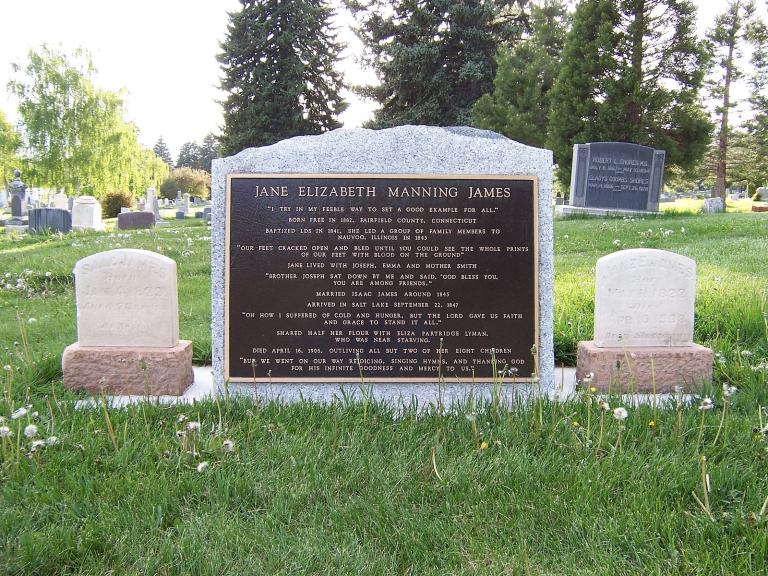
Jane Manning James grave marker
(Photo by Ryan Reeder at the English language Wikipedia)
In this context, I think it worthwhile to revisit something about which I posted here nearly three years ago:
In his important book Religion of a Different Color, Paul Reeve recounts an interesting episode involving Brigham Young:
An early mixed-race (Black and American Indian) member of the Church named William McCary — a rather marginal, somewhat erratic, and even unbalanced fellow, as it turned out, who ultimately and lamentably didn’t remain in the Church — had encountered racial prejudice among some Church members.
In response to this, President Young counseled the Saints to “use the man with respect.” (The verb to use is employed here in a somewhat archaic sense common in Shakespeare. See below. In today’s English, we would use the verb to treat.)
But some problems persisted. And Brother McCary continued to complain.
Was he in some way sub- or even non-human?
“Its nothing to do with the blood,” replied President Young, “for of one blood has God made all flesh.”
Professor Reeve comments on this exchange:
It was an echo of the same New Testament verse (Acts 17:26) that [Joseph] Smith quoted in his presidential platform three years earlier. Both drew upon the Bible to assert a broad commonality among humankind and were simultaneously acknowledging a wider racial debate then animating the scientific and Christian communities. In paraphrasing Acts 17:26, Young and Smith were referencing an important verse then commonly cited among nineteenth-century Christians. Believers used the verse to defend against a polygenesis theory then stirring scientific arguments about the origins of the various races. Scientists who promoted the polygenesis theory believed that there were multiple independent creations rather than just a single biblical creation. Each creation gave rise to a new race, which meant that whites and blacks were in fact from different species. Even though the two species could biologically reproduce, one argument was that an innate repugnance against interracial mixing was intended to preserve ‘species distinction.’ Those who violated the innate repugnance were really violating nature, which was a sure sign of their moral degradation. Physical degeneracy followed and within a few generations the offspring of such unions would be sterile.
[See W. Paul Reeve, Religion of a Different Color: Race and the Mormon Struggle for Whiteness (New York and Oxford: Oxford University Press, 2015), 128-131.]
It’s become fashionable in recent years to demonize Brigham Young as a racist, even a vicious one — and, in some cases, essentially to forget that there was anything else to the man.
I resist this.
He wasn’t perfect, of course. Nor has any subsequent apostle or president of the Church been perfect. Nor am I. Nor are his critics.
“Use every man after his desert,” wrote Shakespeare (in Hamlet II.ii), “and who should ‘scape whipping?” Or, to paraphrase: Treat everybody purely according to his or her merits, and who wouldn’t be worthy of censure or even punishment?
In racial matters, Brigham Young said some things that jar us today, and that we cannot endorse. There’s no denying this. He was, as we all are — even the prophets among us — a man of his time and culture and background.
But he was a good man, a remarkable man, indeed a great man, a sincere disciple of the Lord and a prophet who sought to do God’s will.
I choose to stand with him. “The soul that on Jesus hath leaned for repose I will not, I cannot, desert to his foes.” And, on the specific racial issue described above, President Brigham Young was — notwithstanding the dismissive stereotype of him that’s currently in vogue — on the side of the angels.
Travel and Religion
History and Religion
Previous Post

April 9, 2024
Coincidence? Lies? What?
Next Post
April 11, 2024 The Sacrifice of Adam and Eve
Recent Comments
"A notion shared across the Islamic world"
Islam soon to be the world’s ..."
"Why would I be excluded from this"
Islam soon to be the world’s ..."
"From MS copilot:“Countries that have clearly designated the Muslim Brotherhood itself as a terrorist organization, ..."
"I meant every word of it. You have a lovely day, now."
Joseph Smith on the Religious Freedom ..."
Browse Our Archives
Select a Category Uncategorized
Select a Month November 2026 October 2026 September 2026 August 2026 July 2026 June 2026 May 2026 April 2026 March 2026 February 2026 January 2026 December 2025 November 2025 October 2025 September 2025 August 2025 July 2025 June 2025 May 2025 April 2025 March 2025 February 2025 January 2025 December 2024 November 2024 October 2024 September 2024 August 2024 July 2024 June 2024 May 2024 April 2024 March 2024 February 2024 January 2024 December 2023 November 2023 October 2023 September 2023 August 2023 July 2023 June 2023 May 2023 April 2023 March 2023 February 2023 January 2023 December 2022 November 2022 October 2022 September 2022 August 2022 July 2022 June 2022 May 2022 April 2022 March 2022 February 2022 January 2022 December 2021 November 2021 October 2021 September 2021 August 2021 July 2021 June 2021 May 2021 April 2021 March 2021 February 2021 January 2021 December 2020 November 2020 October 2020 September 2020 August 2020 July 2020 June 2020 May 2020 April 2020 March 2020 February 2020 January 2020 December 2019 November 2019 October 2019 September 2019 August 2019 July 2019 June 2019 May 2019 April 2019 March 2019 February 2019 January 2019 December 2018 November 2018 October 2018 September 2018 August 2018 July 2018 June 2018 May 2018 April 2018 March 2018 February 2018 January 2018 December 2017 November 2017 October 2017 September 2017 August 2017 July 2017 June 2017 May 2017 April 2017 March 2017 February 2017 January 2017 December 2016 November 2016 October 2016 September 2016 August 2016 July 2016 June 2016 May 2016 April 2016 March 2016 February 2016 January 2016 December 2015 November 2015 October 2015 September 2015 August 2015 July 2015 June 2015 May 2015 April 2015 March 2015 February 2015 January 2015 December 2014 November 2014 March 2014 August 2013 February 2012
Follow Us!
TAKE THE
Religious Wisdom Quiz
Who was the slave who became a Christian and whose master was Philemon?
Select your answer to see how you score.
Sosthenes Barnabas Onesimus Tychicus
Related posts from Sic et Non

"Utah saw the biggest shift toward Democrats in...

“It was the spring of hope, it was...

TRENDING AT PATHEOS Latter-day Saint

Adventurous Lectionary -1st. Sunday of Advent - November...
The Adventurous Lectionary - The First Sunday of Advent – November 29,...

Will Islam become the world's biggest religion by 2035? Congo will replace...

The resilience of the Christian faith in the english speaking world of...

An Advent Calendar, and a Tree full of...
I've spent the weekend deeply invested in internet drama about a $150...

How to Have Financial Transparency in Marriage
Despite the fact that financial issues and money problems are the number...
The Healing Power of Forgiveness in Marriage
Learning how to give and accept apologies are essential ingredients of a...
view all Latter-day Saint blogs
What Are Your Thoughts?leave a comment
Ad-Free & Subscriber Log-In Subscription Support
- About Us
- 2026 Calendar
- Videos
- Podcasts
- Library of World Religions
- Faith In Media Tracker
- Advertise With Us
- Write for Us
- Privacy Policy
- Terms of Service
- Do Not Sell My Data
- Contact Us
- Radiant Digital
- Manage Newsletter Subscriptions
- Unsubscribe From Notifications
- Sitemap
Copyright 2008-2026, Patheos. All rights reserved.
Subscription Support Ad-Free & Subscriber Log-In
Follow Patheos