
BuddhistCatholicContemplativeEvangelicalGeneral ChristianHinduJewishLatter-day SaintMuslimNew VisionsProgressive Christian
Beliefs
- Buddhist
- Catholic
- Contemplative
- Evangelical
- General Christian
- Hindu
- Jewish
- Latter-day Saint
- More Voices
- Muslim
- New Visions
- Pagan
- Progressive Christian
Topics
- Religion News
- Food and Religion
- Sports and Religion
- Religious Art
- Religious Music and Entertainment
- Religious Events
- History and Religion
- Style and Religion
- Politics and Religion
- Women in Religion
- Recreation Outdoors and Religion
- Business Finance and Religion
- Careers Workplace and Religion
- Education and Religion
- Family Parenting and Religion
- Health Fitness and Religion
- Home and Religion
- Relationships and Religion
- Technology and Religion
- Travel and Religion
Columnists
- Buddhist Columnists
- Business Finance and Religion Columnists
- Careers Workplace and Religion Columnists
- Catholic Columnists
- Contemplative Columnists
- Education and Religion Columnists
- Evangelists Columnists
- Family Parenting and Religion Columnists
- General Christian Columnists
- Health Fitness and Religion Columnists
- Hindu Columnists
- History and Religion Columnists
- Home and Religion Columnists
- Jewish Columnists
- More Voices Columnists
- Latter Day Columnists
- Muslim Columnists
- New Visions Columnists
- Nonreligious Columnists
- Pagan Columnists
- Politics and Religion Columnists
- Progressive Columnists
- Recreation Outdoors and Religion Columnists
- Relationships and Religion Columnists
- Religion News Columnists
- Religious Art Columnists
- Religious Events Columnists
- Religious Music and Entertainment Columnists
- Sports and Religion Columnists
- Style and Religion Columnists
- Technology and Religion Columnists
- Travel and Religion Columnists
- Women in Religion Columnists
Resource Library
- 2026 Calendar
- Library of World Religions
- The 100 Most Holy Places on Earth
- Patheos Answers
- Podcasts
- Videos
- Faith Leaders Database
- Anglican Episcopalian
- Bahai
- Baptist
- Buddhism
- Christianity
- Confucianism
- Eastern Orthodoxy
- Hinduism
- Holiness and Pentecostal
- ISKCON
- Islam
- Judaism
- Lutheran
- Methodist
- The Church of Jesus Christ of Latter-day Saints
- New Age
- Paganism
- Presbytarian and Reformed
- Protestantism
- Religion Behind the Scenes
- Roman Catholic
- Scientology
- Shia Islam
- Sikhism
- Sufism
- Sunni Islam
- Taoism
- Zen
- See all religions
Research Tools
 Ad-Free & Subscriber Log-In Subscription Support
Ad-Free & Subscriber Log-In Subscription Support
Follow Patheos 

- Trending:
- Forgiveness
- |
- Marriage
- |
- Consciousness
- |
- Death Penalty
- |
- Election
- |
- Halloween

- Home
- Latter-day Saint
- Travel and Religion
- Coincidence? Lies? What?
Coincidence? Lies? What?
Last updated on: April 9, 2024 at 6:57 pm by Dan Peterson
Coincidence? Lies? What? 2024-04-09T18:57:05-06:00 Dan Peterson
Patheos Explore the world's faith through different perspectives on religion and spirituality! Patheos has the views of the prevalent religions and spiritualities of the world.
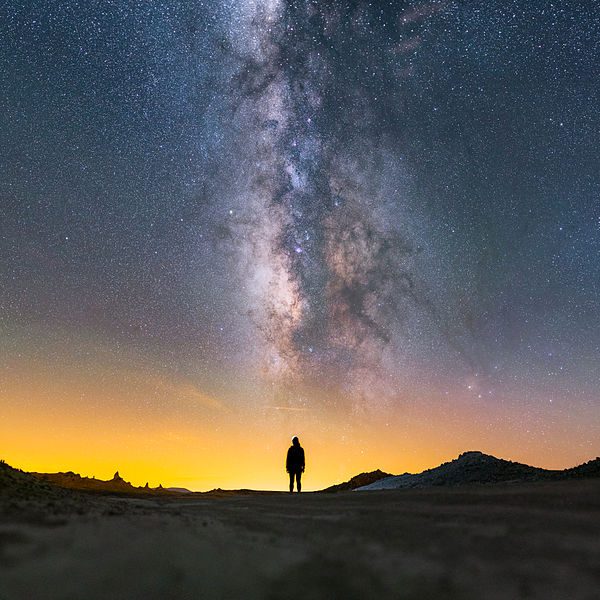
A not-strictly-relevant but somehow appropriate image of the Milky Way above California’s Mojave Desert. (Wikimedia Commons public domain image)
Some while ago, I read William J. Peters, At Heaven’s Door: What Shared Journeys to the Afterlife Teach About Dying Well and Living Better (New York and London: Simon and Schuster, 2022), written with Michael Kinsella. A practicing grief and bereavement therapist, William Peters holds degrees from Harvard’s Graduate School of Education and the University of California at Berkeley. He is the founder of the Shared Crossing Project and director of its Research Initiative. Michael Kinsella earned a Ph.D. in religious studies from the University of California at Santa Barbara, where he remains affiliated as a researcher with that university’s Religion, Experience, and Mind Group.
I want to share a couple of passages from the book with you. Here’s the first:
Jackie is in her forties and works with special needs students in the province of British Columbia, Canada. “I was having a regular night,” she recalls. “About one or two a.m., I felt this sharp, horrible pain in my chest. I was feeling it all in my arms. They were tingling. It was really horrible, and I didn’t know what was going on. I phoned my girlfriend and I told her that I didn’t know if I was having a heart attack or a panic attack. I said, ‘I’m terrified, so please just stay on the phone with me, and if something happens, phone the ambulance.’ She was trying to calm me down, and I felt like the room was spinning. I felt a serious sense of doom, like something bad was happening.”
In the midst of this, Jackie began to see the eyes of the man whom she considered her lifelong best friend — “Luke would come to my house almost daily, I’d feed him dinner. I loved him, but he was kind of a womanizer. My dad was a big womanizer, and I didn’t want to follow in my mother’s footsteps, so I told him I loved him, but I couldn’t be with him.”
Now, in this moment in the middle of the night, Jackie saw his blue eyes. She remembers they were “kind of glossy and dead. I didn’t know what this was about,” she adds. “I thought I was dying, so I was like, ‘What does this have to do with him?” The episode passed, but “the image of Luke’s dead eyes kept coming into my head. It was almost like I was seeing him.” At 8 a.m., she received a call that Luke had died. “The worst part was, I wasn’t surprised. Most people would be in denial that their best friend died, and I felt so horrible because part of me knew that he died.” When she pieced the story together, she realized that “the time that I thought I was having a heart attack was approximately the time that he OD’d on fentanyl.” (115-116)
The second involves Julie, her daughter Sophie, and Julie’s remarried ex-husband, with whom she had been out of contact for roughly a decade. (Julie, too, had remarried.). Julie describes herself as “a skeptic by nature. I don’t believe in ghosts. I’ve never had a ‘psychic’ experience. As a nurse, I have seen patients die and have comforted families, but I had never heard of a shared death experience, much less had one” (152).
The ex-husband had entered into the very early stages of dementia. Daughter Sophie came to visit Julie, with whom she left her own two daughters, and then headed off to spend some time with her father in the nursing facility where he was staying. Julie and her granddaughters decided to go out to a movie:
About halfway through the movie, Julie had what she describes as “a distracting impression” and felt a sensation that, “Something’s happening. His condition is changing. He’s going.
I pushed the thought away as imagination, but it stayed and was hard to ignore, like when my dog stares at me silently with his big eyes. I was being asked to do something, and in my spirit, I hesitated, but then said yes.” What happened next was transformative. Julie explains, “I closed my my eyes and time and space changed. I was with him in this new space. The movie screen and sounds completely were gone.”
Julie describes seeing her ex-husband “wrapped like a mummy, with only his head uncovered. His features were not clear, like an image in an old mirror and with a sepia filter. The outer layers of fabric around his form were loose and flowing, a linen-like material but more flowy. It had no end; the fabric just merged into the dark background space around him.
“He was moving upward to the light above his head. I looked at it.” She recalls seeing “a beautiful, diffuse light that was more than light. It was a place, a space, an energy. It was freedom and release and forgiveness and acceptance.” She felt that “I was glimpsing eternity.”
In that moment, Julie heard him “saying, ‘I have to go. I can’t hang on,’ not in voice or words,” she adds, but instead expressed “clearly and to me. More clear than voice or words, it was a knowing. Then I understood I was there to help him pass. He had to go, and somehow I was part of it. I sent my energy to help propel his spirit upward. To pass. I told him, ‘It’s good, yes, go. Go in peace.'”
Julie says, “It was the most profound, indescribable, and most peaceful feeling I have ever, ever experienced. Then, it was over. Julie’s attention returned to the movie and the smell of popcorn. She recalls thinking, “Did this just happen? Have I imagined it all?” Her next thoughts were, “No one would believe me, and I wasn’t sure I believed it.”
“I needed to know the time. I reached inside my purse for my phone. It was 1:32
“I decided to text my daughter.” Julie thought about asking if “your dad just died,” but instead she wrote, Weird feeling. Sophie responded immediately, I think he just died.
“I know, I texted back. I felt it.” In that moment, Julie says, “I realized how hard this was going to be to tell anyone. It transcended words.” She adds, “I was humbled that somehow I was chosen or allowed to witness his passing.”
Later, Sophie told her mom that in her father’s last moments, “He opened his eyes just before he died, and his lips moved.” To which, Julie says, “I thought, ‘Yes, I know,'” adding, “To glimpse eternity as a mere mortal, the whole thing brought me to my spiritual knees.” Julie says that this experience has left her “less skeptical and not afraid of death.” And she hopes her story helps others and “gives comfort.” (153-154)
Now, I understand that my sharing these two accounts is absolutely guaranteed to elicit charges of “pseudo-science” from some of my critics.
But these are just two of many in the book, and they are of a type that has been extensively documented since at least the past century and a half, and to which parallel accounts exist back into antiquity. Incidentally, nothing in my own personal worldview demands that they be accepted at face value — although such acceptance would probably be easier on my assumptions than on those of a naturalistic materialist. In any case, whether they ultimately represent some sort of mysterious interpersonal communication, or mere coincidence, or hallucination, or attempts at deception extending across centuries, it isn’t clear to me that the properly scientific approach to them would be to pretend that that such accounts simply don’t exist.
Travel and Religion
History and Religion
Previous Post
April 8, 2024
Brigham Young and "Slavery in Zion"
Next Post
April 10, 2024 More on race and slavery among the early Utah pioneers
Recent Comments
"DP: “But Mr. Sutherland worries about the fact that our time, when we can communicate ..."
Learning more about a region of ..."
"Sutherland's lecture sounds interesting. He seems to restate the Washington consensus that trade brings peace ..."
Learning more about a region of ..."
"In a meeting today, I learned another important reason why accurate (or at least as ..."
From Serbia’s “White City,” Belgrade
"I've been watching a lot of video interviews of NDErs and researchers. I think in ..."
Browse Our Archives
Select a Category Uncategorized
Select a Month October 2026 September 2026 August 2026 July 2026 June 2026 May 2026 April 2026 March 2026 February 2026 January 2026 December 2025 November 2025 October 2025 September 2025 August 2025 July 2025 June 2025 May 2025 April 2025 March 2025 February 2025 January 2025 December 2024 November 2024 October 2024 September 2024 August 2024 July 2024 June 2024 May 2024 April 2024 March 2024 February 2024 January 2024 December 2023 November 2023 October 2023 September 2023 August 2023 July 2023 June 2023 May 2023 April 2023 March 2023 February 2023 January 2023 December 2022 November 2022 October 2022 September 2022 August 2022 July 2022 June 2022 May 2022 April 2022 March 2022 February 2022 January 2022 December 2021 November 2021 October 2021 September 2021 August 2021 July 2021 June 2021 May 2021 April 2021 March 2021 February 2021 January 2021 December 2020 November 2020 October 2020 September 2020 August 2020 July 2020 June 2020 May 2020 April 2020 March 2020 February 2020 January 2020 December 2019 November 2019 October 2019 September 2019 August 2019 July 2019 June 2019 May 2019 April 2019 March 2019 February 2019 January 2019 December 2018 November 2018 October 2018 September 2018 August 2018 July 2018 June 2018 May 2018 April 2018 March 2018 February 2018 January 2018 December 2017 November 2017 October 2017 September 2017 August 2017 July 2017 June 2017 May 2017 April 2017 March 2017 February 2017 January 2017 December 2016 November 2016 October 2016 September 2016 August 2016 July 2016 June 2016 May 2016 April 2016 March 2016 February 2016 January 2016 December 2015 November 2015 October 2015 September 2015 August 2015 July 2015 June 2015 May 2015 April 2015 March 2015 February 2015 January 2015 December 2014 November 2014 March 2014 August 2013 February 2012
Follow Us!
TAKE THE
Religious Wisdom Quiz
True or False: Matthew's Gospel begins with a genealogy tracing Jesus' lineage back to King David.
Select your answer to see how you score.
TRUE FALSE
Related posts from Sic et Non



TRENDING AT PATHEOS Latter-day Saint

The Sermon on the Mount, Part I: Matthew...
The Sermon on the Mount, Part I (Matthew 4:12-5:12) St. Matthew moves...

What's up from Crossway: Reviewing some of their latest A few weeks...

Janie Learns the Way of the Cross: A...
Teaching children about Jesus' Passion can be challenging. Many parents and educators...

Looking For Good Catholic Writing - October 2026
He alone extends the heavens, and he walks upon the waves of...

In "Irreplaceable," our book on vocation and technology, Trevor Sutton and I...

I was strolling through the top floor of the brand new Parthenon...
view all Latter-day Saint blogs
What Are Your Thoughts?leave a comment
Ad-Free & Subscriber Log-In Subscription Support
- About Us
- 2026 Calendar
- Videos
- Podcasts
- Library of World Religions
- Faith In Media Tracker
- Advertise With Us
- Write for Us
- Privacy Policy
- Terms of Service
- Do Not Sell My Data
- Contact Us
- Radiant Digital
- Manage Newsletter Subscriptions
- Unsubscribe From Notifications
- Sitemap
Copyright 2008-2026, Patheos. All rights reserved.
Subscription Support Ad-Free & Subscriber Log-In
Follow Patheos