
BuddhistCatholicContemplativeEvangelicalGeneral ChristianHinduJewishLatter-day SaintMuslimNew VisionsProgressive Christian
Beliefs
- Buddhist
- Catholic
- Contemplative
- Evangelical
- General Christian
- Hindu
- Jewish
- Latter-day Saint
- More Voices
- Muslim
- New Visions
- Pagan
- Progressive Christian
Topics
- Religion News
- Food and Religion
- Sports and Religion
- Religious Art
- Religious Music and Entertainment
- Religious Events
- History and Religion
- Style and Religion
- Politics and Religion
- Women in Religion
- Recreation Outdoors and Religion
- Business Finance and Religion
- Careers Workplace and Religion
- Education and Religion
- Family Parenting and Religion
- Health Fitness and Religion
- Home and Religion
- Relationships and Religion
- Technology and Religion
- Travel and Religion
Columnists
- Buddhist Columnists
- Business Finance and Religion Columnists
- Careers Workplace and Religion Columnists
- Catholic Columnists
- Contemplative Columnists
- Education and Religion Columnists
- Evangelists Columnists
- Family Parenting and Religion Columnists
- General Christian Columnists
- Health Fitness and Religion Columnists
- Hindu Columnists
- History and Religion Columnists
- Home and Religion Columnists
- Jewish Columnists
- More Voices Columnists
- Latter Day Columnists
- Muslim Columnists
- New Visions Columnists
- Nonreligious Columnists
- Pagan Columnists
- Politics and Religion Columnists
- Progressive Columnists
- Recreation Outdoors and Religion Columnists
- Relationships and Religion Columnists
- Religion News Columnists
- Religious Art Columnists
- Religious Events Columnists
- Religious Music and Entertainment Columnists
- Sports and Religion Columnists
- Style and Religion Columnists
- Technology and Religion Columnists
- Travel and Religion Columnists
- Women in Religion Columnists
Resource Library
- 2026 Calendar
- Library of World Religions
- The 100 Most Holy Places on Earth
- Patheos Answers
- Podcasts
- Videos
- Faith Leaders Database
- Anglican Episcopalian
- Bahai
- Baptist
- Buddhism
- Christianity
- Confucianism
- Eastern Orthodoxy
- Hinduism
- Holiness and Pentecostal
- ISKCON
- Islam
- Judaism
- Lutheran
- Methodist
- The Church of Jesus Christ of Latter-day Saints
- New Age
- Paganism
- Presbytarian and Reformed
- Protestantism
- Religion Behind the Scenes
- Roman Catholic
- Scientology
- Shia Islam
- Sikhism
- Sufism
- Sunni Islam
- Taoism
- Zen
- See all religions
Research Tools
 Ad-Free & Subscriber Log-In Subscription Support
Ad-Free & Subscriber Log-In Subscription Support
Follow Patheos 

- Trending:
- Forgiveness
- |
- Marriage
- |
- Consciousness
- |
- Death Penalty
- |
- Election
- |
- Halloween

- Home
- Latter-day Saint
- Travel and Religion
- “The Easter Connection”
“The Easter Connection”
Last updated on: March 4, 2024 at 4:38 pm by Dan Peterson
“The Easter Connection” 2024-03-04T16:38:58-07:00 Dan Peterson
Patheos Explore the world's faith through different perspectives on religion and spirituality! Patheos has the views of the prevalent religions and spiritualities of the world.
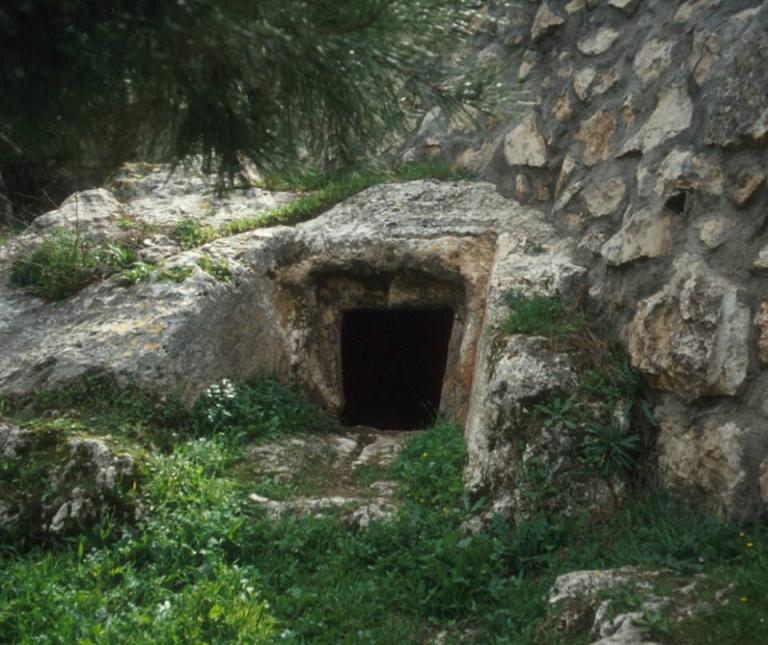
An empty tomb in Jerusalem dating to the Herodian period. The photograph was taken by my friend and colleague Dr. Jeffrey Chadwick, and I use it here with his kind permission. Neither of us believes either the Garden Tomb or the Holy Sepulcher to be the right place, so this will have to represent the as-yet unknown site of Christ’s burial and resurrection.
Interpreter Radio Show — February 25, 2024
For the 25 February 2024 episode of the Interpreter Radio Show, Steve Densley and John Thompson spoke with their special guest, Kerry Muhlestein. They discussed Come, Follow Me Book of Mormon lesson 12 and Kerry’s new book The Easter Connection.
Their conversation, shorn of commercial breaks and archived for your listening pleasure, is now freely available online. The “Book of Mormon in Context” portion of this show, for the Come, Follow Me Book of Mormon lesson 12, will also be posted separately on Tuesday, 12 March 2024.
The Interpreter Radio Show can be enjoyed as it is unfolding on Sunday evenings from 7 to 9 PM (MDT), on K-TALK, AM 1640, or you can listen to it live — and enjoy it every bit as much — on the Internet at ktalkmedia.com.
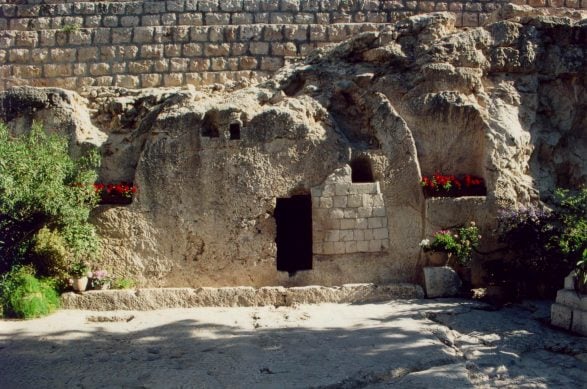
The Garden Tomb in Jerusalem (Wikimedia Commons public domain photo)
For the record: I don’t actually believe that the Garden Tomb is the right place. But it’s familiar, it will serve as a good illustration, and, anyhow, we don’t know exactly where the right place is (though it’s probably within a few hundred yards) and, so far as we know, have no photographs of it.
In anticipation of a public lecture in Mesa, Arizona, that I was apparently about to give in March or so of 2009, a vocal former Latter-day Saint who had apparently turned atheist wrote to me. Here is a short set of notes that, it seems, I wrote in response to him (though I don’t remember whether I used them anywhere or incorporated them in a reply):
I’m sure your presentation will be interesting and engaging, but with all due respect, from a secular evidentiary point of view, you would first have to establish that it is even possible to live again after ones own death.
I don’t agree. That’s one possible approach, but it’s not the only one and, in this case, not at all the best one. (However, I would recommend to you the Claremont philosopher Stephen Davis’s fine book Risen Indeed: Making Sense of the Resurrection, in which he not only considers the historical evidence but the intelligibility of the claim itself. This was the book that got me thinking along the lines that I’ll briefly touch upon in Mesa, although there won’t be much if any of Davis in this particular fireside.)
From the other side, though, if convincing proof could be given that Jesus rose from the dead — if, say, you had actually seen him dead and then, three days later, conversed with him alive — that would settle the question.
This is nicely illustrated in the ancient Christian pseudo-Clementine literature, in which Clement, a young student of philosophy in Rome, having despaired of any meaningful resolution of the endless back-and-forth about whether life after death is possible, encounters an apostolic eyewitness of Christ’s resurrection at a street meeting near his home. A reliable eyewitness, he decides, is worth much more than any number of theoretical disputes.
As will be readily apparent, the thinking in the fragment above is related to what I wrote in my recent blog entry on “Fact and Theory and Extraordinary Claims.”
And here is another fragmentary set of notes, the occasion for which I no longer recall:
Helmut Koester writes that the appearances of Jesus “cannot very well be questioned.”[1] “We can say with complete certainty,” writes the agnostic New Testament scholar Bart Ehrman, “that some of his disciples at some later time insisted that he soon appeared to them. . . . Historians, of course, have no difficulty whatsoever speaking about the belief in Jesus’ resurrection, since it is a matter of public record.”[2] [“At some later time”? Early.] Traugott Holtz declares that the disciples’ “experience of resurrection . . . is in fact an undeniable historical event.”[3]
Critics who, by and large, accept the notion that the disciples genuinely had experiences of a living Jesus after his crucifixion and death can move in basically two directions. They might point out that events such as the resurrection simply don’t occur, or that life after death is an incoherent concept. Or they might say that we simply don’t, or can’t, know what happened.
What we know, says Fuller, “requires that the historian postulate some other event” besides the disciples’ faith in order to explain the sequel. We must identify the cause of the Easter faith . . . outside of their belief.”[4]
There are a number of alternative, naturalistic explanations for the resurrection. Raymond E. Brown terms them “gratuitous charges,” which suggests the seriousness with which most serious scholars have taken them.[5] As James Dunn says, “alternative interpretations of the data fail to provide a more satisfactory explanation” than does the claim of resurrection.[6] The Claremont philosopher Stephen Davis writes “All of the alternative hypotheses with which I am familiar are historically weak; some are so weak that they collapse of their own weight once spelled out. . . . The alternative theories that have been proposed are not only weaker but far weaker at explaining the available historical evidence.”[7] J. A. T. Robinson declares that “it is indeed very difficult to dismiss [Jesus’ postmortal appearances] and still find a credible explanation.”[8]
There is also the claim most notably made by the late Hugh Schonfeld that Jesus really didn’t die on the cross, but was taken down in a swoon.
[1] Helmut Koester, History and Literature, 84.
[2] Bart Ehrman, Jesus: Apocalyptic Prophet of the New Millennium (New York: Oxford University Press, 1999), 230-231.
[3] Traugott Holtz, “Kenntnis von Jesus und Kenntnis Jesu,” Theologische Literaturzeitung 104 (1979): 10. [Make own translation.]
[4] Fuller, The Formation of the Resurrection Narratives, 169, 181.
[5] Brown, An Introduction to New Testament Christology, 163. See 163-167.
[6] Dunn, The Evidence for Jesus, 76. Compare N. T. Wright, “Christian Origins and the Resurrection of Jesus: The Resurrection of Jesus as a Historical Problem,” Sewanee Theological Review 41 (1998): 118-122.
[7] Stephen T. Davis, “Is Belief in the Resurrection Rational?” Philo 2 (1999): 57-58.
[8] J. A. T. Robinson, Can We Trust the New Testament? (Grand Rapids, MI: Eerdmans, 1977), 124.
Travel and Religion
History and Religion
Previous Post
March 3, 2024
"The Power of Boundless Compassion"
Next Post
March 5, 2024 This is a banner day!
Recent Comments
"DP: “But Mr. Sutherland worries about the fact that our time, when we can communicate ..."
Learning more about a region of ..."
"Another class of memories are of individuals who previously lived. Some of these remembered individuals ..."
"Sutherland's lecture sounds interesting. He seems to restate the Washington consensus that trade brings peace ..."
Learning more about a region of ..."
"In a meeting today, I learned another important reason why accurate (or at least as ..."
From Serbia’s “White City,” Belgrade
Browse Our Archives
Select a Category Uncategorized
Select a Month October 2026 September 2026 August 2026 July 2026 June 2026 May 2026 April 2026 March 2026 February 2026 January 2026 December 2025 November 2025 October 2025 September 2025 August 2025 July 2025 June 2025 May 2025 April 2025 March 2025 February 2025 January 2025 December 2024 November 2024 October 2024 September 2024 August 2024 July 2024 June 2024 May 2024 April 2024 March 2024 February 2024 January 2024 December 2023 November 2023 October 2023 September 2023 August 2023 July 2023 June 2023 May 2023 April 2023 March 2023 February 2023 January 2023 December 2022 November 2022 October 2022 September 2022 August 2022 July 2022 June 2022 May 2022 April 2022 March 2022 February 2022 January 2022 December 2021 November 2021 October 2021 September 2021 August 2021 July 2021 June 2021 May 2021 April 2021 March 2021 February 2021 January 2021 December 2020 November 2020 October 2020 September 2020 August 2020 July 2020 June 2020 May 2020 April 2020 March 2020 February 2020 January 2020 December 2019 November 2019 October 2019 September 2019 August 2019 July 2019 June 2019 May 2019 April 2019 March 2019 February 2019 January 2019 December 2018 November 2018 October 2018 September 2018 August 2018 July 2018 June 2018 May 2018 April 2018 March 2018 February 2018 January 2018 December 2017 November 2017 October 2017 September 2017 August 2017 July 2017 June 2017 May 2017 April 2017 March 2017 February 2017 January 2017 December 2016 November 2016 October 2016 September 2016 August 2016 July 2016 June 2016 May 2016 April 2016 March 2016 February 2016 January 2016 December 2015 November 2015 October 2015 September 2015 August 2015 July 2015 June 2015 May 2015 April 2015 March 2015 February 2015 January 2015 December 2014 November 2014 March 2014 August 2013 February 2012
Follow Us!
TAKE THE
Religious Wisdom Quiz
Who climbed a sycamore tree to see Jesus?
Select your answer to see how you score.
Bartimaeus Simon Zacchaeus Nicodemus
Related posts from Sic et Non

An action movie and some vacuous theology

"The World's Sixteen Crucified Saviors"?
"The Loss of Jesus in the Small Plates...
We definitely didn't elect a mere choirboy.
TRENDING AT PATHEOS Latter-day Saint

Swimfan: Forgotten Aughts Pleasures
This is a recovery effort. In 2002, My Big Fat Greek Wedding...

Top Three Anti-Catholic Lies About Catholicism
This is my initial transcript for the video, "THE 3 WORST...

Pope Leo Celebrates Mass for Nurses & Docs...
I don't have any idea how he did it, but Pope Leo...

The Sermon on the Mount, Part I: Matthew...
The Sermon on the Mount, Part I (Matthew 4:12-5:12) St. Matthew moves...

What's up from Crossway: Reviewing some of their latest A few weeks...

Janie Learns the Way of the Cross: A...
Teaching children about Jesus' Passion can be challenging. Many parents and educators...
view all Latter-day Saint blogs
What Are Your Thoughts?leave a comment
Ad-Free & Subscriber Log-In Subscription Support
- About Us
- 2026 Calendar
- Videos
- Podcasts
- Library of World Religions
- Faith In Media Tracker
- Advertise With Us
- Write for Us
- Privacy Policy
- Terms of Service
- Do Not Sell My Data
- Contact Us
- Radiant Digital
- Manage Newsletter Subscriptions
- Unsubscribe From Notifications
- Sitemap
Copyright 2008-2026, Patheos. All rights reserved.
Subscription Support Ad-Free & Subscriber Log-In
Follow Patheos