
BuddhistCatholicContemplativeEvangelicalGeneral ChristianHinduJewishLatter-day SaintMuslimNew VisionsProgressive Christian
Beliefs
- Buddhist
- Catholic
- Contemplative
- Evangelical
- General Christian
- Hindu
- Jewish
- Latter-day Saint
- More Voices
- Muslim
- New Visions
- Pagan
- Progressive Christian
Topics
- Religion News
- Food and Religion
- Sports and Religion
- Religious Art
- Religious Music and Entertainment
- Religious Events
- History and Religion
- Style and Religion
- Politics and Religion
- Women in Religion
- Recreation Outdoors and Religion
- Business Finance and Religion
- Careers Workplace and Religion
- Education and Religion
- Family Parenting and Religion
- Health Fitness and Religion
- Home and Religion
- Relationships and Religion
- Technology and Religion
- Travel and Religion
Columnists
- Buddhist Columnists
- Business Finance and Religion Columnists
- Careers Workplace and Religion Columnists
- Catholic Columnists
- Contemplative Columnists
- Education and Religion Columnists
- Evangelists Columnists
- Family Parenting and Religion Columnists
- General Christian Columnists
- Health Fitness and Religion Columnists
- Hindu Columnists
- History and Religion Columnists
- Home and Religion Columnists
- Jewish Columnists
- More Voices Columnists
- Latter Day Columnists
- Muslim Columnists
- New Visions Columnists
- Nonreligious Columnists
- Pagan Columnists
- Politics and Religion Columnists
- Progressive Columnists
- Recreation Outdoors and Religion Columnists
- Relationships and Religion Columnists
- Religion News Columnists
- Religious Art Columnists
- Religious Events Columnists
- Religious Music and Entertainment Columnists
- Sports and Religion Columnists
- Style and Religion Columnists
- Technology and Religion Columnists
- Travel and Religion Columnists
- Women in Religion Columnists
Resource Library
- 2026 Calendar
- Library of World Religions
- The 100 Most Holy Places on Earth
- Patheos Answers
- Podcasts
- Videos
- Faith Leaders Database
- Anglican Episcopalian
- Bahai
- Baptist
- Buddhism
- Christianity
- Confucianism
- Eastern Orthodoxy
- Hinduism
- Holiness and Pentecostal
- ISKCON
- Islam
- Judaism
- Lutheran
- Methodist
- The Church of Jesus Christ of Latter-day Saints
- New Age
- Paganism
- Presbytarian and Reformed
- Protestantism
- Religion Behind the Scenes
- Roman Catholic
- Scientology
- Shia Islam
- Sikhism
- Sufism
- Sunni Islam
- Taoism
- Zen
- See all religions
Research Tools
 Ad-Free & Subscriber Log-In Subscription Support
Ad-Free & Subscriber Log-In Subscription Support
Follow Patheos 

- Trending:
- Forgiveness
- |
- Marriage
- |
- Consciousness
- |
- Death Penalty
- |
- Election
- |
- Halloween

- Home
- Latter-day Saint
- Some Notes on “Fine-Tuning” and the Multiverse
Some Notes on “Fine-Tuning” and the Multiverse
Last updated on: March 13, 2024 at 3:42 pm by Dan Peterson
Some Notes on “Fine-Tuning” and the Multiverse 2024-03-13T15:42:04-06:00 Dan Peterson
Patheos Explore the world's faith through different perspectives on religion and spirituality! Patheos has the views of the prevalent religions and spiritualities of the world.
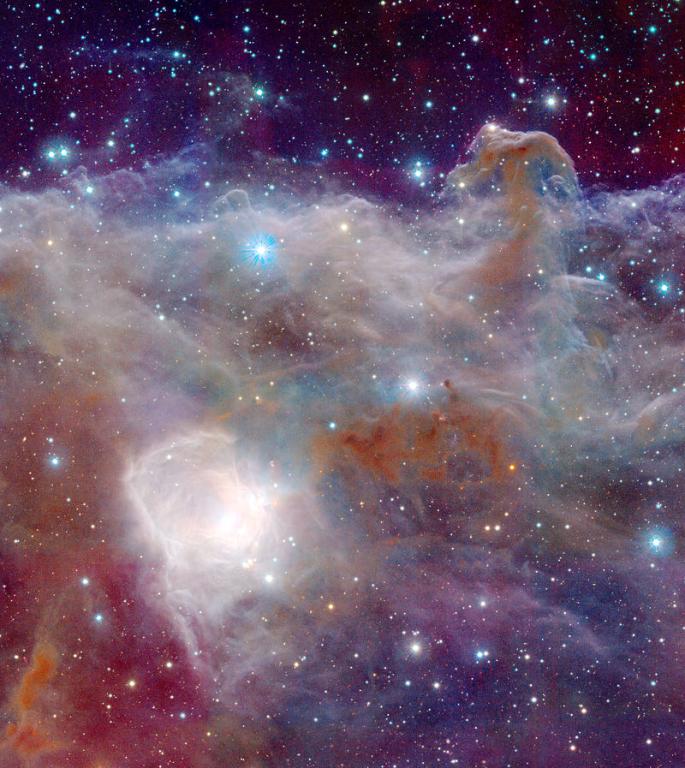
A view of the Horsehead Nebula
(Wikimedia Commons public domain image)
The following is basically a close paraphrase or a gloss (for my note-taking purposes) of “A Beginner’s Guide to the ‘Fine-Tuning’ Argument” by Max Baker-Hytch of the University of Oxford. As always with such notes, I make no claim of originality for what follows but share them because, while I’m taking notes for my own eventual use elsewhere, I think others might find them of potential interest. I do not claim entries on this blog as publications of mine:
Over the past few decades — I, at least, certainly didn’t notice such claims when I was in high school — a number of physicists, philosophers, and others have begun to maintain that many aspects of the physical cosmos appear to be ‘fine-tuned’ for life, which is to say that various aspects of the basic structure of the universe and of the fundamental laws that govern it are balanced, as it were, on a knife’s edge. If any of them had been different by even the tiniest amount, the universe would have been incapable of giving rise to or sustaining life. In several cases, these “fine-tuned” features of the universe are such that, had they differed only very slightly from what they actually are, the universe would not have given rise to stars or even galaxies, let alone to complex and conscious creatures like . . . well, us.
Many specific examples of fine-tuning are available for consideration. I’ll mention two of them here, briefly:
It’s been estimated by physicists that, if the strength of gravity were to differ by just one part in 1060 — 1060 being a 1 followed by sixty (60) zeros, making one part in 1060 an almost inconceivably small number — there would be no stars and no galaxies. If it were a tiny bit stronger than it is, all matter would have collapsed back in on itself; it if were a tiny bit weaker, matter would have dispersed too quickly for galaxies or stars to be able to form.
Another example is what’s known as the “cosmological constant.” What is it? The cosmological constant is a number representing a factor that governs how fast space itself expands or contracts. Again, if it were a tiny bit too strong the universe would have collapsed back upon itself; if it were, by contrast, to be a tiny bit too weak, well, the universe would have expanded so quickly that galaxies and stars would be unable to form. It’s estimated that the chance of the cosmological constant having a value that would permit life is roughly 1 in 1053. (That’s a one followed by fifty-three zeros. So 1 over 1053 is, again, a very, very small number.)
Still, while many scientists and philosophers concur that the universe manifests “fine-tuning,” that agreement doesn’t extend to the meaning of the apparent fact. Some, for example, argue that it is an indication that a supremely intelligent and powerful being is responsible for our universe. (Overall, many scientists seem to me to be much more expressly friendly to theism than I recall from my youth.) Others, by contrast, contend that it is, simply, a “brute fact.” It just is, they argue, and no explanation for it is either necessary or possible.
One fairly witty way of denying that any explanation is needed for apparent “fine-tuning” runs roughly as follows:
If the universe hadn’t been fine-tuned for life, we wouldn’t be here to notice that fact. There’s no other kind of universe that we could have observed other than a fine-tuned universe! And, so, we shouldn’t be surprised to find ourselves in such a universe. If a puddle were somehow to exclaim in wonderment how the depression in the asphalt happens, as if by design, to fit his contours perfectly, we would laugh. Wouldn’t we?
The Canadian philosopher John Leslie has famously responded to this objection with a cute analogy that has become fairly popular: Suppose that you were condemned to be executed by firing squad. Fifty of the best marksmen in the land assemble, each of them armed with a rife and live ammunition. On command, they take aim and fire. To your amazement, though, after the crack of the rifles you’re still standing. You’re still alive, uninjured.
Once the immediate exhilaration and relief had passed, wouldn’t you be at least slightly curious about why you were still living, still unhit? Would you have much patience if someone were to approach you, saying, “Actually, you shouldn’t be surprised or curious. After all, if the firing squad hadn’t missed you wouldn’t be standing here to wonder about it.” On the understanding that every member of the firing squad intended to kill you, and that every single one of them was individually capable of doing so, your survival seems to have been extremely improbable and something for which you might understandably want an explanation. Leslie’s analogy is meant to represent the universe, of course: It appears to be true that the only kind of universe we could observe is a universe that is fine-tuned for our survival, but the existence of such a fine-tuned universe is very, very improbable on the hypothesis of sheer chance. Simple curiosity seems to suggest that we should be looking for another hypothesis to explain our being here.
What other hypotheses are on offer?
Some theists (and their fellow-travelers) have argued that the fine-tuning of the universe isn’t the result of mere chance but, instead, represents the deliberate choice or choices of an incredibly powerful rational mind, one to which the title God could reasonably be applied.
But there is another hypothesis that has been proposed, perhaps primarily if not solely to ward off the possible theistic implications of cosmic “fine-tuning” The hypothesis of a “multiverse” postulates that the universe that we know isn’t the only universe that exists. Instead, the hypothesis suggests, there is a vast ensemble of universes with differing initial conditions and different fundamental physical laws. Given enough such universes, so the hypothesis runs, one of them at least is bound to exhibit initial conditions and physical laws that enable the emergence of life.
So how well does the multiverse hypothesis actually work? Does it better account for “fine-tuning” than theism does? The debate continues to rage on this subject.
The theistic philosopher Robin Collins has devoted considerable attention to the question, and he suggests that the notion of a multiverse poses a serious dilemma: Either the multiverse is “unrestricted” (that is, it is essentially infinite and contains every logically possible universe) or it is “restricted” (which is to say that it contains only some of the logically possible universes).
If the latter, if the multiverse is restricted, then the question remains why the multiverse contains only this set of universes rather than some other set. But this choice simply kicks the “fine-tuning” can down the road a bit. The puzzle still remains as to why one of the finite number of universes available on the “restricted” view is apparently fine-tuned for life.
If, on the other hand, the multiverse is “unrestricted,” containing an infinite number of universes, this seems to pose potentially fatal problems for the very concept of scientific explanation itself. Why? Because, if the hypothesis of an unrestricted multiverse is true, then every logically possible event will actually happen somewhere in the boundless, infinitely capacious multiverse.
Suppose, Collins proposes, you roll a die a hundred times and, with every roll, it lands on six. If that were to happen in Las Vegas or Atlantic City, the casino proprietors and the observers standing around the table would all quite justifiably suspect that the die was rigged. In the unrestricted multiverse, though, everything that is logically possible actually does occur, and that includes a die legitimately landing on six a hundred times in a row. Or a thousand times in a row. Or a million times. Whenever something astounding happens, there won’t be any reason to ask “why.” So fifty sharpshooters missed you at very close range? No big deal. Everything that is logically possible — and there’s nothing strictly illogical about being missed by a fifty-member firing squad — actually happens in our unrestricted multiverse. So don’t worry. Be happy. Move along; there’s nothing to see here. And that would probably put an end to scientific investigation. No reasons are needed, so why should anybody seek them? Eat, drink, and be merry!
The fine-tuning argument does have at least one significant limitation from a theistic point of view, though: It doesn’t help us to choose between variant views of God. It certainly doesn’t establish the existence of the Judeo-Christian or Abrahamic God, the God of the Bible or the God of the Qur’an. It is consistent with most versions of theism, in the sense that it seems to provide grounds for belief in a supremely powerful and enormously intelligent designer. But no more. Thus, while it doesn’t establish any specific conception of deity, it can, potentially, serve as a component part of a broader cumulative argument for Christian theism.
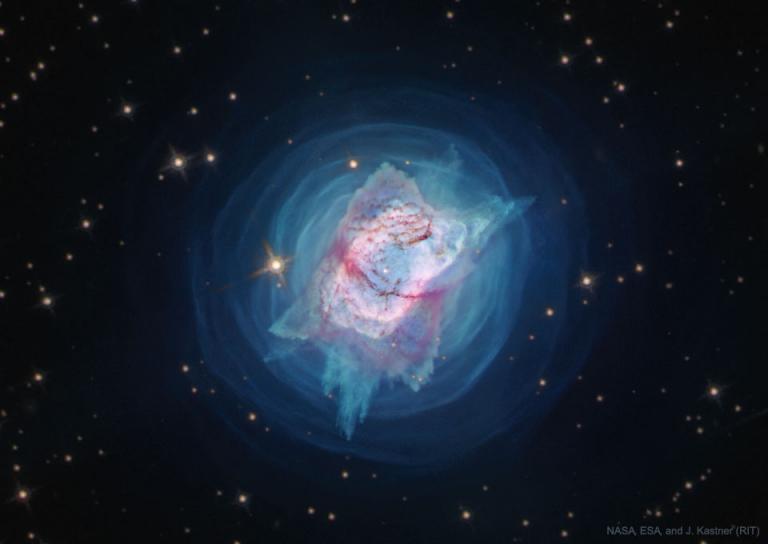
Bright Planetary Nebula NGC 7027 from the Hubble
Space Telescope
(NASA, ESA, Joel Kastner public domain image; processing by Alyssa Pagan)
Some of us — myself very much included — continue to bask in the glow of receiving the Kirtland Temple and other buildings and artifacts back into the custody of the Church of Jesus Christ of Latter-day Saints, and to contemplate their significance.
Nebula (Wikimedia Commons public domain)
Here’s an idea to consider: “Utah Rivers Council encourages water conservation with subsidized rain barrels: The recycled-plastic barrels normally cost more than $150, but are available to residents of partnering municipalities for $55 and to all Utah residents for $83”
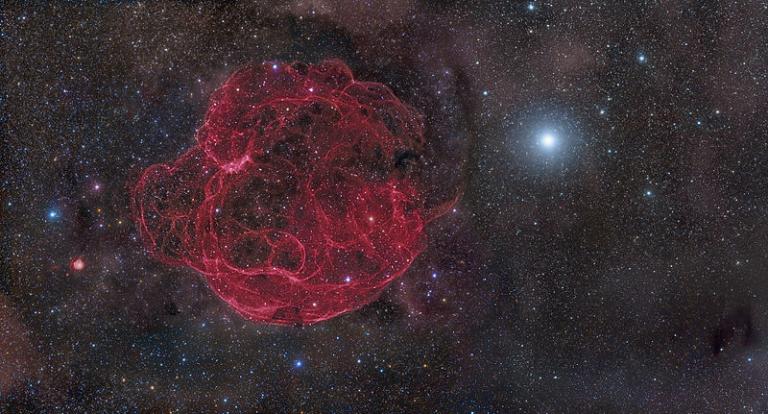
Photograph by Rogelio Bernal Andreo of Simeis 147. Also known as the Spaghetti Nebula and cataloged as Sharpless 2-240, this filamentary structure can be found in the constellation Taurus, close to the border of Auriga, in roughly the same line of sight as the star Elnath. Approximately 3000 light years away, the nebula stretches about 150 light years across.
(Wikimedia Commons public domain photo)
The Book of Mormon in Context Lesson 12: “This Is the Way”: 2 Nephi 31-33
During the 25 February 2024 Come, Follow Me segment of the Interpreter Radio Show, Steve Densley, John Thompson, and special guest Kerry Muhlestein discussed Book of Mormon lesson 12, “This Is the Way,” on 2 Nephi 31-33.
A recording of their discussion has now been edited to remove commercial breaks and placed online for your listening pleasure at no charge. The other segments of the 25 February 2024 radio program can be accessed at https://interpreterfoundation.org/interpreter-radio-show-february-25-2024.
The Interpreter Radio Show can be heard on Sunday evenings each week from 7 to 9 PM (MDT), on K-TALK, AM 1640, or you can listen live on the Internet at ktalkmedia.com.
Editor’s Note: Four years ago, Jonn Claybaugh began writing the Study and Teaching Helps series of articles for Interpreter. We now have these wonderful and useful posts for all four years of Come, Follow Me lessons. Beginning this year we will be reposting these articles, with dates, lesson numbers, and titles updated for the current year’s lessons. Jonn has graciously agreed to write new study aids for those lessons that do not directly correspond to 2020 lessons.
I found this abomination in the Christopher Hitchens Memorial “How Religion Poisons Everything” File™, and feel obliged to inflict it upon you, as well: “How Do We Fix Poverty? ‘[We’ve] Got to Work Together,’ Humanitarian Services Director Says: Sharon Eubank participates in panel at the UN Commission on the Status of Women”
Previous Post

March 11, 2024
Offense and Defense
Next Post

March 13, 2024 "Objective Public Proof"?
Recent Comments
"DP: “But Mr. Sutherland worries about the fact that our time, when we can communicate ..."
Learning more about a region of ..."
"Another class of memories are of individuals who previously lived. Some of these remembered individuals ..."
"Sutherland's lecture sounds interesting. He seems to restate the Washington consensus that trade brings peace ..."
Learning more about a region of ..."
"In a meeting today, I learned another important reason why accurate (or at least as ..."
From Serbia’s “White City,” Belgrade
Browse Our Archives
Select a Category Uncategorized
Select a Month October 2026 September 2026 August 2026 July 2026 June 2026 May 2026 April 2026 March 2026 February 2026 January 2026 December 2025 November 2025 October 2025 September 2025 August 2025 July 2025 June 2025 May 2025 April 2025 March 2025 February 2025 January 2025 December 2024 November 2024 October 2024 September 2024 August 2024 July 2024 June 2024 May 2024 April 2024 March 2024 February 2024 January 2024 December 2023 November 2023 October 2023 September 2023 August 2023 July 2023 June 2023 May 2023 April 2023 March 2023 February 2023 January 2023 December 2022 November 2022 October 2022 September 2022 August 2022 July 2022 June 2022 May 2022 April 2022 March 2022 February 2022 January 2022 December 2021 November 2021 October 2021 September 2021 August 2021 July 2021 June 2021 May 2021 April 2021 March 2021 February 2021 January 2021 December 2020 November 2020 October 2020 September 2020 August 2020 July 2020 June 2020 May 2020 April 2020 March 2020 February 2020 January 2020 December 2019 November 2019 October 2019 September 2019 August 2019 July 2019 June 2019 May 2019 April 2019 March 2019 February 2019 January 2019 December 2018 November 2018 October 2018 September 2018 August 2018 July 2018 June 2018 May 2018 April 2018 March 2018 February 2018 January 2018 December 2017 November 2017 October 2017 September 2017 August 2017 July 2017 June 2017 May 2017 April 2017 March 2017 February 2017 January 2017 December 2016 November 2016 October 2016 September 2016 August 2016 July 2016 June 2016 May 2016 April 2016 March 2016 February 2016 January 2016 December 2015 November 2015 October 2015 September 2015 August 2015 July 2015 June 2015 May 2015 April 2015 March 2015 February 2015 January 2015 December 2014 November 2014 March 2014 August 2013 February 2012
Follow Us!
TAKE THE
Religious Wisdom Quiz
According to Jesus, what defiles a person?
Select your answer to see how you score.
Money What comes out of the heart Food eaten Clothing
Related posts from Sic et Non


Evidence and argument in thinking about the existence...

Desire, Experience, and the Divine

Intimations of the divine, from science and from...
TRENDING AT PATHEOS Latter-day Saint

Nearly every morning, I make the drive to Detroit with my high-school-age...

The Real AI Story Is Adoption Without Trust
Artificial intelligence has crossed a political threshold. It is no longer a...

A new article, written by Jeff Lindsay and Gale L. Pooley,...

Swimfan: Forgotten Aughts Pleasures
This is a recovery effort. In 2002, My Big Fat Greek Wedding...

Top Three Anti-Catholic Lies About Catholicism
This is my initial transcript for the video, "THE 3 WORST...

Pope Leo Celebrates Mass for Nurses & Docs...
I don't have any idea how he did it, but Pope Leo...
view all Latter-day Saint blogs
What Are Your Thoughts?leave a comment
Ad-Free & Subscriber Log-In Subscription Support
- About Us
- 2026 Calendar
- Videos
- Podcasts
- Library of World Religions
- Faith In Media Tracker
- Advertise With Us
- Write for Us
- Privacy Policy
- Terms of Service
- Do Not Sell My Data
- Contact Us
- Radiant Digital
- Manage Newsletter Subscriptions
- Unsubscribe From Notifications
- Sitemap
Copyright 2008-2026, Patheos. All rights reserved.
Subscription Support Ad-Free & Subscriber Log-In
Follow Patheos