
BuddhistCatholicContemplativeEvangelicalGeneral ChristianHinduJewishLatter-day SaintMuslimNew VisionsProgressive Christian
Beliefs
- Buddhist
- Catholic
- Contemplative
- Evangelical
- General Christian
- Hindu
- Jewish
- Latter-day Saint
- More Voices
- Muslim
- New Visions
- Pagan
- Progressive Christian
Topics
- Religion News
- Food and Religion
- Sports and Religion
- Religious Art
- Religious Music and Entertainment
- Religious Events
- History and Religion
- Style and Religion
- Politics and Religion
- Women in Religion
- Recreation Outdoors and Religion
- Business Finance and Religion
- Careers Workplace and Religion
- Education and Religion
- Family Parenting and Religion
- Health Fitness and Religion
- Home and Religion
- Relationships and Religion
- Technology and Religion
- Travel and Religion
Columnists
- Buddhist Columnists
- Business Finance and Religion Columnists
- Careers Workplace and Religion Columnists
- Catholic Columnists
- Contemplative Columnists
- Education and Religion Columnists
- Evangelists Columnists
- Family Parenting and Religion Columnists
- General Christian Columnists
- Health Fitness and Religion Columnists
- Hindu Columnists
- History and Religion Columnists
- Home and Religion Columnists
- Jewish Columnists
- More Voices Columnists
- Latter Day Columnists
- Muslim Columnists
- New Visions Columnists
- Nonreligious Columnists
- Pagan Columnists
- Politics and Religion Columnists
- Progressive Columnists
- Recreation Outdoors and Religion Columnists
- Relationships and Religion Columnists
- Religion News Columnists
- Religious Art Columnists
- Religious Events Columnists
- Religious Music and Entertainment Columnists
- Sports and Religion Columnists
- Style and Religion Columnists
- Technology and Religion Columnists
- Travel and Religion Columnists
- Women in Religion Columnists
Resource Library
- 2026 Calendar
- Library of World Religions
- The 100 Most Holy Places on Earth
- Patheos Answers
- Podcasts
- Videos
- Faith Leaders Database
- Anglican Episcopalian
- Bahai
- Baptist
- Buddhism
- Christianity
- Confucianism
- Eastern Orthodoxy
- Hinduism
- Holiness and Pentecostal
- ISKCON
- Islam
- Judaism
- Lutheran
- Methodist
- The Church of Jesus Christ of Latter-day Saints
- New Age
- Paganism
- Presbytarian and Reformed
- Protestantism
- Religion Behind the Scenes
- Roman Catholic
- Scientology
- Shia Islam
- Sikhism
- Sufism
- Sunni Islam
- Taoism
- Zen
- See all religions
Research Tools
 Ad-Free & Subscriber Log-In Subscription Support
Ad-Free & Subscriber Log-In Subscription Support
Follow Patheos 

- Trending:
- Forgiveness
- |
- Marriage
- |
- Consciousness
- |
- Death Penalty
- |
- Election
- |
- Halloween

- Home
- Latter-day Saint
- History and Religion
- “Kingly Names, Kingly Ambitions”
“Kingly Names, Kingly Ambitions”
Last updated on: March 1, 2024 at 3:01 pm by Dan Peterson
“Kingly Names, Kingly Ambitions” 2024-03-01T15:01:19-07:00 Dan Peterson
Patheos Explore the world's faith through different perspectives on religion and spirituality! Patheos has the views of the prevalent religions and spiritualities of the world.
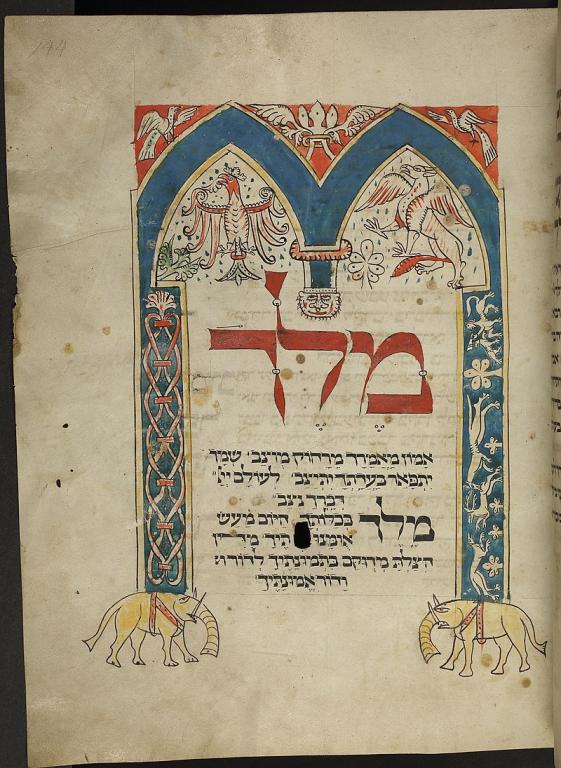
A page from a Rosh Hashanah prayerbook with Hebrew מלך (melekh) in large red text
(Wikimedia Commons public domain image).
“Proper Names and Political Claims: Semitic Echoes as Foundations for Claims to the Nephite Throne,” written by Lyle H. Hamblin
Abstract: The Book of Mormon contains examples of phonemes in character names that resemble Semitic root words. The possible meanings of the names and their timing in the Book of Mormon narrative provide a deeper level of context to the Nephite political challenges in the books of Mosiah through 3 Nephi. Specifically, the English phonemes for the Hebrew and Arabic root-word for “king,” M-L-K, appear in character names in the Book of Mormon narrative when the people of Zarahemla, who were descended from Mulek, the last king of Judah, are discovered by the Nephites in the book of Omni. “King” names then appear frequently during the time in the narrative in which there are attempts to reestablish a monarchy during the early reign of the judges. “King” names disappear after “Moroni put an end to those king-men, that there were not any known by the appellation of king-men” (Alma 51:21, 62:9). The presence and timing of these “king” names suggests that the Mulekite claim to the local Israelite throne resonated rhetorically through Nephite politics for over a century and was violently contested in the multiple civil and external wars in the books of Alma through 3 Nephi.
“Interpreting Interpreter: Kingly Names; Kingly Ambitions,” written by Kyler Rasmussen
This post is a summary of the article “Proper Names and Political Claims: Semitic Echoes as Foundations for Claims to the Nephite Throne” by Lyle H. Hamblin in Volume 60 of Interpreter: A Journal of Latter-day Saint Faith and Scholarship. All of the Interpreting Interpreter articles may be seen at https://interpreterfoundation.org/category/summaries/. An introduction to the Interpreting Interpreter series is available at https://interpreterfoundation.org/interpreting-interpreter-on-abstracting-thought/.
The Takeaway: Hamblin identifies the names in the Book of Mormon that appear to be related to the root M-L-K—meaning “king” in Hebrew, Aramaic, and Arabic—outlining and cautioning against the often-monarchical ambitions of these figures, which begin with the appearance of the Mulekites and end with Moroni’s purge of the king-men.
Incidentally, the Interpreter website is so inactive, and the Interpreter Foundation so unproductive, that it’s really difficult for me not to fall behind in calling attention to the latest Interpreter developments. But I’m going to try to catch up today, now that I’m finally back home and trying to settle back into a productive routine. Accordingly, here are three additional recent items that I had not yet called to your notice:
Hugh Nibley Observed: “About the Portrait of Hugh Nibley,” by Rebecca Fechser Everett
Rebecca Fechser Everett says in Hugh Nibley Observed of her portrait of Hugh Nibley “I have enjoyed the whole process of creating this portrait from thought to finish. I’ve developed the piece to attempt to include as many images as I could associate with Brother Nibley and his life’s interests.”
Part of our book chapter reprint series, this article originally appeared in Hugh Nibley Observed, edited by Jeffrey M. Bradshaw, Shirley S. Ricks, and Stephen T. Whitlock. For more information, go to https://interpreterfoundation.org/books/hugh-nibley-observed/.
Ryan Dahle spoke about “Centralizing Scriptural Resources” at the Tracing Ancient Threads in the Book of Moses Conference on Saturday, 19 September 2020.
All of the conference presentations were filmed, and both video and audio recordings of each presentation are available. Videos, audio recordings and transcripts are available at https://interpreterfoundation.org/conferences/2020-book-of-moses-conference/papers/. The videos are also available on the Interpreter Foundation YouTube channel at https://www.youtube.com/c/theinterpreterfoundation. A YouTube playlist is also available at https://www.youtube.com/playlist?list=PLRMn4gyXMWLv7A618LA-cCvxMqWRk8kxI.
Interpreter Radio Show — February 18, 2024
For the 18 February 2024 episode of the Interpreter Radio Show, Bruce Webster and Robert Boylan and Kris Frederickson discussed Come, Follow Me Book of Mormon lesson 11, the recent article in Interpreter: A Journal of Latter-day Saint Faith and Scholarship by David M. Belnap and Nalini M. Nadkarni, naturalistic explanations of the Book of Mormon, and the Mountain Meadows Massacre.
Their conversation was recorded, and it has now been archived, freed from commercial interruptions, and made available online for your listening pleasure. The “New Testament in Context” portion of this show, for the Come, Follow Me Book of Mormon lesson 11, will also be posted separately on Tuesday, 5 March 2024.
The Interpreter Radio Show can be heard regularly on Sunday evenings from 7 to 9 PM (MDT), on K-TALK, AM 1640, or you can listen live on the Internet at ktalkmedia.com.
And have I mentioned this newly available Interpreter book?
Stephen D. Ricks and Jeffrey M. Bradshaw, eds. The Temple: Symbols, Sermons, and Settings
Proceedings of the Fourth Interpreter Matthew B. Brown Memorial Conference
“The Temple on Mount Zion,” 10 November 2018 (Temple on Mount Zion Series 5)
Someday, perhaps — and to the absolute astonishment of some of my critics — the Interpreter Foundation will produce something that isn’t mere name-calling and personal attacks intended to injure and wound others. I mean, it’s theoretically possible. Right?

At the end of July 2023, these women in eastern Kenya celebrate the delivery to their village of beehives that were provided by donors to the Giving Machines.
In closing, I offer a trio of inflammatory entries from the Christopher Hitchens Memorial “How Religion Poisons Everything” File™:
- “Relief Amid Turmoil: Aid to Lebanon’s Displaced: A joint effort by the Church and URDA brings essential supplies to families in need”
- “Record Number of Giving Machine Donations to Bless the World: Millions will be fed, clothed and protected due to selfless donations made during the 2023 holiday season”
- “Service Stitched With Love: JustServe Volunteer Turns Wedding Gowns Into Tiny Angel Robes: Alabama Latter-day Saint Mary Helen Allred finds joy in using JustServe to continue a legacy of service” (This one hits home personally.)
Imagine a world in which there are no longer any religious people to commit such outrages. It’s easy, if you try. Imagine, above us, that there’s only sky. Imagine all the people living for today.
As the late Karl Marx (1818-1883) wrote in his 1843 Critique of Hegel’s Philosophy of Right:
Religious distress is at the same time the expression of real distress and the protest against real distress. Religion is the sigh of the oppressed creature, the heart of a heartless world, just as it is the spirit of a spiritless situation. It is the opium of the people. The abolition of religion as the illusory happiness of the people is required for their real happiness. The demand to give up the illusion about its condition is the demand to give up a condition which needs illusions.
History and Religion
Politics and Religion
Previous Post

February 29, 2024
Christian California
Next Post
March 2, 2024 "Christ's Resurrection (UCLA)"
Recent Comments
"Sutherland's lecture sounds interesting. He seems to restate the Washington consensus that trade brings peace ..."
Learning more about a region of ..."
"In a meeting today, I learned another important reason why accurate (or at least as ..."
From Serbia’s “White City,” Belgrade
"I've been watching a lot of video interviews of NDErs and researchers. I think in ..."
"PL: "Let's hope he doesn't have your address..."I have to frankly confess that a few ..."
From Serbia’s “White City,” Belgrade
Browse Our Archives
Select a Category Uncategorized
Select a Month October 2026 September 2026 August 2026 July 2026 June 2026 May 2026 April 2026 March 2026 February 2026 January 2026 December 2025 November 2025 October 2025 September 2025 August 2025 July 2025 June 2025 May 2025 April 2025 March 2025 February 2025 January 2025 December 2024 November 2024 October 2024 September 2024 August 2024 July 2024 June 2024 May 2024 April 2024 March 2024 February 2024 January 2024 December 2023 November 2023 October 2023 September 2023 August 2023 July 2023 June 2023 May 2023 April 2023 March 2023 February 2023 January 2023 December 2022 November 2022 October 2022 September 2022 August 2022 July 2022 June 2022 May 2022 April 2022 March 2022 February 2022 January 2022 December 2021 November 2021 October 2021 September 2021 August 2021 July 2021 June 2021 May 2021 April 2021 March 2021 February 2021 January 2021 December 2020 November 2020 October 2020 September 2020 August 2020 July 2020 June 2020 May 2020 April 2020 March 2020 February 2020 January 2020 December 2019 November 2019 October 2019 September 2019 August 2019 July 2019 June 2019 May 2019 April 2019 March 2019 February 2019 January 2019 December 2018 November 2018 October 2018 September 2018 August 2018 July 2018 June 2018 May 2018 April 2018 March 2018 February 2018 January 2018 December 2017 November 2017 October 2017 September 2017 August 2017 July 2017 June 2017 May 2017 April 2017 March 2017 February 2017 January 2017 December 2016 November 2016 October 2016 September 2016 August 2016 July 2016 June 2016 May 2016 April 2016 March 2016 February 2016 January 2016 December 2015 November 2015 October 2015 September 2015 August 2015 July 2015 June 2015 May 2015 April 2015 March 2015 February 2015 January 2015 December 2014 November 2014 March 2014 August 2013 February 2012
Follow Us!
TAKE THE
Religious Wisdom Quiz
Who said, "I am doing a great work, so that I cannot come down"?
Select your answer to see how you score.
Joshua Elijah Nehemiah Solomon
Related posts from Sic et Non

Notes on Women, Priesthood, and General Conference

"The Book of Moses as a Temple Text"


Some notes on the archaeology of the Bible
TRENDING AT PATHEOS Latter-day Saint

I was strolling through the top floor of the brand new Parthenon...

What Does Gêvâh Mean For Kimberley Guifoyle &...
This week, a lot of the news is focused on Kimberly Guilfoyle....

INNER CIRCLE: Profound Mystery (Of Christ In All...
Ephesians 5:31-32 “For this reason, a man will leave his father and...

Do Not Rejoice When Your Enemy Falls: The...
Turning an execution into a public spectacle is a disturbing expression of...

'The Chosen' S6 Trailer: The Passion Gets Very...
Not many watching 'The Chosen' worry about spoilers, but just because they...

The purpose-driven labor priest
A labor activist reads Rick Warren and it gets me wondering about...
view all Latter-day Saint blogs
What Are Your Thoughts?leave a comment
Ad-Free & Subscriber Log-In Subscription Support
- About Us
- 2026 Calendar
- Videos
- Podcasts
- Library of World Religions
- Faith In Media Tracker
- Advertise With Us
- Write for Us
- Privacy Policy
- Terms of Service
- Do Not Sell My Data
- Contact Us
- Radiant Digital
- Manage Newsletter Subscriptions
- Unsubscribe From Notifications
- Sitemap
Copyright 2008-2026, Patheos. All rights reserved.
Subscription Support Ad-Free & Subscriber Log-In
Follow Patheos