
BuddhistCatholicContemplativeEvangelicalGeneral ChristianHinduJewishLatter-day SaintMuslimNew VisionsProgressive Christian
Beliefs
- Buddhist
- Catholic
- Contemplative
- Evangelical
- General Christian
- Hindu
- Jewish
- Latter-day Saint
- More Voices
- Muslim
- New Visions
- Pagan
- Progressive Christian
Topics
- Religion News
- Food and Religion
- Sports and Religion
- Religious Art
- Religious Music and Entertainment
- Religious Events
- History and Religion
- Style and Religion
- Politics and Religion
- Women in Religion
- Recreation Outdoors and Religion
- Business Finance and Religion
- Careers Workplace and Religion
- Education and Religion
- Family Parenting and Religion
- Health Fitness and Religion
- Home and Religion
- Relationships and Religion
- Technology and Religion
- Travel and Religion
Columnists
- Buddhist Columnists
- Business Finance and Religion Columnists
- Careers Workplace and Religion Columnists
- Catholic Columnists
- Contemplative Columnists
- Education and Religion Columnists
- Evangelists Columnists
- Family Parenting and Religion Columnists
- General Christian Columnists
- Health Fitness and Religion Columnists
- Hindu Columnists
- History and Religion Columnists
- Home and Religion Columnists
- Jewish Columnists
- More Voices Columnists
- Latter Day Columnists
- Muslim Columnists
- New Visions Columnists
- Nonreligious Columnists
- Pagan Columnists
- Politics and Religion Columnists
- Progressive Columnists
- Recreation Outdoors and Religion Columnists
- Relationships and Religion Columnists
- Religion News Columnists
- Religious Art Columnists
- Religious Events Columnists
- Religious Music and Entertainment Columnists
- Sports and Religion Columnists
- Style and Religion Columnists
- Technology and Religion Columnists
- Travel and Religion Columnists
- Women in Religion Columnists
Resource Library
- 2026 Calendar
- Library of World Religions
- The 100 Most Holy Places on Earth
- Patheos Answers
- Podcasts
- Videos
- Faith Leaders Database
- Anglican Episcopalian
- Bahai
- Baptist
- Buddhism
- Christianity
- Confucianism
- Eastern Orthodoxy
- Hinduism
- Holiness and Pentecostal
- ISKCON
- Islam
- Judaism
- Lutheran
- Methodist
- The Church of Jesus Christ of Latter-day Saints
- New Age
- Paganism
- Presbytarian and Reformed
- Protestantism
- Religion Behind the Scenes
- Roman Catholic
- Scientology
- Shia Islam
- Sikhism
- Sufism
- Sunni Islam
- Taoism
- Zen
- See all religions
Research Tools
 Ad-Free & Subscriber Log-In Subscription Support
Ad-Free & Subscriber Log-In Subscription Support
Follow Patheos 

- Trending:
- Forgiveness
- |
- Marriage
- |
- Consciousness
- |
- Death Penalty
- |
- Election
- |
- Halloween

- Home
- Latter-day Saint
- Travel and Religion
- “Are religious people happier?”
“Are religious people happier?”
Last updated on: March 25, 2024 at 10:55 pm by Dan Peterson
“Are religious people happier?” 2024-03-25T22:55:28-06:00 Dan Peterson
Patheos Explore the world's faith through different perspectives on religion and spirituality! Patheos has the views of the prevalent religions and spiritualities of the world.

A view of Monet’s garden at Giverny, by Art Anderson (Wikimedia Commons public domain image) Since I have no current photographs of Eden or Paradise, this will have to do for now.
I think that, this time around, I’ll lead off with something from the Christopher Hitchens Memorial “How Religion Poisons Everything” File™. I mean, this claim, asserted by Dr. Stephen Cranney, is so horrible and so very alarming that it really does cry out for drastic emergency action:
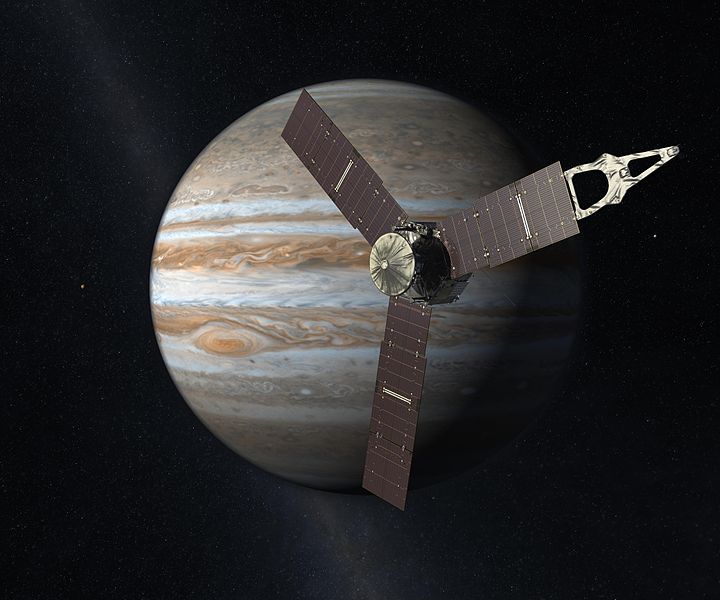
An artist’s rendition (from NASA/JPL) of the JUNO orbiter approaching the planet Jupiter
(Wikimedia Commons public domain image)
I want to share a few more passages here that I’ve extracted for my own undoubtedly nefarious purposes from my reading of Robert Spitzer, Science at the Doorstep to God: Science and Reason in Support of God, the Soul, and Life after Death:
On the cosmological front, in their 2018 article in the Journal of High Energy Physics, Stephen Hawking and his co-author, Thomas Hertog, show on the basis of observational data that eternal inflation and the infinite multiverse are exceedingly unlikely. They explain that any multiverse that could generate our universe would have to have a boundary in past time—that is, a beginning. When this is combined with other highly improbable consequences of eternal inflation and an infinite multiverse, such as Boltzmann Brains and Brief Brains, the preponderance of cosmological evidence has shifted toward a beginning of physical reality (regardless of whether this is a multiverse, bouncing universe, or simply our universe). (13)
My own personal sense — and, of course, I could be wrong; there is some slight precedent for believing in my fallibility — is that much science and many scientists are more openly favorable to theism and theistic claims today than they were when I was younger.
[A] large percentage of young scientists consider themselves believers in God or a higher spiritual reality. (13-14)
Though some have contended that scientific evidence overwhelmingly favors materialism—that is, rejection of God, religion, or a spiritual dimension of humans (e.g., a soul)—it is interesting to note a survey conducted by the Pew Research Center found that 51 percent of scientists profess belief in God or a spiritual reality, while 41 percent are agnostics or atheists. 6 Interestingly, younger scientists profess belief in God or a higher spiritual reality more than older ones. According to the same survey, 66 percent of young scientists profess belief in God or a higher spiritual reality, while only 32 percent are agnostic or atheist—two-thirds are believers, while only one-third are not.
The statistics concerning faith of physicians are more striking. According to the 2014 survey reported in the Journal of Religion and Health, 76 percent of physicians are believers in God or a higher spiritual power, while 12.4 percent are agnostic and 11.6 percent are atheist—three-quarters are believers and one-fourth are not. Furthermore, 74 percent of physicians believe that miracles have occurred in the past, and 73 percent believe they occur in the present.
It is also worth noting that most of the originators of modern physics were religious believers, including Galileo Galilei (the father of observational astronomy and initial laws of dynamics and gravity), Sir Isaac Newton (father of calculus, classical mechanics, and quantitative optics), James Clerk Maxwell (father of the classical theory of electromagnetic radiation), Max Planck (father of quantum theory and co-founder of modern physics), Albert Einstein (father of the theory of relativity and co-founder of modern physics), Kurt Gödel (one of the greatest modern mathematicians and logicians and originator of the incompleteness theorems), Sir Arthur Eddington (father of the nuclear fusion explanation of stellar radiation), Werner Heisenberg (father of the matrix theory of quantum mechanics and the uncertainty principle), and Freeman Dyson (originator of multiple theories in contemporary quantum electrodynamics). There are many other contemporary Nobel Prize–winning physicists, chemists, and biologists who have openly professed belief in God and a transphysical soul. (15)
And it should scarcely be surprising that this passage caught my attention:
Beyond physics and cosmology, new developments in the evidence for transcendent causation and intelligence are occurring in the areas of medicine, neuroscience, and philosophy of mind. The peer-reviewed research in near-death experiences and terminal lucidity has become so prolific that the New York Academy of Sciences recently issued a consensus statement among physicians and scientists that states, “Evidence suggests that neither physiological nor cognitive processes end with death.” Based on peer-reviewed medical studies of near-death experiences, terminal lucidity, and cognition in hydrocephalic patients, combined with linguistic-genetic studies of the origin of syntactically significant language by Noam Chomsky and Robert Berwick, as well as studies of self-consciousness and interior experience by David Chalmers and Thomas Nagel, the reality of a transphysical dimension of human consciousness and intellection capable of surviving bodily death (like a soul) becomes not only admissible but also compellingly probable. This transphysical dimension of consciousness seems to be the explanation for why human language and thought are categorically different from ape language. (14)
I’ll close with this short passage, which I like but don’t fully agree with:
It is said that an argument is what convinces reasonable men and a proof is what it takes to convince even an unreasonable man. (52)
I understand the fundamental point, and I agree with it. But I would modify the saying by pointing out that a good or even a successful argument will convince reasonable men. (Or, to avoid giving offense, I should say that it “will convince reasonable people.“). But, of course, some people will be convinced by bad arguments, and there are plenty of good arguments that, for one reason or another, fail to convince seemingly “reasonable” people.
As I’ve observed here several times before, humans are not fully — or, anyway, solely — rational beings. We are influenced by our life histories, our emotions, our emotional or psychological baggage, our areas of ignorance, our precommitments or biases, the limits of our intelligence, and a host of other factors. And that’s every bit as true for atheists as it is for theists. Or, if you prefer, it’s every bit as true for theists as it is for atheists.
Travel and Religion
History and Religion
Science at the Doorstep of God
Previous Post

March 23, 2024
“Shall we not go on in so great a cause?"
Next Post

March 25, 2024 I'm happy to see this
Recent Comments
"DP: “But Mr. Sutherland worries about the fact that our time, when we can communicate ..."
Learning more about a region of ..."
"Another class of memories are of individuals who previously lived. Some of these remembered individuals ..."
"Sutherland's lecture sounds interesting. He seems to restate the Washington consensus that trade brings peace ..."
Learning more about a region of ..."
"In a meeting today, I learned another important reason why accurate (or at least as ..."
From Serbia’s “White City,” Belgrade
Browse Our Archives
Select a Category Uncategorized
Select a Month October 2026 September 2026 August 2026 July 2026 June 2026 May 2026 April 2026 March 2026 February 2026 January 2026 December 2025 November 2025 October 2025 September 2025 August 2025 July 2025 June 2025 May 2025 April 2025 March 2025 February 2025 January 2025 December 2024 November 2024 October 2024 September 2024 August 2024 July 2024 June 2024 May 2024 April 2024 March 2024 February 2024 January 2024 December 2023 November 2023 October 2023 September 2023 August 2023 July 2023 June 2023 May 2023 April 2023 March 2023 February 2023 January 2023 December 2022 November 2022 October 2022 September 2022 August 2022 July 2022 June 2022 May 2022 April 2022 March 2022 February 2022 January 2022 December 2021 November 2021 October 2021 September 2021 August 2021 July 2021 June 2021 May 2021 April 2021 March 2021 February 2021 January 2021 December 2020 November 2020 October 2020 September 2020 August 2020 July 2020 June 2020 May 2020 April 2020 March 2020 February 2020 January 2020 December 2019 November 2019 October 2019 September 2019 August 2019 July 2019 June 2019 May 2019 April 2019 March 2019 February 2019 January 2019 December 2018 November 2018 October 2018 September 2018 August 2018 July 2018 June 2018 May 2018 April 2018 March 2018 February 2018 January 2018 December 2017 November 2017 October 2017 September 2017 August 2017 July 2017 June 2017 May 2017 April 2017 March 2017 February 2017 January 2017 December 2016 November 2016 October 2016 September 2016 August 2016 July 2016 June 2016 May 2016 April 2016 March 2016 February 2016 January 2016 December 2015 November 2015 October 2015 September 2015 August 2015 July 2015 June 2015 May 2015 April 2015 March 2015 February 2015 January 2015 December 2014 November 2014 March 2014 August 2013 February 2012
Follow Us!
TAKE THE
Religious Wisdom Quiz
Which book of the Bible contains the phrase "Vanity of vanities"?
Select your answer to see how you score.
Proverbs Ecclesiastes Job Psalms
Related posts from Sic et Non

Once more unto the breach, dear friends, once...



Desire, Experience, and the Divine
TRENDING AT PATHEOS Latter-day Saint

Swimfan: Forgotten Aughts Pleasures
This is a recovery effort. In 2002, My Big Fat Greek Wedding...

Top Three Anti-Catholic Lies About Catholicism
This is my initial transcript for the video, "THE 3 WORST...

Pope Leo Celebrates Mass for Nurses & Docs...
I don't have any idea how he did it, but Pope Leo...

The Sermon on the Mount, Part I: Matthew...
The Sermon on the Mount, Part I (Matthew 4:12-5:12) St. Matthew moves...

What's up from Crossway: Reviewing some of their latest A few weeks...

Janie Learns the Way of the Cross: A...
Teaching children about Jesus' Passion can be challenging. Many parents and educators...
view all Latter-day Saint blogs
What Are Your Thoughts?leave a comment
Ad-Free & Subscriber Log-In Subscription Support
- About Us
- 2026 Calendar
- Videos
- Podcasts
- Library of World Religions
- Faith In Media Tracker
- Advertise With Us
- Write for Us
- Privacy Policy
- Terms of Service
- Do Not Sell My Data
- Contact Us
- Radiant Digital
- Manage Newsletter Subscriptions
- Unsubscribe From Notifications
- Sitemap
Copyright 2008-2026, Patheos. All rights reserved.
Subscription Support Ad-Free & Subscriber Log-In
Follow Patheos