
BuddhistCatholicContemplativeEvangelicalGeneral ChristianHinduJewishLatter-day SaintMuslimNew VisionsProgressive Christian
Beliefs
- Buddhist
- Catholic
- Contemplative
- Evangelical
- General Christian
- Hindu
- Jewish
- Latter-day Saint
- More Voices
- Muslim
- New Visions
- Pagan
- Progressive Christian
Topics
- Religion News
- Food and Religion
- Sports and Religion
- Religious Art
- Religious Music and Entertainment
- Religious Events
- History and Religion
- Style and Religion
- Politics and Religion
- Women in Religion
- Recreation Outdoors and Religion
- Business Finance and Religion
- Careers Workplace and Religion
- Education and Religion
- Family Parenting and Religion
- Health Fitness and Religion
- Home and Religion
- Relationships and Religion
- Technology and Religion
- Travel and Religion
Columnists
- Buddhist Columnists
- Business Finance and Religion Columnists
- Careers Workplace and Religion Columnists
- Catholic Columnists
- Contemplative Columnists
- Education and Religion Columnists
- Evangelists Columnists
- Family Parenting and Religion Columnists
- General Christian Columnists
- Health Fitness and Religion Columnists
- Hindu Columnists
- History and Religion Columnists
- Home and Religion Columnists
- Jewish Columnists
- More Voices Columnists
- Latter Day Columnists
- Muslim Columnists
- New Visions Columnists
- Nonreligious Columnists
- Pagan Columnists
- Politics and Religion Columnists
- Progressive Columnists
- Recreation Outdoors and Religion Columnists
- Relationships and Religion Columnists
- Religion News Columnists
- Religious Art Columnists
- Religious Events Columnists
- Religious Music and Entertainment Columnists
- Sports and Religion Columnists
- Style and Religion Columnists
- Technology and Religion Columnists
- Travel and Religion Columnists
- Women in Religion Columnists
Resource Library
- 2026 Calendar
- Library of World Religions
- The 100 Most Holy Places on Earth
- Patheos Answers
- Podcasts
- Videos
- Faith Leaders Database
- Anglican Episcopalian
- Bahai
- Baptist
- Buddhism
- Christianity
- Confucianism
- Eastern Orthodoxy
- Hinduism
- Holiness and Pentecostal
- ISKCON
- Islam
- Judaism
- Lutheran
- Methodist
- The Church of Jesus Christ of Latter-day Saints
- New Age
- Paganism
- Presbytarian and Reformed
- Protestantism
- Religion Behind the Scenes
- Roman Catholic
- Scientology
- Shia Islam
- Sikhism
- Sufism
- Sunni Islam
- Taoism
- Zen
- See all religions
Research Tools
 Ad-Free & Subscriber Log-In Subscription Support
Follow Patheos 

- Trending:
- Advent
- |
- Forgiveness
- |
- Thanksgiving
- |
- Election
- |
- Seasonal Holidays
- |
- Marriage

- Home
- Latter-day Saint
- History and Religion
- The Book of Mormon and then-prevailing notions of scripture
The Book of Mormon and then-prevailing notions of scripture
Last updated on: February 1, 2024 at 3:07 pm by Dan Peterson
The Book of Mormon and then-prevailing notions of scripture 2024-02-01T15:07:03-07:00 Dan Peterson
Patheos Explore the world's faith through different perspectives on religion and spirituality! Patheos has the views of the prevalent religions and spiritualities of the world.

On the grounds of Hawaii’s second temple, in Kona, on the eastern side of the Big Island of Hawaii
(LDS Media Library)
Conference Talks: The Symbolism of the Cupped Hand in Ancient Egypt and Israel: Iconography, Text, and Artifact, presented at the Interpreter Foundation’s 2018 Temple on Mount Zion Conference by Stephen Smoot
Stephen Smoot spoke on “The Symbolism of the Cupped Hand in Ancient Egypt and Israel: Iconography, Text, and Artifact” at the fourth Temple on Mount Zion Conference, held on Saturday, 10 November 2018 in the Tanner Building at Brigham Young University, Provo, Utah.
The presentations were filmed, and both video and audio recordings of each presentation are available. The videos are currently available both at https://interpreterfoundation.org/conferences/2018-temple-on-mount-zion-conference/2018-temple-on-mount-zion-conference-videos/and on the Interpreter Foundation YouTube channel at https://www.youtube.com/c/theinterpreterfoundation. A YouTube playlist is also available at https://www.youtube.com/playlist?list=PLRMn4gyXMWLsWt34zVNC5FmTqBtFfcnxl. The audio recordings are available at https://interpreterfoundation.org/conferences/2018-temple-on-mount-zion-conference/2018-temple-on-mount-zion-conference-audio/.
Sacred Time, Sacred Space, & Sacred Meaning: “Women in Public Worship in Ancient Israel,” written by Camille Fronk Olson
Camille Fronk Olson highlights the significant ways that women influenced and shaped ancient Israelite worship, including song and dance as a means of proclaiming revelatory truths.
Part of our book chapter reprint series, this article originally appeared in Sacred Time, Sacred Space, & Sacred Meaning, Proceedings of the Third Interpreter Matthew B. Brown Memorial Conference “The Temple on Mount Zion,” 2 November, 2016, edited by Stephen D. Ricks and Jeffrey M. Bradshaw. For more information, go to https://interpreterfoundation.org/books/sacred-time-sacred-space-sacred-meaning/
Interpreter Radio Show — January 21, 2024
For the 21 January 2024 episode of the Interpreter Radio Show, which is now available to you, archived and at no charge and stripped of commercial and other extraneous interruptions, the discussants were Bruce Webster, Kris Frederickson, and Robert Boylan. They talked about Come, Follow Me Book of Mormon lesson 7, how well members know the Book of Mormon, and the best resources for Book of Mormon study. The “New Testament in Context” portion of this show, for the Come, Follow Me Book of Mormon lesson 7, will also be posted separately, on Tuesday, 6 February 2024.
The Interpreter Radio Show can be heard live without fail each and every Sunday evening, from 7 to 9 PM (MDT), on K-TALK, AM 1640. Or, if you don’t live in the Salt Lake Valley, you can listen live on the Internet at ktalkmedia.com.

On the set of the Interpreter Foundation’s 2021 theatrical film, “Witnesses.”
(Still photograph by James Jordan)
These comments from Richard Lyman Bushman’s recent book Joseph Smith’s Gold Plates: A Cultural History strike me as both deeply insightful and very, very important, worthy of reflection:
The Book of Mormon’s candor about its own making is at odds with the prevailing sense [in the first part of the nineteenth century] of how scriptures came to be. Most Christians in 1830 thought that the Bible, which the Book of Mormon devotedly emulates, had been composed by pure inspiration. They assumed that words came to prophets in the manner described by the ancient Jewish philosopher Philo, who believed that prophets “proffer nothing of their own, but matter altogether foreign to themselves, and communicated to them internally by the operation of God. So long as the state of a prophet be rapture, he knows nothing of himself.” Scripture was purely God’s word, unsullied by human thought. The Book of Mormon was compiled in another way. Mormon selected and blended materials from various plates, making editorial decisions all along the line. Scripture emerged from his work as an editor, extracting the history from his sources, much like other historians.
This unconventional view had relevance in 1830. This was a time when the problems of constructing the Bible were of growing interest to Christian scholars. In the century preceding the publication of the Book of Mormon, scrutiny of the Bible had made the text seem more like a history than the privileged word of God. This movement toward the historicization of biblical texts came primarily from Germany where scholars were emphasizing the human influences on the production of the scriptures. They argued that to understand the composition of biblical texts readers had to grasp the historical conditions under which they emerged, in the process humanizing scripture-making. American scholars were bringing back this new biblical scholarship just as Joseph Smith was translating the gold plates. . . .
Anxiety about fallible human influence on scripture-making was absent from the Book of Mormon. A book whose origins were enshrouded in miraculous events was surprisingly at ease with historical influences on the actual production of scripture. Although Joseph Smith had no known connections with German biblical scholarship, his translation depicted scripture as emerging from specific historical circumstances and consisting of texts stitched together by a later editor much as the German scholars envisioned the origins of the Bible. While the text of the Book of Mormon insists on its privileges as inspired writing, readers of the Book of Mormon are permitted to view the very human process by which the text came into existence. It was a conglomeration of texts just as the new critics claimed the Bible was. Mormon, the general editor, took pains to explain exactly where the various elements of his book came from, making clear that the Book of Mormon consisted of the writings of various prophets and leaders going back through time and recorded on various plates. The book does not even shy away from the possibility of human errors creeping into the text. The Book of Mormon’s title page warns that “if there be fault, it be the mistake of men,” pretty much summing up the Unitarian view of holy writ.
The Book of Mormon and the higher criticism both returned scripture to history. The essence of the German critical approach was to imagine biblical authors as writers grounded in concrete cultural and historical circumstances. Eighteenth-and nineteenth-century Bible critics read the book as they would any historical document, discerning the influences of its times on its production. Book of Mormon writers followed the same pattern. In the book’s pages, the scriptures are a human production: minds writing under heavenly influence but in particular historical circumstances, diligently inscribing events and inspiration on plates made by human hands.
Alike as humanistic scholarship and the Book of Mormon were, however, the two actually pointed in opposite directions. If the thrust of German scholarship was to turn holy scriptures into human history, the Book of Mormon did the reverse: it turned history into holy writ. The biblical critics said little about how texts edited, blended, and revised by human editors rose to be treated as the word of God. The Book of Mormon offers itself as an example of that elevation. It reveals how a record kept as a history was in time transmuted into scripture. (31-33)
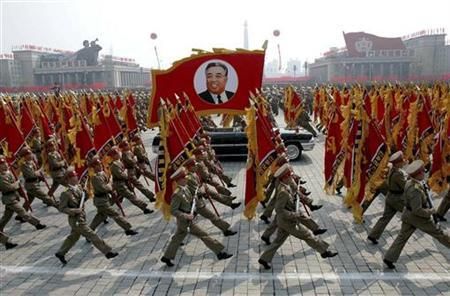
A group of happy secularists out for a stroll in North Korea
(Wikimedia Commons public domain image)
I share with you now a trio of appalling horrors from the Christopher Hitchens Memorial “How Religion Poisons Everything” File™. Fortunately, though, the first of these may finally be fading away:
“Church’s Donation Helps Build Nursing and Midwifery Development Center in Kurdistan”
And here are two further examples of the evils routinely visited by religious believers directly upon innocent secularists, who only want, obviously, to be left alone in peace:
“‘Insulted, beaten, imprisoned’ Nicaraguan priest details persecution”
Someday, perhaps, if they are given a long enough course of gentle tutelage such as that recorded above, theists will learn to stop provoking and irritating unbelievers.

Groundhog Day 2005 (Wikimedia Commons public domain image). 2 February is a pivotal day in meteorological science each year.
Important Reminder: Tomorrow, Friday, 2 February 2024, is Groundhog Day. Observe it with fitting solemnity, dress appropriately, and, if this applies to you, drink responsibly. Perhaps you should even watch The Sacred Movie.
Posted from Ko Olina, O’ahu, Hawai’i
History and Religion
Travel and Religion
Previous Post

February 1, 2024
ESP and other supposedly discredited things
Next Post

February 2, 2024 For Groundhog Day
Recent Comments
"Well, that may be true, I just don't know. What I'm more preoccupied with, as ..."
Demmed if it do and demmed ..."
"TB: "I didn’t see you on top of the Herefordshire Beacon?"You were paying attention!My left ..."
Demmed if it do and demmed ..."
"TB: "Dan, can you find and restore my missing comment?"Sorry. I've been traveling since well ..."
Demmed if it do and demmed ..."
"Dan, can you find and restore my missing comment?"
Demmed if it do and demmed ..."
Browse Our Archives
Select a Category Uncategorized
Select a Month November 2026 October 2026 September 2026 August 2026 July 2026 June 2026 May 2026 April 2026 March 2026 February 2026 January 2026 December 2025 November 2025 October 2025 September 2025 August 2025 July 2025 June 2025 May 2025 April 2025 March 2025 February 2025 January 2025 December 2024 November 2024 October 2024 September 2024 August 2024 July 2024 June 2024 May 2024 April 2024 March 2024 February 2024 January 2024 December 2023 November 2023 October 2023 September 2023 August 2023 July 2023 June 2023 May 2023 April 2023 March 2023 February 2023 January 2023 December 2022 November 2022 October 2022 September 2022 August 2022 July 2022 June 2022 May 2022 April 2022 March 2022 February 2022 January 2022 December 2021 November 2021 October 2021 September 2021 August 2021 July 2021 June 2021 May 2021 April 2021 March 2021 February 2021 January 2021 December 2020 November 2020 October 2020 September 2020 August 2020 July 2020 June 2020 May 2020 April 2020 March 2020 February 2020 January 2020 December 2019 November 2019 October 2019 September 2019 August 2019 July 2019 June 2019 May 2019 April 2019 March 2019 February 2019 January 2019 December 2018 November 2018 October 2018 September 2018 August 2018 July 2018 June 2018 May 2018 April 2018 March 2018 February 2018 January 2018 December 2017 November 2017 October 2017 September 2017 August 2017 July 2017 June 2017 May 2017 April 2017 March 2017 February 2017 January 2017 December 2016 November 2016 October 2016 September 2016 August 2016 July 2016 June 2016 May 2016 April 2016 March 2016 February 2016 January 2016 December 2015 November 2015 October 2015 September 2015 August 2015 July 2015 June 2015 May 2015 April 2015 March 2015 February 2015 January 2015 December 2014 November 2014 March 2014 August 2013 February 2012
Follow Us!
TAKE THE
Religious Wisdom Quiz
Which chapter of Genesis recounts the genealogy from Adam to Noah?
Select your answer to see how you score.
Genesis 10 Genesis 7 Genesis 2 Genesis 5
Related posts from Sic et Non


Some notes on the archaeology of the Bible

TRENDING AT PATHEOS Latter-day Saint

Here are two Thanksgiving columns that I originally wrote for the...

Book III, Chapter 3: Christ "Classic" (Matt. 9:9-34)
Book III, Chapter 3: Christ "Classic" (Matt. 9:9-34) In honor of tomorrow's...

Jesus explicitly mentions the book of Jonah twice, but he retells the...

Peggy Sue Got Married: Coppola’s Always Been Like...
I enjoyed Megalopolis (2024). It’s a mess, but I enjoyed it. The...

My dissertation The Place of Mysticism in the Late Middle Ages concerns...

God and the Contingency of This World
The great Catholic philosopher Aquinas and the great Lutheran philosopher Leibniz developed...
view all Latter-day Saint blogs
What Are Your Thoughts?leave a comment
Ad-Free & Subscriber Log-In Subscription Support
- About Us
- 2026 Calendar
- Videos
- Podcasts
- Library of World Religions
- Faith In Media Tracker
- Advertise With Us
- Write for Us
- Privacy Policy
- Terms of Service
- Do Not Sell My Data
- Contact Us
- Radiant Digital
- Manage Newsletter Subscriptions
- Unsubscribe From Notifications
- Sitemap
Copyright 2008-2026, Patheos, part of the Radiant Digital network of media brands. All rights reserved.
Subscription Support Ad-Free & Subscriber Log-In
Follow Patheos