
BuddhistCatholicContemplativeEvangelicalGeneral ChristianHinduJewishLatter-day SaintMuslimNew VisionsProgressive Christian
Beliefs
- Buddhist
- Catholic
- Contemplative
- Evangelical
- General Christian
- Hindu
- Jewish
- Latter-day Saint
- More Voices
- Muslim
- New Visions
- Pagan
- Progressive Christian
Topics
- Religion News
- Food and Religion
- Sports and Religion
- Religious Art
- Religious Music and Entertainment
- Religious Events
- History and Religion
- Style and Religion
- Politics and Religion
- Women in Religion
- Recreation Outdoors and Religion
- Business Finance and Religion
- Careers Workplace and Religion
- Education and Religion
- Family Parenting and Religion
- Health Fitness and Religion
- Home and Religion
- Relationships and Religion
- Technology and Religion
- Travel and Religion
Columnists
- Buddhist Columnists
- Business Finance and Religion Columnists
- Careers Workplace and Religion Columnists
- Catholic Columnists
- Contemplative Columnists
- Education and Religion Columnists
- Evangelists Columnists
- Family Parenting and Religion Columnists
- General Christian Columnists
- Health Fitness and Religion Columnists
- Hindu Columnists
- History and Religion Columnists
- Home and Religion Columnists
- Jewish Columnists
- More Voices Columnists
- Latter Day Columnists
- Muslim Columnists
- New Visions Columnists
- Nonreligious Columnists
- Pagan Columnists
- Politics and Religion Columnists
- Progressive Columnists
- Recreation Outdoors and Religion Columnists
- Relationships and Religion Columnists
- Religion News Columnists
- Religious Art Columnists
- Religious Events Columnists
- Religious Music and Entertainment Columnists
- Sports and Religion Columnists
- Style and Religion Columnists
- Technology and Religion Columnists
- Travel and Religion Columnists
- Women in Religion Columnists
Resource Library
- 2026 Calendar
- Library of World Religions
- The 100 Most Holy Places on Earth
- Patheos Answers
- Podcasts
- Videos
- Faith Leaders Database
- Anglican Episcopalian
- Bahai
- Baptist
- Buddhism
- Christianity
- Confucianism
- Eastern Orthodoxy
- Hinduism
- Holiness and Pentecostal
- ISKCON
- Islam
- Judaism
- Lutheran
- Methodist
- The Church of Jesus Christ of Latter-day Saints
- New Age
- Paganism
- Presbytarian and Reformed
- Protestantism
- Religion Behind the Scenes
- Roman Catholic
- Scientology
- Shia Islam
- Sikhism
- Sufism
- Sunni Islam
- Taoism
- Zen
- See all religions
Research Tools
 Ad-Free & Subscriber Log-In Subscription Support
Follow Patheos 

- Trending:
- Advent
- |
- Forgiveness
- |
- Thanksgiving
- |
- Election
- |
- Seasonal Holidays
- |
- Marriage

- Home
- Latter-day Saint
- History and Religion
- Pre-Columbian contact between South America and New Zealand?
Pre-Columbian contact between South America and New Zealand?
Last updated on: February 3, 2024 at 5:40 pm by Dan Peterson
Pre-Columbian contact between South America and New Zealand? 2024-02-03T17:40:00-07:00 Dan Peterson
Patheos Explore the world's faith through different perspectives on religion and spirituality! Patheos has the views of the prevalent religions and spiritualities of the world.
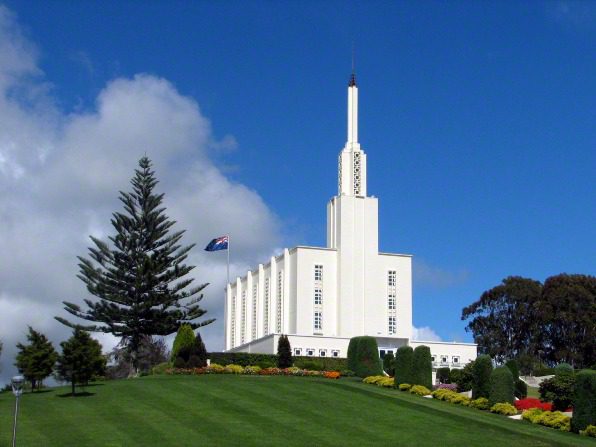
The Hamilton New Zealand Temple (LDS.org)
The standard view of the origins of the Polynesians, and specifically of the Māori of New Zealand, is that they derive from the Lapita civilization of Melanesia and Micronesia. Here is a passage from Māori History: A Captivating Guide to the History of the Indigenous Polynesian People of New Zealand (2022), apparently written by Matt Clayton, that I found particularly interesting:
It seems that for roughly one thousand years, the Lapita people consolidated some of the basic Polynesian cultural characteristics, like the language and religious beliefs and concepts like, for example, mana, as well as the pantheon of gods. They also formed the roots of a social system with kinship and ranks, which are today linked with the Polynesian civilization. It could also be theorized that, over time, they also improved and advanced their maritime technology and techniques. Around 700 CE, they resumed their eastward explorations, reaching the Cook Islands, Tahiti, and the rest of what is today French Polynesia. By then, the Lapita were transformed into the Polynesians, a change that is marked by the loss of their distinctive pottery.
Over the next several hundred years, the Polynesian people spread across what is today known as Polynesia, which roughly stretches from Samoa in the west to Easter Island in the east and Hawaii in the north to New Zealand in the south. This is a rather wide area that covers large chunks of open waters in the Pacific Ocean. The astonishing feat of covering such large distances and treacherous seas has made some modern scholars doubt if these Polynesian voyages were deliberate. For Western historians, it seemed inexplicable that a culture that seemed far inferior to any in Europe or around the Mediterranean Sea could travel so far, especially considering their Western contemporaries barely managed to leave their coasts. However, modern researchers have almost undoubtedly proved that the Polynesians, like their Austronesian ancestors, sailed with full intent and the knowledge of how to do so with minimal risks. . . .
Coupled with their planning techniques were their well-crafted outrigger canoes. They sometimes used the double outrigger design. Here, it is important to note that our minds often link canoes with small vessels, like a rowboat carrying a few people. However, the Polynesians, like other branches of the Austronesian people, built large ships capable of carrying dozens of people, with the boats powered by sails and the wind. It is also worth noting that the Polynesian sailors were capable navigators. They knew how to navigate with the help of the sun and the stars, and they used various methods, like spotting birds and cloud formations, to deduce if there was land beyond the visible horizon. They would pass this information on to other navigators and make repeated voyages, further reinforcing the notion that their trips were deliberate.
If that wasn’t enough to prove the maritime quality and capability of the Polynesian explorers, then there is the fact that, according to some research, they reached as far east as the western coasts of South America. There is some evidence to support such claims. The Polynesians cultivated sweet potatoes before the arrival of Europeans to the region. The sweet potato or batata, often mistakenly referred to as yams, originated in Central or South America. Thus, the Polynesians managed to reach the American continent before Christopher Columbus. On the Cook Islands, archaeologists found traces of this vegetable as early as the 11th century CE, prompting some scholars to deduce that Polynesian trips to the Americas must predate this century. Some bolder claims date Polynesian contact with the Americas to possibly the 8th century, though there is no evidence to support these claims. Another interesting facet of this implied contact is the fact that in various Polynesian languages, sweet potato is called kumara (also known as kumala or umala), while Bolivian and Peruvian Quechua sometimes refer to the plants as kumara or kumar, which is strikingly similar.
Apart from the sweet potato, some genetic studies of both chicken and human remains infer possible contact. In the case of human remains, several DNA markers found on certain Polynesian remains showed some mixture with the genes of the natives on the Columbian coast. Some scholars proposed this was a result of a single contact that took place in the late 12th or early 13th century. Also, some chicken remains found on the Chilean coast were dated to the early 14th century, with some of its genes sharing similarities to the
domesticated chickens raised by the Polynesians. This has led some scholars to theorize that the Polynesians brought domesticated poultry to the Americas. However, these theories are still relatively new, and there is no conclusive scholarly agreement on them. Similarly, even less conclusive are the linguistic similarities found in a few words. Nevertheless, even if the linguistic and genetic similarities are completely disregarded, the unwavering evidence in the form of the kumara proves that the Polynesians reached South America most likely more than once. (5-9)

The Suva Fiji Temple. (LDS.org)
We’re commonly portrayed as nice but comically rather dull and dimwitted naïfs (think of Broadway’s musical The Book of Mormon). At the same time, we seem to be fascinatingly salacious. The streaming channel Hulu, at least, can’t seem to get enough of us:
- “New Hulu series puts Latter-day Saints in the spotlight again. Is it time to address religious stereotypes in the media?”
- “Those sexy Mormon swingers: Here’s the reality that will never feature in a ‘reality’ TV series: Most Mormons are deeply, predictably, embarrassingly boring when it comes to their sex lives.”
We’re also routinely accused in some circles — or, at least, our leaders (a group that includes not only General Authorities of the Church but also local stake presidents and bishops) are routinely accused — of being serenely indifferent to child sex abuse. It is said, quite falsely, that sexual abuse is rife within the Church and that the Church maintains a sex abuse hotline for local leaders in order to cover such offenses up and to avoid legal culpability for our actions. Very recently, in this light, certain critics of the Church have ben celebrating the charge against a Pennsylvania stake president that he failed to report a case of child abuse. There might, though, be another side to this story. One that fails to make the Church look evil: “Church calls charge against Latter-day Saint stake president ‘misguided’: Court date set for Friday in failure to report child abuse case in Pennsylvania” Don’t expect it to get much coverage in the media, though. Don’t hold your breath for a miniseries on Hulu.

The Papeete Tahiti Temple (LDS.org)
This is a good essay, and it even features the Church of Jesus Christ of Latter-day Saints. In my very limited direct personal experience with Richard J. Mouw — in debate settings, no less — he really has been a civil, pleasant, and fair-minded person: “Timeless Truths: Encouraging Civil Discourse.”
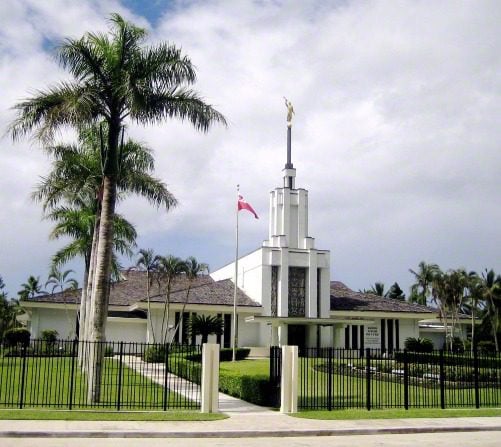
The Nuku’alofa Tonga Temple (LDS.org)
Here are a few more installments — I parcel them out in small doses so as not to overwhelm my readers with the sheer horror of it all — from the Christopher Hitchens Memorial “How Religion Poisons Everything” File™:
- “Historic Black Cemetery Restored With Help From Local Latter-day Saints”
- “Religious People Coped Better with Covid-19 Pandemic”
- “How Service United a Colorado Community at Christmas: Missionaries, members, JustServe volunteers and people from several faiths work together in Pueblo”
- “Church responds to Japan earthquake with donations, service and relief: Missionaries and members clean, serve, deliver, donate and give other efforts in the month after Noto Peninsula earthquake”
We can only hope that, if theism really is declining, such traumatic crimes will eventually fade away and be forgotten.
Posted from Ko Olina, O’ahu, Hawai’i
History and Religion
Travel and Religion
Previous Post

February 2, 2024
For Groundhog Day
Next Post

February 4, 2024 Puʻuhonua
Recent Comments
"There is a ward of The Church of Jesus Christ of Latter-day Saints in Dearborn. ..."
Islam soon to be the world’s ..."
"Interesting question. I have closely read Stephen Smoots book, asked Kara Cooney her views. Kerry ..."
"There's more amazement still, too. Most of the metals that humanity has ever extracted from ..."
"Did you know someone stole Shakespeare's skull? It was thought to be a rumour but ..."
Browse Our Archives
Select a Category Uncategorized
Select a Month November 2026 October 2026 September 2026 August 2026 July 2026 June 2026 May 2026 April 2026 March 2026 February 2026 January 2026 December 2025 November 2025 October 2025 September 2025 August 2025 July 2025 June 2025 May 2025 April 2025 March 2025 February 2025 January 2025 December 2024 November 2024 October 2024 September 2024 August 2024 July 2024 June 2024 May 2024 April 2024 March 2024 February 2024 January 2024 December 2023 November 2023 October 2023 September 2023 August 2023 July 2023 June 2023 May 2023 April 2023 March 2023 February 2023 January 2023 December 2022 November 2022 October 2022 September 2022 August 2022 July 2022 June 2022 May 2022 April 2022 March 2022 February 2022 January 2022 December 2021 November 2021 October 2021 September 2021 August 2021 July 2021 June 2021 May 2021 April 2021 March 2021 February 2021 January 2021 December 2020 November 2020 October 2020 September 2020 August 2020 July 2020 June 2020 May 2020 April 2020 March 2020 February 2020 January 2020 December 2019 November 2019 October 2019 September 2019 August 2019 July 2019 June 2019 May 2019 April 2019 March 2019 February 2019 January 2019 December 2018 November 2018 October 2018 September 2018 August 2018 July 2018 June 2018 May 2018 April 2018 March 2018 February 2018 January 2018 December 2017 November 2017 October 2017 September 2017 August 2017 July 2017 June 2017 May 2017 April 2017 March 2017 February 2017 January 2017 December 2016 November 2016 October 2016 September 2016 August 2016 July 2016 June 2016 May 2016 April 2016 March 2016 February 2016 January 2016 December 2015 November 2015 October 2015 September 2015 August 2015 July 2015 June 2015 May 2015 April 2015 March 2015 February 2015 January 2015 December 2014 November 2014 March 2014 August 2013 February 2012
Follow Us!
TAKE THE
Religious Wisdom Quiz
True or False: 1 Peter teaches that judgment must begin with the family of God.
Select your answer to see how you score.
FALSE TRUE
Related posts from Sic et Non

We shouldn't act as if WE'RE in the...

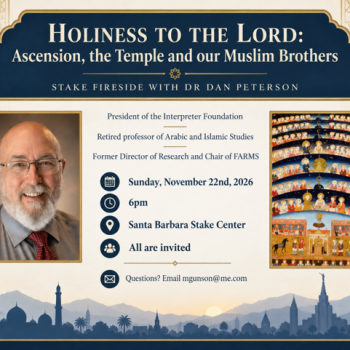
This coming Sunday in Santa Barbara
More on the 1978 Priesthood Revelation
TRENDING AT PATHEOS Latter-day Saint

Smart people saying smart things (11.24.26)
Please take time to listen to Perry Bacon, Sarah Posner, Adam Serwer,...

The Contingency of Our Technology
Last week we were hit with a raft of massive technology outages....

In 1939, President Franklin D. Roosevelt moved Thanksgiving from November 30 to...

Reasons for Restraint: Ricardo Gonzalez, Florida and Dec...
The Morning of January 3 I begin with the dead. On the...

I published this column for Thanksgiving 2012 in the Deseret News....

For many years, Catholicism has been caught up in division over the...
view all Latter-day Saint blogs
What Are Your Thoughts?leave a comment
Ad-Free & Subscriber Log-In Subscription Support
- About Us
- 2026 Calendar
- Videos
- Podcasts
- Library of World Religions
- Faith In Media Tracker
- Advertise With Us
- Write for Us
- Privacy Policy
- Terms of Service
- Do Not Sell My Data
- Contact Us
- Radiant Digital
- Manage Newsletter Subscriptions
- Unsubscribe From Notifications
- Sitemap
Copyright 2008-2026, Patheos, part of the Radiant Digital network of media brands. All rights reserved.
Subscription Support Ad-Free & Subscriber Log-In
Follow Patheos