
BuddhistCatholicContemplativeEvangelicalGeneral ChristianHinduJewishLatter-day SaintMuslimNew VisionsProgressive Christian
Beliefs
- Buddhist
- Catholic
- Contemplative
- Evangelical
- General Christian
- Hindu
- Jewish
- Latter-day Saint
- More Voices
- Muslim
- New Visions
- Pagan
- Progressive Christian
Topics
- Religion News
- Food and Religion
- Sports and Religion
- Religious Art
- Religious Music and Entertainment
- Religious Events
- History and Religion
- Style and Religion
- Politics and Religion
- Women in Religion
- Recreation Outdoors and Religion
- Business Finance and Religion
- Careers Workplace and Religion
- Education and Religion
- Family Parenting and Religion
- Health Fitness and Religion
- Home and Religion
- Relationships and Religion
- Technology and Religion
- Travel and Religion
Columnists
- Buddhist Columnists
- Business Finance and Religion Columnists
- Careers Workplace and Religion Columnists
- Catholic Columnists
- Contemplative Columnists
- Education and Religion Columnists
- Evangelists Columnists
- Family Parenting and Religion Columnists
- General Christian Columnists
- Health Fitness and Religion Columnists
- Hindu Columnists
- History and Religion Columnists
- Home and Religion Columnists
- Jewish Columnists
- More Voices Columnists
- Latter Day Columnists
- Muslim Columnists
- New Visions Columnists
- Nonreligious Columnists
- Pagan Columnists
- Politics and Religion Columnists
- Progressive Columnists
- Recreation Outdoors and Religion Columnists
- Relationships and Religion Columnists
- Religion News Columnists
- Religious Art Columnists
- Religious Events Columnists
- Religious Music and Entertainment Columnists
- Sports and Religion Columnists
- Style and Religion Columnists
- Technology and Religion Columnists
- Travel and Religion Columnists
- Women in Religion Columnists
Resource Library
- 2026 Calendar
- Library of World Religions
- The 100 Most Holy Places on Earth
- Patheos Answers
- Podcasts
- Videos
- Faith Leaders Database
- Anglican Episcopalian
- Bahai
- Baptist
- Buddhism
- Christianity
- Confucianism
- Eastern Orthodoxy
- Hinduism
- Holiness and Pentecostal
- ISKCON
- Islam
- Judaism
- Lutheran
- Methodist
- The Church of Jesus Christ of Latter-day Saints
- New Age
- Paganism
- Presbytarian and Reformed
- Protestantism
- Religion Behind the Scenes
- Roman Catholic
- Scientology
- Shia Islam
- Sikhism
- Sufism
- Sunni Islam
- Taoism
- Zen
- See all religions
Research Tools
 Ad-Free & Subscriber Log-In Subscription Support
Ad-Free & Subscriber Log-In Subscription Support
Follow Patheos 

- Trending:
- Forgiveness
- |
- Marriage
- |
- Consciousness
- |
- Death Penalty
- |
- Election
- |
- Halloween

- Home
- Latter-day Saint
- History and Religion
- Notes on the Origin of New Zealand
Notes on the Origin of New Zealand
Last updated on: February 9, 2024 at 4:44 am by Dan Peterson
Notes on the Origin of New Zealand 2024-02-09T04:44:50-07:00 Dan Peterson
Patheos Explore the world's faith through different perspectives on religion and spirituality! Patheos has the views of the prevalent religions and spiritualities of the world.
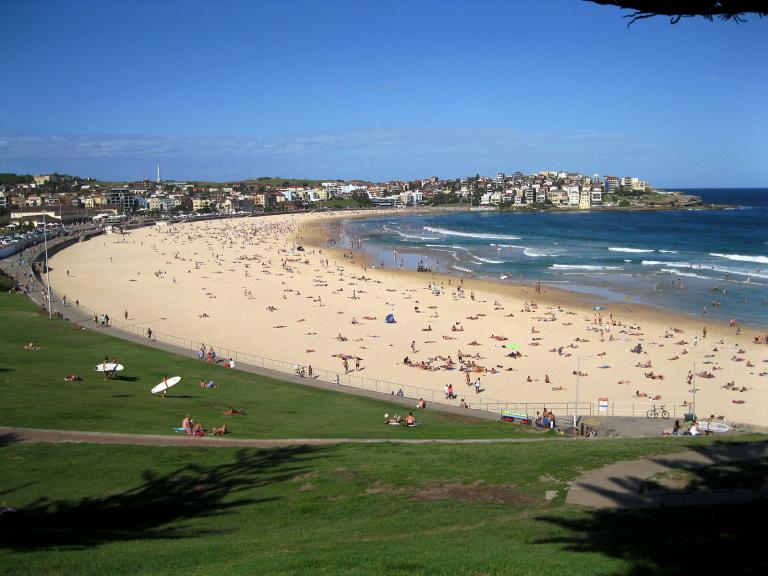
Greater Sydney’s famous Bondi Beach is an almost perfect crescent.
(Wikimedia Commons public domain image)
We began the day with almost all of our group taking a multi-hour minibus tour of mostly eastern Sydney, looking at the Sydney Harbour Bridge and the magnificent Sydney Opera House and including really good fish and chips and shrimp, followed by gelato, at Bondi Beach.
As I sit down to commence writing this blog entry, we’re just emerging from Sydney’s huge and excellent harbor (harbour?). From our veranda of our cabin, I’m looking southward at the sheer cliffs facing this portion of the Pacific Ocean. Our ship is the Ovation of the Seas. In the distance, I see the intermittent flash of a coastal lighthouse high atop the shore. I’m a little bit surprised to see such a lantern lighthouse still functioning, as opposed to the electronic navigation devices that (I had thought) have come to dominate coastal shipping. Maybe—is it even remotely thinkable?—I don’t know quite as much about such things as I’ve imagined that I did.
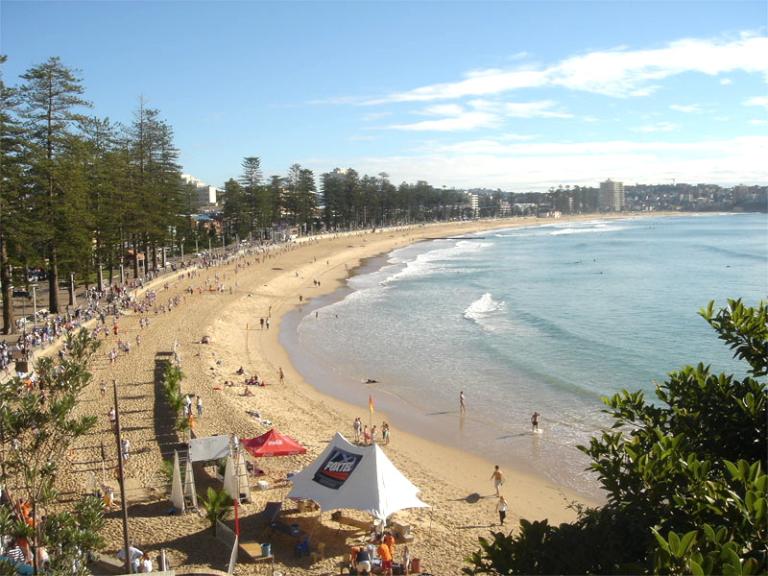
While on the topic of Australian beaches, there’s one question that I urgently need to clear up: Contrary to widespread rumor, Manly Beach, in New South Wales near Sydney, wasn’t, as a matter of fact, named in my honor — although Gnarly Beach almost certainly was.
(Wikimedia Commons public domain image)
I now know quite a bit more about New Zealand than I did just a few weeks ago, having devoted some considerable time to reading about it and its history. I have at least seven lectures to deliver (or, better, discussions to lead) over the next twelve or thirteen days, and I prefer to know something about the subject that I’m discussing.
Roughly eighty million years ago, the land that was to become New Zealand separated from a supercontinent that geologists call Gondwana. This consisted of modern-day Australia, South America, Africa, India, Arabia, and Antarctica.
But, of course, the geological movement and changes didn’t suddenly stop. (They still haven’t.) Eventually, what is now New Zealand became sufficiently isolated from Australia, and even further isolated from what had once been Gondwana, to put an end to animal migrations between those formerly connected areas. Today’s New Zealand lies roughly 1,200 miles (2,000 kilometers) southeast of the Australian mainland across the Tasman Sea, a body of water that is notorious for its unpredictable and harsh weather.
And subsequent developments proceeded rather differently according to location. That is why Australia boasts such a unique array of wallabies, Tasmanian devils, emus, echidnas, cassowaries, koalas, dingos, venomous Inland Taipans, kangaroos, wombats, and red-legged pademelons. However, when mammals and marsupials took over from the dinosaurs, the New Zealand archipelago remained dominated by reptiles, though they were much smaller than their forebears, and by birds. Because they lacked serious predators, those birds grew to become much larger than in other parts of the world and many of them (e.g., the moa and the kiwi) remained flightless.
The country of New Zealand consists, of course, of two major islands: the North Island (or, in Māori, Te Ika-a-Māui, which means “the Fish of Māui”) and the South Island (or Te Waipounamu, which, referring to jade, means “the Water of Greenstone”), as well as about seven hundred smaller islands. Combined, the islands are bounded by approximately 9,400 miles (15,100 kilometers) of coastline—though, in an era of fractals, I wonder how accurate such a figure can really be) and a surface area of about 103,000 square miles (268,000 square kilometers).
Driving around Sydney—on a continent that some New Zealanders puckishly call the West Island—we were assured multiple times that it is literally founded upon rock—much of it is easily visible—and that it is not subject to earthquakes. The last Australian volcano apparently died out many, many years go. As far as I know, this is entirely correct.
The islands of New Zealand were, however, not similarly blessed. They lie on the border between the Pacific and Indo-Australian tectonic plates. These plates crash into each other, creating a zone that is dotted with volcanoes and prone to both earthquakes and tsunamis.
Another quite dramatic difference between New Zealand and Australia concerns their settlement by humans. Standard accounts have the Aboriginal people of Australia reached its shores roughly fifty thousand years ago. (To put that into perspective, the Aboriginal people of Australia reached its shores some fifty thousand years ago, while, again according to current standard views, humans first crossed into the Americas approximately twenty thousand years later.) It is currently believed, however, that the Polynesian ancestors of today’s Māoris, who are wholly unrelated to the Australian Aboriginals, arrived in New Zealand only in the twelfth, thirteenth, or even fourteenth century. (Which by the way, in my view, makes it somewhat problematic to call the Māoris “indigenous” to New Zealand.) There is, thus far, not a scrap of direct evidence for prior human occupation. This means that New Zealand was the last significant habitable area of Planet Earth to be settled by humans.
And, in a way, New Zealand is enormous: It represents nearly 90 percent of the entire Polynesian landmass. The second-largest Polynesian archipelago is Hawaii, which covers about 5 to 6 percent of its landmass. And other Polynesian islands and island clusters (e.g., Samoa, Fiji, Tonga, and Tahiti) are even smaller.
Moreover, New Zealand’s geographical location meant that the arriving Polynesian settlers came into contact with different climates for the first time in the thousands of years since their presumably Austronesian ancestors began their migration from the coast of Asia. New Zealand—especially its South Island—is much cooler than are such places as Hawaii, Fiji, Samoa, Tahiti, and Tonga.
Here are three good summary passages from Michael King’s Penguin History of New Zealand:
What would ensure the uniqueness of New Zealand’s landscape, flora and fauna was the fact that the country had been torn loose from Gondwana prior to the evolution of marsupials and other mammals. All its vegetation and animal life continued to evolve in the absence of such predators. And the places that mammals would take in the ecosystems of other countries–all other major land masses apart from Antarctica–would in New Zealand be filled by birds, insects and reptiles. Wētā, giant crickets, grew into the largest insects on earth and hunted like mice. . . .
The whole ecosystem, surrounded by 18,000 km of coastline that hosted fish, shellfish, seabirds and marine mammals, developed over a period of 82 million years into what one twentieth-century ecologist would call ‘a larder of protein’. And that larder was much better stocked for the fact that there was no predator—no thylacine, no bear, no wolf, no large cats—to raid it, and, of course, no humans. Even as recently as 10,000 years ago humankind had spread to and over every habitable continent on Earth, including New Zealand’s nearest neighbour, Australia. And this occupation and colonisation had major effects on the subsequent evolution of plants, animals and land forms. But not in New Zealand. In New Zealand, as an early geographer put it, ‘a land without people waited for a people without land’. . . .
If the country’s geological, natural and human history were represented by an hour on a clock face, then the land began to detach itself from Gondwana at one second past twelve, its dinosaurs were gone by twelve minutes past, its cargo of Gondwana birds was being supplemented by avian immigrants from Australia by a quarter past, volcanic eruptions and uplifts of land were laying the foundations of modern ecosystems by half past, and the ice age that would shape much of the surface landscape of ‘modern’ New Zealand had begun at less than two minutes to and ended at half a second to one. This tiny fraction of time is all that is left for the redistribution of flora and fauna into the configurations that humankind would encounter. And then humanity itself arrives, Māori and European, within the space of 300ths of a second to one o’clock. (10-11)
Posted from the Tasman Sea, east of Sydney
History and Religion
Travel and Religion
Previous Post
February 8, 2024
An apology for my travels
Next Post

February 10, 2024 An Appropriate and Defensible Etymology for "Cumorah"?
Recent Comments
"About 10 of the BYU medical school faculty are women. One of tgese women gave ..."
The Iron Gates and the Lion ..."
"The BYU School of medicine alreasy has some female faculty members. Having done a complete ..."
The Iron Gates and the Lion ..."
"“Enough and to Spare”I love their closing statement:“Joseph’s revelations related to the issues of scarcity ..."
"Thanks John. You always have so many interesting facts. I could listen to you read ..."
Browse Our Archives
Select a Category Uncategorized
Select a Month October 2026 September 2026 August 2026 July 2026 June 2026 May 2026 April 2026 March 2026 February 2026 January 2026 December 2025 November 2025 October 2025 September 2025 August 2025 July 2025 June 2025 May 2025 April 2025 March 2025 February 2025 January 2025 December 2024 November 2024 October 2024 September 2024 August 2024 July 2024 June 2024 May 2024 April 2024 March 2024 February 2024 January 2024 December 2023 November 2023 October 2023 September 2023 August 2023 July 2023 June 2023 May 2023 April 2023 March 2023 February 2023 January 2023 December 2022 November 2022 October 2022 September 2022 August 2022 July 2022 June 2022 May 2022 April 2022 March 2022 February 2022 January 2022 December 2021 November 2021 October 2021 September 2021 August 2021 July 2021 June 2021 May 2021 April 2021 March 2021 February 2021 January 2021 December 2020 November 2020 October 2020 September 2020 August 2020 July 2020 June 2020 May 2020 April 2020 March 2020 February 2020 January 2020 December 2019 November 2019 October 2019 September 2019 August 2019 July 2019 June 2019 May 2019 April 2019 March 2019 February 2019 January 2019 December 2018 November 2018 October 2018 September 2018 August 2018 July 2018 June 2018 May 2018 April 2018 March 2018 February 2018 January 2018 December 2017 November 2017 October 2017 September 2017 August 2017 July 2017 June 2017 May 2017 April 2017 March 2017 February 2017 January 2017 December 2016 November 2016 October 2016 September 2016 August 2016 July 2016 June 2016 May 2016 April 2016 March 2016 February 2016 January 2016 December 2015 November 2015 October 2015 September 2015 August 2015 July 2015 June 2015 May 2015 April 2015 March 2015 February 2015 January 2015 December 2014 November 2014 March 2014 August 2013 February 2012
Follow Us!
TAKE THE
Religious Wisdom Quiz
What was primary method of land transfer?
Select your answer to see how you score.
Verbal agreement Written deed Oath Witness testimony
Related posts from Sic et Non

Memories Connected with Sydney (and Rome)
Of fjords, both under water and in the...
TRENDING AT PATHEOS Latter-day Saint

In one sense walking into Westminster Abbey is like walking down the...

'Super Scam Me' Exposes AI Jon Bon Jovi...
Leslie Pickett believed she was in a relationship with Jon Bon Jovi....

The Brazilian Remake of Kendricks' 'Flywheel' Opens in...
“Flywheel,” the story that launched the Kendrick Brothers’ filmmaking career is getting...

The Dangers of Gradual Accommodation (Winking at Sin)
Recently, the “law of gradualness” resurfaced during the opening of a weeklong,...

The Iron Gates and the Lion of the...
Yesterday, I didn't finish my report about, well, yesterday. So I'll...

The Image: On the Horror of Capitalism and...
The Image Then went the Pharisees, and took counsel how they might...
view all Latter-day Saint blogs
What Are Your Thoughts?leave a comment
Ad-Free & Subscriber Log-In Subscription Support
- About Us
- 2026 Calendar
- Videos
- Podcasts
- Library of World Religions
- Faith In Media Tracker
- Advertise With Us
- Write for Us
- Privacy Policy
- Terms of Service
- Do Not Sell My Data
- Contact Us
- Radiant Digital
- Manage Newsletter Subscriptions
- Unsubscribe From Notifications
- Sitemap
Copyright 2008-2026, Patheos. All rights reserved.
Subscription Support Ad-Free & Subscriber Log-In
Follow Patheos