
BuddhistCatholicContemplativeEvangelicalGeneral ChristianHinduJewishLatter-day SaintMuslimNew VisionsProgressive Christian
Beliefs
- Buddhist
- Catholic
- Contemplative
- Evangelical
- General Christian
- Hindu
- Jewish
- Latter-day Saint
- More Voices
- Muslim
- New Visions
- Pagan
- Progressive Christian
Topics
- Religion News
- Food and Religion
- Sports and Religion
- Religious Art
- Religious Music and Entertainment
- Religious Events
- History and Religion
- Style and Religion
- Politics and Religion
- Women in Religion
- Recreation Outdoors and Religion
- Business Finance and Religion
- Careers Workplace and Religion
- Education and Religion
- Family Parenting and Religion
- Health Fitness and Religion
- Home and Religion
- Relationships and Religion
- Technology and Religion
- Travel and Religion
Columnists
- Buddhist Columnists
- Business Finance and Religion Columnists
- Careers Workplace and Religion Columnists
- Catholic Columnists
- Contemplative Columnists
- Education and Religion Columnists
- Evangelists Columnists
- Family Parenting and Religion Columnists
- General Christian Columnists
- Health Fitness and Religion Columnists
- Hindu Columnists
- History and Religion Columnists
- Home and Religion Columnists
- Jewish Columnists
- More Voices Columnists
- Latter Day Columnists
- Muslim Columnists
- New Visions Columnists
- Nonreligious Columnists
- Pagan Columnists
- Politics and Religion Columnists
- Progressive Columnists
- Recreation Outdoors and Religion Columnists
- Relationships and Religion Columnists
- Religion News Columnists
- Religious Art Columnists
- Religious Events Columnists
- Religious Music and Entertainment Columnists
- Sports and Religion Columnists
- Style and Religion Columnists
- Technology and Religion Columnists
- Travel and Religion Columnists
- Women in Religion Columnists
Resource Library
- 2026 Calendar
- Library of World Religions
- The 100 Most Holy Places on Earth
- Patheos Answers
- Podcasts
- Videos
- Faith Leaders Database
- Anglican Episcopalian
- Bahai
- Baptist
- Buddhism
- Christianity
- Confucianism
- Eastern Orthodoxy
- Hinduism
- Holiness and Pentecostal
- ISKCON
- Islam
- Judaism
- Lutheran
- Methodist
- The Church of Jesus Christ of Latter-day Saints
- New Age
- Paganism
- Presbytarian and Reformed
- Protestantism
- Religion Behind the Scenes
- Roman Catholic
- Scientology
- Shia Islam
- Sikhism
- Sufism
- Sunni Islam
- Taoism
- Zen
- See all religions
Research Tools
 Ad-Free & Subscriber Log-In Subscription Support
Ad-Free & Subscriber Log-In Subscription Support
Follow Patheos 

- Trending:
- Forgiveness
- |
- Marriage
- |
- Consciousness
- |
- Death Penalty
- |
- Election
- |
- Halloween

- Home
- Latter-day Saint
- Travel and Religion
- A transient paradise
A transient paradise
Last updated on: February 24, 2024 at 10:57 pm by Dan Peterson
A transient paradise 2024-02-24T22:57:56-07:00 Dan Peterson
Patheos Explore the world's faith through different perspectives on religion and spirituality! Patheos has the views of the prevalent religions and spiritualities of the world.
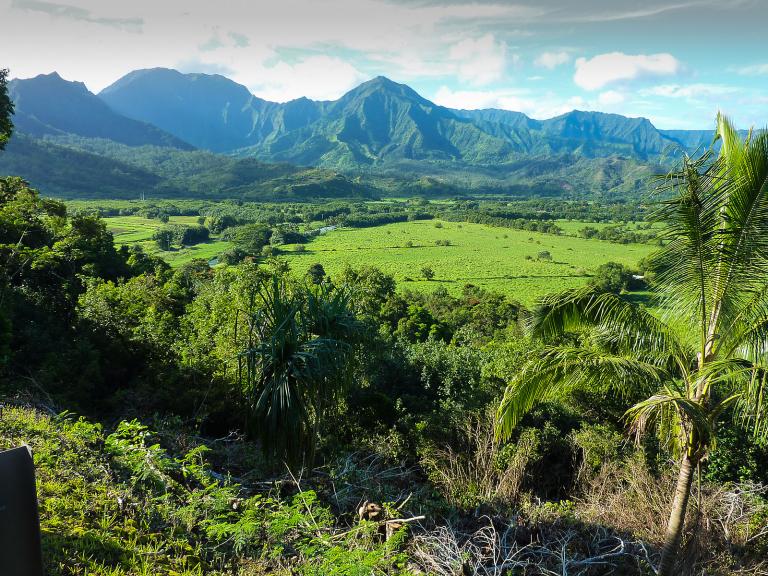
A landscape near Hanalei, not far from Princeville on Kaua’i’s northern shore
(Wikimedia Commons public domain image)
Traveling around Hawai’i — we went up and around to Princeville today, and out to the overlook by Kilauea Point Lighthouse — it’s interesting to see evidences of the forces that made its islands and that are now, in most places here, very slowly unmaking them. As the tectonic plate on which the Hawaiian Islands sit, the Pacific Plate, moves to the northwest at an annual rate of about 2.75 inches or seven centimeters — they leave behind them the stationary “hot spot” that formed them. Kaua’i and O‘ahu and the other islands age and begin very slowly to decay under the onslaught of rain and wind and — far and away the most important factor — under the relentless, never-ceasing pounding of the Pacific Ocean. Kaua’i — often called “The Garden Isle” — is the oldest of the significant tourist islands, geologically speaking. Necker Island, located about 430 miles northwest of Honolulu, rose at one point about 3300 feet above the ocean and was roughly the size of today’s O’ahu. Today, it’s little more than a rocky ridge. Its highest point is roughly 277 feet above sea level, its length is 0.8 miles, and its width at its very widest point is well under seven hundred feet.
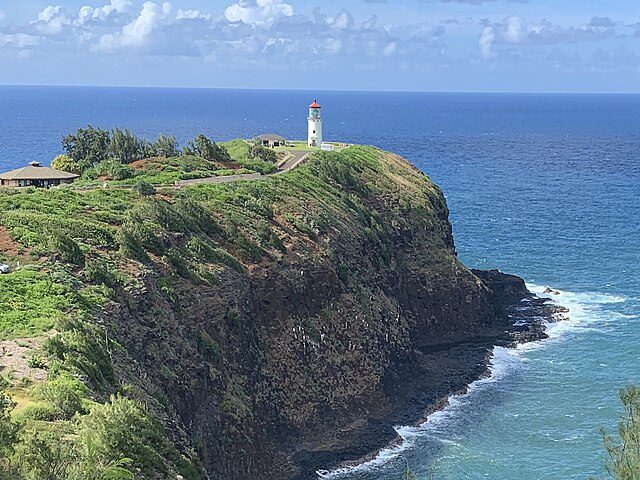
Kilauea Point, with its lighthouse. (Wikimedia Commons public domain image)
Kaua’i, long since volcanically quiescent, is very gradually approaching the fate of Necker Island. The resorts here will no longer be available for vacationing at that time; Lilikoi’s will no longer offer its excellent mahi-mahi fish and chips. Maui’s western volcano is scarcely recognizable as a volcano any more, except to an observant geologist or the occasional visiting geek like me who likes to read about local geological features while on vacation. Its eastern volcano, Haleakalā, is dormant. However, it still rises to more than ten thousand feet, and it’s still thought capable of erupting even now; its last recorded eruption occurred in 1790, which is, in geological terms, the merest blink of an eye.
But the real geological vitality in Hawai’i today continues in and near the southeastern-most of the islands, the so-called “Big Island,” which is itself named Hawai’i. Anybody who was paying attention to the news at that time will be aware of the fact that Mauna Loa erupted in November and December of 2022, and that Kilauea is erupting as I write. Further, underwater and offshore to the south southeast of the Big Island is the active volcanic seamount formerly known as “Lōʻihi.” In 2021, in its wisdom, the U.S. Geological Survey adopted for it, instead, the more ambitiously Hawaiian name of “glowing child of Kanaloa,” or Kamaʻehuakanaloa. (Kanaloa is the Hawaiian god of the ocean.) Somewhere between ten thousand years from now and a hundred thousand years from now, Kamaʻehuakanaloa will emerge above the surface of the Pacific Ocean. That’s probably sufficient time for real estate salespeople and condo developers to devise a way of dealing with its somewhat unwieldy new name. Perhaps, taking a cue from Jennifer Lopez, it can be K-Loa. (Can I collect royalties on that name?)
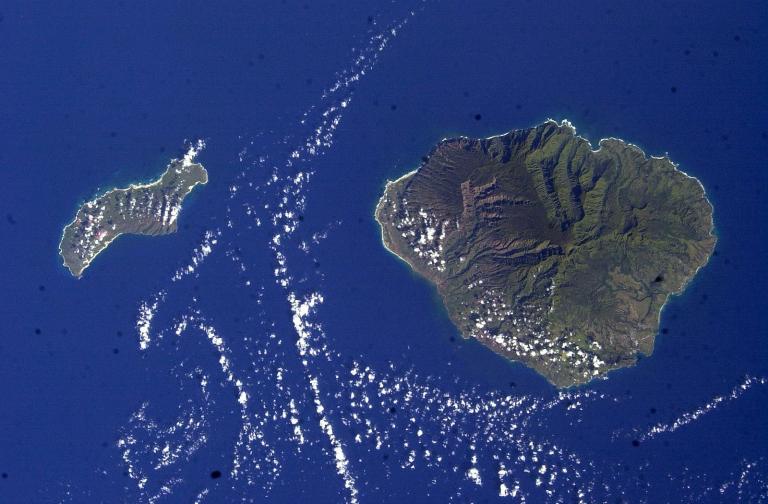
The so-called “Forbidden Island” of Ni’ihau is shown here to the west of the larger island of Kaua’i. I’m writing from the top of the little bay that is about at the five o’clock position on Kaua’i’s southeastern coast. I can see the bay through our window and from our veranda, where I’m sitting at the moment. (NASA public domain photograph)
I suppose that my overall meditation is this: In my ever-advancing old age, as people who meant a great deal to me and whom I love have passed on, the sentiment expressed in the hymn has come to mean more and more to me:
Abide with me; fast falls the eventide;
The darkness deepens; Lord with me abide.
When other helpers fail and comforts flee,
Help of the helpless, O abide with me.Swift to its close ebbs out life’s little day;
Earth’s joys grow dim; its glories pass away;
Change and decay in all around I see;
O Thou who changest not, abide with me.
If there is anything at all that could be termed a “terrestrial paradise,” I suppose that the Hawaiian Islands might come close. They are very beautiful. Their climate is delightful. Their breezes are (mostly) gentle. They are, today, fertile and rich with life. Even Mark Twain, a notable cynic, was deeply moved by them:
“No alien land in all the world has any deep strong charm for me but that one, no other land could so longingly and so beseechingly haunt me, sleeping and walking, through half a lifetime, as that one has done. Other things leave me, but it abides; other things change, but it remains the same. For me its balmy airs are always blowing, its summer seas flashing in the sun; the pulsing of its surfbeat is in my ear, I can see its garlanded crags, its leaping cascades, its plumy palms drowsing by the shore, its remote summits floating like islands above the cloud wrack; I can feel the spirit of its woodland solitudes, I can hear the splash of its brooks; in my nostrils still lives the breath of flowers that perished twenty years ago.”
But the Hawaiian Islands are unstable. Biology and geology have taught us that there is nothing immutable here on earth, and Hawai’i is one of our planet’s most obviously mutable locations.
The Hawaiian paradise began as barren volcanic rock emerging from the sea. It will end as barren volcanic rock crumbling into the sea. In the meantime, human corruption exists here just as it exists everywhere else. (Have you really never seen Hawaii Five-O?). And sickness and death are present here, as well. We passed at least two old cemeteries along the road to Princeville. The serpent has long since entered the Garden.
There is no earthly paradise. Not yet, anyway.
And there is no natural paradise in outer space. Pre-Copernican astronomy assured us that, in the superlunary world, beyond the sphere of the moon, all was changeless perfection. Orbits were perfect circles, the crystalline spheres were made of a perfectly transparent celestial element, a quintessence unlike the four changeable elements familiar to us here below. But Galileo and comets and sunspots changed all that.
Our hope for paradise must be fulfilled elsewhere, or not at all. As the author of the epistle to the Hebrews put it, speaking of the ancient saints:
13 All these people died in faith without receiving the promises, but they saw the promises from a distance and welcomed them. They confessed that they were strangers and immigrants on earth. 14 People who say this kind of thing make it clear that they are looking for a homeland. 15 If they had been thinking about the country that they had left, they would have had the opportunity to return to it. 16 But at this point in time, they are longing for a better country, that is, a heavenly one. Therefore, God isn’t ashamed to be called their God—he has prepared a city for them. (Hebrews 11:13-16, Common English Bible)
Posted from Līhuʻe, Kauaʻi, Hawai’i
Travel and Religion
History and Religion
Previous Post
February 23, 2024
Jodi Hildebrandt, Ruby Franke, and Mosiah's Dynasties
Next Post
February 25, 2024 Fact and Theory and Extraordinary Claims
Recent Comments
"I have cpnsidered in my mond if the 4 volume Saints could be made into ..."
From Serbia’s “White City,” Belgrade
"Another class of memories are of individuals who previously lived. Some of these remembered individuals ..."
"Sutherland's lecture sounds interesting. He seems to restate the Washington consensus that trade brings peace ..."
Learning more about a region of ..."
"In a meeting today, I learned another important reason why accurate (or at least as ..."
From Serbia’s “White City,” Belgrade
Browse Our Archives
Select a Category Uncategorized
Select a Month October 2026 September 2026 August 2026 July 2026 June 2026 May 2026 April 2026 March 2026 February 2026 January 2026 December 2025 November 2025 October 2025 September 2025 August 2025 July 2025 June 2025 May 2025 April 2025 March 2025 February 2025 January 2025 December 2024 November 2024 October 2024 September 2024 August 2024 July 2024 June 2024 May 2024 April 2024 March 2024 February 2024 January 2024 December 2023 November 2023 October 2023 September 2023 August 2023 July 2023 June 2023 May 2023 April 2023 March 2023 February 2023 January 2023 December 2022 November 2022 October 2022 September 2022 August 2022 July 2022 June 2022 May 2022 April 2022 March 2022 February 2022 January 2022 December 2021 November 2021 October 2021 September 2021 August 2021 July 2021 June 2021 May 2021 April 2021 March 2021 February 2021 January 2021 December 2020 November 2020 October 2020 September 2020 August 2020 July 2020 June 2020 May 2020 April 2020 March 2020 February 2020 January 2020 December 2019 November 2019 October 2019 September 2019 August 2019 July 2019 June 2019 May 2019 April 2019 March 2019 February 2019 January 2019 December 2018 November 2018 October 2018 September 2018 August 2018 July 2018 June 2018 May 2018 April 2018 March 2018 February 2018 January 2018 December 2017 November 2017 October 2017 September 2017 August 2017 July 2017 June 2017 May 2017 April 2017 March 2017 February 2017 January 2017 December 2016 November 2016 October 2016 September 2016 August 2016 July 2016 June 2016 May 2016 April 2016 March 2016 February 2016 January 2016 December 2015 November 2015 October 2015 September 2015 August 2015 July 2015 June 2015 May 2015 April 2015 March 2015 February 2015 January 2015 December 2014 November 2014 March 2014 August 2013 February 2012
Follow Us!
TAKE THE
Religious Wisdom Quiz
Who is known as the "weeping prophet"?
Select your answer to see how you score.
Joel Jeremiah Ezekiel Isaiah
Related posts from Sic et Non

"Am I Not a Man and a Brother?"
Historical notes about England and Hawaii
Still thinking about Kamehameha the Great

"Reclaiming Jefferson's University"
TRENDING AT PATHEOS Latter-day Saint

The First Eucharistic Controversy: Christ’s Real Presence
For Catholics, the Eucharist is the source and summit of the Christian...

What a Stop Sign Can Teach Us About...
How to Make a Decision When You Can't Hear God Main point:...

Archdiocese Hosts Military Marriage Retreat in Germany
RASTATT, Germany — The transient military lifestyle, with its frequent deployments and...

Nearly every morning, I make the drive to Detroit with my high-school-age...

The Real AI Story Is Adoption Without Trust
Artificial intelligence has crossed a political threshold. It is no longer a...

A new article, written by Jeff Lindsay and Gale L. Pooley,...
view all Latter-day Saint blogs
What Are Your Thoughts?leave a comment
Ad-Free & Subscriber Log-In Subscription Support
- About Us
- 2026 Calendar
- Videos
- Podcasts
- Library of World Religions
- Faith In Media Tracker
- Advertise With Us
- Write for Us
- Privacy Policy
- Terms of Service
- Do Not Sell My Data
- Contact Us
- Radiant Digital
- Manage Newsletter Subscriptions
- Unsubscribe From Notifications
- Sitemap
Copyright 2008-2026, Patheos. All rights reserved.
Subscription Support Ad-Free & Subscriber Log-In
Follow Patheos