
BuddhistCatholicContemplativeEvangelicalGeneral ChristianHinduJewishLatter-day SaintMuslimNew VisionsProgressive Christian
Beliefs
- Buddhist
- Catholic
- Contemplative
- Evangelical
- General Christian
- Hindu
- Jewish
- Latter-day Saint
- More Voices
- Muslim
- New Visions
- Pagan
- Progressive Christian
Topics
- Religion News
- Food and Religion
- Sports and Religion
- Religious Art
- Religious Music and Entertainment
- Religious Events
- History and Religion
- Style and Religion
- Politics and Religion
- Women in Religion
- Recreation Outdoors and Religion
- Business Finance and Religion
- Careers Workplace and Religion
- Education and Religion
- Family Parenting and Religion
- Health Fitness and Religion
- Home and Religion
- Relationships and Religion
- Technology and Religion
- Travel and Religion
Columnists
- Buddhist Columnists
- Business Finance and Religion Columnists
- Careers Workplace and Religion Columnists
- Catholic Columnists
- Contemplative Columnists
- Education and Religion Columnists
- Evangelists Columnists
- Family Parenting and Religion Columnists
- General Christian Columnists
- Health Fitness and Religion Columnists
- Hindu Columnists
- History and Religion Columnists
- Home and Religion Columnists
- Jewish Columnists
- More Voices Columnists
- Latter Day Columnists
- Muslim Columnists
- New Visions Columnists
- Nonreligious Columnists
- Pagan Columnists
- Politics and Religion Columnists
- Progressive Columnists
- Recreation Outdoors and Religion Columnists
- Relationships and Religion Columnists
- Religion News Columnists
- Religious Art Columnists
- Religious Events Columnists
- Religious Music and Entertainment Columnists
- Sports and Religion Columnists
- Style and Religion Columnists
- Technology and Religion Columnists
- Travel and Religion Columnists
- Women in Religion Columnists
Resource Library
- 2026 Calendar
- Library of World Religions
- The 100 Most Holy Places on Earth
- Patheos Answers
- Podcasts
- Videos
- Faith Leaders Database
- Anglican Episcopalian
- Bahai
- Baptist
- Buddhism
- Christianity
- Confucianism
- Eastern Orthodoxy
- Hinduism
- Holiness and Pentecostal
- ISKCON
- Islam
- Judaism
- Lutheran
- Methodist
- The Church of Jesus Christ of Latter-day Saints
- New Age
- Paganism
- Presbytarian and Reformed
- Protestantism
- Religion Behind the Scenes
- Roman Catholic
- Scientology
- Shia Islam
- Sikhism
- Sufism
- Sunni Islam
- Taoism
- Zen
- See all religions
Research Tools
 Ad-Free & Subscriber Log-In Subscription Support
Ad-Free & Subscriber Log-In Subscription Support
Follow Patheos 

- Trending:
- Forgiveness
- |
- Marriage
- |
- Consciousness
- |
- Death Penalty
- |
- Election
- |
- Halloween

- Home
- Latter-day Saint
- History and Religion
- Exclusivism, brokenness, and good health
Exclusivism, brokenness, and good health
Last updated on: January 18, 2024 at 7:15 pm by Dan Peterson
Exclusivism, brokenness, and good health 2024-01-18T19:15:13-07:00 Dan Peterson
Patheos Explore the world's faith through different perspectives on religion and spirituality! Patheos has the views of the prevalent religions and spiritualities of the world.

Magdalene Bridge and College, University of Cambridge, United Kingdom (Wikimedia Commons photograph by Simon Palmer)
Relatively late in his teaching career, C. S. Lewis left Magdalen College, Oxford, and took a professorship in this college, Magdalene College, in the University of Cambridge. Both are roughly a couple of hours outside of London, albeit in quite different directions.
As I say, I re-read C. S. Lewis’s book Mere Christianity on the flight over. It has been a fair while since I’ve read that particular book, and here are a couple of the many passages that struck me. I supply no page references both because there are multiple editions and because I was reading it on my iPad:
I have been asked to tell you what Christians believe, and I am going to begin by telling you one thing that Christians do not need to believe. If you are a Christian you do not have to believe that all the other religions are simply wrong all through. If you are an atheist you do have to believe that the main point in all the religions of the whole world is simply one huge mistake. If you are a Christian, you are free to think that all those religions, even the queerest ones, contain at least some hint of the truth. When I was an atheist I had to try to persuade myself that most of the human race have always been wrong about the question that mattered to them most; when I became a Christian I was able to take a more liberal view. But, of course, being a Christian does mean thinking that where Christianity differs from other religions, Christianity is right and they are wrong.. As in arithmetic – there is only one right answer to a sum, and all other answers are wrong; but some of the wrong answers are much nearer being right than others.
The first big division of humanity is into the majority, who believe in some kind of God or gods, and the minority who do not. On this point, Christianity lines up with the majority – lines up with ancient Greeks and Romans, modern savages, Stoics, Platonists, Hindus, Mohammedans, etc., against the modern Western European materialists. (C. S. Lewis, “The Rival Conceptions of God,” in Mere Christianity)
And this, from a few pages later:
My argument against God was that the universe seemed so cruel and unjust. But how had I got this idea of just and unjust? A man does not call a line crooked unless he has some idea of a straight line. What was I comparing this universe with when I called it unjust? If the whole show was bad and senseless from A to Z, so to speak, why did I, who was supposed to be part of the show, find myself in such violent reaction against it? A man feels wet when he falls into water, because man is not a water animal; a fish would not feel wet. Of course I could have given up my idea of justice by saying it was nothing but a private idea of my own. But if I did that, then my argument against God collapsed too – for the argument depended on saying that the world was really unjust, not simply that it did not happen to please my fancies. Thus in the very act of trying to prove that God did not exist – in other words, that the whole of reality was senseless – I found I was forced to assume that one part of reality – namely my idea of justice – was full of sense. Consequently atheism turns out to be too simple. If the whole universe has no meaning, we should never have found out that it has no meaning: just as, if there were no light in the universe and therefore no creature with eyes, we should never know it was dark. Dark would be a word without meaning. (C. S. Lewis, “The Rival Conceptions of God,” in Mere Christianity)
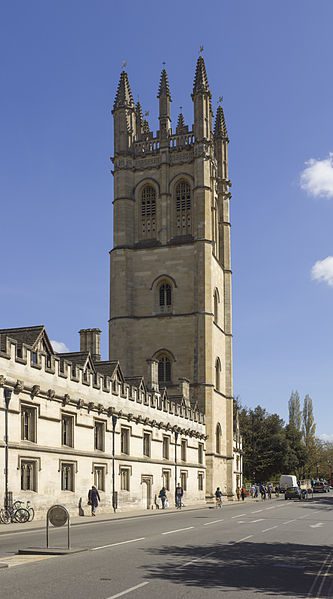
Magdalen Tower, from High Street
Magdalen College, Oxford, where C. S. Lewis spent much of his academic career, was founded in 1458.
(Wikimedia Commons public domain image)
But now — partly adhering, though not by design, to a celebration of British authors — I serve up something from the Christopher Hitchens Memorial “How Religion Poisons Everything” File™, which never fails in its steady stream of horrors visited upon innocent humanity:
Michael W. Parker, DSW; W. A. Achenbaum, PhD; Walter L. Larimore, MD, and Harold G. Koenig, MD, “Rowe and Kahn’s Model of Successful Aging Revisited: Positive Spirituality—The Forgotten Factor,” The Gerontologist 42/5 (2002), 613–620. At the time of this article’s publication, the authors were affiliated, respectively, with the Department of Psychology, The University of Alabama, Tuscaloosa; the Department of Social Work, The University of Alabama, Tuscaloosa; the College of Humanities, Fine Arts and Communication, The University of Houston, Texas; Focus on the Family, Colorado Springs, Colorado; and Duke University Medical Center and GRECC, VA Medical Center, Durham, North Carolina:
Purpose: We explain a new concept, positive spirituality,and offer evidence that links positive spirituality with health; describe effective partnerships between health professionals and religious communities; and summarize the information as a basis for strengthening the existing successful aging model proposed by Rowe and Kahn.Design and Methods: A missing component to Rowe and Kahn’s three-factor model of successful aging is identified, and we propose strengthening the model with a fourth factor, positive spirituality.Results: We developed an enhanced model of successful aging based on Rowe and Kahn’s theoretical framework. Evidence presented suggests that the addition of spirituality to interventions focused on health promotion has been received positively by older adults.Implications:Leaders in gerontology often fail to incorporate the growing body of scientific evidence regarding health, aging, and spirituality into their conceptual models to promote successful aging. The proposed enhancement of Rowe and Kahn’s model will help health professionals, religious organizations, and governmental agencies work collaboratively to promote wellness among older adults.
In other words, the authors argue that religion and spirituality are good for the health of older people — a group in whom, by the way, and rather curiously and for no obvious reason, I seem to take an ever-growing interest.
Posted from London, England
History and Religion
Health, Fitness and Religion
Previous Post

January 7, 2024
One of the greatest of all logicians on life after death
Next Post

January 9, 2024 Marratan ukhra fi umm al-dunya
Recent Comments
"I have cpnsidered in my mond if the 4 volume Saints could be made into ..."
From Serbia’s “White City,” Belgrade
"DP: “But Mr. Sutherland worries about the fact that our time, when we can communicate ..."
Learning more about a region of ..."
"Another class of memories are of individuals who previously lived. Some of these remembered individuals ..."
"Sutherland's lecture sounds interesting. He seems to restate the Washington consensus that trade brings peace ..."
Learning more about a region of ..."
Browse Our Archives
Select a Category Uncategorized
Select a Month October 2026 September 2026 August 2026 July 2026 June 2026 May 2026 April 2026 March 2026 February 2026 January 2026 December 2025 November 2025 October 2025 September 2025 August 2025 July 2025 June 2025 May 2025 April 2025 March 2025 February 2025 January 2025 December 2024 November 2024 October 2024 September 2024 August 2024 July 2024 June 2024 May 2024 April 2024 March 2024 February 2024 January 2024 December 2023 November 2023 October 2023 September 2023 August 2023 July 2023 June 2023 May 2023 April 2023 March 2023 February 2023 January 2023 December 2022 November 2022 October 2022 September 2022 August 2022 July 2022 June 2022 May 2022 April 2022 March 2022 February 2022 January 2022 December 2021 November 2021 October 2021 September 2021 August 2021 July 2021 June 2021 May 2021 April 2021 March 2021 February 2021 January 2021 December 2020 November 2020 October 2020 September 2020 August 2020 July 2020 June 2020 May 2020 April 2020 March 2020 February 2020 January 2020 December 2019 November 2019 October 2019 September 2019 August 2019 July 2019 June 2019 May 2019 April 2019 March 2019 February 2019 January 2019 December 2018 November 2018 October 2018 September 2018 August 2018 July 2018 June 2018 May 2018 April 2018 March 2018 February 2018 January 2018 December 2017 November 2017 October 2017 September 2017 August 2017 July 2017 June 2017 May 2017 April 2017 March 2017 February 2017 January 2017 December 2016 November 2016 October 2016 September 2016 August 2016 July 2016 June 2016 May 2016 April 2016 March 2016 February 2016 January 2016 December 2015 November 2015 October 2015 September 2015 August 2015 July 2015 June 2015 May 2015 April 2015 March 2015 February 2015 January 2015 December 2014 November 2014 March 2014 August 2013 February 2012
Follow Us!
TAKE THE
Religious Wisdom Quiz
Who is considered the ideal wife and mother in Proverbs?
Select your answer to see how you score.
Martha Eve The Proverbs 31 woman Mary Magdalene
Related posts from Sic et Non


From the sublime to the monstrous
TRENDING AT PATHEOS Latter-day Saint

The First Eucharistic Controversy: Christ’s Real Presence
For Catholics, the Eucharist is the source and summit of the Christian...

What a Stop Sign Can Teach Us About...
How to Make a Decision When You Can't Hear God Main point:...

Archdiocese Hosts Military Marriage Retreat in Germany
RASTATT, Germany — The transient military lifestyle, with its frequent deployments and...

Nearly every morning, I make the drive to Detroit with my high-school-age...

The Real AI Story Is Adoption Without Trust
Artificial intelligence has crossed a political threshold. It is no longer a...

A new article, written by Jeff Lindsay and Gale L. Pooley,...
view all Latter-day Saint blogs
What Are Your Thoughts?leave a comment
Ad-Free & Subscriber Log-In Subscription Support
- About Us
- 2026 Calendar
- Videos
- Podcasts
- Library of World Religions
- Faith In Media Tracker
- Advertise With Us
- Write for Us
- Privacy Policy
- Terms of Service
- Do Not Sell My Data
- Contact Us
- Radiant Digital
- Manage Newsletter Subscriptions
- Unsubscribe From Notifications
- Sitemap
Copyright 2008-2026, Patheos. All rights reserved.
Subscription Support Ad-Free & Subscriber Log-In
Follow Patheos