
BuddhistCatholicContemplativeEvangelicalGeneral ChristianHinduJewishLatter-day SaintMuslimNew VisionsProgressive Christian
Beliefs
- Buddhist
- Catholic
- Contemplative
- Evangelical
- General Christian
- Hindu
- Jewish
- Latter-day Saint
- More Voices
- Muslim
- New Visions
- Pagan
- Progressive Christian
Topics
- Religion News
- Food and Religion
- Sports and Religion
- Religious Art
- Religious Music and Entertainment
- Religious Events
- History and Religion
- Style and Religion
- Politics and Religion
- Women in Religion
- Recreation Outdoors and Religion
- Business Finance and Religion
- Careers Workplace and Religion
- Education and Religion
- Family Parenting and Religion
- Health Fitness and Religion
- Home and Religion
- Relationships and Religion
- Technology and Religion
- Travel and Religion
Columnists
- Buddhist Columnists
- Business Finance and Religion Columnists
- Careers Workplace and Religion Columnists
- Catholic Columnists
- Contemplative Columnists
- Education and Religion Columnists
- Evangelists Columnists
- Family Parenting and Religion Columnists
- General Christian Columnists
- Health Fitness and Religion Columnists
- Hindu Columnists
- History and Religion Columnists
- Home and Religion Columnists
- Jewish Columnists
- More Voices Columnists
- Latter Day Columnists
- Muslim Columnists
- New Visions Columnists
- Nonreligious Columnists
- Pagan Columnists
- Politics and Religion Columnists
- Progressive Columnists
- Recreation Outdoors and Religion Columnists
- Relationships and Religion Columnists
- Religion News Columnists
- Religious Art Columnists
- Religious Events Columnists
- Religious Music and Entertainment Columnists
- Sports and Religion Columnists
- Style and Religion Columnists
- Technology and Religion Columnists
- Travel and Religion Columnists
- Women in Religion Columnists
Resource Library
- 2026 Calendar
- Library of World Religions
- The 100 Most Holy Places on Earth
- Patheos Answers
- Podcasts
- Videos
- Faith Leaders Database
- Anglican Episcopalian
- Bahai
- Baptist
- Buddhism
- Christianity
- Confucianism
- Eastern Orthodoxy
- Hinduism
- Holiness and Pentecostal
- ISKCON
- Islam
- Judaism
- Lutheran
- Methodist
- The Church of Jesus Christ of Latter-day Saints
- New Age
- Paganism
- Presbytarian and Reformed
- Protestantism
- Religion Behind the Scenes
- Roman Catholic
- Scientology
- Shia Islam
- Sikhism
- Sufism
- Sunni Islam
- Taoism
- Zen
- See all religions
Research Tools
 Ad-Free & Subscriber Log-In Subscription Support
Follow Patheos 

- Trending:
- Advent
- |
- Forgiveness
- |
- Thanksgiving
- |
- Election
- |
- Seasonal Holidays
- |
- Marriage

- Home
- Latter-day Saint
- History and Religion
- Notes on Shared Death Experiences
Notes on Shared Death Experiences
Last updated on: November 25, 2023 at 8:41 pm by Dan Peterson
Notes on Shared Death Experiences 2023-11-25T20:41:56-07:00 Dan Peterson
Patheos Explore the world's faith through different perspectives on religion and spirituality! Patheos has the views of the prevalent religions and spiritualities of the world.

On the campus of the College of William & Mary, in Williamsburg, Virginia
(Wikimedia Commons public domain image)
While we were in Virginia recently, we not only took the time to visit some Civil War battlefields but to take family members to Jamestown — the first permanent English settlement in the Americas, famously associated with Pocahontas — out by Williamsburg, and, in the other direction, to Carter Mountain, near Charlottesville. In preparation for the Jamestown visit, some of us watched the 1995 Disney film Pocahontas. (Age appropriate, and all that.). And, of course, at Carter Mountain we picked apples, bought fresh apple pie, drank hot apple cider, and enjoyed the magnificent view of the surrounding countryside on a very clear and beautiful day.
The other high point during our stay in Williamsburg was that my former student Nathan B. Oman, who is currently Rita Anne Rollins Professor of Law at William & Mary Law School, dropped by the place where we were lodging. He and I had a very good conversation that evening. He is, in my judgment, one of the most interesting thinkers in the Church, even when, as does occasionally happen, we don’t quite see things in exactly the same way.
The College of William & Mary has a remarkable heritage.
It was founded in 1693 under a royal charter issued by King William III and Queen Mary II — hence its name — which makes it the second-oldest institution of higher education in the United States (after Harvard College, which was established in 1636) and the ninth-oldest in the English-speaking world altogether. Among its many distinguished alumni are Presidents Thomas Jefferson, James Monroe, John Tyler, and, in a sense, George Washington, as well as Chief Justice John Marshall, Senators Henry Clay and Thomas Hart Benton, Jon Stewart, the actress Glenn Close, General Winfield Scott, and the author (one of my favorites) James Branch Cabell.
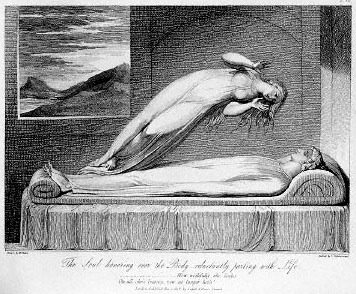
“The Soul Leaving the Body”
Luigi Schiavonetti (d. 1810)
Wikimedia Commons public domain image
It’s been a while since I’ve posted anything here about near-death experiences, which are a significant interest of mine. However, I recently read through the latest issue of the principal academic journal in the field. So I will now share a little bit from “Comparing Near-Death Experiences and Shared Death Experiences: An Illuminating Contrast,” Journal of Near-Death Studies 40/21 (Summer 2022), 77-94. (Obviously, the journal is a bit behind its publication schedule. Sadly, not uncommon with many academic periodicals.) Authorship of the article is attributed to the “Shared Crossing Research Initiative (SCRI),” a team of researchers based in Santa Barbara, California, but the principal authors appear to have been Michael Kinsella and William Peters. They note that “To date, researchers have published only one qualitative study of SDEs” — and that one, published in 2021, was done by SCRI itself.
What are “shared death experiences”?
Individuals may sense — physically and/or intuitively — that a loved one is dying; witness various unusual phenomena associated with death — such as seeing what is believed to be the dying person’s spirit leaving their body; find themselves either out of body or in a visionary realm where they seem to be accompanying the dying to some destination; and/or feel that they are somehow actively assisting the dying to transition. (79)
The authors note that near-death experiences are often “dismissed” — unpersuasively, they say (and I agree) — “as perceptual hallucinations occurring by natural mechanisms or due to various neurobiological or psychological factors” linked to the dying process or, even, to the perception (whether accurate or not) of impending death
But SDE’s are more difficult to explain in that they happen to individuals who are not themselves physically or psychologically close to dying. (79)
The authors point out that their previous study had noted strong similarities between NDEs and SDEs. Among those similarities is that both seemed very real, indeed hyper-real (78).
“It was like being in a vision, but very real and vivid, unmistakably real.” (Cynthia Ploski regarding her NDE, cited on page 80; italics in the original)
“[T]his experience where I was there seemed realer than this real.” (Magrethe K of her SDE, pages 80-81, 82)
Another important commonality is this one:
NDErs sometimes return with information not yet known in the physical world but subsequently verified as accurate. We observed this same feature in SDEs. (81)
One of the recurring features of near-death experiences is a strange and ultimately indescribable light, often golden, that seems not only brilliant but somehow loving and inviting and sometimes even personal. That same feature seems to occur in SDEs, too. The authors share part of an experience that Angela H. claims to have had while approaching the deathbed of her mother in law:
I noticed that the room was a welcoming gold color and unusual. It looked warm and it looked as though you wanted to be in there. . . . I started to think, “Oh, it looks an absolutely beautiful gold color!” And as I got to the room, it felt like the whole room was in some kind of a bubble. (83)
Scott T’s girlfriend died as the result of a tragic car accident. A few days later, that girlfriend’s son also died from injuries sustained in the accident, while Scott T sat by the boy’s bedside:
So, I’m in the room, and I have stepped into another dimension. “Stepped” isn’t the right word, but I have entered into another dimension that is simultaneous with the one that I am in. And so that’s how come I can say I was in the space with [his girlfriend] and [his girlfriend’s son] and got to witness their reunion and got to go with them into the light, and into the light meant opening to the light that is in us all. And so that’s the only language that I can use to describe it. This is why the very first thing, when you read about the common components of near-death experiences, the very first one is ineffable. It is really hard to describe what it’s like to be in the physical and at the same time to be someplace else that is this extraordinary place of divine love. (85)
(to be continued)

A twenty-first-century Latter-day Saint maiden?
(Wikimedia Commons public domain image)
Finally, I nod briefly in the direction of the Christopher Hitchens Memorial “How Religion Poisons Everything” File™:
A brief article from the unfailingly worthwhile Stephen Cranney: “Perspective: Religion isn’t sexually repressive. Just read the data. Those who insist that religion is a buzzkill have not read the literature” And if you’re tempted to doubt that those who insist that religion is a buzzkill haven’t read the literature, just take a look at the unwittingly amusing comments that follow the article. Empirical data plainly has little or no effect on such folks.
History and Religion
Education and Religion
Previous Post

November 24, 2023
Mormon, Zeniff, and Limhi
Next Post

November 26, 2023 Of quasars and Jesus
Recent Comments
"the Problem: I suspect, since you are commenting here, that your lead levels did not ..."
Demmed if it do and demmed ..."
"https://www.youtube.com/watch?v=m7dM6SJgoM0Just a bit of folk music honouring old Tom Paine. I should probably link the ..."
Thomas Paine, the Smiths, the apostles ..."
"I've joked more than once, that had I not attached so many lead sinkers to ..."
Demmed if it do and demmed ..."
"A Big Bang may not necessarily be the Beginning. It may be an event in ..."
Browse Our Archives
Select a Category Uncategorized
Select a Month November 2026 October 2026 September 2026 August 2026 July 2026 June 2026 May 2026 April 2026 March 2026 February 2026 January 2026 December 2025 November 2025 October 2025 September 2025 August 2025 July 2025 June 2025 May 2025 April 2025 March 2025 February 2025 January 2025 December 2024 November 2024 October 2024 September 2024 August 2024 July 2024 June 2024 May 2024 April 2024 March 2024 February 2024 January 2024 December 2023 November 2023 October 2023 September 2023 August 2023 July 2023 June 2023 May 2023 April 2023 March 2023 February 2023 January 2023 December 2022 November 2022 October 2022 September 2022 August 2022 July 2022 June 2022 May 2022 April 2022 March 2022 February 2022 January 2022 December 2021 November 2021 October 2021 September 2021 August 2021 July 2021 June 2021 May 2021 April 2021 March 2021 February 2021 January 2021 December 2020 November 2020 October 2020 September 2020 August 2020 July 2020 June 2020 May 2020 April 2020 March 2020 February 2020 January 2020 December 2019 November 2019 October 2019 September 2019 August 2019 July 2019 June 2019 May 2019 April 2019 March 2019 February 2019 January 2019 December 2018 November 2018 October 2018 September 2018 August 2018 July 2018 June 2018 May 2018 April 2018 March 2018 February 2018 January 2018 December 2017 November 2017 October 2017 September 2017 August 2017 July 2017 June 2017 May 2017 April 2017 March 2017 February 2017 January 2017 December 2016 November 2016 October 2016 September 2016 August 2016 July 2016 June 2016 May 2016 April 2016 March 2016 February 2016 January 2016 December 2015 November 2015 October 2015 September 2015 August 2015 July 2015 June 2015 May 2015 April 2015 March 2015 February 2015 January 2015 December 2014 November 2014 March 2014 August 2013 February 2012
Follow Us!
TAKE THE
Religious Wisdom Quiz
True or False: Boaz was Ruth's brother-in-law who married her.
Select your answer to see how you score.
TRUE FALSE
Related posts from Sic et Non




TRENDING AT PATHEOS Latter-day Saint

Debate on Purgatory & Biblical Evidences for It
This is from a combox on my video channel, Catholic Bible Highlights....

Set the table for the coming King
On Thursday we visited my sister-in-law for Thanksgiving, and throughout the entire...

If I Stop Becoming, Will I Disappear?
(At our most recent half day Zen retreat, Dr Chris Hoff, a...

A Modest Proposal for President Trump
Trump should just quit the loser Republicans who failed him so badly...

Praise and Thanks As Natural as Breathing
This week I had the privilege of sitting down with Deacon Tom...

Jesus is Coming with Glory and Power
https://www.youtube.com/watch?v=_lt60EDHOQ4&list=RD_lt60EDHOQ4&start_radio=1
view all Latter-day Saint blogs
What Are Your Thoughts?leave a comment
Ad-Free & Subscriber Log-In Subscription Support
- About Us
- 2026 Calendar
- Videos
- Podcasts
- Library of World Religions
- Faith In Media Tracker
- Advertise With Us
- Write for Us
- Privacy Policy
- Terms of Service
- Do Not Sell My Data
- Contact Us
- Radiant Digital
- Manage Newsletter Subscriptions
- Unsubscribe From Notifications
- Sitemap
Copyright 2008-2026, Patheos, part of the Radiant Digital network of media brands. All rights reserved.
Subscription Support Ad-Free & Subscriber Log-In
Follow Patheos