
BuddhistCatholicContemplativeEvangelicalGeneral ChristianHinduJewishLatter-day SaintMuslimNew VisionsProgressive Christian
Beliefs
- Buddhist
- Catholic
- Contemplative
- Evangelical
- General Christian
- Hindu
- Jewish
- Latter-day Saint
- More Voices
- Muslim
- New Visions
- Pagan
- Progressive Christian
Topics
- Religion News
- Food and Religion
- Sports and Religion
- Religious Art
- Religious Music and Entertainment
- Religious Events
- History and Religion
- Style and Religion
- Politics and Religion
- Women in Religion
- Recreation Outdoors and Religion
- Business Finance and Religion
- Careers Workplace and Religion
- Education and Religion
- Family Parenting and Religion
- Health Fitness and Religion
- Home and Religion
- Relationships and Religion
- Technology and Religion
- Travel and Religion
Columnists
- Buddhist Columnists
- Business Finance and Religion Columnists
- Careers Workplace and Religion Columnists
- Catholic Columnists
- Contemplative Columnists
- Education and Religion Columnists
- Evangelists Columnists
- Family Parenting and Religion Columnists
- General Christian Columnists
- Health Fitness and Religion Columnists
- Hindu Columnists
- History and Religion Columnists
- Home and Religion Columnists
- Jewish Columnists
- More Voices Columnists
- Latter Day Columnists
- Muslim Columnists
- New Visions Columnists
- Nonreligious Columnists
- Pagan Columnists
- Politics and Religion Columnists
- Progressive Columnists
- Recreation Outdoors and Religion Columnists
- Relationships and Religion Columnists
- Religion News Columnists
- Religious Art Columnists
- Religious Events Columnists
- Religious Music and Entertainment Columnists
- Sports and Religion Columnists
- Style and Religion Columnists
- Technology and Religion Columnists
- Travel and Religion Columnists
- Women in Religion Columnists
Resource Library
- 2026 Calendar
- Library of World Religions
- The 100 Most Holy Places on Earth
- Patheos Answers
- Podcasts
- Videos
- Faith Leaders Database
- Anglican Episcopalian
- Bahai
- Baptist
- Buddhism
- Christianity
- Confucianism
- Eastern Orthodoxy
- Hinduism
- Holiness and Pentecostal
- ISKCON
- Islam
- Judaism
- Lutheran
- Methodist
- The Church of Jesus Christ of Latter-day Saints
- New Age
- Paganism
- Presbytarian and Reformed
- Protestantism
- Religion Behind the Scenes
- Roman Catholic
- Scientology
- Shia Islam
- Sikhism
- Sufism
- Sunni Islam
- Taoism
- Zen
- See all religions
Research Tools
 Ad-Free & Subscriber Log-In Subscription Support
Ad-Free & Subscriber Log-In Subscription Support
Follow Patheos 

- Trending:
- Forgiveness
- |
- Marriage
- |
- Consciousness
- |
- Death Penalty
- |
- Election
- |
- Halloween

- Home
- Latter-day Saint
- History and Religion
- Up in the Air
Up in the Air
Last updated on: October 14, 2023 at 12:52 pm by Dan Peterson
Up in the Air 2023-10-14T12:52:44-06:00 Dan Peterson
Patheos Explore the world's faith through different perspectives on religion and spirituality! Patheos has the views of the prevalent religions and spiritualities of the world.
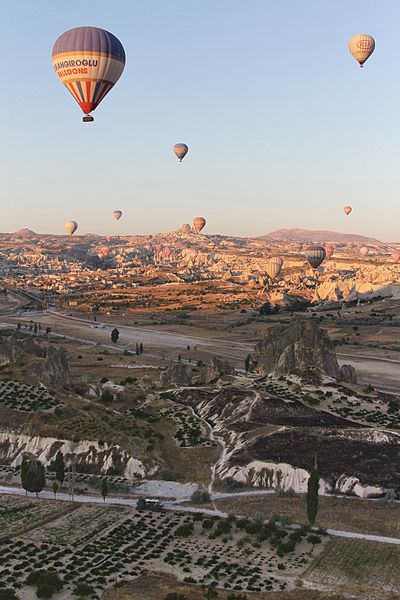
(Wikimedia Commons public domain image)
Cappadocia, in Turkey, is one of the most interesting places I’ve ever visited, and has one of the most interesting landscapes. And the dawn balloon rides are fabulous.
Two new articles appeared yesterday on the website of the Interpreter Foundation. I’m behind in calling attention to them, partly because I’m nine hours ahead of the time zone in which Interpreter is headquartered and partly because, well, I’m really busy. Anyway, here they be:
“Joseph Smith’s Education and Intellect as Described in Documentary Sources,” written by Brian C. Hales
Abstract: Although Joseph Smith has been credited with “approximately seven full school years” of district schooling, further research supports that his education consisted of basic instruction in “reading, writing and the ground rules of arithmetic” comprising “less than two years of formal schooling.” The actual number of terms he experienced in common schools in upstate New York is probably less critical since the curricula in district schools did not then teach creative writing, composition, or extemporaneous speaking. If Joseph Smith learned how to compose and dictate a book, extracurricular activities would likely have been the training source. Six of those can be identified: (1) private Bible studies, (2) Hyrum Smith’s possible tutoring in 1813, (3) participation in local religious activities, (4) involvement with the local juvenile debate club, (5) occasional family storytelling gatherings, and (6) brief participation as an exhorter at Methodist meetings. Three of his teachers in Kirtland in 1834–1836 recalled his impressive learning ability, but none described him as an accomplished scholar. A review of all available documentation shows that no acquaintance at that time or later called him highly educated or as capable of authoring the Book of Mormon. Despite its current popularity, the theory that Joseph Smith possessed the skills needed to create the Book of Mormon in 1829 is contradicted by dozens of eyewitness accounts and supported only by minimal historical data.
“Interpreting Interpreter: Education and Intellect,” written by Kyler Rasmussen
This post is a summary of the article “Joseph Smith’s Education and Intellect as Described in Documentary Sources” by Brian C. Hales in Volume 59 of Interpreter: A Journal of Latter-day Saint Faith and Scholarship. All of the articles may be seen at https://interpreterfoundation.org/category/summaries/. An introduction to the Interpreting Interpreter series is available at https://interpreterfoundation.org/interpreting-interpreter-on-abstracting-thought/.
The Takeaway: Hales provides a thorough account of Joseph Smith’s educational attainments and intellectual abilities, concluding that there is little evidence that either would have given him the skills needed to fabricate the Book of Mormon in 1829.
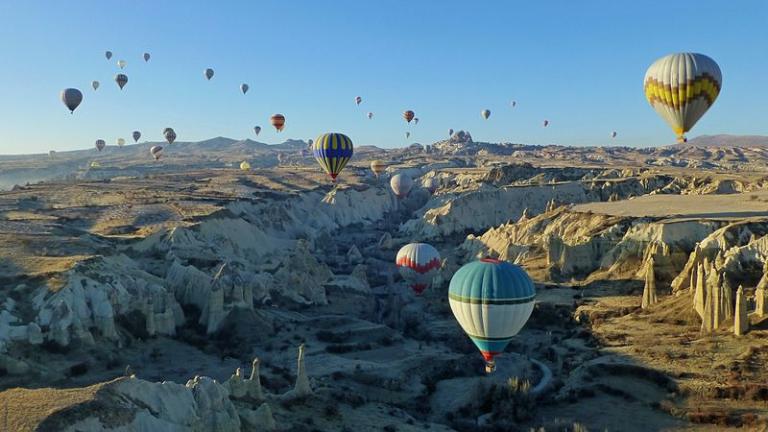
One of the favorite tourist activities in Cappadocia is taking an early morning balloon ride. This Wikimedia Commons photograph, by Nevit Dilmen, shows such balloons near Göreme, which is where my wife and I have now done it twice.
Incidentally, Brian Hales and his wife are here with us right now, on this Interpreter Foundation tour in Cappadocia.
But what on earth is Cappadocia?
It is a region in central Anatolia, which is to say that it lies in the center of modern Turkey or Türkiye. Have I explained those terms yet? The name Turkey is apparently attested in an early work by Geoffrey Chaucer, written somewhere about 1368, called The Book of the Duchess. It means “land of the Turks.” Since the proclamation of the Turkish republic on 29 October 1923, the official name of Turkey in Turkish has been Türkiye Cumhuriyeti, “the Republic of Turkey.” (The letter c is pronounced in Turkish like the English letter j in, say, jello or jeopardy.) In 2021, Turkey changed its spelling in English to Türkiye. And, out of respect for the preferences of the Turks, that spelling is increasingly being used worldwide—by the U.S. Department of State, for example, and by the Church of Jesus Christ of Latter-day Saints. It will, I admit, take some getting used to. But, really, hasn’t it always been embarrassing to have a country that seems to have been named after a particularly stupid bird?
Actually, of course, the naming seems to have gone the other way. I’m tired right now, so I’m simply going to shamelessly quote from Wikipedia:
The linguist Mario Pei proposes two possible explanations for the name turkey. One theory suggests that when Europeans first encountered turkeys in the Americas, they incorrectly identified the birds as a type of guineafowl, which were already being imported into Europe by English merchants to the levant via Constantinople. The birds were therefore nicknamed turkey coqs. The name of the North American bird may have then become turkey fowl or Indian turkeys, which was eventually shortened to turkeys.
A second theory arises from turkeys coming to England not directly from the Americas, but via merchant ships from the Middle East, where they were domesticated successfully. Again the importers lent the name to the bird; hence turkey-cocks and turkey-hens, and soon thereafter, turkeys.
In 1550, the English navigator William Strickland, who had introduced the turkey into England, was granted a coat of arms including a “turkey-cock in his pride proper.” William Shakespeare used the term in Twelfth Night, believed to be written in 1601 or 1602. The lack of context around his usage suggests that the term was already widespread.
The name Cappadocia is frequently pronounced by speakers of English as either KappaDOSHa or KappaDOtcha, and I suppose that that is, or has become, acceptable. Strictly speaking, though, the word should probably be pronounced with a hard k sound rather than a sh sound. In Greek, the name is Kappadokía (Καππαδοκία), and, in Turkish, it is Kapadokya.
Cappadocia appears both in ancient scripture and, as a result of that mention, in modern scripture. In the account given in the book of Acts (at 2:9), the Cappadocians are named as one of the groups (listed among “Parthians, Medes and Elamites; residents of Mesopotamia, Judea and Cappadocia, Pontus and Asia”) who heard the good news of the Gospel in their own language on the day of Pentecost shortly after the resurrection of Christ. As Acts 2:5 explains, “Now there were staying in Jerusalem God-fearing Jews from every nation under heaven”—which, by the way, seems to suggest that those Cappadocians (or, at least, some of them) were diaspora Jews who happened to be present in Jerusalem at the time.
The second scriptural mention of Cappadocia occurs in Joseph F. Smith’s account of his 1918 “Vision of the Redemption of the Dead,” which has been included in the scriptural canon of the Church of Jesus Christ of Latter-day Saints since 1976:
On the third of October, in the year nineteen hundred and eighteen, I sat in my room pondering over the scriptures;
And reflecting upon the great atoning sacrifice that was made by the Son of God, for the redemption of the world;
And the great and wonderful love made manifest by the Father and the Son in the coming of the Redeemer into the world;
That through his atonement, and by obedience to the principles of the gospel, mankind might be saved.
While I was thus engaged, my mind reverted to the writings of the apostle Peter, to the primitive saints scattered abroad throughout Pontus, Galatia, Cappadocia, and other parts of Asia, where the gospel had been preached after the crucifixion of the Lord. (Doctrine and Covenants 138:1-5)
Most of us commenced the morning with a very early hot-air balloon ride. (We were picked up by the shuttles for the launch site at 4:50 AM.) We floated over and among the weird rock formations that are characteristic of the area, and then, from a high altitude, caught the sunrise over a volcanic peak to the east.
We spent the remainder of the day looking at surreal landscapes and churches carved into the rock – e.g. at Çavuşin Valley, at Göreme, and at Paşabağı – and then finishing it off with a visit to a ceramics factory or studio. Cappadocia has been known for its ceramic pottery and tiles since the age of the Hittites, in the early second millennium BC.
Posted from Ürgüp, Cappadocia, Türkiye
History and Religion
Travel and Religion
Previous Post
October 13, 2023
In Cappadocia
Next Post
October 15, 2023 Kaymaklı and Göreme
Recent Comments
"DP: “But Mr. Sutherland worries about the fact that our time, when we can communicate ..."
Learning more about a region of ..."
"Another class of memories are of individuals who previously lived. Some of these remembered individuals ..."
"Sutherland's lecture sounds interesting. He seems to restate the Washington consensus that trade brings peace ..."
Learning more about a region of ..."
"In a meeting today, I learned another important reason why accurate (or at least as ..."
From Serbia’s “White City,” Belgrade
Browse Our Archives
Select a Category Uncategorized
Select a Month October 2026 September 2026 August 2026 July 2026 June 2026 May 2026 April 2026 March 2026 February 2026 January 2026 December 2025 November 2025 October 2025 September 2025 August 2025 July 2025 June 2025 May 2025 April 2025 March 2025 February 2025 January 2025 December 2024 November 2024 October 2024 September 2024 August 2024 July 2024 June 2024 May 2024 April 2024 March 2024 February 2024 January 2024 December 2023 November 2023 October 2023 September 2023 August 2023 July 2023 June 2023 May 2023 April 2023 March 2023 February 2023 January 2023 December 2022 November 2022 October 2022 September 2022 August 2022 July 2022 June 2022 May 2022 April 2022 March 2022 February 2022 January 2022 December 2021 November 2021 October 2021 September 2021 August 2021 July 2021 June 2021 May 2021 April 2021 March 2021 February 2021 January 2021 December 2020 November 2020 October 2020 September 2020 August 2020 July 2020 June 2020 May 2020 April 2020 March 2020 February 2020 January 2020 December 2019 November 2019 October 2019 September 2019 August 2019 July 2019 June 2019 May 2019 April 2019 March 2019 February 2019 January 2019 December 2018 November 2018 October 2018 September 2018 August 2018 July 2018 June 2018 May 2018 April 2018 March 2018 February 2018 January 2018 December 2017 November 2017 October 2017 September 2017 August 2017 July 2017 June 2017 May 2017 April 2017 March 2017 February 2017 January 2017 December 2016 November 2016 October 2016 September 2016 August 2016 July 2016 June 2016 May 2016 April 2016 March 2016 February 2016 January 2016 December 2015 November 2015 October 2015 September 2015 August 2015 July 2015 June 2015 May 2015 April 2015 March 2015 February 2015 January 2015 December 2014 November 2014 March 2014 August 2013 February 2012
Follow Us!
TAKE THE
Religious Wisdom Quiz
According to Jesus, what defiles a person?
Select your answer to see how you score.
Money What comes out of the heart Food eaten Clothing
Related posts from Sic et Non
How many divine beings appeared in Joseph's First...

"The Physicality of the Small Plates"
TRENDING AT PATHEOS Latter-day Saint

Nearly every morning, I make the drive to Detroit with my high-school-age...

The Real AI Story Is Adoption Without Trust
Artificial intelligence has crossed a political threshold. It is no longer a...

A new article, written by Jeff Lindsay and Gale L. Pooley,...

Swimfan: Forgotten Aughts Pleasures
This is a recovery effort. In 2002, My Big Fat Greek Wedding...

Top Three Anti-Catholic Lies About Catholicism
This is my initial transcript for the video, "THE 3 WORST...

Pope Leo Celebrates Mass for Nurses & Docs...
I don't have any idea how he did it, but Pope Leo...
view all Latter-day Saint blogs
What Are Your Thoughts?leave a comment
Ad-Free & Subscriber Log-In Subscription Support
- About Us
- 2026 Calendar
- Videos
- Podcasts
- Library of World Religions
- Faith In Media Tracker
- Advertise With Us
- Write for Us
- Privacy Policy
- Terms of Service
- Do Not Sell My Data
- Contact Us
- Radiant Digital
- Manage Newsletter Subscriptions
- Unsubscribe From Notifications
- Sitemap
Copyright 2008-2026, Patheos. All rights reserved.
Subscription Support Ad-Free & Subscriber Log-In
Follow Patheos