
BuddhistCatholicContemplativeEvangelicalGeneral ChristianHinduJewishLatter-day SaintMuslimNew VisionsProgressive Christian
Beliefs
- Buddhist
- Catholic
- Contemplative
- Evangelical
- General Christian
- Hindu
- Jewish
- Latter-day Saint
- More Voices
- Muslim
- New Visions
- Pagan
- Progressive Christian
Topics
- Religion News
- Food and Religion
- Sports and Religion
- Religious Art
- Religious Music and Entertainment
- Religious Events
- History and Religion
- Style and Religion
- Politics and Religion
- Women in Religion
- Recreation Outdoors and Religion
- Business Finance and Religion
- Careers Workplace and Religion
- Education and Religion
- Family Parenting and Religion
- Health Fitness and Religion
- Home and Religion
- Relationships and Religion
- Technology and Religion
- Travel and Religion
Columnists
- Buddhist Columnists
- Business Finance and Religion Columnists
- Careers Workplace and Religion Columnists
- Catholic Columnists
- Contemplative Columnists
- Education and Religion Columnists
- Evangelists Columnists
- Family Parenting and Religion Columnists
- General Christian Columnists
- Health Fitness and Religion Columnists
- Hindu Columnists
- History and Religion Columnists
- Home and Religion Columnists
- Jewish Columnists
- More Voices Columnists
- Latter Day Columnists
- Muslim Columnists
- New Visions Columnists
- Nonreligious Columnists
- Pagan Columnists
- Politics and Religion Columnists
- Progressive Columnists
- Recreation Outdoors and Religion Columnists
- Relationships and Religion Columnists
- Religion News Columnists
- Religious Art Columnists
- Religious Events Columnists
- Religious Music and Entertainment Columnists
- Sports and Religion Columnists
- Style and Religion Columnists
- Technology and Religion Columnists
- Travel and Religion Columnists
- Women in Religion Columnists
Resource Library
- 2026 Calendar
- Library of World Religions
- The 100 Most Holy Places on Earth
- Patheos Answers
- Podcasts
- Videos
- Faith Leaders Database
- Anglican Episcopalian
- Bahai
- Baptist
- Buddhism
- Christianity
- Confucianism
- Eastern Orthodoxy
- Hinduism
- Holiness and Pentecostal
- ISKCON
- Islam
- Judaism
- Lutheran
- Methodist
- The Church of Jesus Christ of Latter-day Saints
- New Age
- Paganism
- Presbytarian and Reformed
- Protestantism
- Religion Behind the Scenes
- Roman Catholic
- Scientology
- Shia Islam
- Sikhism
- Sufism
- Sunni Islam
- Taoism
- Zen
- See all religions
Research Tools
 Ad-Free & Subscriber Log-In Subscription Support
Ad-Free & Subscriber Log-In Subscription Support
Follow Patheos 

- Trending:
- Forgiveness
- |
- Marriage
- |
- Consciousness
- |
- Death Penalty
- |
- Election
- |
- Halloween

- Home
- Latter-day Saint
- History and Religion
- Smyrna and Pergamum
Smyrna and Pergamum
Last updated on: October 19, 2023 at 2:21 pm by Dan Peterson
Smyrna and Pergamum 2023-10-19T14:21:20-06:00 Dan Peterson
Patheos Explore the world's faith through different perspectives on religion and spirituality! Patheos has the views of the prevalent religions and spiritualities of the world.
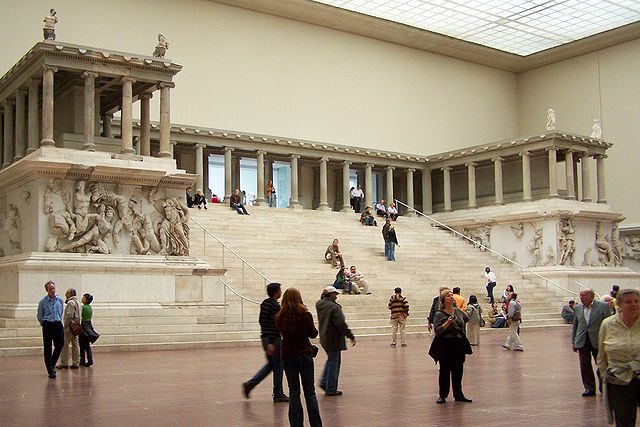
The Pergamon Altar as it has been displayed in Berlin
(Wikimedia Commons public domain photo)
The church of Smyrna (Σμύρνη, Smýrnē, or Σμύρνα, Smýrna) was also one of the seven churches of Asia that are mentioned in the Revelation of John. (See Revelation 2.) Since around 1930 (in the wake of the founding of the Republic of Turkey), Smyrna has been known as Izmir. It’s where we spent last night.
It is a port city that is located at a strategic point on the Aegean coast of Türkiye or Anatolia. Smyrna was situated at the mouth of a small river called Hermus and at the head of a deep arm of the sea (Smyrnaeus Sinus, today’s Gulf of Izmir) that reached far inland. This enabled Greek trading ships to sail into the heart of Lydia and, thus, made the city an important part of a vital trade route running between central Anatolia and the Aegean.
The Meles River, which flowed by Smyrna, was famous in classical literature and was even worshipped by those living in the valley. Moreover, a common and consistent tradition connects the great poet Homer with the valley of Smyrna and the banks of the Meles. The epithet Melesigenes (roughly, “born of the Meles”) was applied to him; the cave where he is said to have composed his poems was historically pointed out to visitors near the source of the river; his temple, the Homereum, stood on its banks.
A Christian church and, indeed, a bishopric existed in Pergamon from very early times, probably because of the city’s significant ancient Jewish minority. Its most important early Christian figure was its onetime bishop, St. Polycarp, whose name means something like “much fruit” and who was martyred at the enthusiastic urging of a combined mob of Jews and pagans in or around AD 153. Polycarp is said to have been a disciple of the apostle John and to have been ordained a bishop under John’s hand. Some scholars even believe that the New Testament epistles of 1 Timothy, 2 Timothy, and Titus were actually written by St. Polycarp rather than by the apostle Paul. Polycarp definitely wrote an epistle of his own, to the Philippians. St. Ignatius of Antioch, who was martyred at Rome in the first half of the second century, visited Smyrna and later wrote letters to St. Polycarp. And St. Irenaeus of Lyon (martyred ca. AD 202), who, as a boy, heard St. Polycarp preach, was probably a native of Smyrna.
This morning, we visited the most important historical structure of ancient Smyrna, its Agora, which is said to be (and I have no reason to doubt it) one of the best-preserved structures of ancient Ionia. Both my wife and I were amazed at how extensive and well displayed it was; our memories of when we first visited it many years ago agree that it was just a few rocks in a field of mostly dirt, scarcely worth visiting again.
After spending a fair amount of time visiting the heart of ancient Smyrna, we drove to Bergama. There we visited the Asclepion, the ancient temple of Aesculapius (the Greek god or demigod of medicine and of healing), one of the major “medical” centers of antiquity, where the great Galen (AD 129-216) received his basic training as a physician.
A larger-than-life-size statue of Galen adorns one of the intersections in Bergama. I was delighted to see it, not only because he became famous as a philosopher and as physician to Emperor Marcus Aurelius, but because he was perhaps the most prolific author of antiquity and because, in small part, the Middle Eastern Texts Initiative that I founded at Brigham Young University was involved with him.
After walking around the Asclepion, we ascended to the Acropolis of ancient Pergamum or Pergamon (Πέργαμον or, in modern Greek Pergamos [Πέργαμος]) by bus and by aerial tramway, where we walked about and examined such features as the city’s temple of Trajan.
The church of Pergamon, another of the famous seven churches – the northernmost of them — was praised for its forbearance (see Revelation 2:12-17) and some say that it was here that the first Christians were executed by Rome.
During the Hellenistic period, Pergamon became the capital of the Kingdom of Pergamon and one of the major cultural centers of the entire Greek world. The temple of Trajan, already mentioned, is merely one of the very impressive sights to be seen on the acropolis. But the most famous structure from the city is undoubtedly its monumental Great Altar, dating to the early second century before Christ, which was most likely dedicated either to Zeus or to Athena. The altar measures about 36 x 33 meters at its base. Its foundations can still be seen, but the high-relief frieze from it, roughly 2.3 meters high and 113 meters long, which depicts the Gigantomachy, the battle between the gods of Olympus and the Titans or giants, was carried away at the end of the nineteenth century to Germany. There it is housed in the magnificent Pergamonmuseum in Berlin – which, alas, is currently closed for renovations.
The reference at Revelation 2:13 to Satan’s “seat” or throne may allude to the great Pergamon Altar, which resembles a gigantic throne:
I know thy works, and where thou dwellest, even where Satan’s seat is: and thou holdest fast my name, and hast not denied my faith, even in those days wherein Antipas was my faithful martyr, who was slain among you, where Satan dwelleth.
Pergamon had the second-largest library in the Greco-Roman world, surpassed only by the Great Library at Alexandria. It is said to have housed a collection of approximately 200,000 scrolls. (To think of all the riches that were once there! The lost works of Aristotle! The lost plays of Sophocles! And on and on and on.) In fact, Pergamon was a center of parchment production, which reduced the Greco-Roman world’s dependence upon Egyptian papyrus; the very term parchment is derived from Pergamon.
One of the unexpected surprises of the day – I’ve never driven this particular route before – was to see the island of Lesbos. It was much closer than I had expected, although I’ve seen it plenty of times on a map. Seeing Lesbos got me to thinking about Sappho, and so I couldn’t resist reading her famous “Midnight Poem” to the patient and long-suffering people on the bus, who are unable to jump from the vehicle because it’s typically moving too fast and who, therefore, really have no place to go. I read it to them in both Greek and an English translation; for some reason, I find the Greek extraordinarily melancholy and affecting:
Δέδυκε μὲν ἀ σελάννα
καὶ Πληΐαδες, μέσαι δέ
νύκτες, πάρα δ’ ἔρχετ’ ὤρα,
ἔγω δὲ μόνα κατεύδω.The moon and the Pleiades have set.
It is midnight.
Time is passing,
but I sleep alone.
Posted from Kazdağları, Türkiye
History and Religion
Travel and Religion
Previous Post

October 18, 2023
In the land of King Croesus
Next Post
October 20, 2023 In Ilium
Recent Comments
"I have cpnsidered in my mond if the 4 volume Saints could be made into ..."
From Serbia’s “White City,” Belgrade
"DP: “But Mr. Sutherland worries about the fact that our time, when we can communicate ..."
Learning more about a region of ..."
"Another class of memories are of individuals who previously lived. Some of these remembered individuals ..."
"Sutherland's lecture sounds interesting. He seems to restate the Washington consensus that trade brings peace ..."
Learning more about a region of ..."
Browse Our Archives
Select a Category Uncategorized
Select a Month October 2026 September 2026 August 2026 July 2026 June 2026 May 2026 April 2026 March 2026 February 2026 January 2026 December 2025 November 2025 October 2025 September 2025 August 2025 July 2025 June 2025 May 2025 April 2025 March 2025 February 2025 January 2025 December 2024 November 2024 October 2024 September 2024 August 2024 July 2024 June 2024 May 2024 April 2024 March 2024 February 2024 January 2024 December 2023 November 2023 October 2023 September 2023 August 2023 July 2023 June 2023 May 2023 April 2023 March 2023 February 2023 January 2023 December 2022 November 2022 October 2022 September 2022 August 2022 July 2022 June 2022 May 2022 April 2022 March 2022 February 2022 January 2022 December 2021 November 2021 October 2021 September 2021 August 2021 July 2021 June 2021 May 2021 April 2021 March 2021 February 2021 January 2021 December 2020 November 2020 October 2020 September 2020 August 2020 July 2020 June 2020 May 2020 April 2020 March 2020 February 2020 January 2020 December 2019 November 2019 October 2019 September 2019 August 2019 July 2019 June 2019 May 2019 April 2019 March 2019 February 2019 January 2019 December 2018 November 2018 October 2018 September 2018 August 2018 July 2018 June 2018 May 2018 April 2018 March 2018 February 2018 January 2018 December 2017 November 2017 October 2017 September 2017 August 2017 July 2017 June 2017 May 2017 April 2017 March 2017 February 2017 January 2017 December 2016 November 2016 October 2016 September 2016 August 2016 July 2016 June 2016 May 2016 April 2016 March 2016 February 2016 January 2016 December 2015 November 2015 October 2015 September 2015 August 2015 July 2015 June 2015 May 2015 April 2015 March 2015 February 2015 January 2015 December 2014 November 2014 March 2014 August 2013 February 2012
Follow Us!
TAKE THE
Religious Wisdom Quiz
True or False: Romans teaches that we are justified by works of the law.
Select your answer to see how you score.
FALSE TRUE
Related posts from Sic et Non

Preparing to head off across the Atlantic

John and Paul, but no George or Ringo
TRENDING AT PATHEOS Latter-day Saint

57th Dove Awards Honor Dolly Parton, Crown New...
On gospel music’s biggest night, the 57th annual GMA Dove Awards honored...

The First Eucharistic Controversy: Christ’s Real Presence
For Catholics, the Eucharist is the source and summit of the Christian...

What a Stop Sign Can Teach Us About...
How to Make a Decision When You Can't Hear God Main point:...

Archdiocese Hosts Military Marriage Retreat in Germany
RASTATT, Germany — The transient military lifestyle, with its frequent deployments and...

Nearly every morning, I make the drive to Detroit with my high-school-age...

The Real AI Story Is Adoption Without Trust
Artificial intelligence has crossed a political threshold. It is no longer a...
view all Latter-day Saint blogs
What Are Your Thoughts?leave a comment
Ad-Free & Subscriber Log-In Subscription Support
- About Us
- 2026 Calendar
- Videos
- Podcasts
- Library of World Religions
- Faith In Media Tracker
- Advertise With Us
- Write for Us
- Privacy Policy
- Terms of Service
- Do Not Sell My Data
- Contact Us
- Radiant Digital
- Manage Newsletter Subscriptions
- Unsubscribe From Notifications
- Sitemap
Copyright 2008-2026, Patheos. All rights reserved.
Subscription Support Ad-Free & Subscriber Log-In
Follow Patheos