
BuddhistCatholicContemplativeEvangelicalGeneral ChristianHinduJewishLatter-day SaintMuslimNew VisionsProgressive Christian
Beliefs
- Buddhist
- Catholic
- Contemplative
- Evangelical
- General Christian
- Hindu
- Jewish
- Latter-day Saint
- More Voices
- Muslim
- New Visions
- Pagan
- Progressive Christian
Topics
- Religion News
- Food and Religion
- Sports and Religion
- Religious Art
- Religious Music and Entertainment
- Religious Events
- History and Religion
- Style and Religion
- Politics and Religion
- Women in Religion
- Recreation Outdoors and Religion
- Business Finance and Religion
- Careers Workplace and Religion
- Education and Religion
- Family Parenting and Religion
- Health Fitness and Religion
- Home and Religion
- Relationships and Religion
- Technology and Religion
- Travel and Religion
Columnists
- Buddhist Columnists
- Business Finance and Religion Columnists
- Careers Workplace and Religion Columnists
- Catholic Columnists
- Contemplative Columnists
- Education and Religion Columnists
- Evangelists Columnists
- Family Parenting and Religion Columnists
- General Christian Columnists
- Health Fitness and Religion Columnists
- Hindu Columnists
- History and Religion Columnists
- Home and Religion Columnists
- Jewish Columnists
- More Voices Columnists
- Latter Day Columnists
- Muslim Columnists
- New Visions Columnists
- Nonreligious Columnists
- Pagan Columnists
- Politics and Religion Columnists
- Progressive Columnists
- Recreation Outdoors and Religion Columnists
- Relationships and Religion Columnists
- Religion News Columnists
- Religious Art Columnists
- Religious Events Columnists
- Religious Music and Entertainment Columnists
- Sports and Religion Columnists
- Style and Religion Columnists
- Technology and Religion Columnists
- Travel and Religion Columnists
- Women in Religion Columnists
Resource Library
- 2026 Calendar
- Library of World Religions
- The 100 Most Holy Places on Earth
- Patheos Answers
- Podcasts
- Videos
- Faith Leaders Database
- Anglican Episcopalian
- Bahai
- Baptist
- Buddhism
- Christianity
- Confucianism
- Eastern Orthodoxy
- Hinduism
- Holiness and Pentecostal
- ISKCON
- Islam
- Judaism
- Lutheran
- Methodist
- The Church of Jesus Christ of Latter-day Saints
- New Age
- Paganism
- Presbytarian and Reformed
- Protestantism
- Religion Behind the Scenes
- Roman Catholic
- Scientology
- Shia Islam
- Sikhism
- Sufism
- Sunni Islam
- Taoism
- Zen
- See all religions
Research Tools
 Ad-Free & Subscriber Log-In Subscription Support
Ad-Free & Subscriber Log-In Subscription Support
Follow Patheos 

- Trending:
- Forgiveness
- |
- Marriage
- |
- Consciousness
- |
- Death Penalty
- |
- Election
- |
- Halloween

- Home
- Latter-day Saint
- Politics and Religion
- Newly-minted mosques, alas
Newly-minted mosques, alas
Last updated on: October 12, 2023 at 11:26 pm by Dan Peterson
Newly-minted mosques, alas 2023-10-12T23:26:48-06:00 Dan Peterson
Patheos Explore the world's faith through different perspectives on religion and spirituality! Patheos has the views of the prevalent religions and spiritualities of the world.
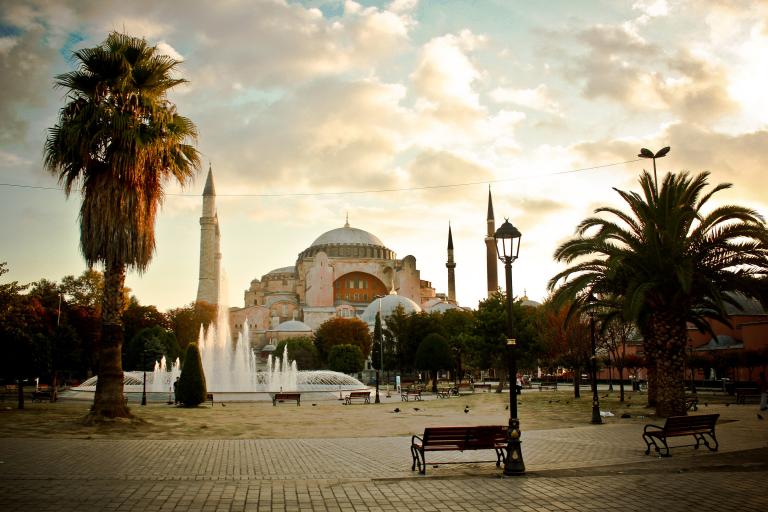
Hagia Sophia was already roughly a century old by the time of Jarir, Farazdaq, and the Camel-Herd, who almost certainly never came within hundreds of miles of seeing it.
(Wikimedia Commons public domain photograph)
This morning, we went first to the Hagia Sophia (Ἁγία Σοφία)—also called, depending upon the language, Ayasufya and Santa Sophia and Sancta Sapientia and the Church of Holy Wisdom (or Divine Wisdom). Sophia isn’t the name of a female saint; it is the Greek equivalent of English “wisdom.”
After its completion in AD 537, Hagia Sophia was the largest Christian church in the world for roughly a thousand years—only being supplanted in that rank in the early sixteenth century by Spain’s Cathedral of Seville, which was in turn beaten out by St. Peter’s Basilica in Rome (or Vatican City) shortly thereafter. It is said that, when the Emperor Justinian I (“the Great”) entered the building for its dedication, he thought of the ancient temple of Jerusalem and remarked “Solomon, I have triumphed!”
I’m in awe of the rich history not only of Istanbul but of Hagia Sophia specifically, and of the fact that Hagia Sophia has stood basically intact for nearly a millennium and a half in an area that is extremely active, seismically speaking. The Anatolian transform fault system has been ranked as perhaps the most active in the world; it separates the Eurasian plate from the Anatolian plate in northern Turkey. But when we walk into the great church today, we are walking into the same building that Justinian saw.
The present Hagia Sophia is the most recent of three church buildings to be erected, successively, on the site. Its immediate predecessor was destroyed during the dramatic Nika Revolt of AD 532. The prolific St. John Chrysostom, archbishop of Constantinople, preached in one of the two earlier buildings. (Chrysostom means “golden mouthed” in Greek; it is a tribute to his legendary eloquence.). For a few decades after 1204, as a result of the disgraceful Latin conquest of Constantinople during the Fourth Crusade, it became a Roman Catholic cathedral. (The Eastern and Western churches had mutually excommunicated each other by this point, and there was no love lost between them.) After the conquest of Constantinople by the Ottoman Turks in 1453, the Hagia Sophia was turned into a mosque. (Hence the four large minarets that are now attached to it.) In 1935, as part of the modernizing and secularizing reforms of Mustafa Kemal Atatürk, it became a museum. In 2020, as part of the Islamizing measures enacted by the current Turkish president, Recep Tayyip Erdoğan, it became a mosque yet again. I was relieved, although we were not allowed to climb to the higher floors, that the paintings and mosaics were somewhat less concealed than I had expected and feared.
Next, we visited the Istanbul Archeological Museum, which is said to be Türkiye’s largest museum. (This was my first time at the Museum.) Its collection includes more than a million artifacts, including one of the three serpent heads from the serpent column at the Hippodrome, but that portion of the Museum was apparently closed. At least, I didn’t see it. Nor did I see the famous Treaty of Kadesh, which is located there. Still, the Museum is a wonderful place, very clearly and elegantly displaying what we could see of its treasures. Its collection of classical sarcophagi is amazingly good; they look new. And its treatment of Troy is fascinating, including an aerial recreation that shows that city’s famed and fateful history from earliest times.
Our last stop was to the Spice Bazaar or Spice Market, which was built in the 1660s. In Turkish, it is known as the “Egyptian Bazaar” (Mısır Çarşısı), because it was built with revenues from the Ottoman province or eyalet of Egypt. It is one of the most colorful bazaars in Istanbul, offering innumerable souvenirs, spices, dried nuts, and more. It was in the Spice Market, years ago, that I first understood why, after his arrival in Narnia, Edmund would betray his siblings, Peter and Susan and Lucy, to the White Witch in exchange for Turkish delight. When I first read The Lion, the Witch and the Wardrobe, I couldn’t understand his betrayal. But now I definitely do.
I was disappointed that we were unable to visit the Great Palace Mosaic Museum, as we had originally thought to do. (It closed last month, for something or other.) It is an actual part of the Great Palace complex—the Μέγα Παλάτιον (Méga Palátion) of Byzantine Constantinople. (It was also called the Ἱερὸν Παλάτιον [Hieròn Palátion], or “Sacred Palace.”) It was first laid out in the southeastern end of the peninsula by the emperor Constantine in the area that is now called “Old Istanbul,” the former ancient Constantinople proper. The Great Palace served as the residence of the Eastern Roman or Byzantine emperors until 1081, and was the center of imperial administration for nearly seven hundred years.
Only a few remnants and fragments of its foundations have survived into the present day. The site of the Great Palace Mosaic Museum is one of the few extensively excavated sections of the ancient palace, and its mosaic floor is one of the best surviving examples of the art of Late Antiquity.
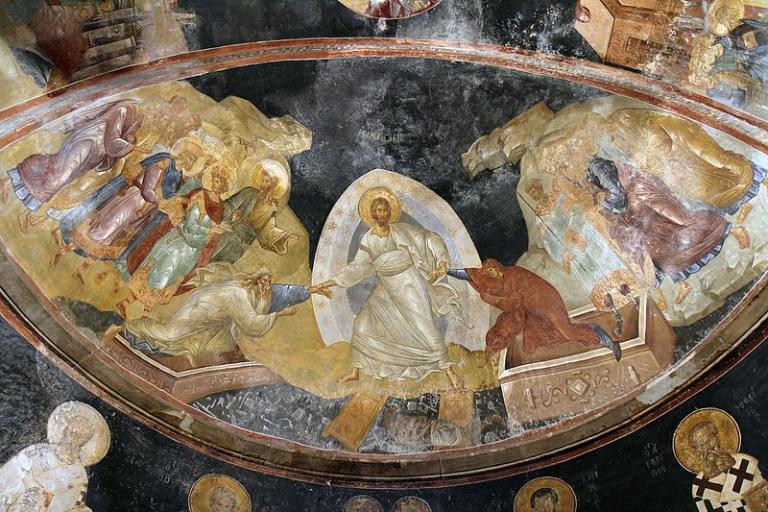
Between his crucifixion and his resurrection, Christ visits the world of spirits and, taking them by the hand, lifts Adam and Eve from their lost state. This fresco –entitled “ἀνάστασις” (“Resurrection,” but really a representation of the “Descensus” or the “Harrowing of Hell”) — appears in Istanbul’s (Constantinople’s) marvelous “Chora Church,” which is also known as the Kariye Mosque (Turkish: Kariye Camii), or the Church of the Holy Savior in Chora (Greek: Ἐκκλησία τοῦ Ἁγίου Σωτῆρος ἐν τῇ Χώρᾳ), and is located in the Edirnekapı neighborhood of Istanbul, Turkey, near the city’s great Byzantine walls. Christ stands triumphantly on the shattered gates of Hell (or Hades). The smashed lock mechanism of the gates is clearly visible, in pieces, as is the Devil, who is pinned down beneath the doors of the spirit world.
(Wikimedia Commons public domain image)
Even more, I was enormously disappointed that we could not take our people to the relatively tiny Chora Church, which has been one of my favorite places in the city since my first visit, particularly for its remarkable Christian frescoes and mosaics. It is located in the Edirnekapı neighborhood of Istanbul, very near the place that, as I mentioned in a previous entry here, some of us visited on the first day of our arrival, where the Ottomans first breached the massive land walls of Constantinople on 29 May 1453. But the original Chora was built in the early fourth century as part of a monastery complex that was outside the city walls of Constantinople. Those walls had been erected by Constantine the Great to the south of the Golden Horn as part of the original founding of the city. Hence, its name: Literally translated, the church’s full title was The Church of the Holy Saviour in the Country or The Church of the Holy Redeemer in the Fields (ἡ Ἐκκλησία τοῦ Ἁγίου Σωτῆρος ἐν τῇ Χώρᾳ, hē Ekklēsia tou Hagiou Sōtēros en tēi Chōrāi).
However, when Theodosius II built his famously formidable land walls in AD 413–414, the church became incorporated within the city’s defences. Even so, though, it retained the name Chora. The situation is rather like that of London’s St. Martin-in-the-Fields, the forerunner of which was located in the farmlands and fields beyond London’s city wall. The current neoclassical church dates to the early eighteenth century and sits at the northeast corner of Trafalgar Square, which is surrounded by the City of Westminster, London. Another comparison might be made to Rome’s Basilica Papale di San Paolo fuori le Mura (the “Papal Basilica of St. Paul Outside the Walls”), which was founded by Constantine the Great (!) over the likely burial place of the Apostle Paul. Its name derives from the fact that it lies outside the city’s third-century Aurelian Walls, but it is now very much a part of the city of Rome.
In its current form, the Chora dates mostly from the eleventh century, though it was substantially rebuilt in the fourteenth century, which is also the period of its great mosaics and frescoes. By far my favorite of those is the fresco of “The Resurrection,” which appears above.
After the Ottoman conquest of Constantinople in 1453, and probably after about 1500, the Chora was transformed into the Kariye Camii (or “Kariye Mosque,” the word Kariye deriving from the Greek Chora). It remained a mosque until the Turkish government declared it a museum in 1945. In 2020, though, it was again declared to be a mosque under the Islamizing government of Recep Tayyip Erdoğan. Sigh. It is now closed indefinitely for “restoration.”
Have I mentioned before that this is an astonishing city?
In its heyday during the Byzantine period, Constantinople was absolutely enraptured with theological debates. At least, so it was according to St. Gregory of Nyssa, who famously described it thus in his Oratio de deitate Filii et Spiriti Sancti, (= Oration on the deity of the Son and of the Holy Spirit) which is printed in Patrologia Graeca 46, where the passage is on col. 557, section B:
Everywhere, in the public squares, at crossroads, on the streets and lanes, people would stop you and discourse at random about the Trinity. If you asked something of a moneychanger, he would begin discussing the question of the Begotten and the Unbegotten. If you questioned a baker about the price of bread, he would answer that the Father is greater and the Son is subordinate to Him. If you went to take a bath, the Anomoean bath attendant would tell you that in his opinion the Son simply comes from nothing.
From the Spice Market, our bus picked us up and took us to the Istanbul Airport, where we caught a flight down to the southern Turkish city of Adana. It is my first time here. I’m excited.
Posted from Adana, Türkiye
Politics and Religion
History and Religion
Previous Post
October 11, 2023
On foot in a very ancient city
Next Post
October 13, 2023 In Cappadocia
Recent Comments
"I have cpnsidered in my mond if the 4 volume Saints could be made into ..."
From Serbia’s “White City,” Belgrade
"DP: “But Mr. Sutherland worries about the fact that our time, when we can communicate ..."
Learning more about a region of ..."
"Another class of memories are of individuals who previously lived. Some of these remembered individuals ..."
"Sutherland's lecture sounds interesting. He seems to restate the Washington consensus that trade brings peace ..."
Learning more about a region of ..."
Browse Our Archives
Select a Category Uncategorized
Select a Month October 2026 September 2026 August 2026 July 2026 June 2026 May 2026 April 2026 March 2026 February 2026 January 2026 December 2025 November 2025 October 2025 September 2025 August 2025 July 2025 June 2025 May 2025 April 2025 March 2025 February 2025 January 2025 December 2024 November 2024 October 2024 September 2024 August 2024 July 2024 June 2024 May 2024 April 2024 March 2024 February 2024 January 2024 December 2023 November 2023 October 2023 September 2023 August 2023 July 2023 June 2023 May 2023 April 2023 March 2023 February 2023 January 2023 December 2022 November 2022 October 2022 September 2022 August 2022 July 2022 June 2022 May 2022 April 2022 March 2022 February 2022 January 2022 December 2021 November 2021 October 2021 September 2021 August 2021 July 2021 June 2021 May 2021 April 2021 March 2021 February 2021 January 2021 December 2020 November 2020 October 2020 September 2020 August 2020 July 2020 June 2020 May 2020 April 2020 March 2020 February 2020 January 2020 December 2019 November 2019 October 2019 September 2019 August 2019 July 2019 June 2019 May 2019 April 2019 March 2019 February 2019 January 2019 December 2018 November 2018 October 2018 September 2018 August 2018 July 2018 June 2018 May 2018 April 2018 March 2018 February 2018 January 2018 December 2017 November 2017 October 2017 September 2017 August 2017 July 2017 June 2017 May 2017 April 2017 March 2017 February 2017 January 2017 December 2016 November 2016 October 2016 September 2016 August 2016 July 2016 June 2016 May 2016 April 2016 March 2016 February 2016 January 2016 December 2015 November 2015 October 2015 September 2015 August 2015 July 2015 June 2015 May 2015 April 2015 March 2015 February 2015 January 2015 December 2014 November 2014 March 2014 August 2013 February 2012
Follow Us!
TAKE THE
Religious Wisdom Quiz
What Christian group reads the Book of Mormon?
Select your answer to see how you score.
Jehovah’s Witnesses Baptists Latter-day Saints Pentecostals
Related posts from Sic et Non
On foot in a very ancient city
Dolmabahçe Sarayı, Edirnekapı, Galata, and Cağaloğlu Hammamı
TRENDING AT PATHEOS Latter-day Saint

The First Eucharistic Controversy: Christ’s Real Presence
For Catholics, the Eucharist is the source and summit of the Christian...

What a Stop Sign Can Teach Us About...
How to Make a Decision When You Can't Hear God Main point:...

Archdiocese Hosts Military Marriage Retreat in Germany
RASTATT, Germany — The transient military lifestyle, with its frequent deployments and...

Nearly every morning, I make the drive to Detroit with my high-school-age...

The Real AI Story Is Adoption Without Trust
Artificial intelligence has crossed a political threshold. It is no longer a...

A new article, written by Jeff Lindsay and Gale L. Pooley,...
view all Latter-day Saint blogs
What Are Your Thoughts?leave a comment
Ad-Free & Subscriber Log-In Subscription Support
- About Us
- 2026 Calendar
- Videos
- Podcasts
- Library of World Religions
- Faith In Media Tracker
- Advertise With Us
- Write for Us
- Privacy Policy
- Terms of Service
- Do Not Sell My Data
- Contact Us
- Radiant Digital
- Manage Newsletter Subscriptions
- Unsubscribe From Notifications
- Sitemap
Copyright 2008-2026, Patheos. All rights reserved.
Subscription Support Ad-Free & Subscriber Log-In
Follow Patheos