
BuddhistCatholicContemplativeEvangelicalGeneral ChristianHinduJewishLatter-day SaintMuslimNew VisionsProgressive Christian
Beliefs
- Buddhist
- Catholic
- Contemplative
- Evangelical
- General Christian
- Hindu
- Jewish
- Latter-day Saint
- More Voices
- Muslim
- New Visions
- Pagan
- Progressive Christian
Topics
- Religion News
- Food and Religion
- Sports and Religion
- Religious Art
- Religious Music and Entertainment
- Religious Events
- History and Religion
- Style and Religion
- Politics and Religion
- Women in Religion
- Recreation Outdoors and Religion
- Business Finance and Religion
- Careers Workplace and Religion
- Education and Religion
- Family Parenting and Religion
- Health Fitness and Religion
- Home and Religion
- Relationships and Religion
- Technology and Religion
- Travel and Religion
Columnists
- Buddhist Columnists
- Business Finance and Religion Columnists
- Careers Workplace and Religion Columnists
- Catholic Columnists
- Contemplative Columnists
- Education and Religion Columnists
- Evangelists Columnists
- Family Parenting and Religion Columnists
- General Christian Columnists
- Health Fitness and Religion Columnists
- Hindu Columnists
- History and Religion Columnists
- Home and Religion Columnists
- Jewish Columnists
- More Voices Columnists
- Latter Day Columnists
- Muslim Columnists
- New Visions Columnists
- Nonreligious Columnists
- Pagan Columnists
- Politics and Religion Columnists
- Progressive Columnists
- Recreation Outdoors and Religion Columnists
- Relationships and Religion Columnists
- Religion News Columnists
- Religious Art Columnists
- Religious Events Columnists
- Religious Music and Entertainment Columnists
- Sports and Religion Columnists
- Style and Religion Columnists
- Technology and Religion Columnists
- Travel and Religion Columnists
- Women in Religion Columnists
Resource Library
- 2026 Calendar
- Library of World Religions
- The 100 Most Holy Places on Earth
- Patheos Answers
- Podcasts
- Videos
- Faith Leaders Database
- Anglican Episcopalian
- Bahai
- Baptist
- Buddhism
- Christianity
- Confucianism
- Eastern Orthodoxy
- Hinduism
- Holiness and Pentecostal
- ISKCON
- Islam
- Judaism
- Lutheran
- Methodist
- The Church of Jesus Christ of Latter-day Saints
- New Age
- Paganism
- Presbytarian and Reformed
- Protestantism
- Religion Behind the Scenes
- Roman Catholic
- Scientology
- Shia Islam
- Sikhism
- Sufism
- Sunni Islam
- Taoism
- Zen
- See all religions
Research Tools
 Ad-Free & Subscriber Log-In Subscription Support
Ad-Free & Subscriber Log-In Subscription Support
Follow Patheos 

- Trending:
- Forgiveness
- |
- Marriage
- |
- Consciousness
- |
- Death Penalty
- |
- Election
- |
- Halloween

- Home
- Latter-day Saint
- History and Religion
- Mingling Homer and the New Testament
Mingling Homer and the New Testament
Last updated on: October 16, 2023 at 2:22 pm by Dan Peterson
Mingling Homer and the New Testament 2023-10-16T14:22:21-06:00 Dan Peterson
Patheos Explore the world's faith through different perspectives on religion and spirituality! Patheos has the views of the prevalent religions and spiritualities of the world.
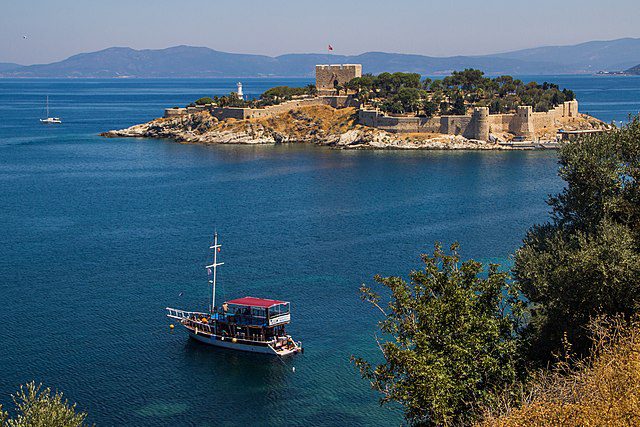
Near Kuşadası, in Aydın Province, Türkiye, in a 2016 Wikimedia Commons public domain photograph by Tevfik Teker
We were up very early this morning to fly from Kayseri to Izmir. Izmir is the ancient Smyrna, the traditional birthplace of the enormously important Greek poet Homer. Kayseri is only one of several towns named Caesarea in the ancient world – think, for example, of Caesarea Maritima on the Mediterranean coast of Israel and of Caesarea Philippi in the northern Galilee; everybody in antiquity wanted to flatter the emperor – and, in the Middle Ages, was once the capital of the early Turkish Seljuq Sultanate of Rum.
At one point during our travels today, I spoke to the group about the curious fact that much of Greek civilization actually had its origin outside of Greece proper, in what is today Türkiye. Besides Homer, who was famously “the teacher of Greece” and whose Iliad and Odyssey served, in a sense, as the classical Greek “Bible,” there is the other great early Greek poet, Hesiod. And several of the pre-Socratic philosophers (e.g., Thales, Anaximander, Xenophanes, and Melissus) were from “Ionia” (that is, western Anatolia), as well. Anaxagoras was born near Smyrna. Sappho, the famous poetess, lived just off the coast of Anatolia on the island of Lesbos. The great Heraclitus came from Ephesus, which seems apt given the eight-kilometer distance that now separates its onetime harbor from the sea, the changing course of its river, and its transformation from a populous and wealthy city to a famous set of ruins. Panta rhei (πάντα ῥεῖ), “everything flows” or “everything is in flux” or “everything changes,” is probably the most familiar of Heraclitus’ sayings, although he may not actually have said those particular words. (The exact phrase wasn’t ascribed to Heraclitus until the sixth century, by Simplicius, although a similar saying that expresses the same idea — panta chorei (πάντα χωρεῖ), or “everything moves” – is definitely Heraclitean.)
First, we visited the ruins of the Church of St. John, a traditional burial place of the apostle John—a tradition that Latter-day Saints tend to doubt—who is said to have lived for a time in Ephesus (and perhaps to have written his gospel there) and, having been commissioned by Jesus from the cross to care for Mary, to have brought her here, as well.
We next dropped by the ruins of the Artemisium, the great temple of Artemis or Diana that was completed around 550 BC. It’s a powerful commentary on the transience of human greatness to see one of the Seven Wonders of the Ancient World reduced to one standing column—standing only because restorers put it back upright—with a stork’s nest on its top. (For the first time that I’ve been here, the ruins were dry, rather than immersed in a swamp, and the storks had abandoned their nest for their annual migration.)
Then we went for a really fine outdoor lunch and some carpet shopping. (I’ll have to get the name of the place; I highly recommend it for both the food and the carpets.)
On the whole, I am not an acquisitive person. But oriental carpets and kilims are very definitely one of my weaknesses. I can’t go into a carpet store or a carpet factory without falling in love with at least one carpet. We’ve bought carpets during previous visits here in the Ephesus area and in Egypt. And one of my favorites is a Tabrizi that I bought in the Islamic Republic of Iran. The trouble is that we don’t have room for any more of them. They’re on our floor, and other weavings (one even made by a relative in Norway) hang on our walls. In fact, we have more than we can display at any one time. So many carpets, so little space. And so little money. So we bought another.
Next, we went to Ephesus itself. Some have called it the second most important city of the Roman Empire. I personally might argue that, say, Alexandria held second rank, but Ephesus was certainly an important city. For one thing, it was the capital of the Roman province of Asia Minor and, because of the confluence of a navigable river connecting to the sea and a trade route all the way to Mesopotamia, it was a major trading center and port. Paul lived in Ephesus for well over two years and, as I mentioned above, many believe that the Gospel of John was written in the city. It had a population of roughly a quarter of a million people, which was a very large number for the ancient world.
But its meandering river, the Küçükmenderes or “Little Meander,” let it down. It silted up the city’s harbor. Incidentally, the term to meander derives from the name of that winding river, the Menderes, which was sometimes known to the ancient Greeks as Μαίανδρος (Maiandros, or Latin Maeander), which was characterised by a very convoluted path along its lower reach. As a result, even in classical Greece the name of the river seems to have become a common noun denoting anything that was convoluted and winding, including speeches. Strabo said of the river that “its course is so exceedingly winding that everything winding is called meandering.”
The ruins of Ephesus are extensive and relatively well preserved. It’s possible, walking down the main street, to get a real sense of an ancient Greco-Roman city. Notable along the way are Hadrian’s temple, the luxurious terrace houses of the economic elite, the magnificent Library of Celsus, and the impressive Roman theater, which could accommodate more than 25,000 spectators. Along with the temple of Diana or Artemis, the theater figures prominently in the interesting account given at Acts 19 (https://www.churchofjesuschrist.org/study/scriptures/nt/acts/19?lang=eng). I read that account to our group and commented on it as we sat on benches in the theater, perhaps in the very places where some of those sat who cried out, for two hours, “Great is Diana of the Ephesians! Great is Diana of the Ephesians!”
We’re spending the night in the Charisma Hotel, overlooking the Aegean Sea, in the beautiful resort town of Kuşadası. It is a popular stopping point for cruise ships — which are currently making their way to Türkiye in somewhat heightened numbers because they cannot dock in Israel.
Posted from Kuşadası, Aydın Province, Türkiye
History and Religion
Travel and Religion
Previous Post
October 15, 2023
Kaymaklı and Göreme
Next Post

October 17, 2023 John and Paul, but no George or Ringo
Recent Comments
"I have cpnsidered in my mond if the 4 volume Saints could be made into ..."
From Serbia’s “White City,” Belgrade
"DP: “But Mr. Sutherland worries about the fact that our time, when we can communicate ..."
Learning more about a region of ..."
"Another class of memories are of individuals who previously lived. Some of these remembered individuals ..."
"Sutherland's lecture sounds interesting. He seems to restate the Washington consensus that trade brings peace ..."
Learning more about a region of ..."
Browse Our Archives
Select a Category Uncategorized
Select a Month October 2026 September 2026 August 2026 July 2026 June 2026 May 2026 April 2026 March 2026 February 2026 January 2026 December 2025 November 2025 October 2025 September 2025 August 2025 July 2025 June 2025 May 2025 April 2025 March 2025 February 2025 January 2025 December 2024 November 2024 October 2024 September 2024 August 2024 July 2024 June 2024 May 2024 April 2024 March 2024 February 2024 January 2024 December 2023 November 2023 October 2023 September 2023 August 2023 July 2023 June 2023 May 2023 April 2023 March 2023 February 2023 January 2023 December 2022 November 2022 October 2022 September 2022 August 2022 July 2022 June 2022 May 2022 April 2022 March 2022 February 2022 January 2022 December 2021 November 2021 October 2021 September 2021 August 2021 July 2021 June 2021 May 2021 April 2021 March 2021 February 2021 January 2021 December 2020 November 2020 October 2020 September 2020 August 2020 July 2020 June 2020 May 2020 April 2020 March 2020 February 2020 January 2020 December 2019 November 2019 October 2019 September 2019 August 2019 July 2019 June 2019 May 2019 April 2019 March 2019 February 2019 January 2019 December 2018 November 2018 October 2018 September 2018 August 2018 July 2018 June 2018 May 2018 April 2018 March 2018 February 2018 January 2018 December 2017 November 2017 October 2017 September 2017 August 2017 July 2017 June 2017 May 2017 April 2017 March 2017 February 2017 January 2017 December 2016 November 2016 October 2016 September 2016 August 2016 July 2016 June 2016 May 2016 April 2016 March 2016 February 2016 January 2016 December 2015 November 2015 October 2015 September 2015 August 2015 July 2015 June 2015 May 2015 April 2015 March 2015 February 2015 January 2015 December 2014 November 2014 March 2014 August 2013 February 2012
Follow Us!
TAKE THE
Religious Wisdom Quiz
Who was called by God to leave his home and go to a land God would show him?
Select your answer to see how you score.
Moses Jacob Abram Noah
Related posts from Sic et Non
The interesting hospitality rituals of great Homeric houses
"God was manifest in the flesh"
TRENDING AT PATHEOS Latter-day Saint

Methodist Central Hall and Westminster Abbey
Situated on the same square is Methodist Central Hall and Westminster Abbey. ...

57th Dove Awards Honor Dolly Parton, Crown New...
On gospel music’s biggest night, the 57th annual GMA Dove Awards honored...

The First Eucharistic Controversy: Christ’s Real Presence
For Catholics, the Eucharist is the source and summit of the Christian...

What a Stop Sign Can Teach Us About...
How to Make a Decision When You Can't Hear God Main point:...

Archdiocese Hosts Military Marriage Retreat in Germany
RASTATT, Germany — The transient military lifestyle, with its frequent deployments and...

Nearly every morning, I make the drive to Detroit with my high-school-age...
view all Latter-day Saint blogs
What Are Your Thoughts?leave a comment
Ad-Free & Subscriber Log-In Subscription Support
- About Us
- 2026 Calendar
- Videos
- Podcasts
- Library of World Religions
- Faith In Media Tracker
- Advertise With Us
- Write for Us
- Privacy Policy
- Terms of Service
- Do Not Sell My Data
- Contact Us
- Radiant Digital
- Manage Newsletter Subscriptions
- Unsubscribe From Notifications
- Sitemap
Copyright 2008-2026, Patheos. All rights reserved.
Subscription Support Ad-Free & Subscriber Log-In
Follow Patheos