
BuddhistCatholicContemplativeEvangelicalGeneral ChristianHinduJewishLatter-day SaintMuslimNew VisionsProgressive Christian
Beliefs
- Buddhist
- Catholic
- Contemplative
- Evangelical
- General Christian
- Hindu
- Jewish
- Latter-day Saint
- More Voices
- Muslim
- New Visions
- Pagan
- Progressive Christian
Topics
- Religion News
- Food and Religion
- Sports and Religion
- Religious Art
- Religious Music and Entertainment
- Religious Events
- History and Religion
- Style and Religion
- Politics and Religion
- Women in Religion
- Recreation Outdoors and Religion
- Business Finance and Religion
- Careers Workplace and Religion
- Education and Religion
- Family Parenting and Religion
- Health Fitness and Religion
- Home and Religion
- Relationships and Religion
- Technology and Religion
- Travel and Religion
Columnists
- Buddhist Columnists
- Business Finance and Religion Columnists
- Careers Workplace and Religion Columnists
- Catholic Columnists
- Contemplative Columnists
- Education and Religion Columnists
- Evangelists Columnists
- Family Parenting and Religion Columnists
- General Christian Columnists
- Health Fitness and Religion Columnists
- Hindu Columnists
- History and Religion Columnists
- Home and Religion Columnists
- Jewish Columnists
- More Voices Columnists
- Latter Day Columnists
- Muslim Columnists
- New Visions Columnists
- Nonreligious Columnists
- Pagan Columnists
- Politics and Religion Columnists
- Progressive Columnists
- Recreation Outdoors and Religion Columnists
- Relationships and Religion Columnists
- Religion News Columnists
- Religious Art Columnists
- Religious Events Columnists
- Religious Music and Entertainment Columnists
- Sports and Religion Columnists
- Style and Religion Columnists
- Technology and Religion Columnists
- Travel and Religion Columnists
- Women in Religion Columnists
Resource Library
- 2026 Calendar
- Library of World Religions
- The 100 Most Holy Places on Earth
- Patheos Answers
- Podcasts
- Videos
- Faith Leaders Database
- Anglican Episcopalian
- Bahai
- Baptist
- Buddhism
- Christianity
- Confucianism
- Eastern Orthodoxy
- Hinduism
- Holiness and Pentecostal
- ISKCON
- Islam
- Judaism
- Lutheran
- Methodist
- The Church of Jesus Christ of Latter-day Saints
- New Age
- Paganism
- Presbytarian and Reformed
- Protestantism
- Religion Behind the Scenes
- Roman Catholic
- Scientology
- Shia Islam
- Sikhism
- Sufism
- Sunni Islam
- Taoism
- Zen
- See all religions
Research Tools
 Ad-Free & Subscriber Log-In Subscription Support
Follow Patheos 

- Trending:
- Advent
- |
- Forgiveness
- |
- Thanksgiving
- |
- Election
- |
- Seasonal Holidays
- |
- Marriage

- Home
- Latter-day Saint
- Travel and Religion
- İstanbula hoş geldiniz!
İstanbula hoş geldiniz!
Last updated on: October 9, 2023 at 6:05 pm by Dan Peterson
İstanbula hoş geldiniz! 2023-10-09T18:05:08-06:00 Dan Peterson
Patheos Explore the world's faith through different perspectives on religion and spirituality! Patheos has the views of the prevalent religions and spiritualities of the world.
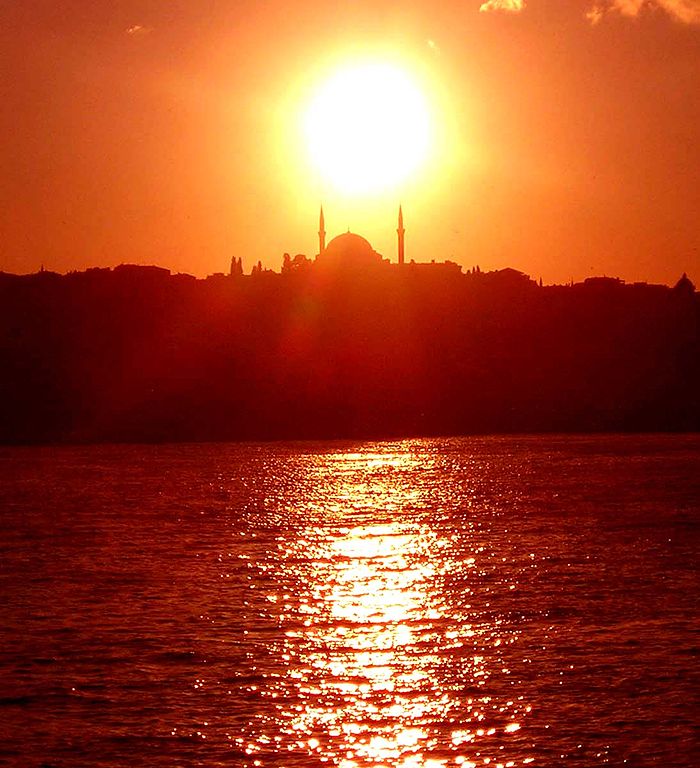
Sunset over Istanbul’s Golden Horn, in Turkey (Wikimedia Commons public domain photograph)
It’s good to be back in Istanbul, one of my very favorite cities. One of my favorite places on Earth. (We flew in just a few hours ago, via Amsterdam.) I’m not sure how long it’s been since we were here last, but it could possibly have been as long as eight years. And my last visit to Turkey beyond Istanbul was probably eleven years ago. So I’m very happy to be back.
I love the setting of the city, virtually surrounded by water. (I can see water from my hotel window right now, bejeweled with the lights of the city.) Istanbul reminds me just a tiny bit of San Francisco or Seattle. I also love the fact that you can walk through very modern urban areas, then (in some parts of the city) turn a corner and find yourself very much in the Middle East. Most of all, though, I love its rich, layered history – notably from its time as the capital of the Christian eastern Roman Empire (eventually known to many, though not to its own residents, as the Byzantine Empire) and then as the capital of the Ottoman Empire, ruled over by Muslim Turks who had originally come from distant central Asia.
According to the classical historians, there has been a city here since its founding by Byzas of Megara in 667 BC. From him comes its original name, Byzantium, which eventually, even after the city’s refounding and renaming, gave us the “Byzantine” Empire. He is said to have been advised by the famous oracle of Apollo at Delphi to “settle opposite the land of the blind,” on the other side of the water — by which, supposedly, the area of Chalcedon was intended (because they blindly failed to notice the superior territory directly adjacent to them).
Between 512 BC and 488 BC, the Persians held Byzantium until it was liberated by the Spartan general Pausanius.
When Philip II of Macedon (the father of Alexander the Great) besieged the city in 340-339 BC, the residents of the city took many defensive measures. Among them was an appeal to the goddess Hecate, which included putting her symbols, the crescent moon and the star, on its coinage—which, some say, led to the adoption of those symbols, centuries later, by the Ottoman Turks and even by Islam more generally.
The Roman emperor Constantine I—yes, Constantine the Great—was acclaimed emperor by his troops in York, in the British Isles, after the death of his father, Constantius, and spent the first period of his reign fighting in what his now Germany and then in conflict with his co-emperors.
Once he was established as the sole ruler of the Empire, though, his attention had shifted to the east, where the biggest and longest lasting threat was that posed by, essentially, the Persians. Since the fall of the Republic and the rise of the Empire (which occurred essentially under Octavian or Augustus Caesar), the Senate had become more or less irrelevant, and the emperors, often out on military campaigns, rarely resided in Rome. Practically speaking, the capital was wherever the emperor happened to be.
Unlike the Chalcedonians of a thousand years before, during the lifetime of Byzas, Constantine recognized the enormous advantages conferred by Byzantium’s location. Located on a peninsula, it was protected by the sea on three sides. It sat on a sundered land bridge connecting Europe with Asia (offering an east-west trade route), and astride a series of easily defensible narrow water channels (the Bosporus and the Dardanelles or Hellespont) connecting the world of the Black Sea to that of the Mediterranean. It’s astonishing to me that it hadn’t already become the capital of an empire.
So Constantine established Νέα Ῥώμη (Nea Roma, Nova Roma, or “New Rome”) as his capital. Conveniently, like the original Rome, it included seven hills. Soon, though, it began to be called Κωνσταντινούπολις (Kōnstantinoupolis; “city of Constantine”).
By AD 476, one of the traditional dates for “the fall of Rome,” the authority of the government in Rome itself wielded, at most, negligible military, political, or financial power, and it held little if any sway over the scattered Western domains that could still be described as Roman. So, when the city fell, its fall had very little effect over the actual empire, for which the center of gravity had long since shifted eastward. The West is fascinated even today with “the fall of Rome,” perhaps, but those in the east still thought of themselves as Romans—significantly, using Greek rather than Latin: Romanoi—and the Muslim peoples called the Byzantine Empire Rūm (“Rome”). In a very real sense, then, the Roman Empire actually survived until AD 1453.
That was the year that the armies of the Ottoman Turks finally took the city under the twenty-three year-old sultan Mehmet the Conqueror and renamed it Istanbul. The Muslims had been at war with the Byzantines since the days of Muhammad in early seventh-century Arabia, and there had been at least two serious prior sieges by the Ottomans themselves. This time, though, they brought gunpowder and cannons with them, rendering the famous defensive walls of the city obsolete, and soon rendering large portions of them little more than rubble.
I quote from chapter 68 of The Decline and Fall of the Roman Empire, by Edward Gibbon:
From the first hour of the memorable twenty-ninth of May [1453], disorder and rapine prevailed in Constantinople till the eighth hour of the same day, when the sultan himself passed in triumph through the gate of St. Romanus. He was attended by his vizirs, bashaws, and guards, each of whom (says a Byzantine historian) was robust as Hercules, dexterous as Apollo, and equal in battle to any ten of the race of ordinary mortals. The conqueror gazed with satisfaction and wonder on the strange though splendid appearance of the domes and palaces, so dissimilar from the style of Oriental architecture. In the hippodrome, or atmeidan, his eye was attracted by the twisted column of the three serpents; and, as a trial of his strength, he shattered with his iron mace or battle-axe the under jaw of one of these monsters, which in the eyes of the Turks were the idols or talismans of the city. At the principal door of St. Sophia he alighted from his horse and entered the dome; and such was his jealous regard for that monument of his glory, that, on observing a zealous Musulman in the act of breaking the marble pavement, he admonished him with his scimitar that, if the spoil and captives were granted to the soldiers, the public and private buildings had been reserved for the prince. By his command the metropolis of the Eastern church was transformed into a mosque: the rich and portable instruments of superstition had been removed; the crosses were thrown down; and the walls, which were covered with images and mosaics, were washed and purified, and restored to a state of naked simplicity. On the same day, or on the ensuing Friday, the muezin, or crier, ascended the most lofty turret, and proclaimed the esan, or public invitation, in the name of God and his prophet; the imam preached and Mohammed [Mehmet] the Second performed the namaz of prayer and thanks giving on the great altar, where the Christian mysteries had so lately been celebrated before the last of the Caesars. From St. Sophia he proceeded to the august but desolate mansion of a hundred successors of the great Constantine, but which in a few hours had been stripped of the pomp of royalty. A melancholy reflection on the vicissitudes of human greatness forced itself on his mind, and he repeated an elegant distich of Persian poetry:
” The spider has wove[n] his web in the Imperial palace, and the owl hath sung her watch-song on the towers of Afrasiab.”
Yet his mind was not satisfied, nor did the victory seem complete, till he was informed of the fate of Constantine [XI Palaiologos, the last of the Byzantine emperors]—whether he had escaped or been made prisoner, or had fallen in the battle. Two Janizaries claimed the honour and reward of his death: the body, under a heap of slain, was discovered by the golden eagles embroidered on his shoes; the Greeks acknowledged with tears the head of their late emperor and, after exposing the bloody trophy, Mohammed bestowed on his rival the honours of a decent funeral.
Posted from Istanbul, Türkiye
Travel and Religion
History and Religion
Previous Post
October 8, 2023
An Irresistible Force Encounters an Immoveable Object
Next Post
October 10, 2023 Dolmabahçe Sarayı, Edirnekapı, Galata, and Cağaloğlu Hammamı
Recent Comments
"There is a ward of The Church of Jesus Christ of Latter-day Saints in Dearborn. ..."
Islam soon to be the world’s ..."
"Interesting question. I have closely read Stephen Smoots book, asked Kara Cooney her views. Kerry ..."
"There's more amazement still, too. Most of the metals that humanity has ever extracted from ..."
"Did you know someone stole Shakespeare's skull? It was thought to be a rumour but ..."
Browse Our Archives
Select a Category Uncategorized
Select a Month November 2026 October 2026 September 2026 August 2026 July 2026 June 2026 May 2026 April 2026 March 2026 February 2026 January 2026 December 2025 November 2025 October 2025 September 2025 August 2025 July 2025 June 2025 May 2025 April 2025 March 2025 February 2025 January 2025 December 2024 November 2024 October 2024 September 2024 August 2024 July 2024 June 2024 May 2024 April 2024 March 2024 February 2024 January 2024 December 2023 November 2023 October 2023 September 2023 August 2023 July 2023 June 2023 May 2023 April 2023 March 2023 February 2023 January 2023 December 2022 November 2022 October 2022 September 2022 August 2022 July 2022 June 2022 May 2022 April 2022 March 2022 February 2022 January 2022 December 2021 November 2021 October 2021 September 2021 August 2021 July 2021 June 2021 May 2021 April 2021 March 2021 February 2021 January 2021 December 2020 November 2020 October 2020 September 2020 August 2020 July 2020 June 2020 May 2020 April 2020 March 2020 February 2020 January 2020 December 2019 November 2019 October 2019 September 2019 August 2019 July 2019 June 2019 May 2019 April 2019 March 2019 February 2019 January 2019 December 2018 November 2018 October 2018 September 2018 August 2018 July 2018 June 2018 May 2018 April 2018 March 2018 February 2018 January 2018 December 2017 November 2017 October 2017 September 2017 August 2017 July 2017 June 2017 May 2017 April 2017 March 2017 February 2017 January 2017 December 2016 November 2016 October 2016 September 2016 August 2016 July 2016 June 2016 May 2016 April 2016 March 2016 February 2016 January 2016 December 2015 November 2015 October 2015 September 2015 August 2015 July 2015 June 2015 May 2015 April 2015 March 2015 February 2015 January 2015 December 2014 November 2014 March 2014 August 2013 February 2012
Follow Us!
TAKE THE
Religious Wisdom Quiz
Who was the first son of Adam and Eve?
Select your answer to see how you score.
Abel Cain Irad Levi
Related posts from Sic et Non

Preparing to head off across the Atlantic
TRENDING AT PATHEOS Latter-day Saint

Smart people saying smart things (11.24.26)
Please take time to listen to Perry Bacon, Sarah Posner, Adam Serwer,...

The Contingency of Our Technology
Last week we were hit with a raft of massive technology outages....

In 1939, President Franklin D. Roosevelt moved Thanksgiving from November 30 to...

Reasons for Restraint: Ricardo Gonzalez, Florida and Dec...
The Morning of January 3 I begin with the dead. On the...

I published this column for Thanksgiving 2012 in the Deseret News....

For many years, Catholicism has been caught up in division over the...
view all Latter-day Saint blogs
What Are Your Thoughts?leave a comment
Ad-Free & Subscriber Log-In Subscription Support
- About Us
- 2026 Calendar
- Videos
- Podcasts
- Library of World Religions
- Faith In Media Tracker
- Advertise With Us
- Write for Us
- Privacy Policy
- Terms of Service
- Do Not Sell My Data
- Contact Us
- Radiant Digital
- Manage Newsletter Subscriptions
- Unsubscribe From Notifications
- Sitemap
Copyright 2008-2026, Patheos, part of the Radiant Digital network of media brands. All rights reserved.
Subscription Support Ad-Free & Subscriber Log-In
Follow Patheos