
BuddhistCatholicContemplativeEvangelicalGeneral ChristianHinduJewishLatter-day SaintMuslimNew VisionsProgressive Christian
Beliefs
- Buddhist
- Catholic
- Contemplative
- Evangelical
- General Christian
- Hindu
- Jewish
- Latter-day Saint
- More Voices
- Muslim
- New Visions
- Pagan
- Progressive Christian
Topics
- Religion News
- Food and Religion
- Sports and Religion
- Religious Art
- Religious Music and Entertainment
- Religious Events
- History and Religion
- Style and Religion
- Politics and Religion
- Women in Religion
- Recreation Outdoors and Religion
- Business Finance and Religion
- Careers Workplace and Religion
- Education and Religion
- Family Parenting and Religion
- Health Fitness and Religion
- Home and Religion
- Relationships and Religion
- Technology and Religion
- Travel and Religion
Columnists
- Buddhist Columnists
- Business Finance and Religion Columnists
- Careers Workplace and Religion Columnists
- Catholic Columnists
- Contemplative Columnists
- Education and Religion Columnists
- Evangelists Columnists
- Family Parenting and Religion Columnists
- General Christian Columnists
- Health Fitness and Religion Columnists
- Hindu Columnists
- History and Religion Columnists
- Home and Religion Columnists
- Jewish Columnists
- More Voices Columnists
- Latter Day Columnists
- Muslim Columnists
- New Visions Columnists
- Nonreligious Columnists
- Pagan Columnists
- Politics and Religion Columnists
- Progressive Columnists
- Recreation Outdoors and Religion Columnists
- Relationships and Religion Columnists
- Religion News Columnists
- Religious Art Columnists
- Religious Events Columnists
- Religious Music and Entertainment Columnists
- Sports and Religion Columnists
- Style and Religion Columnists
- Technology and Religion Columnists
- Travel and Religion Columnists
- Women in Religion Columnists
Resource Library
- 2026 Calendar
- Library of World Religions
- The 100 Most Holy Places on Earth
- Patheos Answers
- Podcasts
- Videos
- Faith Leaders Database
- Anglican Episcopalian
- Bahai
- Baptist
- Buddhism
- Christianity
- Confucianism
- Eastern Orthodoxy
- Hinduism
- Holiness and Pentecostal
- ISKCON
- Islam
- Judaism
- Lutheran
- Methodist
- The Church of Jesus Christ of Latter-day Saints
- New Age
- Paganism
- Presbytarian and Reformed
- Protestantism
- Religion Behind the Scenes
- Roman Catholic
- Scientology
- Shia Islam
- Sikhism
- Sufism
- Sunni Islam
- Taoism
- Zen
- See all religions
Research Tools
 Ad-Free & Subscriber Log-In Subscription Support
Ad-Free & Subscriber Log-In Subscription Support
Follow Patheos 

- Trending:
- Forgiveness
- |
- Marriage
- |
- Consciousness
- |
- Death Penalty
- |
- Election
- |
- Halloween

- Home
- Latter-day Saint
- History and Religion
- In the land of King Croesus
In the land of King Croesus
Last updated on: October 18, 2023 at 2:18 pm by Dan Peterson
In the land of King Croesus 2023-10-18T14:18:18-06:00 Dan Peterson
Patheos Explore the world's faith through different perspectives on religion and spirituality! Patheos has the views of the prevalent religions and spiritualities of the world.
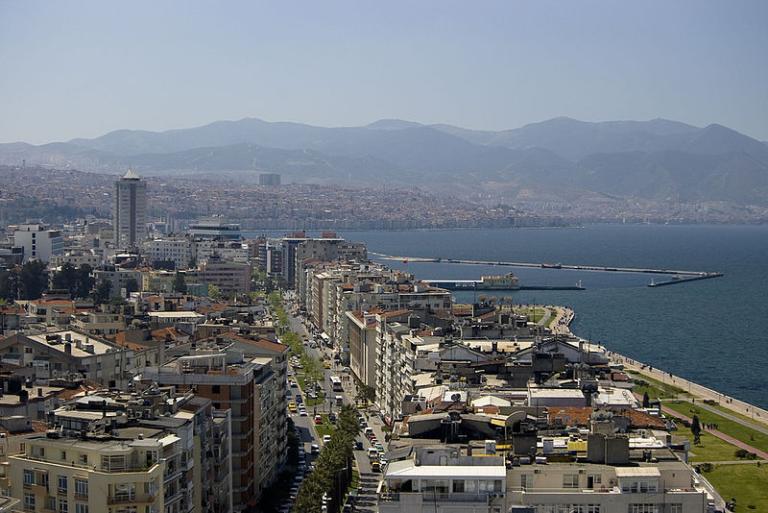
Izmir, Turkey (the ancient Smyrna, birthplace of Homer and site of the very early martyrdom of St. Polycarp); Wikimedia Commons public domain image
Newly posted for your enjoyment on the website of the Interpreter Foundation: Conference Talks: Cherubim and Seraphim: Iconography in the First Jerusalem Temple, presented by John Gee
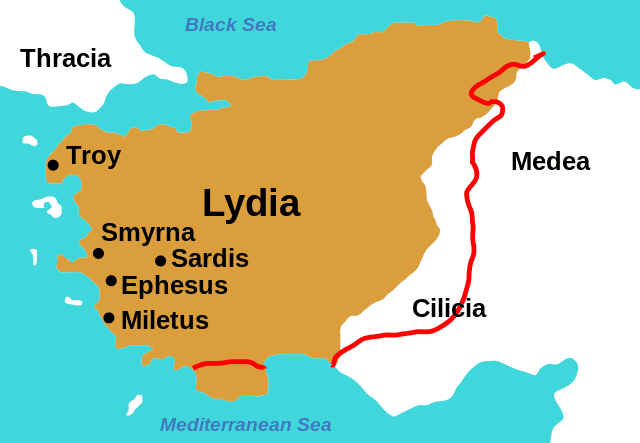
This Wikimedia Commons map of the Lydian Empire around BC 547 (at the time of King Croesus). The red line represents a possible alternative border.
Our first stop this morning was at Colossae, which is, now, little more than a tumulus or a tell that awaits excavation. And this morning it was a muddy one. (See “John and Paul, but no George or Ringo.”)
We next visited Alaşehir, the town known anciently (and, in fact, until it was conquered by the Ottomans in AD 1390) as Philadelphia (Φιλαδέλφεια, i.e., “[the city of him who] loves his brother”). Alaşehir was, in fact, perhaps one of the first ancient cities with the name Philadelphia. It was established in 189 BC by King Eumenes II of Pergamon (reigned 197–160 BC). Eumenes II named the city for the love of his brother, who would eventually succeed him as Attalus II (159–138 BC), whose loyalty had earned him the nickname Philadelphos, which literally means “[one who] loves his brother.”
Lacking an heir when he died in 133 BC, the last of the Attalid kings of Pergamon, Attalus III Philometer (“loves his mother”; I swear that I’m not making this up), bequeathed his kingdom, including Philadelphia, to his Roman allies. Thereupon, in 129 BC, Rome established the province of Asia or Asia Minor by combining Ionia and the former Kingdom of Pergamon.
Within today’s Türkiye, the city of Alaşehir is famed for its dried Sultana raisins, although cultivation for the less labor-intensive fresh fruit market has grown in recent decades. Philadelphia is probably best known as one of the seven churches of Asia in the book of Revelation. At Revelation 3:7-13, the church members here were challenged to “hold fast” and to look forward to the coming of the “new Jerusalem.” The city’s history of earthquakes may lie behind the reference to making her church “a pillar in the temple” (Revelation 3:12). Philadelphia shares the distinction with Smyrna of receiving nothing but praise from the angel, or from Christ, in the Revelation of John.
In the afternoon we visited the ruins of the ancient city of Sardis, the ancient capital of the Lydian Empire and another of the seven cities of Revelation. This is the city that was berated by John for its façade of strength when, in reality, it was weak (Revelation 3:1-6).
Sardis boasts a spectacular ancient synagogue, directly adjacent to a spectacular gymnasium – an ironic and rather unexpected pairing, given the clash of synagogue and gymnasium in Judea – as well as an impressive albeit unfinishedd temple of Artemis in a beautiful nearby valley.
It also has an interesting secular history. I’ll start with a king by the name of Gyges, who lived during the first half of the seventh century BC. The main source for his life is the great historian Herodotus, according to whom he was bodyguard of the previous Lydian king, Candaules, of the Heraclid dynasty, who believed his wife to be the most beautiful woman in the world. In order to prove his point, he arranged that Gyges secretly see his wife naked as she disrobed for bed. But she soon discovered what had happened, and she was so enraged by the betrayal that she confronted Gyges with the choice of either murdering her husband and making himself king or being himself put to death.
The last of the Lydian kings was Croesus, who reigned from 585 BC until he was defeated by the Persian king Cyrus the Great in either 547 BC or 546 BC. Croesus is still famous for his enormous wealth. The saying “As rich as Croesus” is still current; in The Simpsons, Montgomery Burns lives at the corner of Croesus and Mammon Streets.
Croesus is said to have gone to the oracle of Apollo at Delphi, wondering whether he should attack the Achaemenid Empire of the Persian king Cyrus. The oracle responded that, if he went to war against the Persians, he would destroy a great empire. So he did, and he did: The empire that he destroyed was his own. Immediately after his defeat, so the story goes, he was about to commit suicide and Cyrus plucked him from the flames. Or, alternatively, Cyrus was going to burn him alive, but Croesus prayed to Apollo and a sudden storm extinguished the fire, leading Cyrus to spare him. Thereafter, as the two stood watching the Persian troops loot and pillage Sardis, Croesus pointed out to the Persian king that, since the city was no longer his but now belonged to Cyrus, they were looting and pillaging Cyrus’s wealth. Whereupon Cyrus put an end to the pillaging.
One historical fact that seems fairly solid: The first minted coinage in the world appears to have been created under King Croesus.
Lastly, we visited the rather limited remains of the city of Thyatira (or Thyateira;Θυάτειρα), another of the seven cities of Revelation, which was famous for its dyeing facilities and which was a center of the purple cloth trade. Most of Thyatira is now buried under the modern Turkish city of Akhisar (“White Castle”)
During one of our longer drives today, I read and briefly commented upon one of the many Western literary responses to the culture and history of the places we’ve been visiting:
“Sailing to Byzantium,” by William Butler Yeats
I
That is no country for old men. The young
In one another’s arms, birds in the trees,
—Those dying generations—at their song,
The salmon-falls, the mackerel-crowded seas,
Fish, flesh, or fowl, commend all summer long
Whatever is begotten, born, and dies.
Caught in that sensual music all neglect
Monuments of unageing intellect.
II
An aged man is but a paltry thing,
A tattered coat upon a stick, unless
Soul clap its hands and sing, and louder sing
For every tatter in its mortal dress,
Nor is there singing school but studying
Monuments of its own magnificence;
And therefore I have sailed the seas and come
To the holy city of Byzantium.
III
O sages standing in God’s holy fire
As in the gold mosaic of a wall,
Come from the holy fire, perne in a gyre,
And be the singing-masters of my soul.
Consume my heart away; sick with desire
And fastened to a dying animal
It knows not what it is; and gather me
Into the artifice of eternity.
IV
Once out of nature I shall never take
My bodily form from any natural thing,
But such a form as Grecian goldsmiths make
Of hammered gold and gold enamelling
To keep a drowsy Emperor awake;
Or set upon a golden bough to sing
To lords and ladies of Byzantium
Of what is past, or passing, or to come.
Tonight, we’re staying in İzmir, the ancient Smyrna.
Posted from İzmir, Türkiye
History and Religion
Travel and Religion
Previous Post

October 17, 2023
John and Paul, but no George or Ringo
Next Post
October 19, 2023 Smyrna and Pergamum
Recent Comments
"Thanks John. You always have so many interesting facts. I could listen to you read ..."
"You dig out some really interesting information from the background details of the Church."
"The G-20 interreligious summit is happening in Salt Lake City for the first time. President ..."
"Provo High may have some nostalgic value for some folks here--but I have to say ..."
From Serbia’s “White City,” Belgrade
Browse Our Archives
Select a Category Uncategorized
Select a Month October 2026 September 2026 August 2026 July 2026 June 2026 May 2026 April 2026 March 2026 February 2026 January 2026 December 2025 November 2025 October 2025 September 2025 August 2025 July 2025 June 2025 May 2025 April 2025 March 2025 February 2025 January 2025 December 2024 November 2024 October 2024 September 2024 August 2024 July 2024 June 2024 May 2024 April 2024 March 2024 February 2024 January 2024 December 2023 November 2023 October 2023 September 2023 August 2023 July 2023 June 2023 May 2023 April 2023 March 2023 February 2023 January 2023 December 2022 November 2022 October 2022 September 2022 August 2022 July 2022 June 2022 May 2022 April 2022 March 2022 February 2022 January 2022 December 2021 November 2021 October 2021 September 2021 August 2021 July 2021 June 2021 May 2021 April 2021 March 2021 February 2021 January 2021 December 2020 November 2020 October 2020 September 2020 August 2020 July 2020 June 2020 May 2020 April 2020 March 2020 February 2020 January 2020 December 2019 November 2019 October 2019 September 2019 August 2019 July 2019 June 2019 May 2019 April 2019 March 2019 February 2019 January 2019 December 2018 November 2018 October 2018 September 2018 August 2018 July 2018 June 2018 May 2018 April 2018 March 2018 February 2018 January 2018 December 2017 November 2017 October 2017 September 2017 August 2017 July 2017 June 2017 May 2017 April 2017 March 2017 February 2017 January 2017 December 2016 November 2016 October 2016 September 2016 August 2016 July 2016 June 2016 May 2016 April 2016 March 2016 February 2016 January 2016 December 2015 November 2015 October 2015 September 2015 August 2015 July 2015 June 2015 May 2015 April 2015 March 2015 February 2015 January 2015 December 2014 November 2014 March 2014 August 2013 February 2012
Follow Us!
TAKE THE
Religious Wisdom Quiz
What did God use to speak to Moses in the wilderness?
Select your answer to see how you score.
A mighty wind A thunderstorm A pillar of fire A burning bush
Related posts from Sic et Non

Preparing to head off across the Atlantic
John and Paul, but no George or Ringo
TRENDING AT PATHEOS Latter-day Saint

Dolly Parton’s Last Song Wins Dove Award with...
Bluegrass band The Grascals, speaking on the red carpet at the 57th...

The Image: On the Horror of Capitalism and...
The Image Then went the Pharisees, and took counsel how they might...

We are approaching the date of our new American national holiday: October...

Letters on Living the Faith by C.S. Lewis
Most of us met C.S. Lewis as a public intellectual. Mere Christianity....

When Halloween Unmasks Married Hearts
Written by Dr. David K. Ewen from Eternal Truth Bible College Behind...

Aristotle. He’s been called the father of logic, the father of the...
view all Latter-day Saint blogs
What Are Your Thoughts?leave a comment
Ad-Free & Subscriber Log-In Subscription Support
- About Us
- 2026 Calendar
- Videos
- Podcasts
- Library of World Religions
- Faith In Media Tracker
- Advertise With Us
- Write for Us
- Privacy Policy
- Terms of Service
- Do Not Sell My Data
- Contact Us
- Radiant Digital
- Manage Newsletter Subscriptions
- Unsubscribe From Notifications
- Sitemap
Copyright 2008-2026, Patheos. All rights reserved.
Subscription Support Ad-Free & Subscriber Log-In
Follow Patheos