
BuddhistCatholicContemplativeEvangelicalGeneral ChristianHinduJewishLatter-day SaintMuslimNew VisionsProgressive Christian
Beliefs
- Buddhist
- Catholic
- Contemplative
- Evangelical
- General Christian
- Hindu
- Jewish
- Latter-day Saint
- More Voices
- Muslim
- New Visions
- Pagan
- Progressive Christian
Topics
- Religion News
- Food and Religion
- Sports and Religion
- Religious Art
- Religious Music and Entertainment
- Religious Events
- History and Religion
- Style and Religion
- Politics and Religion
- Women in Religion
- Recreation Outdoors and Religion
- Business Finance and Religion
- Careers Workplace and Religion
- Education and Religion
- Family Parenting and Religion
- Health Fitness and Religion
- Home and Religion
- Relationships and Religion
- Technology and Religion
- Travel and Religion
Columnists
- Buddhist Columnists
- Business Finance and Religion Columnists
- Careers Workplace and Religion Columnists
- Catholic Columnists
- Contemplative Columnists
- Education and Religion Columnists
- Evangelists Columnists
- Family Parenting and Religion Columnists
- General Christian Columnists
- Health Fitness and Religion Columnists
- Hindu Columnists
- History and Religion Columnists
- Home and Religion Columnists
- Jewish Columnists
- More Voices Columnists
- Latter Day Columnists
- Muslim Columnists
- New Visions Columnists
- Nonreligious Columnists
- Pagan Columnists
- Politics and Religion Columnists
- Progressive Columnists
- Recreation Outdoors and Religion Columnists
- Relationships and Religion Columnists
- Religion News Columnists
- Religious Art Columnists
- Religious Events Columnists
- Religious Music and Entertainment Columnists
- Sports and Religion Columnists
- Style and Religion Columnists
- Technology and Religion Columnists
- Travel and Religion Columnists
- Women in Religion Columnists
Resource Library
- 2026 Calendar
- Library of World Religions
- The 100 Most Holy Places on Earth
- Patheos Answers
- Podcasts
- Videos
- Faith Leaders Database
- Anglican Episcopalian
- Bahai
- Baptist
- Buddhism
- Christianity
- Confucianism
- Eastern Orthodoxy
- Hinduism
- Holiness and Pentecostal
- ISKCON
- Islam
- Judaism
- Lutheran
- Methodist
- The Church of Jesus Christ of Latter-day Saints
- New Age
- Paganism
- Presbytarian and Reformed
- Protestantism
- Religion Behind the Scenes
- Roman Catholic
- Scientology
- Shia Islam
- Sikhism
- Sufism
- Sunni Islam
- Taoism
- Zen
- See all religions
Research Tools
 Ad-Free & Subscriber Log-In Subscription Support
Ad-Free & Subscriber Log-In Subscription Support
Follow Patheos 

- Trending:
- Forgiveness
- |
- Marriage
- |
- Consciousness
- |
- Death Penalty
- |
- Election
- |
- Halloween

- Home
- Latter-day Saint
- Politics and Religion
- Dolmabahçe Sarayı, Edirnekapı, Galata, and Cağaloğlu Hammamı
Dolmabahçe Sarayı, Edirnekapı, Galata, and Cağaloğlu Hammamı
Last updated on: October 10, 2023 at 3:24 pm by Dan Peterson
Dolmabahçe Sarayı, Edirnekapı, Galata, and Cağaloğlu Hammamı 2023-10-10T15:24:24-06:00 Dan Peterson
Patheos Explore the world's faith through different perspectives on religion and spirituality! Patheos has the views of the prevalent religions and spiritualities of the world.
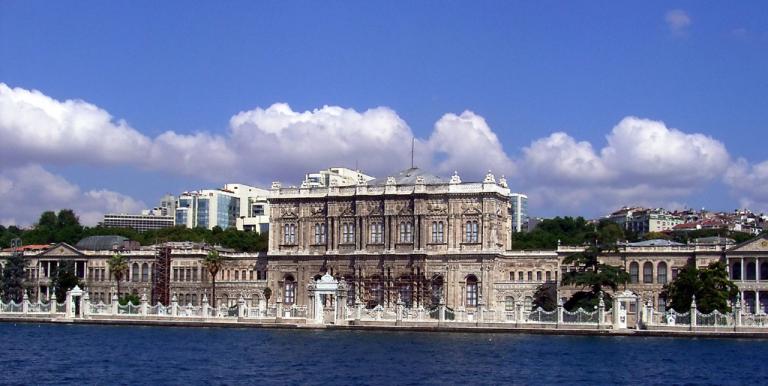
Dolmabahçe Palace, as seen from the Bosporus (Wikimedia Commons public domain image)
From its conquest by the Ottomans in 1453 until the official end of the Ottoman Empire in 1922, Constantinople, renamed Istanbul, was their capital.
The Ottoman Empire reach its zenith under Süleyman (or Suleiman) the Magnificent, who reigned from 1520 to 1566 (roughly overlapping with King Henry VIII of England, “Bloody Mary,” and Queen Elizabeth I, who, compared with his vast domain, were mere petty chieftains). The name Süleyman is the Turkish (and more or less the Arabic) equivalent of the English Solomon. I personally prefer Süleyman to Solomon by a little bit. Both, though, are far preferable to the Hebrew original, Schlomo. (I can’t help but think of Schlomo the Schmuck. Not a very dignified name for an Israelite king or, for that matter, for an Ottoman sultan.)
Shortly after the reign of Süleyman, though, the Empire began to decline. Very, very slowly. For the last century of its existence, it was commonly known among Western diplomats, politicians, and writers as “the sick man of Europe.” Why? Because it lingered—ill and dysfunctional, but not dead. It can be said, that, from the founding of the Ottoman state through Süleyman, the Turks were ruled by roughly ten extremely effective (though not necessarily saintly) sultans. With his departure, though, they entered into a period where they were ruled by roughly an equal number of ineffective sultans.
By the way: What does the word sultan mean? It comes from the Arabic word سلطة sulṭah or sulṭa (“power,” “authority”), and suggests that the Ottoman rulers originally made no attempt to hide the fact that their political power did not derive from any religious mandate. (One thinks of Mao’s famous dictum, that “Political power flows from the barrel of a gun.”) Later, though, during the period of Ottoman expansion, they began to desire religious legitimacy. Thus, after Sultan Selim I conquered Mamluk Egypt in 1517, Ottoman rulers claimed the authority of the “caliph,” the vicarious stand-in for the prophet, that had begun with Abu Bakr shortly after the death of Muhammad and that had eventually found its way (if you’re inclined to believe the medieval propaganda) to Egypt. Seeming to support the Ottoman sultans’ claim to caliphal authority was the fact that, with the conquest of Mamluk Egypt, they inherited the Mamluk sultans’ title of “Defender of the Holy Cities of Mecca and Medina.”
Back, though, to Istanbul: Today, although it remains Turkey’s largest city, Istanbul is no longer the nation’s capital. On 23 April 1920, the Grand National Assembly of Turkey was established in Ankara, which became the headquarters of the Turkish National Movement during the Turkish War of Independence. Upon the establishment of the new Republic of Turkey on 29 October 1929, Ankara became the new Turkish capital, replacing Istanbul. Although it is a relatively new national capital, though, Ankara is actually quite ancient, going back to the Hattic civilization which was then absorbed by the Hittites around 2000 BC. For centuries, it was the principal city and capital of Galatia (home of the biblical Galatians). In one of the many forms of its name, Ankara has given us the Angora wool that is shorn from Angora rabbits, the long-haired Angora goat from which we obtain mohair, and the Angora cat.
Moving the seat of government inland to Ankara from the ancient imperial capital of Constantinople/Istanbul, where it had resided for very nearly sixteen centuries, was entirely congenial to the program of modernizing reforms laid out by Mustafa Kemal (ca. 1881 – 10 November 1938), who is generally acknowledged as the father of modern Turkey or Türkiye. He was a secularizer and a Turkish nationalist who wanted to separate Turkey from its imperial—multinational, multiconfessional, multiethnic, multilingual—past and concentrate on its Turkishness. To do so, among many other things, he completely abolished the caliphate in 1924, freeing the ruler of the new Turkey from an entanglement or responsibility beyond its borders.
Since then, many Islamic fundamentalist groups, not least among them al-Qa‘ida and ISIS, have sought to reestablish the caliphate. Most of the Islamic world, however, although shocked and dismayed by Mustafa Kemal’s abolition of the caliphate, realized fairly soon that the title’s disappearance made little practical difference. The office of caliph hadn’t possessed real, independent power in the Islamic world as a whole for many centuries. It had been a symbol, merely.
Mustafa Kemal also changed the alphabet in which Turkish was written from a modified Arabic script (which, truth be told, was not well suited to representing Turkish, a language featuring a complex system of vowels and vowel harmonies) to a modified Roman one. This had the (likely deliberate) effect of relatively quickly creating a new generation that, without special training, was flatly unable to read, understand, or even to sound out old documents, including the Qur’an and the traditions of the Prophet Muhammad.
Furthermore, Mustafa Kemal required Turkish citizens to adopt surnames, which they had seldom used before. Instead, they had tended to follow the Arabic naming system, with its patronymics and its descriptive titles (e.g., Abu Farid Mustafa ibn Salim al-Halabi, “Father of Farid, Mustafa, son of Salim, the one from Aleppo”), or even just to use a single name. Mustafa Kemal had originally just been Mustafa, until, it is said, a teacher gave him the name Kemal (“complete,” “perfect”) in order both to distinguish him from a classmate who was also named Mustafa and to signal his excellence in mathematics and in his other studies. When the time came to adopt a surname, he led the way by adopting the name Atatürk. “Father of the Turks.” It was officially bestowed upon him by the Turkish parliament in 1934, and it is the name by which he is most commonly known to this day, in the Middle East and outside of it.
We shouldn’t be surprised, by the way, that the Turks hadn’t yet adopted surnames in the Western sense. After all, large parts of the West itself were slow to adopt them. It wasn’t all that long ago in Scandinavia, for instance, that my own surname, Peterson, would have indicated that my father was named Peter. And, before they became surnames, words like Cooper, Porter, Carter, Taylor, Sawyer, Collier, Wagner, Miner, Knight, Farmer (German Bauer), Smith (German Schmidt), Carpenter (Zimmermann), and Miller (Müller) indicated the ways in which we made our livings. And names like York and Forrest and Ford and Woodsand Fields and Rivers and Banks suggested something of where we were from.
Our tour group is almost entirely arrived by now, with most coming in this evening. Those of us who arrived yesterday, though, spent the day in and around the late-Ottoman Dolmabahçe Sarayı, followed by a visit to the Edirnekapı quarter of Istanbul’s Fatih district, which is the very section of the famous Theodosian walls of ancient Constantinople where Sultan Mehmet’s Ottoman troops breached Byzantine defenses on 29 May 1453, thereby conquering the city. Afterwards, we went to the Galata Tower. Then, following dinner back at our hotel, some of us went to the three-hundred-year-old Cağaloğlu Hammamı. I just did the foot massage.
Posted from Istanbul, Türkiye
Politics and Religion
History and Religion
Previous Post
October 9, 2023
İstanbula hoş geldiniz!
Next Post
October 11, 2023 On foot in a very ancient city
Recent Comments
"I have cpnsidered in my mond if the 4 volume Saints could be made into ..."
From Serbia’s “White City,” Belgrade
"DP: “But Mr. Sutherland worries about the fact that our time, when we can communicate ..."
Learning more about a region of ..."
"Another class of memories are of individuals who previously lived. Some of these remembered individuals ..."
"Sutherland's lecture sounds interesting. He seems to restate the Washington consensus that trade brings peace ..."
Learning more about a region of ..."
Browse Our Archives
Select a Category Uncategorized
Select a Month October 2026 September 2026 August 2026 July 2026 June 2026 May 2026 April 2026 March 2026 February 2026 January 2026 December 2025 November 2025 October 2025 September 2025 August 2025 July 2025 June 2025 May 2025 April 2025 March 2025 February 2025 January 2025 December 2024 November 2024 October 2024 September 2024 August 2024 July 2024 June 2024 May 2024 April 2024 March 2024 February 2024 January 2024 December 2023 November 2023 October 2023 September 2023 August 2023 July 2023 June 2023 May 2023 April 2023 March 2023 February 2023 January 2023 December 2022 November 2022 October 2022 September 2022 August 2022 July 2022 June 2022 May 2022 April 2022 March 2022 February 2022 January 2022 December 2021 November 2021 October 2021 September 2021 August 2021 July 2021 June 2021 May 2021 April 2021 March 2021 February 2021 January 2021 December 2020 November 2020 October 2020 September 2020 August 2020 July 2020 June 2020 May 2020 April 2020 March 2020 February 2020 January 2020 December 2019 November 2019 October 2019 September 2019 August 2019 July 2019 June 2019 May 2019 April 2019 March 2019 February 2019 January 2019 December 2018 November 2018 October 2018 September 2018 August 2018 July 2018 June 2018 May 2018 April 2018 March 2018 February 2018 January 2018 December 2017 November 2017 October 2017 September 2017 August 2017 July 2017 June 2017 May 2017 April 2017 March 2017 February 2017 January 2017 December 2016 November 2016 October 2016 September 2016 August 2016 July 2016 June 2016 May 2016 April 2016 March 2016 February 2016 January 2016 December 2015 November 2015 October 2015 September 2015 August 2015 July 2015 June 2015 May 2015 April 2015 March 2015 February 2015 January 2015 December 2014 November 2014 March 2014 August 2013 February 2012
Follow Us!
TAKE THE
Religious Wisdom Quiz
Who was David’s best friend?
Select your answer to see how you score.
Samuel Jonathan Joseph Saul
Related posts from Sic et Non

Preparing to head off across the Atlantic
TRENDING AT PATHEOS Latter-day Saint

When Halloween Unmasks Married Hearts
Written by Dr. David K. Ewen from Eternal Truth Bible College Behind...

Aristotle. He’s been called the father of logic, the father of the...

Methodist Central Hall and Westminster Abbey
Situated on the same square is Methodist Central Hall and Westminster Abbey. ...

57th Dove Awards Honor Dolly Parton, Crown New...
On gospel music’s biggest night, the 57th annual GMA Dove Awards honored...

The First Eucharistic Controversy: Christ’s Real Presence
For Catholics, the Eucharist is the source and summit of the Christian...

What a Stop Sign Can Teach Us About...
How to Make a Decision When You Can't Hear God Main point:...
view all Latter-day Saint blogs
What Are Your Thoughts?leave a comment
Ad-Free & Subscriber Log-In Subscription Support
- About Us
- 2026 Calendar
- Videos
- Podcasts
- Library of World Religions
- Faith In Media Tracker
- Advertise With Us
- Write for Us
- Privacy Policy
- Terms of Service
- Do Not Sell My Data
- Contact Us
- Radiant Digital
- Manage Newsletter Subscriptions
- Unsubscribe From Notifications
- Sitemap
Copyright 2008-2026, Patheos. All rights reserved.
Subscription Support Ad-Free & Subscriber Log-In
Follow Patheos