
BuddhistCatholicContemplativeEvangelicalGeneral ChristianHinduJewishLatter-day SaintMuslimNew VisionsProgressive Christian
Beliefs
- Buddhist
- Catholic
- Contemplative
- Evangelical
- General Christian
- Hindu
- Jewish
- Latter-day Saint
- More Voices
- Muslim
- New Visions
- Pagan
- Progressive Christian
Topics
- Religion News
- Food and Religion
- Sports and Religion
- Religious Art
- Religious Music and Entertainment
- Religious Events
- History and Religion
- Style and Religion
- Politics and Religion
- Women in Religion
- Recreation Outdoors and Religion
- Business Finance and Religion
- Careers Workplace and Religion
- Education and Religion
- Family Parenting and Religion
- Health Fitness and Religion
- Home and Religion
- Relationships and Religion
- Technology and Religion
- Travel and Religion
Columnists
- Buddhist Columnists
- Business Finance and Religion Columnists
- Careers Workplace and Religion Columnists
- Catholic Columnists
- Contemplative Columnists
- Education and Religion Columnists
- Evangelists Columnists
- Family Parenting and Religion Columnists
- General Christian Columnists
- Health Fitness and Religion Columnists
- Hindu Columnists
- History and Religion Columnists
- Home and Religion Columnists
- Jewish Columnists
- More Voices Columnists
- Latter Day Columnists
- Muslim Columnists
- New Visions Columnists
- Nonreligious Columnists
- Pagan Columnists
- Politics and Religion Columnists
- Progressive Columnists
- Recreation Outdoors and Religion Columnists
- Relationships and Religion Columnists
- Religion News Columnists
- Religious Art Columnists
- Religious Events Columnists
- Religious Music and Entertainment Columnists
- Sports and Religion Columnists
- Style and Religion Columnists
- Technology and Religion Columnists
- Travel and Religion Columnists
- Women in Religion Columnists
Resource Library
- 2026 Calendar
- Library of World Religions
- The 100 Most Holy Places on Earth
- Patheos Answers
- Podcasts
- Videos
- Faith Leaders Database
- Anglican Episcopalian
- Bahai
- Baptist
- Buddhism
- Christianity
- Confucianism
- Eastern Orthodoxy
- Hinduism
- Holiness and Pentecostal
- ISKCON
- Islam
- Judaism
- Lutheran
- Methodist
- The Church of Jesus Christ of Latter-day Saints
- New Age
- Paganism
- Presbytarian and Reformed
- Protestantism
- Religion Behind the Scenes
- Roman Catholic
- Scientology
- Shia Islam
- Sikhism
- Sufism
- Sunni Islam
- Taoism
- Zen
- See all religions
Research Tools
 Ad-Free & Subscriber Log-In Subscription Support
Ad-Free & Subscriber Log-In Subscription Support
Follow Patheos 

- Trending:
- Forgiveness
- |
- Marriage
- |
- Consciousness
- |
- Death Penalty
- |
- Election
- |
- Halloween

- Home
- Latter-day Saint
- History and Religion
- Glimpses of Brigham Young
Glimpses of Brigham Young
Last updated on: July 30, 2023 at 8:56 pm by Dan Peterson
Glimpses of Brigham Young 2023-07-30T20:56:56-06:00 Dan Peterson
Patheos Explore the world's faith through different perspectives on religion and spirituality! Patheos has the views of the prevalent religions and spiritualities of the world.
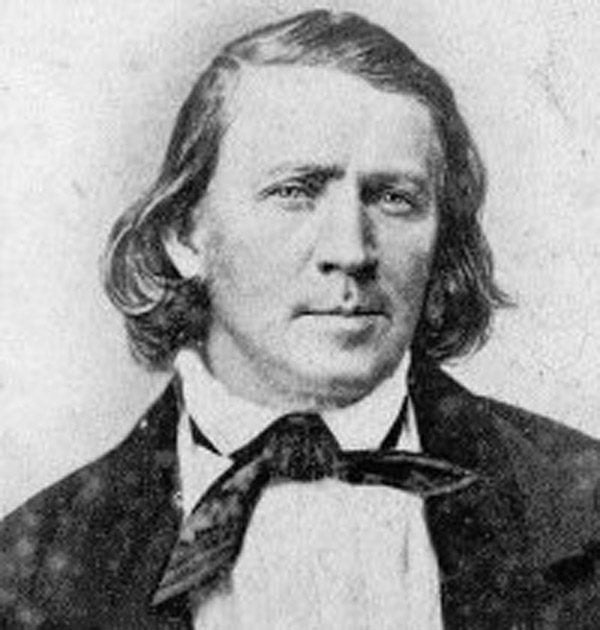
Brigham Young, in an unsourced photograph from ca. 1850
(Wikimedia Commons public domain image)
Earlier this year, in preparation for sitting down to interview Professor Alexander in connection with the Interpreter Foundation’s Six Days in August film project, I re-read Thomas G. Alexander, Brigham Young and the Expansion of the Mormon Faith (Norman: University of Oklahoma Press, 2019). That interview with him — he’s been a friend of ours for many years now — will eventually figure in the docudrama portion of the Foundation’s film effort.
Here are some passages from his very good book that I marked during that re-reading:
In several previously published articles I have argued that objectivity—as scholars generally use the term—is impossible. Every person carries some cultural baggage that no amount of scholarly detachment or persistence can overcome. Historian Charles Beard called the idea of objectivity a Noble Dream. I believe that those who profess to be objective are self-deluded. I have argued and still believe that honesty is the most important virtue historians can seek to achieve. Any written history consists of a text written by weaving together evidence found in clearly fragmentary and often messy documents with prose that links the evidence together in a story or narrative. All too often, historians allow rhetoric and supposition to substitute for evidence. (Preface)
I have tried, as diligently as possible, to write an honest biography. In the text that follows, I have recognized Brigham Young’s failings, especially in his Indian policy, the Mormon Reformation, and the United Orders. Some of his doctrinal views are clearly unorthodox. At the same time, I have also tried to treat his successes as a missionary, family man, businessman, church leader, and colonizer. I would like to have known him personally. Unfortunately, the only paths available to explore his life are documents and narratives. The following text is the result of my exploration. (Preface)
I marked several passages that illustrated Brother Brigham’s sense of humor. Here are three of them:
In 1851 a woman named Elizabeth Green wrote Young asking him to remove her name from church records because she had decided to become a spiritualist. With a touch of humor, Young replied, “I have this day examined the records of baptisms for the remission of sins in the Church of Jesus Christ of Latter Day Saints, and not being able to find the name of ‘Elizabeth Green’ recorded therein I was saved the necessity of erasing your name therefrom. You may therefor consider that your sins have not been remitted you and you may consequently enjoy the benefits therefrom.” (Chapter 11)
Goodwin’s Weekly on April 4, 1914, reported that during his conversation with Tom Thumb, the little man remarked, “I cannot understand polygamy.” We see Young’s ready wit in his reply, “Neither could I when I was your size.” (Chapter 13)
Brigham lamented that “the architects of Zion [must] . . . work with such material as the Lord has provided, stupidity, wooden shoes, and cork brains thrown into the bargain” (Chapter 11).
And now for a couple of passages about Brigham Young and women, a topic that infuriates some folks at its mere mention but that should, I think, be approached more thoughtfully and with greater balance than that:
Young appreciated the support of friendly non-Mormons like Kane, but he also believed that women could assist in the church’s work, and in addition, they had an important role to play in the economic and political life of Utah Territory and the church. With Young’s encouragement, and the active lobbying by Latter-day Saint women, women in Utah achieved a degree of political power shared only by women in Wyoming at the time. At the ratification of the U.S. Constitution, women who owned property in Massachusetts, New York, New Jersey, and Rhode Island could vote, but the state legislatures soon took that right from them. In 1870 Utah’s gender composition was quite different from Wyoming’s. In Utah women made up 48 percent of the population, whereas in Wyoming they made up only 20 percent. Several eastern and midwestern congressmen led by George W. Julian of Indiana had argued that if women could vote in Utah, they would overthrow Utah’s polygamous leadership. Young knew they were wrong, and he urged the legislature to grant suffrage to Utah’s women. His counselor, George Q. Cannon, published editorials in the Deseret News championing the cause of women as a progressive measure. “With women to aid in the great cause of reform,” Cannon wrote, “what wonderful changes can be effected!” Utah women—led by Charlotte Ives Godbe, Young’s stepdaughter, and Mormon women Emmeline B. Wells and Sarah Kimball—lobbied aggressively for the reform by holding rallies and urging acting governor Samuel A. Mann to sign the bill that granted women the vote after the legislature passed it. He did so on February 12, 1870, and among the first women to vote was Seraph A. Young, an attorney and Brigham Young’s grandniece. The U.S. Congress would abolish women’s suffrage in Utah seventeen years later with the Edmunds-Tucker Act of 1887, but, responding to the will of the people, the Utah Constitutional Convention restored woman suffrage at statehood in 1896. (Chapter 12)
Young’s attitudes and actions about women proved important in promoting their activity in the church and the larger community. Although his ideas seem antiquated today, in the nineteenth century, they were progressive. Giving women the responsibility for their own Relief Society, supporting women’s political activity, and encouraging women to study medicine, law, telegraphy, sales, and other professions was extremely important for their progress and for the health of the community. (Chapter 13)
And I like this final appraisal from Professor Alexander, who has devoted a long and productive career and post-career to studying and thinking and writing about the history of Utah and of the Latter-day Saints:
Some churches that were organized or flourished during the Second Great Awakening have survived just as the LDS church did, while others have died out or have left only vestiges of themselves. Significantly, none of these churches experienced the persistent persecution the Mormons endured during the nineteenth century. Absent the strong, gifted, and indeed, inspired leadership that Brigham Young gave the Saints, the Church of Jesus Christ of Latter-day Saints might well have died out as well. Faithful members loved Brigham Young, and they willingly followed him into the Indians’ land, the Mormons’ considered wilderness, to build towns. Most remained faithful despite continued persecution because they believed in his message and his leadership. (Chapter 13)
It is my hope that our Six Days in August film project will help Latter-day Saints and others to more adequately appreciate the contributions of President Brigham Young.
Posted from Park City, Utah
History and Religion
Previous Post

July 29, 2023
Not a prudent move, but a brilliantly successful one
Next Post

July 31, 2023 "If it isn't science, it's fiction"
Recent Comments
"Sutherland's lecture sounds interesting. He seems to restate the Washington consensus that trade brings peace ..."
Learning more about a region of ..."
"In a meeting today, I learned another important reason why accurate (or at least as ..."
From Serbia’s “White City,” Belgrade
"I've been watching a lot of video interviews of NDErs and researchers. I think in ..."
"PL: "Let's hope he doesn't have your address..."I have to frankly confess that a few ..."
From Serbia’s “White City,” Belgrade
Browse Our Archives
Select a Category Uncategorized
Select a Month October 2026 September 2026 August 2026 July 2026 June 2026 May 2026 April 2026 March 2026 February 2026 January 2026 December 2025 November 2025 October 2025 September 2025 August 2025 July 2025 June 2025 May 2025 April 2025 March 2025 February 2025 January 2025 December 2024 November 2024 October 2024 September 2024 August 2024 July 2024 June 2024 May 2024 April 2024 March 2024 February 2024 January 2024 December 2023 November 2023 October 2023 September 2023 August 2023 July 2023 June 2023 May 2023 April 2023 March 2023 February 2023 January 2023 December 2022 November 2022 October 2022 September 2022 August 2022 July 2022 June 2022 May 2022 April 2022 March 2022 February 2022 January 2022 December 2021 November 2021 October 2021 September 2021 August 2021 July 2021 June 2021 May 2021 April 2021 March 2021 February 2021 January 2021 December 2020 November 2020 October 2020 September 2020 August 2020 July 2020 June 2020 May 2020 April 2020 March 2020 February 2020 January 2020 December 2019 November 2019 October 2019 September 2019 August 2019 July 2019 June 2019 May 2019 April 2019 March 2019 February 2019 January 2019 December 2018 November 2018 October 2018 September 2018 August 2018 July 2018 June 2018 May 2018 April 2018 March 2018 February 2018 January 2018 December 2017 November 2017 October 2017 September 2017 August 2017 July 2017 June 2017 May 2017 April 2017 March 2017 February 2017 January 2017 December 2016 November 2016 October 2016 September 2016 August 2016 July 2016 June 2016 May 2016 April 2016 March 2016 February 2016 January 2016 December 2015 November 2015 October 2015 September 2015 August 2015 July 2015 June 2015 May 2015 April 2015 March 2015 February 2015 January 2015 December 2014 November 2014 March 2014 August 2013 February 2012
Follow Us!
TAKE THE
Religious Wisdom Quiz
Who killed Goliath?
Select your answer to see how you score.
Samson Jonathan Saul David
Related posts from Sic et Non

Notes on Women, Priesthood, and General Conference

“Once more unto the breach, dear friends, once...
How many divine beings appeared in Joseph's First...

Does mind derive from mindless matter?
TRENDING AT PATHEOS Latter-day Saint

Janie Learns the Way of the Cross: A...
Teaching children about Jesus' Passion can be challenging. Many parents and educators...

Looking For Good Catholic Writing - October 2026
He alone extends the heavens, and he walks upon the waves of...

In "Irreplaceable," our book on vocation and technology, Trevor Sutton and I...

I was strolling through the top floor of the brand new Parthenon...

What Does Gêvâh Mean For Kimberley Guifoyle &...
This week, a lot of the news is focused on Kimberly Guilfoyle....

INNER CIRCLE: Profound Mystery (Of Christ In All...
Ephesians 5:31-32 “For this reason, a man will leave his father and...
view all Latter-day Saint blogs
What Are Your Thoughts?leave a comment
Ad-Free & Subscriber Log-In Subscription Support
- About Us
- 2026 Calendar
- Videos
- Podcasts
- Library of World Religions
- Faith In Media Tracker
- Advertise With Us
- Write for Us
- Privacy Policy
- Terms of Service
- Do Not Sell My Data
- Contact Us
- Radiant Digital
- Manage Newsletter Subscriptions
- Unsubscribe From Notifications
- Sitemap
Copyright 2008-2026, Patheos. All rights reserved.
Subscription Support Ad-Free & Subscriber Log-In
Follow Patheos