
BuddhistCatholicContemplativeEvangelicalGeneral ChristianHinduJewishLatter-day SaintMuslimNew VisionsProgressive Christian
Beliefs
- Buddhist
- Catholic
- Contemplative
- Evangelical
- General Christian
- Hindu
- Jewish
- Latter-day Saint
- More Voices
- Muslim
- New Visions
- Pagan
- Progressive Christian
Topics
- Religion News
- Food and Religion
- Sports and Religion
- Religious Art
- Religious Music and Entertainment
- Religious Events
- History and Religion
- Style and Religion
- Politics and Religion
- Women in Religion
- Recreation Outdoors and Religion
- Business Finance and Religion
- Careers Workplace and Religion
- Education and Religion
- Family Parenting and Religion
- Health Fitness and Religion
- Home and Religion
- Relationships and Religion
- Technology and Religion
- Travel and Religion
Columnists
- Buddhist Columnists
- Business Finance and Religion Columnists
- Careers Workplace and Religion Columnists
- Catholic Columnists
- Contemplative Columnists
- Education and Religion Columnists
- Evangelists Columnists
- Family Parenting and Religion Columnists
- General Christian Columnists
- Health Fitness and Religion Columnists
- Hindu Columnists
- History and Religion Columnists
- Home and Religion Columnists
- Jewish Columnists
- More Voices Columnists
- Latter Day Columnists
- Muslim Columnists
- New Visions Columnists
- Nonreligious Columnists
- Pagan Columnists
- Politics and Religion Columnists
- Progressive Columnists
- Recreation Outdoors and Religion Columnists
- Relationships and Religion Columnists
- Religion News Columnists
- Religious Art Columnists
- Religious Events Columnists
- Religious Music and Entertainment Columnists
- Sports and Religion Columnists
- Style and Religion Columnists
- Technology and Religion Columnists
- Travel and Religion Columnists
- Women in Religion Columnists
Resource Library
- 2026 Calendar
- Library of World Religions
- The 100 Most Holy Places on Earth
- Patheos Answers
- Podcasts
- Videos
- Faith Leaders Database
- Anglican Episcopalian
- Bahai
- Baptist
- Buddhism
- Christianity
- Confucianism
- Eastern Orthodoxy
- Hinduism
- Holiness and Pentecostal
- ISKCON
- Islam
- Judaism
- Lutheran
- Methodist
- The Church of Jesus Christ of Latter-day Saints
- New Age
- Paganism
- Presbytarian and Reformed
- Protestantism
- Religion Behind the Scenes
- Roman Catholic
- Scientology
- Shia Islam
- Sikhism
- Sufism
- Sunni Islam
- Taoism
- Zen
- See all religions
Research Tools
 Ad-Free & Subscriber Log-In Subscription Support
Ad-Free & Subscriber Log-In Subscription Support
Follow Patheos 

- Trending:
- Forgiveness
- |
- Marriage
- |
- Consciousness
- |
- Death Penalty
- |
- Election
- |
- Halloween

- Home
- Latter-day Saint
- Belief under conditions of uncertainty
Belief under conditions of uncertainty
Last updated on: July 20, 2023 at 10:40 am by Dan Peterson
Belief under conditions of uncertainty 2023-07-20T10:40:36-06:00 Dan Peterson
Patheos Explore the world's faith through different perspectives on religion and spirituality! Patheos has the views of the prevalent religions and spiritualities of the world.
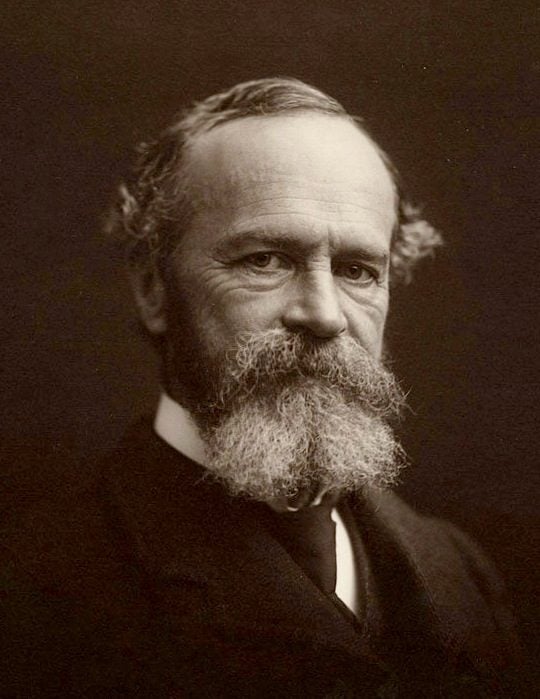
The great American psychologist and philosopher William James (1842-1910), brother of the great novelist Henry James (1843-1916) (Wikimedia Commons public domain image)
Earlier today, one of the commenters on this blog — I hope that he won’t mind my describing him as a non-believer — posted the following:
When faced with an unresolvable uncertainty, the correct response is agnosticism, not to embrace whatever hope or bias you have. You can want or hope, but the moment you let your desire outweigh your objectivity, you’re going to quickly find ways to reinforce it. No-one’s perfect at avoiding this, but that doesn’t mean you shouldn’t try.
I’m not altogether certain, if a matter is genuinely “unresolvable,” if the two (or more) available options are really, for all intents and purposes, equal, why one shouldn’t make a choice based on sheer desire, or whimsically decide by means of a coin toss? Especially if a choice is urgent or in some way inescapable. (The great al-Ghazali [d. 1111] offers a good metaphor for such a situation in the opening chapter of his Tahafut al-falasifa: (“The Incoherence of the Philosophers”): A hungry man stands between two juicy dates. They are, so far as he can tell, identical, but, for some reason, he can only choose one of them. Should he simply stand there forever, unable to decide between the two pieces of fruit? Or should he just choose one?)
Here, though, I want to call attention to the discussion of this very topic that occurs in the classic 1896 lecture “The Will to Believe,” by the great Harvard philosopher and psychologist Williams James (brother of the great novelist Henry James). To a large degree, it represents a response to the English mathematician and philosopher William K. Clifford’s earlier essay “The Ethics of Belief.”
“It is wrong always, everywhere, and for every one,” Clifford had written, “to believe anything upon insufficient evidence.”[1]
James, umm, doesn’t accept Clifford’s position:
Our passional nature not only lawfully may, but must, decide an option between propositions, whenever it is a genuine option that cannot by its nature be decided on intellectual grounds; for to say, under such circumstances, ‘Do not decide, but leave the question open,’ is itself a passional decision,–just like deciding yes or no,–and is attended with the same risk of losing the truth.[2]
Of course, there are cases where the costs of inaction, agnosticism, indecision, are negligible:
Let us agree . . . that wherever there is no forced option, the dispassionately judicial intellect with no pet hypothesis, saving us, as it does, from dupery at any rate, ought to be our ideal.[4]
In other cases, though, a decision is inescapable. Not to decide is, itself, a decision. Claremont philosopher Stephen Davis updates a Jamesian analogy (from carriage to truck, from male coach driver to female truck driver) while continuing to use James’s terminology of “genuine options,” “forced options,” and “momentous options:”
Imagine the following situation: while entering a steep downgrade, a truck driver suddenly discovers that her brakes have failed. The truck is starting to pick up speed and the driver sees that soon she will be in danger. The driver is faced with a choice: she can either immediately jump from the truck, risking bruises and broken bones while escaping the greater danger of a possible crash farther down the hill. Or she can remain in the truck, risking a crash but hoping eventually to guide it down the hill to a level spot. But the driver does not know how long the downgrade is; she cannot see where it ends and this stretch of road is new to her.
It surely seems that this is a genuine option for the driver. It is live, because both possibilities appeal to her as distinct possibilities. It is forced, because there is no third option beside jumping now or staying with the truck (jumping later is a logical possibility, but is clearly too unsafe to be seriously considered). It is momentous, because her life is at stake. And the evidence is ambiguous because, let’s say, neither possibility seems to her any safer or more dangerous than the other. Of course James had more reflective, intellectual situations in mind than this when he wrote ‘The Will to Believe’; in our thought experiment the driver must make up her mind almost instantaneously on the basis of the limited evidence that is available to her. Still, if this case does amount to a genuine option, then James would claim that she now has the intellectual right to choose whichever option she wants to choose, to let her passional nature decide.[5]
But the more careful ‘wishful thinking’ critic will now argue that the passional nature of the driver has nothing to do with the question of which is the safer choice. (We can imagine that one of the two options might prove to be objectively safer than the other to the driver and to other drivers and passengers on the road that day; experiments with many volunteer drivers in similar trucks trying out both options could be carried out.) The critic will claim that the driver has no other rational choice than to make up her mind on the basis of the (admittedly meagre) evidence that is available to her at the moment—her own driving abilities, the speed of the truck at the moment of decision, the appearances of the road ahead, the terrain at the side of the road (where she could possibly jump), etc.
In other words, the critic will argue that Russell’s Principle still holds in cases such as this for the simple reason that the driver’s passional nature might opt for the wrong alternative, the more dangerous one. But this leaves James the option of replying, ‘What evidence is there, in this or any other case of a genuine option, that deciding on the basis of one’s passional nature is more likely to lead to the wrong decision than deciding on the basis of the evidence, which we are granting is ambiguous?’ He could go on and say: ‘If this is a case that can (and thus should) be decided on the basis of evidence, then it is not a genuine option, and thus not a legitimate counter-example to the “right to believe” argument.’”[6]
But, of course, James wasn’t really talking about runaway carriages or coaches, let alone about trucks suffering from brake failure. Back to William James himself:
So proceeding, we see, first, that religion offers itself as a momentous option. We are supposed to gain, even now, by our belief, and to lose by our non-belief, a certain vital good. Secondly, religion is a forced option, so far as that good goes. We cannot escape the issue by remaining sceptical and waiting for more light, because, although we do avoid error in that way if religion be untrue, we lose the good, if it be true, just as certainly as if we positively chose to disbelieve.[7]
“Scepticism, then, is not avoidance of option; it is option of a certain particular kind of risk. Better risk loss of truth than chance of error, — that is your faith-vetoer’s exact position. He is actively playing his stake as much as the believer is; he is backing the field against the religious hypothesis, just as the believer is backing the religious hypothesis against the field. To preach scepticism to us as a duty until ‘sufficient evidence’ for religion is found, is tantamount therefore to telling us, when in presence of the religious hypothesis, that to yield to our fear of its being error is wiser and better than to yield to our hope that it may be true. It is not intellect against all passions, then; it is only intellect with one passion laying down its law. And by what, forsooth, is the supreme wisdom of this passion warranted? Dupery for dupery, what proof is there that dupery through hope is so much worse than dupery through fear? I, for one, can see no proof.”[8]
But that’s not quite all that Professor James has to say about Professor Clifford’s position:
When the Cliffords tell us how sinful it is to be Christians on such ‘insufficient evidence,’ insufficiency is really the last thing they have in mind. For them the evidence is absolutely sufficient, only it makes the other way. They believe so completely in an anti-christian order of the universe that there is no living option: Christianity is a dead hypothesis from the start.[3]
[1] $Cited by James, “The Will to Believe,” 8.*
[2] $ James, “The Will to Believe,” 11 (italics deleted).*
[3] $James, “The Will to Believe,” 14.*
[4] $James, “The Will to Believe,” 21-22.*
[5] $Davis, God, Reason and Theistic Proofs, 173-74.*
[6] $Davis, God, Reason and Theistic Proofs, 174 (emphasis in the original).*
[7] $James, “The Will to Believe,” 26.
[8] $James, “The Will to Believe,” 26-27.*
Posted from Park City, Utah
Previous Post

July 18, 2023
A small tempest about a small temple in Cody
Next Post

July 20, 2023 Joseph, the Keys, and the Twelve
Recent Comments
Browse Our Archives
Select a Category Uncategorized
Select a Month October 2026 September 2026 August 2026 July 2026 June 2026 May 2026 April 2026 March 2026 February 2026 January 2026 December 2025 November 2025 October 2025 September 2025 August 2025 July 2025 June 2025 May 2025 April 2025 March 2025 February 2025 January 2025 December 2024 November 2024 October 2024 September 2024 August 2024 July 2024 June 2024 May 2024 April 2024 March 2024 February 2024 January 2024 December 2023 November 2023 October 2023 September 2023 August 2023 July 2023 June 2023 May 2023 April 2023 March 2023 February 2023 January 2023 December 2022 November 2022 October 2022 September 2022 August 2022 July 2022 June 2022 May 2022 April 2022 March 2022 February 2022 January 2022 December 2021 November 2021 October 2021 September 2021 August 2021 July 2021 June 2021 May 2021 April 2021 March 2021 February 2021 January 2021 December 2020 November 2020 October 2020 September 2020 August 2020 July 2020 June 2020 May 2020 April 2020 March 2020 February 2020 January 2020 December 2019 November 2019 October 2019 September 2019 August 2019 July 2019 June 2019 May 2019 April 2019 March 2019 February 2019 January 2019 December 2018 November 2018 October 2018 September 2018 August 2018 July 2018 June 2018 May 2018 April 2018 March 2018 February 2018 January 2018 December 2017 November 2017 October 2017 September 2017 August 2017 July 2017 June 2017 May 2017 April 2017 March 2017 February 2017 January 2017 December 2016 November 2016 October 2016 September 2016 August 2016 July 2016 June 2016 May 2016 April 2016 March 2016 February 2016 January 2016 December 2015 November 2015 October 2015 September 2015 August 2015 July 2015 June 2015 May 2015 April 2015 March 2015 February 2015 January 2015 December 2014 November 2014 March 2014 August 2013 February 2012
Follow Us!
TAKE THE
Religious Wisdom Quiz
I climbed a tree to see Jesus passing by because I was short in stature and curious about this teacher. Who perched in the branches?
Select your answer to see how you score.
Nicodemus Zacchaeus Bartimaeus Matthew
Related posts from Sic et Non
"The Appeal of Socialism and the Case Against...

Evidence and argument in thinking about the existence...

"You really ought to give Iowa a try"...
Is there seeming evidence against the Restoration? Sure!
TRENDING AT PATHEOS Latter-day Saint

Pope Leo Celebrates Mass for Nurses & Docs...
I don't have any idea how he did it, but Pope Leo...

The Sermon on the Mount, Part I: Matthew...
The Sermon on the Mount, Part I (Matthew 4:12-5:12) St. Matthew moves...

What's up from Crossway: Reviewing some of their latest A few weeks...

Janie Learns the Way of the Cross: A...
Teaching children about Jesus' Passion can be challenging. Many parents and educators...

Looking For Good Catholic Writing - October 2026
He alone extends the heavens, and he walks upon the waves of...

In "Irreplaceable," our book on vocation and technology, Trevor Sutton and I...
view all Latter-day Saint blogs
What Are Your Thoughts?leave a comment
Ad-Free & Subscriber Log-In Subscription Support
- About Us
- 2026 Calendar
- Videos
- Podcasts
- Library of World Religions
- Faith In Media Tracker
- Advertise With Us
- Write for Us
- Privacy Policy
- Terms of Service
- Do Not Sell My Data
- Contact Us
- Radiant Digital
- Manage Newsletter Subscriptions
- Unsubscribe From Notifications
- Sitemap
Copyright 2008-2026, Patheos. All rights reserved.
Subscription Support Ad-Free & Subscriber Log-In
Follow Patheos