
BuddhistCatholicContemplativeEvangelicalGeneral ChristianHinduJewishLatter-day SaintMuslimNew VisionsProgressive Christian
Beliefs
- Buddhist
- Catholic
- Contemplative
- Evangelical
- General Christian
- Hindu
- Jewish
- Latter-day Saint
- More Voices
- Muslim
- New Visions
- Pagan
- Progressive Christian
Topics
- Religion News
- Food and Religion
- Sports and Religion
- Religious Art
- Religious Music and Entertainment
- Religious Events
- History and Religion
- Style and Religion
- Politics and Religion
- Women in Religion
- Recreation Outdoors and Religion
- Business Finance and Religion
- Careers Workplace and Religion
- Education and Religion
- Family Parenting and Religion
- Health Fitness and Religion
- Home and Religion
- Relationships and Religion
- Technology and Religion
- Travel and Religion
Columnists
- Buddhist Columnists
- Business Finance and Religion Columnists
- Careers Workplace and Religion Columnists
- Catholic Columnists
- Contemplative Columnists
- Education and Religion Columnists
- Evangelists Columnists
- Family Parenting and Religion Columnists
- General Christian Columnists
- Health Fitness and Religion Columnists
- Hindu Columnists
- History and Religion Columnists
- Home and Religion Columnists
- Jewish Columnists
- More Voices Columnists
- Latter Day Columnists
- Muslim Columnists
- New Visions Columnists
- Nonreligious Columnists
- Pagan Columnists
- Politics and Religion Columnists
- Progressive Columnists
- Recreation Outdoors and Religion Columnists
- Relationships and Religion Columnists
- Religion News Columnists
- Religious Art Columnists
- Religious Events Columnists
- Religious Music and Entertainment Columnists
- Sports and Religion Columnists
- Style and Religion Columnists
- Technology and Religion Columnists
- Travel and Religion Columnists
- Women in Religion Columnists
Resource Library
- 2026 Calendar
- Library of World Religions
- The 100 Most Holy Places on Earth
- Patheos Answers
- Podcasts
- Videos
- Faith Leaders Database
- Anglican Episcopalian
- Bahai
- Baptist
- Buddhism
- Christianity
- Confucianism
- Eastern Orthodoxy
- Hinduism
- Holiness and Pentecostal
- ISKCON
- Islam
- Judaism
- Lutheran
- Methodist
- The Church of Jesus Christ of Latter-day Saints
- New Age
- Paganism
- Presbytarian and Reformed
- Protestantism
- Religion Behind the Scenes
- Roman Catholic
- Scientology
- Shia Islam
- Sikhism
- Sufism
- Sunni Islam
- Taoism
- Zen
- See all religions
Research Tools
 Ad-Free & Subscriber Log-In Subscription Support
Ad-Free & Subscriber Log-In Subscription Support
Follow Patheos 

- Trending:
- Forgiveness
- |
- Marriage
- |
- Consciousness
- |
- Death Penalty
- |
- Election
- |
- Halloween

- Home
- Latter-day Saint
- Tales of the Gloucester Crypt
Tales of the Gloucester Crypt
Last updated on: June 22, 2023 at 3:36 am by Dan Peterson
Tales of the Gloucester Crypt 2023-06-22T03:36:22-06:00 Dan Peterson
Patheos Explore the world's faith through different perspectives on religion and spirituality! Patheos has the views of the prevalent religions and spiritualities of the world.
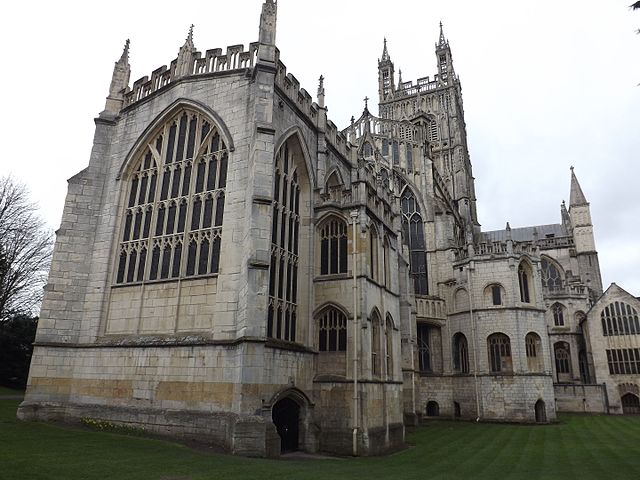
Gloucester Cathedral (Wikimedia Commons public domain photograph)
Our focus today was on the city of Gloucester, and most particular on the city’s cathedral. When I think of Gloucester, I’m afraid that the very first thing that occurs to me is Richard III, who reigned from 1483 until his death — the last English king to die in combat and the last of the Plantagenet monarchs — at the Battle of Bosworth Field in 1485. Prior to his brief tenure as king of England, Richard was duke of Gloucester.
“A horse! A horse!” the beleaguered Richard cries shortly before his death in Shakespeare’s Richard III. “My kingdom for a horse!” And it’s Shakespeare’s Richard — one of the greatest and most cunning villains in all of literature — of whom I particularly think, although some are now arguing that Shakespeare’s portrayal of the king is wildly unjust and the product and embodiment of Tudor propaganda. (The Tudors were the family who displaced the Plantagenets and who overthrew and killed Richard.) One of the most spectacular pieces of acting that I’ve ever seen was Gary Armagnac’s depiction of Richard III at the 1994 Utah Shakespeare Festival. For sheer brilliant evil, I’ve never seen the like (although some of my critics would happily give me the edge in goofball evil, if not in brilliance). It is etched unforgettably in my memory.
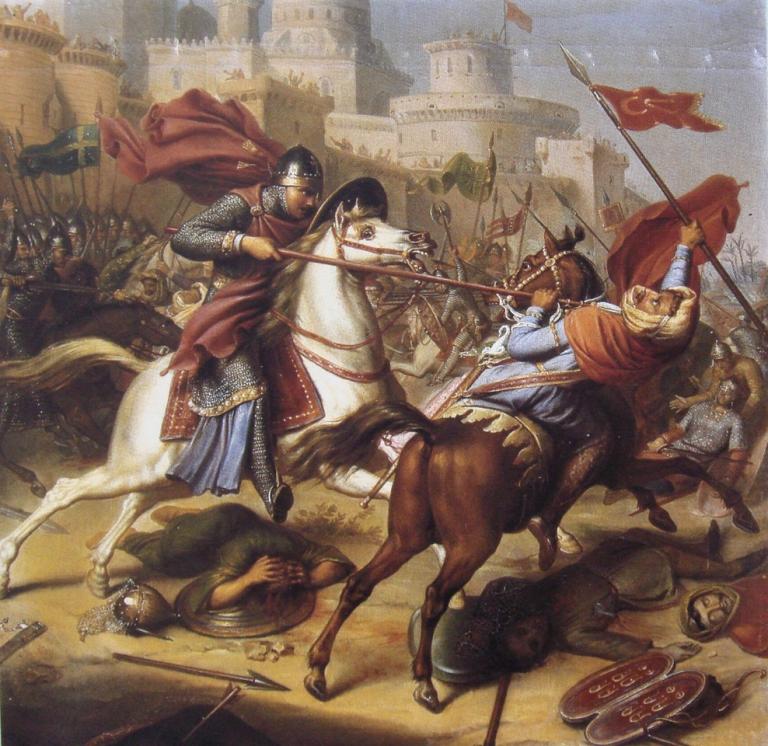
Robert de Normandie in combat before the walls of Antioch, Wikimedia Commons public domain painting by Jean-Joseph Dassy (1850)
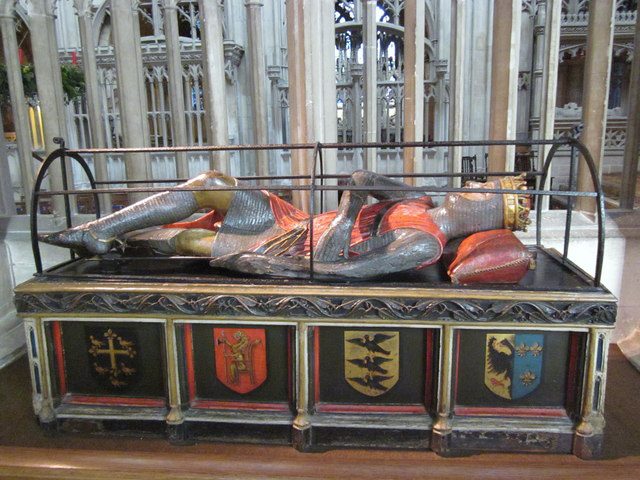
Tomb and effigy of Robert II, Duke of Normandy, in Gloucester Cathedral. The pose is a curious one. He seems to be about to get out of bed while reaching with his right hand for his sword.
(Wikimedia Commons public domain image)
In any case, Richard Plantagenet is nowhere to be found in Gloucester Cathedral. Instead, the cathedral is the site of the tomb of Osric, the Anglo-Saxon King of the Hwicce, who founded what would eventually become the cathedral in about AD 679.
The tomb of Robert II of Normandy (ca. AD 1051-1134), or Robert Curthose, the eldest son of William the Conqueror, is also found in the cathedral. Robert was, by reputation, a heroic warrior. But he was passed over by his father for the rule of England, and probably for good reason. Somewhere in the cathedral literature today I saw a reference to him as “the king we never had” and, elsewhere, as “born to be king.”
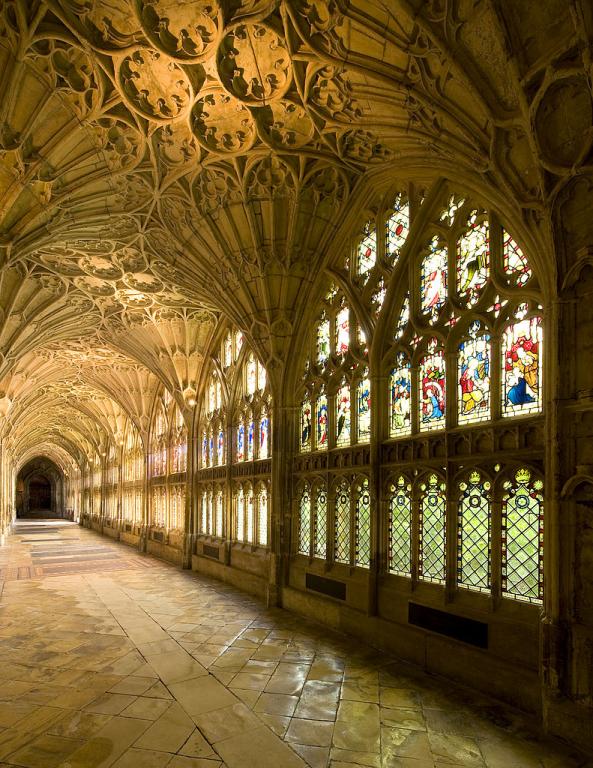
One of the glories of Gloucester Cathedral is the fan vaulting of its Great Cloister
(Wikimedia Commons public domain image)
In October 1216 Gloucester Cathedral was the venue for the coronation of Henry III, after the death of his father, the notorious King John, who has a bit of a public image problem and who could use some reputation management. John has his own play among Shakespeare’s historical dramas, but he is probably most famous for his enforced signing of the Magna Carta, on which he later tried to renege. He has been portrayed in film by Claude Rains (opposite Errol Flynn’s title role and Basil Rathbone’s Sir Guy of Gisbourne in the 1938 Adventures of Robin Hood, which has a special and cherished place in my unwritten autobiography) as well as by a cowardly thumb-sucking lion (voiced by Sir Peter Ustinov in the 1973 Disney Robin Hood). In The Lion in Winter, a very memorable 1968 film, John, who is the son of Henry II (Peter O’Toole) and Eleanor of Aquitaine (Katharine Hepburn) and the younger brother of Richard the Lion Heart (Sir Anthony Hopkins in his first significant film role), is portrayed as an effete weakling, but also as a dishonorable schemer.
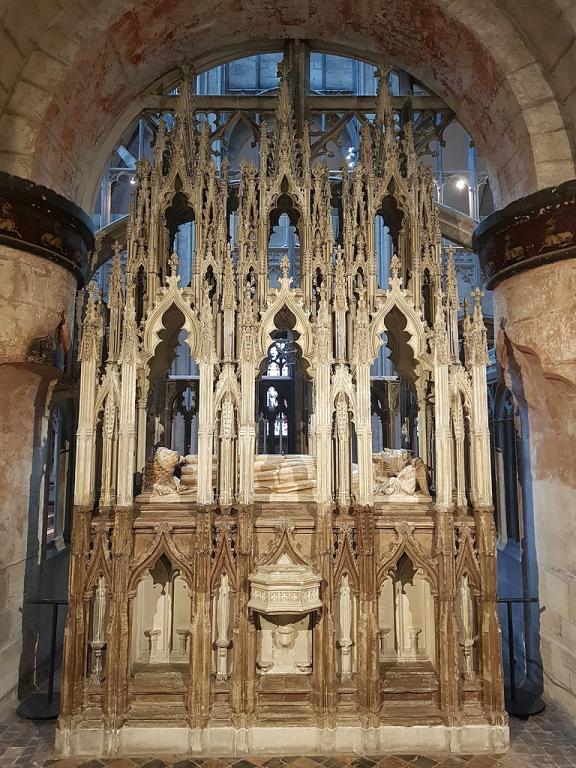
The tomb of Edward II in Gloucester Cathedral
(Wikimedia Commons public domain image)
Perhaps the cathedral’s chief claim to specific fame — apart, that is, from its repeated use in the Harry Potter films (which isn’t altogether uncommon in the places we’ve visited during this trip) — is that it is the burial place of Edward II, the seventh Plantagenet king of England (who reigned, rather poorly, from 1307 to 1327 and who died under mysterious circumstances while effectively under house arrest in nearby Berkeley Castle). We had already spent some time with Edward II up in Scotland, when our group visited the site of the 23-24 June 1314 Battle of Banockburn, where the forces of Robert the Bruce, King of Scots, inflicted a decisive defeat upon Edward’s vastly larger army — some sources give figures of 27,000 English to 6,000 Scots — during the First War of Scottish Independence.
That was perhaps an omen of things to come for Edward II, as was the refusal of the lord of Stirling Castle — a place that we visited on the first day of our group tour — to grant him asylum following the battle.
There was actually a petition, centuries ago, seeking canonization for Edward II, probably on the basis of the fact that he was an anointed king and that his possible murder thus represented martyrdom. The Vatican apparently never acknowledged or responded to the petition. Which was probably lucky for Rome, since there is at least a fifty-fifty chance that Edward’s sexual practices were, umm, quite catholic. Which is to say that they may not have been Catholic. But this may be mere rumor, the result of propaganda designed to justify his having been deposed from the throne, and it may perhaps not be true at all. (The simple fact that a source may be old, or contemporary, doesn’t necessarily mean that it’s not biased or partisan or that it’s accurate. Historiography requires wisdom and judgment and, even so, it’s an inexact “science.”)
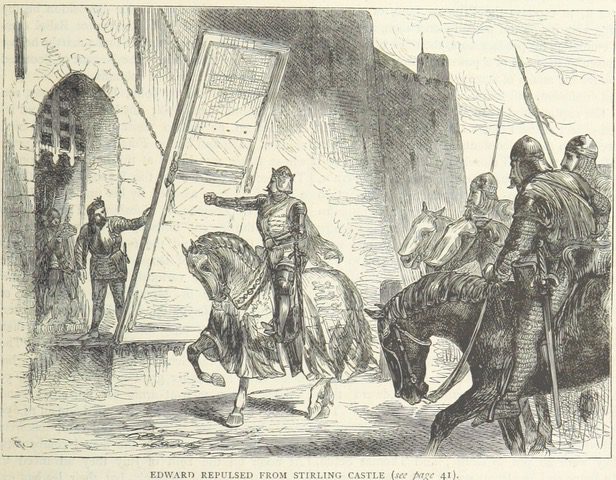
After his defeat by Scottish forces at the Battle of Banockburn, King Edward II of England tried to retreat to Stirling Castle, but the castle’s lord honored an agreement with the Scots and refused to let him enter.
(Wikimedia Commons public domain image)
The Age of Chivalry has much to commend it. Unfortunately, it’s largely myth, and it was as corrupted by human wickedness as every other age has been. Perhaps, though, we can learn some virtues from the romanticized, purified accounts of it that survive in literary texts from the medieval period through the Victorians and beyond. I still love them.
Posted from Cheltenham, Gloucestershire, England
Previous Post

June 19, 2023
A pretty ludicrous counterexplanation of Christ's resurrection
Next Post

June 21, 2023 Is the Church a hotbed of child abuse? Compared to what?
Recent Comments
"I have cpnsidered in my mond if the 4 volume Saints could be made into ..."
From Serbia’s “White City,” Belgrade
"DP: “But Mr. Sutherland worries about the fact that our time, when we can communicate ..."
Learning more about a region of ..."
"Another class of memories are of individuals who previously lived. Some of these remembered individuals ..."
"Sutherland's lecture sounds interesting. He seems to restate the Washington consensus that trade brings peace ..."
Learning more about a region of ..."
Browse Our Archives
Select a Category Uncategorized
Select a Month October 2026 September 2026 August 2026 July 2026 June 2026 May 2026 April 2026 March 2026 February 2026 January 2026 December 2025 November 2025 October 2025 September 2025 August 2025 July 2025 June 2025 May 2025 April 2025 March 2025 February 2025 January 2025 December 2024 November 2024 October 2024 September 2024 August 2024 July 2024 June 2024 May 2024 April 2024 March 2024 February 2024 January 2024 December 2023 November 2023 October 2023 September 2023 August 2023 July 2023 June 2023 May 2023 April 2023 March 2023 February 2023 January 2023 December 2022 November 2022 October 2022 September 2022 August 2022 July 2022 June 2022 May 2022 April 2022 March 2022 February 2022 January 2022 December 2021 November 2021 October 2021 September 2021 August 2021 July 2021 June 2021 May 2021 April 2021 March 2021 February 2021 January 2021 December 2020 November 2020 October 2020 September 2020 August 2020 July 2020 June 2020 May 2020 April 2020 March 2020 February 2020 January 2020 December 2019 November 2019 October 2019 September 2019 August 2019 July 2019 June 2019 May 2019 April 2019 March 2019 February 2019 January 2019 December 2018 November 2018 October 2018 September 2018 August 2018 July 2018 June 2018 May 2018 April 2018 March 2018 February 2018 January 2018 December 2017 November 2017 October 2017 September 2017 August 2017 July 2017 June 2017 May 2017 April 2017 March 2017 February 2017 January 2017 December 2016 November 2016 October 2016 September 2016 August 2016 July 2016 June 2016 May 2016 April 2016 March 2016 February 2016 January 2016 December 2015 November 2015 October 2015 September 2015 August 2015 July 2015 June 2015 May 2015 April 2015 March 2015 February 2015 January 2015 December 2014 November 2014 March 2014 August 2013 February 2012
Follow Us!
TAKE THE
Religious Wisdom Quiz
The queen of Ethiopia in the time of the early church was …
Select your answer to see how you score.
Bernice Esther Candace Hatshepsut
Related posts from Sic et Non
Christmas, the Israelite Tabernacle, and the Gospel of...
My one encounter, such as it was, with...
TRENDING AT PATHEOS Latter-day Saint

57th Dove Awards Honor Dolly Parton, Crown New...
On gospel music’s biggest night, the 57th annual GMA Dove Awards honored...

The First Eucharistic Controversy: Christ’s Real Presence
For Catholics, the Eucharist is the source and summit of the Christian...

What a Stop Sign Can Teach Us About...
How to Make a Decision When You Can't Hear God Main point:...

Archdiocese Hosts Military Marriage Retreat in Germany
RASTATT, Germany — The transient military lifestyle, with its frequent deployments and...

Nearly every morning, I make the drive to Detroit with my high-school-age...

The Real AI Story Is Adoption Without Trust
Artificial intelligence has crossed a political threshold. It is no longer a...
view all Latter-day Saint blogs
What Are Your Thoughts?leave a comment
Ad-Free & Subscriber Log-In Subscription Support
- About Us
- 2026 Calendar
- Videos
- Podcasts
- Library of World Religions
- Faith In Media Tracker
- Advertise With Us
- Write for Us
- Privacy Policy
- Terms of Service
- Do Not Sell My Data
- Contact Us
- Radiant Digital
- Manage Newsletter Subscriptions
- Unsubscribe From Notifications
- Sitemap
Copyright 2008-2026, Patheos. All rights reserved.
Subscription Support Ad-Free & Subscriber Log-In
Follow Patheos