
BuddhistCatholicContemplativeEvangelicalGeneral ChristianHinduJewishLatter-day SaintMuslimNew VisionsProgressive Christian
Beliefs
- Buddhist
- Catholic
- Contemplative
- Evangelical
- General Christian
- Hindu
- Jewish
- Latter-day Saint
- More Voices
- Muslim
- New Visions
- Pagan
- Progressive Christian
Topics
- Religion News
- Food and Religion
- Sports and Religion
- Religious Art
- Religious Music and Entertainment
- Religious Events
- History and Religion
- Style and Religion
- Politics and Religion
- Women in Religion
- Recreation Outdoors and Religion
- Business Finance and Religion
- Careers Workplace and Religion
- Education and Religion
- Family Parenting and Religion
- Health Fitness and Religion
- Home and Religion
- Relationships and Religion
- Technology and Religion
- Travel and Religion
Columnists
- Buddhist Columnists
- Business Finance and Religion Columnists
- Careers Workplace and Religion Columnists
- Catholic Columnists
- Contemplative Columnists
- Education and Religion Columnists
- Evangelists Columnists
- Family Parenting and Religion Columnists
- General Christian Columnists
- Health Fitness and Religion Columnists
- Hindu Columnists
- History and Religion Columnists
- Home and Religion Columnists
- Jewish Columnists
- More Voices Columnists
- Latter Day Columnists
- Muslim Columnists
- New Visions Columnists
- Nonreligious Columnists
- Pagan Columnists
- Politics and Religion Columnists
- Progressive Columnists
- Recreation Outdoors and Religion Columnists
- Relationships and Religion Columnists
- Religion News Columnists
- Religious Art Columnists
- Religious Events Columnists
- Religious Music and Entertainment Columnists
- Sports and Religion Columnists
- Style and Religion Columnists
- Technology and Religion Columnists
- Travel and Religion Columnists
- Women in Religion Columnists
Resource Library
- 2026 Calendar
- Library of World Religions
- The 100 Most Holy Places on Earth
- Patheos Answers
- Podcasts
- Videos
- Faith Leaders Database
- Anglican Episcopalian
- Bahai
- Baptist
- Buddhism
- Christianity
- Confucianism
- Eastern Orthodoxy
- Hinduism
- Holiness and Pentecostal
- ISKCON
- Islam
- Judaism
- Lutheran
- Methodist
- The Church of Jesus Christ of Latter-day Saints
- New Age
- Paganism
- Presbytarian and Reformed
- Protestantism
- Religion Behind the Scenes
- Roman Catholic
- Scientology
- Shia Islam
- Sikhism
- Sufism
- Sunni Islam
- Taoism
- Zen
- See all religions
Research Tools
 Ad-Free & Subscriber Log-In Subscription Support
Ad-Free & Subscriber Log-In Subscription Support
Follow Patheos 

- Trending:
- Forgiveness
- |
- Marriage
- |
- Consciousness
- |
- Death Penalty
- |
- Election
- |
- Halloween

- Home
- Latter-day Saint
- I wonder what the king is doing tonight. What merriment’s the king pursuing tonight?
I wonder what the king is doing tonight. What merriment’s the king pursuing tonight?
Last updated on: June 1, 2023 at 2:30 pm by Dan Peterson
I wonder what the king is doing tonight. What merriment’s the king pursuing tonight? 2023-06-01T14:30:19-06:00 Dan Peterson
Patheos Explore the world's faith through different perspectives on religion and spirituality! Patheos has the views of the prevalent religions and spiritualities of the world.
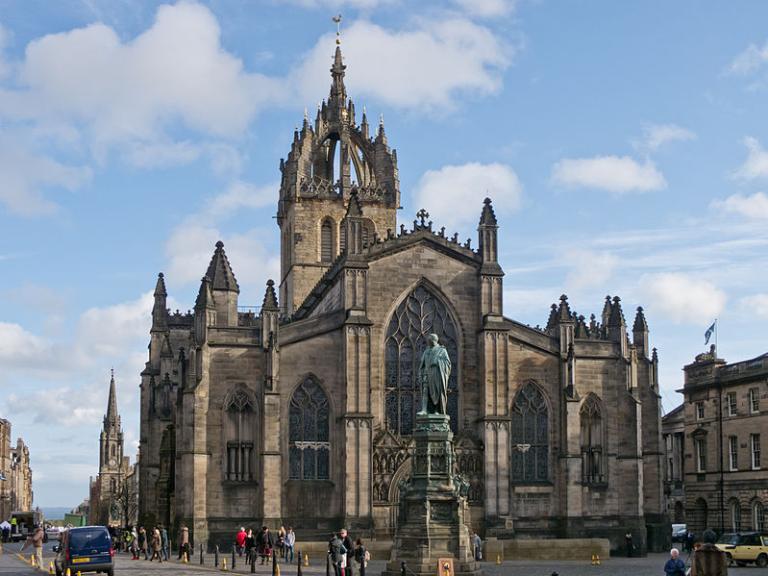
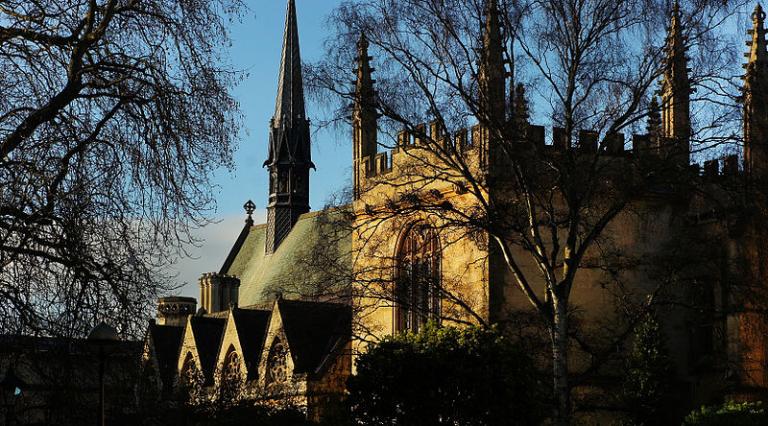
St. Giles Cathedral, Edinburgh, where John Knox served as the minister for thirteen years and where, in September 2022, the body of Queen Elizabeth II lay in state. (Wikimedia Commons public domain photograph)
With very slight modification, the lines below were originally published in the Deseret News on 25 June 2016 as a column by William Hamblin and Daniel Peterson, based on materials that I had just read during a visit to the Cathedral of St. Giles and the house of John Knox in Edinburgh, Scotland:
The name and legacy of John Knox are inseparably connected with Scotland’s capital city of Edinburgh, although important events in his very dramatic life also occurred elsewhere.
Born around 1513-1514 near Haddington, roughly 20 miles east of Edinburgh, Knox crossed the Firth of Forth northward to study at the University of St. Andrews. Following his studies, he was ordained a Catholic priest.
Massive changes were taking place in Christendom, however, and Knox would soon be very much caught up in them. According to traditional accounts, Martin Luther had nailed his famous “95 Theses” to the church door in Wittenberg in 1517, launching the Reformation. By 1522 and 1530, respectively, the Swiss reformers Ulrich Zwingli and John Calvin had themselves broken with Rome, the former in Zurich and the latter in Geneva.
About 1544, Father Knox became a disciple of George Wishart, an early Scottish advocate of the Reformation, and converted to Protestantism. In 1546, though, Wishart was arrested on orders of Cardinal David Beaton. Knox was with Wishart at the time and fully intended to accompany him to prison, but Wishart persuaded him otherwise, saying “Nay, return to your bairns (children) and God bless you. One is sufficient for a sacrifice.”
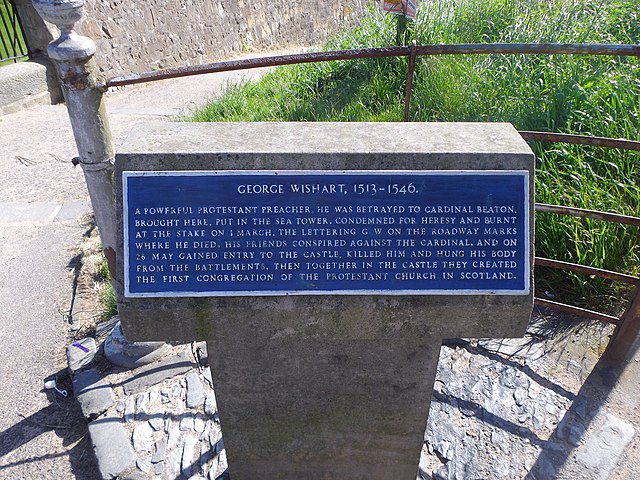
Memorial Plaque for George Wishart (Wikimedia CC photo by Stanley Howe)
On Cardinal Beaton’s orders, Wishart was executed as a heretic at St. Andrews in 1546 after a trial that had plainly been rigged. In revenge, the cardinal himself was assassinated shortly thereafter. (The supposedly precise spot of Wishart’s execution is still marked near the ruins of the St. Andrews Castle, and a nearby marker — shown above — memorializes his story and the immediate ensuing story of Cardinal Beaton.) Amidst the turbulence that ensued, Knox was arrested and confined aboard a French ship as a galley slave, rowing for nineteen months under horrific conditions. After being set free for reasons that remain unclear, he made his way to England. He couldn’t yet return to Scotland, though, because the religious and political climate there was extremely hostile to Protestantism. However, in 1534, King Henry VIII had declared the Church of England independent of Rome, and Knox became an influential preacher in the pulpits of Scotland’s southern neighbor.
But matters were still unsettled in England. Mary I succeeded to the throne of England in 1553, determined to restore Catholicism as the official faith of the nation. (Something of her methods can be guessed from her nickname, “Bloody Mary.”) Knox was obliged to flee to the European continent, where he both studied and taught in Calvin’s Geneva and in Frankfurt. His close contact with Calvin was fundamentally important to the development of his thinking, as was his experience with the theocratic state that Calvin had established.
But Queen Mary died in 1558 and conditions were also changing in Scotland, so, in 1559, Knox resolved to return to his native country as a kind of revolutionary. On June 29, 1559, he preached for the first time in the impressive Church of St. Giles, on the “Royal Mile” near Edinburgh’s famous castle. A week later, he was elected minister of St. Giles, and he held that position for thirteen years, until rather shortly before his death.
In 1560, Scotland itself became officially Protestant, and the change was already so firmly established by 1562 that, when the 19-year-old Catholic Mary, “Queen of Scots,” returned from France to assume the throne, she practiced her faith privately but chose not to interfere with the public Protestantism of her country.
Amidst the religious animosities of the day, though, her conciliatory behavior angered many. The Catholics still in Scotland were enraged at her tolerance of Protestantism, while Knox fiercely denounced her from the pulpit for attending Catholic mass in her private chapel. He boasted that when they met, his harsh language toward her reduced her to tears. Then, having been forced to abdicate the throne and flee Scotland in 1567, she was captured and brought to England**.** Knox demanded that she be executed — which, after many years of imprisonment, she was. She was 44 years old at her death in 1587. (Knox had already died in 1572 and was thus unable to enjoy his triumph.)
Knox is typically considered the founder of Presbyterianism, a movement that takes its name from a mode of governance that relies on councils of “elders” (Greek “presbyteroi”). Presbyterian doctrine, which has been heavily influenced, historically speaking, by the teachings of Calvin, characteristically focuses on the sovereignty of God, including the concept of divine predestination, the supreme authority of the Bible, and God’s grace as the necessary and sole means of salvation. With Calvin, Knox remains a major figure in Presbyterian tradition.
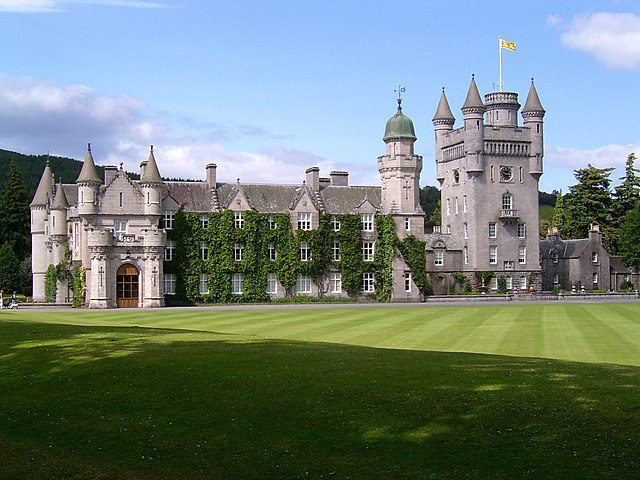
In this 2004 Wikimedia Commons photo by Stuart Yeates of Oxford, the Royal Standard of Scotland flies above the tower of Balmoral Castle, indicating that the monarch is in residence. The Royal Standard was not flying today, which is difficult to explain since our presence in Scotland was made known to government officials immediately upon our arrival at Edinburgh Airport, thus affording the royal family plenty of time to have made their way up from London.
I can only assume that King Charles III was somehow unaware that we’re in town, because he and the entire royal family were absent today when we visited Balmoral Castle and its extensive grounds. However, we managed to have a pleasant time, nonetheless. The weather was gorgeous, the long entry walk among enormous Victorian-planted pine trees is spectacular, the gardens (which actually grow the estate’s vegetables, fruit, and ornamental plants) are interesting, and the ballroom (the only section of the palace itself that is open to the public) is filled with historic photographs of the royals. It was good to refresh our memory of British royal history from Queen Victoria and Prince Albert down to the present. There were formal photographs in the ballroom, including coronation photographs and a continually running film of Elizabeth II’s coronation, but mostly informal photos of Victoria herself, as well as of the lamentable Edward VII, George V, the fortunately never-crowned Edward VIII, George VI, Elizabeth the Queen Mother, Elizabeth II, Charles III, Prince William and Kate, John Brown, Abdul Karim (aka “the Munshi”), and etc.
Posted from just outside Ballater, Aberdeenshire, Scotland
Previous Post

May 31, 2023
Near neighbours to the royal family
Next Post
June 2, 2023 Plagiarizing Salomé?
Recent Comments
"I don't think Putin cares about the Russian Army casualties. In his mind, he's just ..."
The Iron Gates and the Lion ..."
"DP: “According to his best sources, Ukraine is killing roughly 800 to 1400 Russian soldiers ..."
The Iron Gates and the Lion ..."
"Young Parker Stone gave an amazing presentation on “Nephi’s Ark Temple: Cosmic Kingship and the ..."
The Iron Gates and the Lion ..."
"About 10 of the BYU medical school faculty are women. One of tgese women gave ..."
The Iron Gates and the Lion ..."
Browse Our Archives
Select a Category Uncategorized
Select a Month October 2026 September 2026 August 2026 July 2026 June 2026 May 2026 April 2026 March 2026 February 2026 January 2026 December 2025 November 2025 October 2025 September 2025 August 2025 July 2025 June 2025 May 2025 April 2025 March 2025 February 2025 January 2025 December 2024 November 2024 October 2024 September 2024 August 2024 July 2024 June 2024 May 2024 April 2024 March 2024 February 2024 January 2024 December 2023 November 2023 October 2023 September 2023 August 2023 July 2023 June 2023 May 2023 April 2023 March 2023 February 2023 January 2023 December 2022 November 2022 October 2022 September 2022 August 2022 July 2022 June 2022 May 2022 April 2022 March 2022 February 2022 January 2022 December 2021 November 2021 October 2021 September 2021 August 2021 July 2021 June 2021 May 2021 April 2021 March 2021 February 2021 January 2021 December 2020 November 2020 October 2020 September 2020 August 2020 July 2020 June 2020 May 2020 April 2020 March 2020 February 2020 January 2020 December 2019 November 2019 October 2019 September 2019 August 2019 July 2019 June 2019 May 2019 April 2019 March 2019 February 2019 January 2019 December 2018 November 2018 October 2018 September 2018 August 2018 July 2018 June 2018 May 2018 April 2018 March 2018 February 2018 January 2018 December 2017 November 2017 October 2017 September 2017 August 2017 July 2017 June 2017 May 2017 April 2017 March 2017 February 2017 January 2017 December 2016 November 2016 October 2016 September 2016 August 2016 July 2016 June 2016 May 2016 April 2016 March 2016 February 2016 January 2016 December 2015 November 2015 October 2015 September 2015 August 2015 July 2015 June 2015 May 2015 April 2015 March 2015 February 2015 January 2015 December 2014 November 2014 March 2014 August 2013 February 2012
Follow Us!
TAKE THE
Religious Wisdom Quiz
What caused the sailors to throw Jonah overboard?
Select your answer to see how you score.
A prophecy A vision A violent storm A mutiny
Related posts from Sic et Non


Near neighbours to the royal family
"If I were placed on a cannibal island"
TRENDING AT PATHEOS Latter-day Saint

Looking at the Largest Orthodox Cathedral on Earth
There is often a considerable amount of anger and, shall we...

The Problem with False Prophets
Miller’s Station UMC| 10/18/26| Anchor Verse: Jeremiah 23: 1, 9-23 I...

Emotion in Early Christianity by Andrew Crislip
Andrew Crislip’s Emotion in Early Christianity examines an often overlooked dimension of...

16 Spiritual Touchstones for a More Grounded Life
After decades of spiritual study, here are 16 principles I try...

Catholic Evangelization: Sharing Your Faith Every Day
Welcome back to the Graceful Awakening mini-series called, “From Faith to Mission.” ...

The Pillar of the Boatmen: the Ancient Monument...
The Pillar of the Boatmen is a Romano-Gaulish sculpture that dates from...
view all Latter-day Saint blogs
What Are Your Thoughts?leave a comment
Ad-Free & Subscriber Log-In Subscription Support
- About Us
- 2026 Calendar
- Videos
- Podcasts
- Library of World Religions
- Faith In Media Tracker
- Advertise With Us
- Write for Us
- Privacy Policy
- Terms of Service
- Do Not Sell My Data
- Contact Us
- Radiant Digital
- Manage Newsletter Subscriptions
- Unsubscribe From Notifications
- Sitemap
Copyright 2008-2026, Patheos. All rights reserved.
Subscription Support Ad-Free & Subscriber Log-In
Follow Patheos