
BuddhistCatholicContemplativeEvangelicalGeneral ChristianHinduJewishLatter-day SaintMuslimNew VisionsProgressive Christian
Beliefs
- Buddhist
- Catholic
- Contemplative
- Evangelical
- General Christian
- Hindu
- Jewish
- Latter-day Saint
- More Voices
- Muslim
- New Visions
- Pagan
- Progressive Christian
Topics
- Religion News
- Food and Religion
- Sports and Religion
- Religious Art
- Religious Music and Entertainment
- Religious Events
- History and Religion
- Style and Religion
- Politics and Religion
- Women in Religion
- Recreation Outdoors and Religion
- Business Finance and Religion
- Careers Workplace and Religion
- Education and Religion
- Family Parenting and Religion
- Health Fitness and Religion
- Home and Religion
- Relationships and Religion
- Technology and Religion
- Travel and Religion
Columnists
- Buddhist Columnists
- Business Finance and Religion Columnists
- Careers Workplace and Religion Columnists
- Catholic Columnists
- Contemplative Columnists
- Education and Religion Columnists
- Evangelists Columnists
- Family Parenting and Religion Columnists
- General Christian Columnists
- Health Fitness and Religion Columnists
- Hindu Columnists
- History and Religion Columnists
- Home and Religion Columnists
- Jewish Columnists
- More Voices Columnists
- Latter Day Columnists
- Muslim Columnists
- New Visions Columnists
- Nonreligious Columnists
- Pagan Columnists
- Politics and Religion Columnists
- Progressive Columnists
- Recreation Outdoors and Religion Columnists
- Relationships and Religion Columnists
- Religion News Columnists
- Religious Art Columnists
- Religious Events Columnists
- Religious Music and Entertainment Columnists
- Sports and Religion Columnists
- Style and Religion Columnists
- Technology and Religion Columnists
- Travel and Religion Columnists
- Women in Religion Columnists
Resource Library
- 2026 Calendar
- Library of World Religions
- The 100 Most Holy Places on Earth
- Patheos Answers
- Podcasts
- Videos
- Faith Leaders Database
- Anglican Episcopalian
- Bahai
- Baptist
- Buddhism
- Christianity
- Confucianism
- Eastern Orthodoxy
- Hinduism
- Holiness and Pentecostal
- ISKCON
- Islam
- Judaism
- Lutheran
- Methodist
- The Church of Jesus Christ of Latter-day Saints
- New Age
- Paganism
- Presbytarian and Reformed
- Protestantism
- Religion Behind the Scenes
- Roman Catholic
- Scientology
- Shia Islam
- Sikhism
- Sufism
- Sunni Islam
- Taoism
- Zen
- See all religions
Research Tools
 Ad-Free & Subscriber Log-In Subscription Support
Ad-Free & Subscriber Log-In Subscription Support
Follow Patheos 

- Trending:
- Forgiveness
- |
- Marriage
- |
- Consciousness
- |
- Death Penalty
- |
- Election
- |
- Halloween

- Home
- Latter-day Saint
- Travel and Religion
- “Did Christ Visit England?”
“Did Christ Visit England?”
Last updated on: June 13, 2023 at 4:17 pm by Dan Peterson
“Did Christ Visit England?” 2023-06-13T16:17:49-06:00 Dan Peterson
Patheos Explore the world's faith through different perspectives on religion and spirituality! Patheos has the views of the prevalent religions and spiritualities of the world.
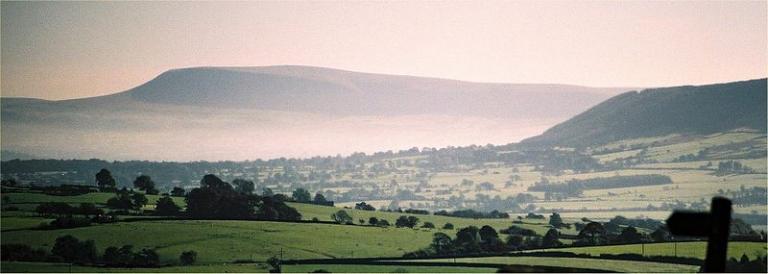
The first Latter-day Saint baptisms in England were performed in the River Ribble, in Lancashire. In this Wikimedia Commons public domain photograph, a mist lies over the Ribble Valley. Beyond that mist stands Pendle Hill.
I published a new article in Meridian Magazine yesterday, and I hope that somebody, somewhere, will read it: “Did Christ Visit England?”

The first Latter-day Saint baptisms in the United Kingdom were performed in the River Ribble, near Preston, Lancashire. (Wikimedia Commons public domain image)
Our superb Latter-day Saint guide here in the United Kingdom, Peter Fagg, shared a couple of quotations with us a few days back that, with his kind help, I want to share with you. The first comes from President Lorenzo Snow. On 1 January 1901, in the Tabernacle of the Church of Jesus Christ of Latter-day Saints in Salt Lake City, President Snow delivered a “Greeting to the World” at special “Centennial Services” to mark the beginning of the twentieth century. Among other things, he said the following:
As a servant of God I bear witness to the revelation of His will in the nineteenth century. It came by His own voice from the heaven, by the personal manifestation of His Son, and by the ministration of holy angels . . .
He will assuredly accomplish His work, and the twentieth century will make its advancement towards the great consummation.
Every unfoldment of the nineteenth century in science, in art, in mechanism, in music, in literature, in poetic fancy, in philosophical thought, was prompted by His Spirit, which before long will be poured out upon all flesh that will receive it.
And, truly, the nineteenth century was marked by spectacular and increasingly rapid progress in many areas, not least among them steamships, the railroad, telegraphy, the rise of mass media, the invention of the telephone, and so forth. James Clerk Maxwell laid the foundation for modern physics and engineering. (See my recent blog entry “Science and Religion: A Great Scottish Example.”).
The emergence of photography and the development of recording devices made it possible to preserve the past in a way that had never before been possible. Consider, for example, the remarkable fact that we are actually able to listen to a great apostolic missionary, a veteran of the mission of the Twelve to England who had been called to the apostleship by the Prophet Joseph Smith in 1839, as he bears his testimony in his own voice: It can be heard at Richard Neitzel Holzapfel and Steven C. Harper, “This Is My Testimony, Spoken by Myself into a Talking Machine: Wilford Woodruff’s 1897 Statement in Stereo.” For background, see Richard Neitzel Holzapfel and Stephen H. Smoot, “Wilford Woodruff’s 1897 Testimony.”

A view of the main street of Downham, Lancashire, with Pendle Hill in the background
(Wikimedia Commons public domain image)
And we should not neglect achievements in literature by such writers as William Blake (on whom see my already mentioned article in Meridian Magazine, “Did Christ Visit England?”) and William Wordsworth (see my recent blog entry titled “Intimations of Antemortality”). In this regard, a passage from Prometheus Unbound: A Lyrical Drama in Four Acts, by the tragically short-lived English poet Percy Bysshe Shelley (1792-1822), is worthy of note. It is the second passage that I’m borrowing for today from Peter Fagg. Said Shelley:
The great writers of our own age are, we have reason to suppose, the companions and forerunners of some unimagined change in our social condition or the opinions which cement it. The cloud of mind is discharging its collected lightning, and the equilibrium between institutions and opinions is now restoring or is about to be restored.
Such sentiments put me immediately in mind of the 1991 book The Birth of the Modern: World Society, 1815-1830, by the brilliant British journalist and historian Paul Johnson (1928-2023), who is, by the way, yet another graduate of Stonyhurst College and who is one of my personal heroes:
The title of this book requires some explanation. I present the fifteen years 1815-1830 as those during which the matrix of the modern world was largely formed.
Have a look at part of Johnson’s preface here, where he explains in more detail his choice of the period 1815-1830 as vitally important. Latter-day Saints, of course, would agree that it was a pivotal time. After all, the First Vision occurred in 1820, and the other vital events of the very early Restoration followed thereafter, culminating in 1830 with the publication of the Book of Mormon and the formal organization of the Church of Jesus Christ of Latter-day Saints.)
Some time ago, too, a reader kindly brought to my attention a passage from the preface to the paperback edition of William J. Bernstein, The Birth of Plenty: How the Prosperity of the Modern World Was Created (New York: McGraw-Hill, 2004). I reproduce that passage here:
When my wife brought P. J. O’Rourke’s Eat the Rich home from the library a decade ago, a few years before McGraw-Hill published the 2002 hardcover edition of this book, I wasn’t expecting much in the way of historical insight. Mr. O’Rourke aims to amuse, and his lighthearted romp through the world’s economic success and sob stories did not disappoint, most memorably his exposition of credit risk: A junk bond is a loan to your little brother; a high-quality bond is a loan to your little brother by the Gambino family.
Mr. O’Rourke’s frothy prose hides painstaking legwork. Scattered among the quips are some well-researched passages, including one that briefly mentioned data assembled by an obscure Scottish economist named Angus Maddison, who found a startling discontinuity in world economic growth around 1820: Before that date, growth was essentially nonexistent; after that date, it was sustained and vigorous.
It took me a while to rustle up a copy of Maddison’s summary work, Monitoring the World Economy, 1820-1992. The bound edition looks as dull and as daunting as the densest legal brief, but inside, Maddison’s dry data lay out the greatest story ever told: the economic birth of the modern world. (vii)
This reminds me of a short piece that my friend Mark Skousen — libertarian economist, investment adviser, prolific author, and organizer of the spectacular annual FreedomFest — published back in 2019 in Meridian Magazine: “The Restored Gospel and the Birth of the Modern Age.”
Posted from Cheltenham, Gloucestershire, England
Travel and Religion
History and Religion
Previous Post

June 12, 2023
Let us remember Emma Jackson Adams
Next Post

June 14, 2023 "The Last Leaf"
Recent Comments
"I have cpnsidered in my mond if the 4 volume Saints could be made into ..."
From Serbia’s “White City,” Belgrade
"Another class of memories are of individuals who previously lived. Some of these remembered individuals ..."
"Sutherland's lecture sounds interesting. He seems to restate the Washington consensus that trade brings peace ..."
Learning more about a region of ..."
"In a meeting today, I learned another important reason why accurate (or at least as ..."
From Serbia’s “White City,” Belgrade
Browse Our Archives
Select a Category Uncategorized
Select a Month October 2026 September 2026 August 2026 July 2026 June 2026 May 2026 April 2026 March 2026 February 2026 January 2026 December 2025 November 2025 October 2025 September 2025 August 2025 July 2025 June 2025 May 2025 April 2025 March 2025 February 2025 January 2025 December 2024 November 2024 October 2024 September 2024 August 2024 July 2024 June 2024 May 2024 April 2024 March 2024 February 2024 January 2024 December 2023 November 2023 October 2023 September 2023 August 2023 July 2023 June 2023 May 2023 April 2023 March 2023 February 2023 January 2023 December 2022 November 2022 October 2022 September 2022 August 2022 July 2022 June 2022 May 2022 April 2022 March 2022 February 2022 January 2022 December 2021 November 2021 October 2021 September 2021 August 2021 July 2021 June 2021 May 2021 April 2021 March 2021 February 2021 January 2021 December 2020 November 2020 October 2020 September 2020 August 2020 July 2020 June 2020 May 2020 April 2020 March 2020 February 2020 January 2020 December 2019 November 2019 October 2019 September 2019 August 2019 July 2019 June 2019 May 2019 April 2019 March 2019 February 2019 January 2019 December 2018 November 2018 October 2018 September 2018 August 2018 July 2018 June 2018 May 2018 April 2018 March 2018 February 2018 January 2018 December 2017 November 2017 October 2017 September 2017 August 2017 July 2017 June 2017 May 2017 April 2017 March 2017 February 2017 January 2017 December 2016 November 2016 October 2016 September 2016 August 2016 July 2016 June 2016 May 2016 April 2016 March 2016 February 2016 January 2016 December 2015 November 2015 October 2015 September 2015 August 2015 July 2015 June 2015 May 2015 April 2015 March 2015 February 2015 January 2015 December 2014 November 2014 March 2014 August 2013 February 2012
Follow Us!
TAKE THE
Religious Wisdom Quiz
How many plagues did God inflict upon Egypt?
Select your answer to see how you score.
7 10 14 21
Related posts from Sic et Non
"Look on my Works, ye Mighty, and despair!"

The Valley of the Kings, Deir al-Bahri, and...

"Vast Prairies and Trackless Wilds of Snow: A...
TRENDING AT PATHEOS Latter-day Saint

The First Eucharistic Controversy: Christ’s Real Presence
For Catholics, the Eucharist is the source and summit of the Christian...

What a Stop Sign Can Teach Us About...
How to Make a Decision When You Can't Hear God Main point:...

Archdiocese Hosts Military Marriage Retreat in Germany
RASTATT, Germany — The transient military lifestyle, with its frequent deployments and...

Nearly every morning, I make the drive to Detroit with my high-school-age...

The Real AI Story Is Adoption Without Trust
Artificial intelligence has crossed a political threshold. It is no longer a...

A new article, written by Jeff Lindsay and Gale L. Pooley,...
view all Latter-day Saint blogs
What Are Your Thoughts?leave a comment
Ad-Free & Subscriber Log-In Subscription Support
- About Us
- 2026 Calendar
- Videos
- Podcasts
- Library of World Religions
- Faith In Media Tracker
- Advertise With Us
- Write for Us
- Privacy Policy
- Terms of Service
- Do Not Sell My Data
- Contact Us
- Radiant Digital
- Manage Newsletter Subscriptions
- Unsubscribe From Notifications
- Sitemap
Copyright 2008-2026, Patheos. All rights reserved.
Subscription Support Ad-Free & Subscriber Log-In
Follow Patheos