
BuddhistCatholicContemplativeEvangelicalGeneral ChristianHinduJewishLatter-day SaintMuslimNew VisionsProgressive Christian
Beliefs
- Buddhist
- Catholic
- Contemplative
- Evangelical
- General Christian
- Hindu
- Jewish
- Latter-day Saint
- More Voices
- Muslim
- New Visions
- Pagan
- Progressive Christian
Topics
- Religion News
- Food and Religion
- Sports and Religion
- Religious Art
- Religious Music and Entertainment
- Religious Events
- History and Religion
- Style and Religion
- Politics and Religion
- Women in Religion
- Recreation Outdoors and Religion
- Business Finance and Religion
- Careers Workplace and Religion
- Education and Religion
- Family Parenting and Religion
- Health Fitness and Religion
- Home and Religion
- Relationships and Religion
- Technology and Religion
- Travel and Religion
Columnists
- Buddhist Columnists
- Business Finance and Religion Columnists
- Careers Workplace and Religion Columnists
- Catholic Columnists
- Contemplative Columnists
- Education and Religion Columnists
- Evangelists Columnists
- Family Parenting and Religion Columnists
- General Christian Columnists
- Health Fitness and Religion Columnists
- Hindu Columnists
- History and Religion Columnists
- Home and Religion Columnists
- Jewish Columnists
- More Voices Columnists
- Latter Day Columnists
- Muslim Columnists
- New Visions Columnists
- Nonreligious Columnists
- Pagan Columnists
- Politics and Religion Columnists
- Progressive Columnists
- Recreation Outdoors and Religion Columnists
- Relationships and Religion Columnists
- Religion News Columnists
- Religious Art Columnists
- Religious Events Columnists
- Religious Music and Entertainment Columnists
- Sports and Religion Columnists
- Style and Religion Columnists
- Technology and Religion Columnists
- Travel and Religion Columnists
- Women in Religion Columnists
Resource Library
- 2026 Calendar
- Library of World Religions
- The 100 Most Holy Places on Earth
- Patheos Answers
- Podcasts
- Videos
- Faith Leaders Database
- Anglican Episcopalian
- Bahai
- Baptist
- Buddhism
- Christianity
- Confucianism
- Eastern Orthodoxy
- Hinduism
- Holiness and Pentecostal
- ISKCON
- Islam
- Judaism
- Lutheran
- Methodist
- The Church of Jesus Christ of Latter-day Saints
- New Age
- Paganism
- Presbytarian and Reformed
- Protestantism
- Religion Behind the Scenes
- Roman Catholic
- Scientology
- Shia Islam
- Sikhism
- Sufism
- Sunni Islam
- Taoism
- Zen
- See all religions
Research Tools
 Ad-Free & Subscriber Log-In Subscription Support
Ad-Free & Subscriber Log-In Subscription Support
Follow Patheos 

- Trending:
- Forgiveness
- |
- Marriage
- |
- Consciousness
- |
- Death Penalty
- |
- Election
- |
- Halloween

- Home
- Latter-day Saint
- History and Religion
- A pretty ludicrous counterexplanation of Christ’s resurrection
A pretty ludicrous counterexplanation of Christ’s resurrection
Last updated on: June 19, 2023 at 4:40 pm by Dan Peterson
A pretty ludicrous counterexplanation of Christ’s resurrection 2023-06-19T16:40:09-06:00 Dan Peterson
Patheos Explore the world's faith through different perspectives on religion and spirituality! Patheos has the views of the prevalent religions and spiritualities of the world.
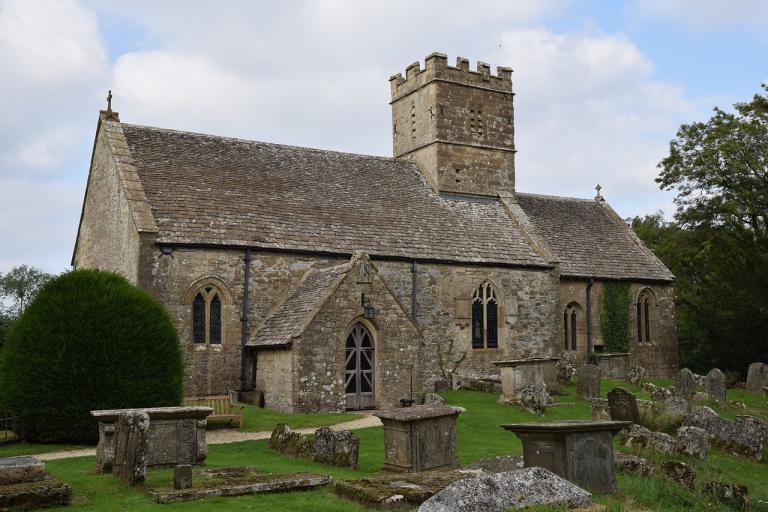
Brimpsfield Church (St. Michael’s), parts of which date back to at least the early 1100s.
(Wikimedia Commons public domain photo)
In Sir Arthur Conan Doyle’s 1890 novel The Sign of the Four, Sherlock Holmes explains his method as a private detective to Dr. Watson: “When you have eliminated the impossible,” he says, “whatever remains, however improbable, must be the truth.”
If a person is determined to disbelieve in the proposition that Jesus rose physically from the dead, if that person dismisses the notion as flatly impossible and unworthy of serious consideration, just about any alternative hypothesis might serve to explain the claim. Here’s a really good one, from L. Eisenberg, “A New Natural Interpretation of the Empty Tomb,” International Journal for Philosophy of Religion (2016): 133-143, as summarized by Andrew Loke, in his book Investigating the Resurrection of Jesus Christ: A New Transdisciplinary Approach (Routledge, 2020), 144:
Eisenberg (2016) has combined a variation of the swoon hypothesis and the remain buried hypothesis together with the intramental hypothesis and the mistaken identity hypothesis. The key question asked by Eisenberg is this: What would have happened if those who retrieved Jesus’ body found that he was still alive? Eisenberg suggests the following scenario: Jesus survived the crucifixion and was discovered to be barely alive by the few followers (e.g., Joseph [of Arimathea]) who retrieved him. Hoping that Jesus would survive, and fearful that the Romans would discover he had illegally rescued a condemned man, Joseph faked the burial of Jesus (by having his slaves go to an available tomb, carrying a corpse-shaped bundle of burial cloth, placed it inside, and then sealed the tomb) while trying to revive Jesus. However, Jesus expired soon after, and was buried quietly in an anonymous grave. Nevertheless, rumour of his survival reached his followers and the Romans, who opened the tomb and discovered the body missing. To sooth their grief the disciples seized on the rumour of Jesus’ survival and encouraged each other to hear the voice and see the image of Jesus in other people, which later became interpreted as a physical resurrection. . . .
[R]eports of feeling the presence of a post-crucifixion Jesus in another person would have been readily accepted by disciples given the fact that people of the first century commonly believed in possession by demons or spirits, visitations by gods, and the transmigration of souls, and given that Jesus predicted his own resurrection.
Right. Sure. I’m convinced.
If you just toss all of the primary-source accounts out the window and invent a new narrative out of whole cloth, you’ll come up with quite a different story!
There is, of course, precisely no evidence that Jesus was found still barely alive after his crucifixion. There is no evidence that Joseph of Arimathea faked the burial of Jesus. There is no evidence that Jesus died after attempts to revive him or that he was buried quietly in an anonymous grave. There is no evidence the disciples encouraged each other to hear the voice and see the image of Jesus in other people. (Would they really have given their lives for such a silly cause?)
I’m reminded of the atheistic Utah historian Dale Morgan (1914-1971), who was once something of a fashionable darling of cultural Mormons. In 1945, he wrote a letter to the believing Latter-day Saint historian Juanita Brooks (1898-1989, the heroic pioneer on serious scholarship about the Mountain Meadows Massacre) in which he stated the fundamental issue between them with unusual frankness and candor: “With my point of view on God,” he said, “I am incapable of accepting the claims of Joseph Smith and the Mormons, be they however so convincing. If God does not exist, how can Joseph Smith’s story have any possible validity? I will look everywhere for explanations except to the ONE explanation that is the position of the church.” (Dale Morgan to Juanita Brooks, 15 December 1945, at Arlington, Virginia. Transcribed in John Phillip Walker, ed., Dale Morgan on Early Mormonism: Correspondence and a New History [Salt Lake City: Signature Books, 1986], 84–91. The quoted passage occurs on page 87.)
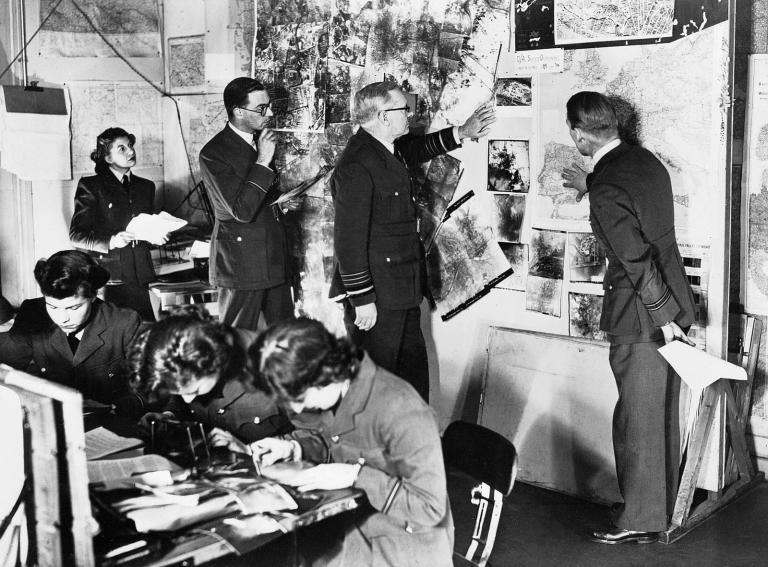
“Air Chief Marshal Sir Arthur Harris studies aerial reconnaissance photos at his High Wycombe Headquarters a few days after the second anniversary of his appointment as Commander in Chief of Bomber Command. Photographic intelligence played a vital role in the selection of targets and the assessment of the effects of a raid.” (From the collections of the Imperial War Museum)
We spent last night in High Wycombe, Buckinghamshire, about half way between London and Oxford. My father spent several months there during World War II working on photo reconnaissance matters before he crossed the English Channel onto the European continent with General Patton’s Third Army.
High Wycombe is far enough out in the countryside that it wasn’t subjected to the V-1 and V-2 attacks that were terrifying London during that period, and my father was safe there.
But he wasn’t allowed to remain safe. He was a staff sergeant at the time, and one of the American captains assigned to High Wycombe regularly requisitioned him as a driver into London, where the V-1s and V-2s were raining down. Why? Because the captain, who had a wife back in the United States, was carrying on an affair with a female English military volunteer in the city. So my father was obliged to sit in London during the Captain’s adulterous trysts, under German assault. At one point, the captain was standing by a window in his love nest, looking out and smoking a cigarette, when a bomb or a rocket exploded nearby. The window shattered, and a shard of glass scratched his face. He received a Purple Heart for having been wounded by enemy action.
My father always lamented, though, that he had never seen London at night with its lights on. It was always under blackout during his time there. We got him back to Europe more than once, but one of my dreams was to take him to England so that he could see London illuminated in the dark. Unfortunately, I never did. I deeply regret that.
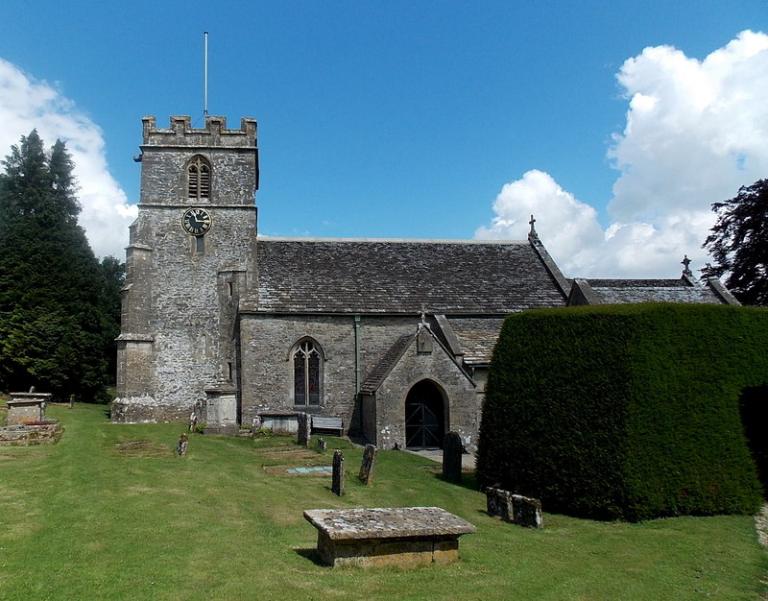
The Church of St. Andrew at Miserden
(Wikimedia Commons public domain photo by Jaggery)
Today was devoted to exploring some of the territory where my wife’s paternal ancestors lived (before they accepted the Restoration and gathered to Zion). Particularly, we visited a very pretty and very old village called Miserden (pronounced MIZZ-er-den) in the Cotswolds, with its Saxon Church of St. Andrew, as well as the equally old nearby village of Brimpsfield, where we had a pleasant conversation with a plainly well-traveled and well-educated local woman who, as a volunteer, was cleaning the interior of the Church of St. Michael.
Posted from Cheltenham, Gloucestershire, England
History and Religion
Previous Post

June 18, 2023
The older William Law
Next Post
June 20, 2023 Tales of the Gloucester Crypt
Recent Comments
"DP: “But Mr. Sutherland worries about the fact that our time, when we can communicate ..."
Learning more about a region of ..."
"Sutherland's lecture sounds interesting. He seems to restate the Washington consensus that trade brings peace ..."
Learning more about a region of ..."
"In a meeting today, I learned another important reason why accurate (or at least as ..."
From Serbia’s “White City,” Belgrade
"I've been watching a lot of video interviews of NDErs and researchers. I think in ..."
Browse Our Archives
Select a Category Uncategorized
Select a Month October 2026 September 2026 August 2026 July 2026 June 2026 May 2026 April 2026 March 2026 February 2026 January 2026 December 2025 November 2025 October 2025 September 2025 August 2025 July 2025 June 2025 May 2025 April 2025 March 2025 February 2025 January 2025 December 2024 November 2024 October 2024 September 2024 August 2024 July 2024 June 2024 May 2024 April 2024 March 2024 February 2024 January 2024 December 2023 November 2023 October 2023 September 2023 August 2023 July 2023 June 2023 May 2023 April 2023 March 2023 February 2023 January 2023 December 2022 November 2022 October 2022 September 2022 August 2022 July 2022 June 2022 May 2022 April 2022 March 2022 February 2022 January 2022 December 2021 November 2021 October 2021 September 2021 August 2021 July 2021 June 2021 May 2021 April 2021 March 2021 February 2021 January 2021 December 2020 November 2020 October 2020 September 2020 August 2020 July 2020 June 2020 May 2020 April 2020 March 2020 February 2020 January 2020 December 2019 November 2019 October 2019 September 2019 August 2019 July 2019 June 2019 May 2019 April 2019 March 2019 February 2019 January 2019 December 2018 November 2018 October 2018 September 2018 August 2018 July 2018 June 2018 May 2018 April 2018 March 2018 February 2018 January 2018 December 2017 November 2017 October 2017 September 2017 August 2017 July 2017 June 2017 May 2017 April 2017 March 2017 February 2017 January 2017 December 2016 November 2016 October 2016 September 2016 August 2016 July 2016 June 2016 May 2016 April 2016 March 2016 February 2016 January 2016 December 2015 November 2015 October 2015 September 2015 August 2015 July 2015 June 2015 May 2015 April 2015 March 2015 February 2015 January 2015 December 2014 November 2014 March 2014 August 2013 February 2012
Follow Us!
TAKE THE
Religious Wisdom Quiz
What does the name "Moses" mean?
Select your answer to see how you score.
Delivered Saved Drawn out (of water) Judge
Related posts from Sic et Non

An action movie and some vacuous theology
Thinking about D-Day, of course!
How fundamental is Christ's resurrection?
A brief note on one way of thinking...
TRENDING AT PATHEOS Latter-day Saint

Pope Leo Celebrates Mass for Nurses & Docs...
I don't have any idea how he did it, but Pope Leo...

The Sermon on the Mount, Part I: Matthew...
The Sermon on the Mount, Part I (Matthew 4:12-5:12) St. Matthew moves...

What's up from Crossway: Reviewing some of their latest A few weeks...

Janie Learns the Way of the Cross: A...
Teaching children about Jesus' Passion can be challenging. Many parents and educators...

Looking For Good Catholic Writing - October 2026
He alone extends the heavens, and he walks upon the waves of...

In "Irreplaceable," our book on vocation and technology, Trevor Sutton and I...
view all Latter-day Saint blogs
What Are Your Thoughts?leave a comment
Ad-Free & Subscriber Log-In Subscription Support
- About Us
- 2026 Calendar
- Videos
- Podcasts
- Library of World Religions
- Faith In Media Tracker
- Advertise With Us
- Write for Us
- Privacy Policy
- Terms of Service
- Do Not Sell My Data
- Contact Us
- Radiant Digital
- Manage Newsletter Subscriptions
- Unsubscribe From Notifications
- Sitemap
Copyright 2008-2026, Patheos. All rights reserved.
Subscription Support Ad-Free & Subscriber Log-In
Follow Patheos