
BuddhistCatholicContemplativeEvangelicalGeneral ChristianHinduJewishLatter-day SaintMuslimNew VisionsProgressive Christian
Beliefs
- Buddhist
- Catholic
- Contemplative
- Evangelical
- General Christian
- Hindu
- Jewish
- Latter-day Saint
- More Voices
- Muslim
- New Visions
- Pagan
- Progressive Christian
Topics
- Religion News
- Food and Religion
- Sports and Religion
- Religious Art
- Religious Music and Entertainment
- Religious Events
- History and Religion
- Style and Religion
- Politics and Religion
- Women in Religion
- Recreation Outdoors and Religion
- Business Finance and Religion
- Careers Workplace and Religion
- Education and Religion
- Family Parenting and Religion
- Health Fitness and Religion
- Home and Religion
- Relationships and Religion
- Technology and Religion
- Travel and Religion
Columnists
- Buddhist Columnists
- Business Finance and Religion Columnists
- Careers Workplace and Religion Columnists
- Catholic Columnists
- Contemplative Columnists
- Education and Religion Columnists
- Evangelists Columnists
- Family Parenting and Religion Columnists
- General Christian Columnists
- Health Fitness and Religion Columnists
- Hindu Columnists
- History and Religion Columnists
- Home and Religion Columnists
- Jewish Columnists
- More Voices Columnists
- Latter Day Columnists
- Muslim Columnists
- New Visions Columnists
- Nonreligious Columnists
- Pagan Columnists
- Politics and Religion Columnists
- Progressive Columnists
- Recreation Outdoors and Religion Columnists
- Relationships and Religion Columnists
- Religion News Columnists
- Religious Art Columnists
- Religious Events Columnists
- Religious Music and Entertainment Columnists
- Sports and Religion Columnists
- Style and Religion Columnists
- Technology and Religion Columnists
- Travel and Religion Columnists
- Women in Religion Columnists
Resource Library
- 2026 Calendar
- Library of World Religions
- The 100 Most Holy Places on Earth
- Patheos Answers
- Podcasts
- Videos
- Faith Leaders Database
- Anglican Episcopalian
- Bahai
- Baptist
- Buddhism
- Christianity
- Confucianism
- Eastern Orthodoxy
- Hinduism
- Holiness and Pentecostal
- ISKCON
- Islam
- Judaism
- Lutheran
- Methodist
- The Church of Jesus Christ of Latter-day Saints
- New Age
- Paganism
- Presbytarian and Reformed
- Protestantism
- Religion Behind the Scenes
- Roman Catholic
- Scientology
- Shia Islam
- Sikhism
- Sufism
- Sunni Islam
- Taoism
- Zen
- See all religions
Research Tools
 Ad-Free & Subscriber Log-In Subscription Support
Follow Patheos 

- Trending:
- Advent
- |
- Forgiveness
- |
- Thanksgiving
- |
- Election
- |
- Seasonal Holidays
- |
- Marriage

- Home
- Latter-day Saint
- “Understanding the Lamanite Mark,” and Other Issues
“Understanding the Lamanite Mark,” and Other Issues
Last updated on: May 5, 2023 at 4:10 pm by Dan Peterson
“Understanding the Lamanite Mark,” and Other Issues 2023-05-05T16:10:18-06:00 Dan Peterson
Patheos Explore the world's faith through different perspectives on religion and spirituality! Patheos has the views of the prevalent religions and spiritualities of the world.

“The Daughters of the Lamanites” (Minerva Teichert, ca. 1950, LDS.org)
A new article has appeared in Interpreter: A Journal of Latter-day Saint Faith and Scholarship: “Understanding the Lamanite Mark,” writtten by Clifford P. Jones
Abstract: The Book of Mormon describes a dark mark on the skin that distinguished people who rebelled against God and his laws from those who obeyed God. The Old Testament refers to a mark that fits this description and has nothing to do with natural skin color. The law of Moses prohibited the Lord’s covenant people from cutting sacrilegious marks (ancient tattoos) into their skin. The Bible simply calls these prohibited tattoos “marks” (Leviticus 19:28). This biblical meaning of the word mark*, together with biblical meanings of other related words, helps us understand all Book of Mormon passages associated with the Lamanite mark.*
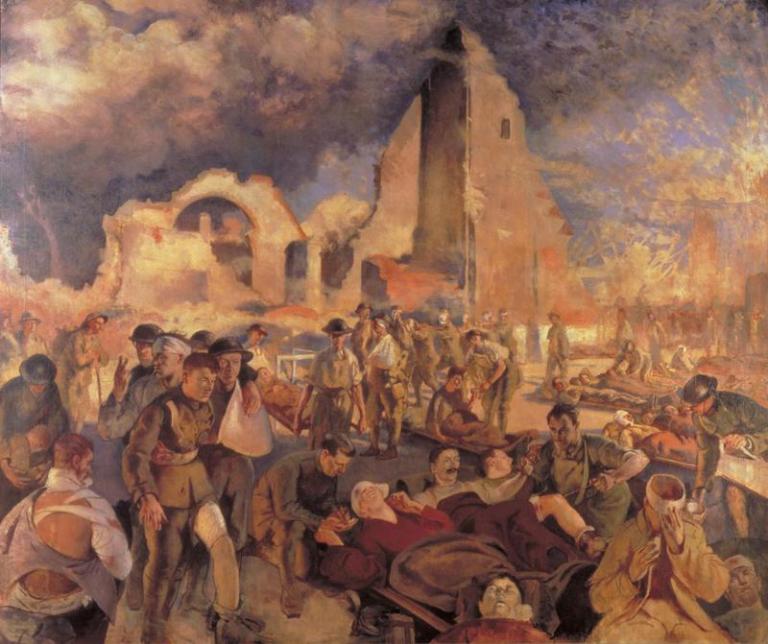
An advanced field dressing station sited by a ruined church in 1918 France during the First World War. The scene is crowded with casualties, many being brought in by stretcher-bearers. The men have bandaged limbs and some have head wounds. In the sky above there are dark grey clouds, possibly of smoke, in the left half of the composition, and patches of blue on the right.
Can atheists be good?
The unequivocal answer is that, yes, unbelievers can be good — and I hasten to add that, in my experience and reading, they quite often are. There is actually biblical support for this, in such passages as Romans 2:14-15:
For when the Gentiles, which have not the law, do by nature the things contained in the law, these, having not the law, are a law unto themselves: Which shew the work of the law written in their hearts, their conscience also bearing witness, and their thoughts the mean while accusing or else excusing one another. (Romans 2:14-15)
Now, I’ll admit that that particular selection of Jacobean English is more than a tad obscure. So let’s try, say, the Common English Bible:
Gentiles don’t have the Law. But when they instinctively do what the Law requires they are a Law in themselves, though they don’t have the Law. They show the proof of the Law written on their hearts, and their consciences affirm it. Their conflicting thoughts will accuse them, or even make a defense for them.
The apostle Paul is saying in that passage that even unbelievers — the “Gentiles” in his day were people who had not received or accepted biblical revelation — have moral principles “written in their hearts.” For most things, they don’t need direct divine commands to judge right from wrong. They might be unaware of a divine prohibition on smoking cigarettes or a divine commandment to partake regularly of the sacrament, because such things are matters of special revelation given to the Latter-day Saints. But they know, mysteriously but quite certainly, that murder is wrong, as is tormenting animals for pleasure, and that kindness and service to others are good. Some mainstream Christian thinkers have seen in this an effect of “general revelation,” not unlike what Jewish thinkers have called “Noahide laws” or “Noachic laws.”
The question — and it is a very important one — is, What is the basis for such moral “knowledge”? I’m not inclined at this point to try to answer it, except eventually to suggest what the basis probably cannot be.
All of those who read this blog entry, I hope, will agree that the Holocaust was morally wrong. But on what basis do we come — instantly, I would presume — to that judgment?
In his book A Devil’s Chaplain, the Oxford biologist and polemical atheist Richard Dawkins writes that
Science has no methods for deciding what is ethical. That is a matter for individuals and society. (Richard Dawkins, A Devil’s Chaplain: Reflections on Hope, Lies, Science, and Love [New York: Houghton Mifflin, 2003], 34)
And, of course, he’s right on that. But on what basis are individuals and society to make such decisions?
We say that the Holocaust was wrong. However, advocates of the Third Reich not only believed it to be right but an imperative moral duty. (They were convinced Social Darwinists.) Were they wrong? Or was it merely a matter of preferences, like a taste for broccoli or a distaste for split pea soup? For a person living under the Third Reich, the society in which he lived had made the determination, or seemingly so. Should he dissent or resist? On what basis?
One might respond, of course, that the Third Reich was a moral anomaly, and that the surrounding non-Nazi world rejected the lethal anti-Semitism of Hitler and his associates. And that is, of course, more or less correct. So perhaps Professor Dawkins’s morality-determining “society” should be bigger than merely Germany, Austria, and occupied France?
Alright. Suppose, now, that the Reich had won World War Two and even conquered the entire world — and that it eventually convinced all, or even a majority, of its global subjects that the Final Solution was morally justified. (The Nazis were, after all, extraordinarily adept practitioners of the art of propaganda.) Would it have actually become right? If society as a whole believed the extermination of “lesser races” to be morally correct, if every single person worldwide affirmed it to be right, would it be morally correct? If not, why not? On what basis?
For Richard Dawkins’s “New Atheist” ally Sam Harris — whose bestseller The End of Faith includes a chapter titled “A Science of Good and Evil” (Professor Dawkins! Call your office!) — “questions of right and wrong are really questions about the happiness and suffering of sentient creatures.” (Sam Harris, The End of Faith: Religion, Terror, and the Future of Reason [New York: W. W. Norton, 2005], 178)
But which sentient creatures? Molluscs are sentient. So are shrimp and lobsters and crabs, and we eat them. We farm and eat fish, chickens, sheep, and cows, who are plainly sentient. In H. G. Wells’s 1895 novel The Time Machine, which describes a future in which humanity has evolved into two distinct groups, the Eloi live off the labors of the Morlocks, much as the Third Reich sought to exploit the inferior races (e.g., the Slavs) that it didn’t altogether exterminate. (The German noun Sklave and its English counterpart, slave, both derive ultimately from the medieval Latin sclava [“Slavonic,” “captive”].) On what basis should one of the Eloi object to the enslavement of the Morlocks? To the limited extent that they think about anything at all, every Eloi would undoubtedly think it the natural order of things. And, every 0nce in a while, the Morlocks would pick off one of the Eloi and eat it. On what basis should an (inconceivable) Morlock philosopher criticize such predatory behavior? Isn’t it rather like deer-hunting for venison?
I’ll return to this.

This found-object art installation attempts to represent the overflowing richness of the Hitchens File in symbolic fashion. Art critics have differed as to how successfully it achieves its aim.
(Wikimedia Commons public domain image)
In the meantime, though, here are a couple of issues (and multiple links) from the immediate surroundings of the Christopher Hitchens Memorial “How Religion Poisons Everything” File™:
“Porn group sues Utah over law requiring age verification”
“Podcast: Religion ghosts in Pornhub’s battle with Utah, Louisiana and red-state America?”
As background for the items above you might find this interesting and of use:
Also found in the vicinity of the Hitchens File™ is this otherwise cheery item: “Opinion: Loneliness is a killer: U.S. Surgeon General Vivek Murthy says action needs to be taken immediately.” Many studies have found that religious involvement — prepare yourselves for the horror of it! — mitigates loneliness and enhances mental, physical, and emotional well-being. For the advisory itself, see here. (Incidentally, according to the Brigham Young University homepage, “BYU professor & international expert on loneliness and social isolation Julianne Holt-Lunstad is the lead scientist on a new National Advisory from the U.S. Surgeon General about the epidemic of loneliness and isolation facing our country and the extraordinary healing power of our relationships.”)
Posted from Park City, Utah
Previous Post

May 4, 2023
Touching a Third Rail
Next Post
May 6, 2023 Jesus, Osiris, and the Mystery Cults
Recent Comments
"the Problem: I suspect, since you are commenting here, that your lead levels did not ..."
Demmed if it do and demmed ..."
"https://www.youtube.com/watch?v=m7dM6SJgoM0Just a bit of folk music honouring old Tom Paine. I should probably link the ..."
Thomas Paine, the Smiths, the apostles ..."
"I've joked more than once, that had I not attached so many lead sinkers to ..."
Demmed if it do and demmed ..."
"A Big Bang may not necessarily be the Beginning. It may be an event in ..."
Browse Our Archives
Select a Category Uncategorized
Select a Month November 2026 October 2026 September 2026 August 2026 July 2026 June 2026 May 2026 April 2026 March 2026 February 2026 January 2026 December 2025 November 2025 October 2025 September 2025 August 2025 July 2025 June 2025 May 2025 April 2025 March 2025 February 2025 January 2025 December 2024 November 2024 October 2024 September 2024 August 2024 July 2024 June 2024 May 2024 April 2024 March 2024 February 2024 January 2024 December 2023 November 2023 October 2023 September 2023 August 2023 July 2023 June 2023 May 2023 April 2023 March 2023 February 2023 January 2023 December 2022 November 2022 October 2022 September 2022 August 2022 July 2022 June 2022 May 2022 April 2022 March 2022 February 2022 January 2022 December 2021 November 2021 October 2021 September 2021 August 2021 July 2021 June 2021 May 2021 April 2021 March 2021 February 2021 January 2021 December 2020 November 2020 October 2020 September 2020 August 2020 July 2020 June 2020 May 2020 April 2020 March 2020 February 2020 January 2020 December 2019 November 2019 October 2019 September 2019 August 2019 July 2019 June 2019 May 2019 April 2019 March 2019 February 2019 January 2019 December 2018 November 2018 October 2018 September 2018 August 2018 July 2018 June 2018 May 2018 April 2018 March 2018 February 2018 January 2018 December 2017 November 2017 October 2017 September 2017 August 2017 July 2017 June 2017 May 2017 April 2017 March 2017 February 2017 January 2017 December 2016 November 2016 October 2016 September 2016 August 2016 July 2016 June 2016 May 2016 April 2016 March 2016 February 2016 January 2016 December 2015 November 2015 October 2015 September 2015 August 2015 July 2015 June 2015 May 2015 April 2015 March 2015 February 2015 January 2015 December 2014 November 2014 March 2014 August 2013 February 2012
Follow Us!
TAKE THE
Religious Wisdom Quiz
Which prophet was taken up to heaven in a whirlwind?
Select your answer to see how you score.
Elisha Jeremiah Elijah Isaiah
Related posts from Sic et Non

"Utah saw the biggest shift toward Democrats in...

“It was the spring of hope, it was...

"America's Most Neighborly City"? It's not in Switzerland

TRENDING AT PATHEOS Latter-day Saint

As was predicted many years ago, the Interpreter Foundation's website is...

"Why Do Churches Talk So Much About Money?"
If you were inclined to do so, you could probably find any...

Watch and Pray: On Mark 13:33-37
Jesus said to his disciples: “Be watchful! Be alert! You do not...

Debate on Purgatory & Biblical Evidences for It
This is from a combox on my video channel, Catholic Bible Highlights....

Set the table for the coming King
On Thursday we visited my sister-in-law for Thanksgiving, and throughout the entire...

If I Stop Becoming, Will I Disappear?
(At our most recent half day Zen retreat, Dr Chris Hoff, a...
view all Latter-day Saint blogs
What Are Your Thoughts?leave a comment
Ad-Free & Subscriber Log-In Subscription Support
- About Us
- 2026 Calendar
- Videos
- Podcasts
- Library of World Religions
- Faith In Media Tracker
- Advertise With Us
- Write for Us
- Privacy Policy
- Terms of Service
- Do Not Sell My Data
- Contact Us
- Radiant Digital
- Manage Newsletter Subscriptions
- Unsubscribe From Notifications
- Sitemap
Copyright 2008-2026, Patheos, part of the Radiant Digital network of media brands. All rights reserved.
Subscription Support Ad-Free & Subscriber Log-In
Follow Patheos