
BuddhistCatholicContemplativeEvangelicalGeneral ChristianHinduJewishLatter-day SaintMuslimNew VisionsProgressive Christian
Beliefs
- Buddhist
- Catholic
- Contemplative
- Evangelical
- General Christian
- Hindu
- Jewish
- Latter-day Saint
- More Voices
- Muslim
- New Visions
- Pagan
- Progressive Christian
Topics
- Religion News
- Food and Religion
- Sports and Religion
- Religious Art
- Religious Music and Entertainment
- Religious Events
- History and Religion
- Style and Religion
- Politics and Religion
- Women in Religion
- Recreation Outdoors and Religion
- Business Finance and Religion
- Careers Workplace and Religion
- Education and Religion
- Family Parenting and Religion
- Health Fitness and Religion
- Home and Religion
- Relationships and Religion
- Technology and Religion
- Travel and Religion
Columnists
- Buddhist Columnists
- Business Finance and Religion Columnists
- Careers Workplace and Religion Columnists
- Catholic Columnists
- Contemplative Columnists
- Education and Religion Columnists
- Evangelists Columnists
- Family Parenting and Religion Columnists
- General Christian Columnists
- Health Fitness and Religion Columnists
- Hindu Columnists
- History and Religion Columnists
- Home and Religion Columnists
- Jewish Columnists
- More Voices Columnists
- Latter Day Columnists
- Muslim Columnists
- New Visions Columnists
- Nonreligious Columnists
- Pagan Columnists
- Politics and Religion Columnists
- Progressive Columnists
- Recreation Outdoors and Religion Columnists
- Relationships and Religion Columnists
- Religion News Columnists
- Religious Art Columnists
- Religious Events Columnists
- Religious Music and Entertainment Columnists
- Sports and Religion Columnists
- Style and Religion Columnists
- Technology and Religion Columnists
- Travel and Religion Columnists
- Women in Religion Columnists
Resource Library
- 2026 Calendar
- Library of World Religions
- The 100 Most Holy Places on Earth
- Patheos Answers
- Podcasts
- Videos
- Faith Leaders Database
- Anglican Episcopalian
- Bahai
- Baptist
- Buddhism
- Christianity
- Confucianism
- Eastern Orthodoxy
- Hinduism
- Holiness and Pentecostal
- ISKCON
- Islam
- Judaism
- Lutheran
- Methodist
- The Church of Jesus Christ of Latter-day Saints
- New Age
- Paganism
- Presbytarian and Reformed
- Protestantism
- Religion Behind the Scenes
- Roman Catholic
- Scientology
- Shia Islam
- Sikhism
- Sufism
- Sunni Islam
- Taoism
- Zen
- See all religions
Research Tools
 Ad-Free & Subscriber Log-In Subscription Support
Follow Patheos 

- Trending:
- Advent
- |
- Forgiveness
- |
- Thanksgiving
- |
- Election
- |
- Seasonal Holidays
- |
- Marriage

- Home
- Latter-day Saint
- Against dogmatic rigidity
Against dogmatic rigidity
Last updated on: May 23, 2023 at 12:07 pm by Dan Peterson
Against dogmatic rigidity 2023-05-23T12:07:51-06:00 Dan Peterson
Patheos Explore the world's faith through different perspectives on religion and spirituality! Patheos has the views of the prevalent religions and spiritualities of the world.
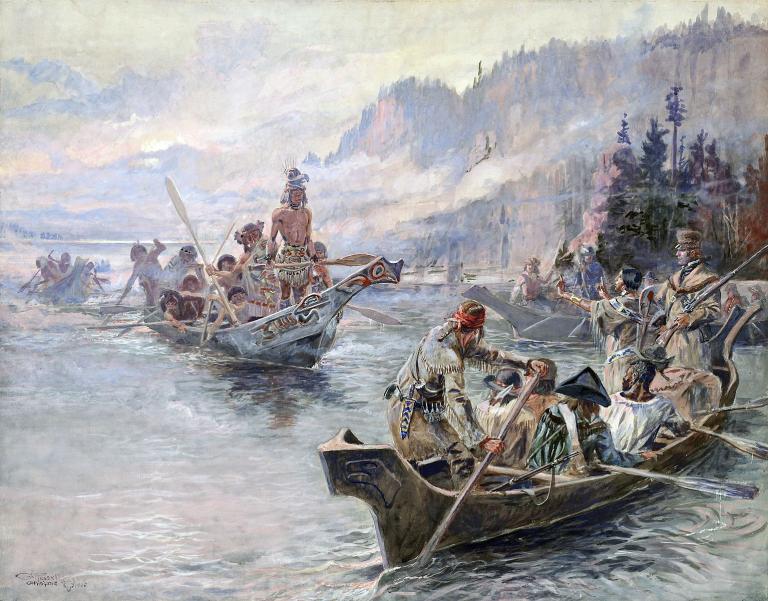
“Lewis and Clark on the Lower Columbia,” by Charles Marion Russell (1905)
(Wikimedia Commons public domain image)
One of the speakers in our sacrament meeting today referred briefly to the story of John Colter, who appears to have been the first person of European descent to have explored the area of today’s Yellowstone National Park and to have seen the Grand Tetons, and who is often termed the first of the “mountain men.”
John Colter (or Coalter or Coulter) was born in the first half of the 1770s in Virginia. From 1804 to 1806, he participated as a member of the Lewis and Clark Expedition, the famous “Corps of Discovery.” Afterwards, though, during the winter of 1807-1808, he explored the area of modern-day Wyoming largely on his own, and he died in the vicinity of St. Louis, Missouri, on either 7 May 1812 or 22 November 1813
Colter left no record of his own behind but, reportedly, he visited at least one geyser basin during his 1807-1808 journeys. Many authorities now believe that he most likely was near present-day Cody, Wyoming, which may still have had some geothermal activity at that time to the immediate west.
Heading north and then west thereafter, he is believed to have come across Yellowstone Lake, another location in which he saw geysers and other geothermal features.
At the conclusion of his adventure, Colter arrived back at Fort Raymond, which was located at the confluence of the Yellowstone and Bighorn Rivers in what is now known as Montana. When he reported jets of scalding water soaring into the sky (geysers), bubbling mudpots, and steaming pools of sulfurous water, very few in his audience believed him. Such things were far outside of their experience and seemed to them merely his fantasies. In fact, he was ridiculed for his claims, and the region of which he told came to be known, jokingly, as “Colter’s Hell.”
We now know, of course, that Colter’s reports were accurate, though we still don’t know exactly where to locate “Colter’s Hell.” Many believe it to have been immediately west of Cody, Wyoming, where some thermal activity still exists and for which other reports from near Colter’s time report phenomena similar to those that Colter had first described. The name “Colter’s Hell” may refer specifically to the region of the Stinking Water, which is now known as the Shoshone River, and particularly the section of it that runs through Cody. The river’s original name was given because of the presence of sulfur in the area surrounding it.
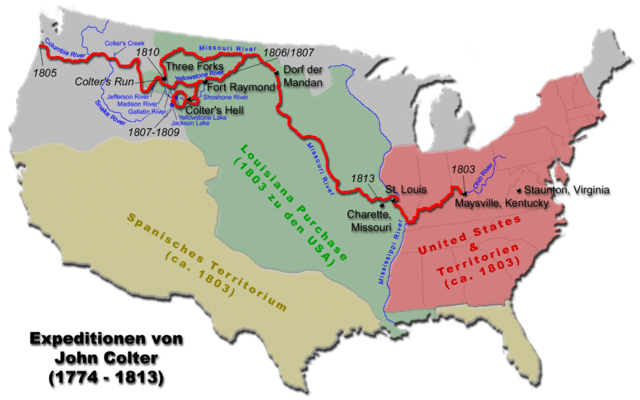
Expeditionen des John Colter zwischen 1803 und 1810 (erstellt durch “Benutzer:Pandat”)
Wikimedia Commons public domain image
When Benjamin Silliman and James Kingsley from Yale reported that stones had fallen from the sky over Weston, Connecticut, Thomas Jefferson, very much a man of the Enlightenment and very much in the spirit of the skeptical philosopher David Hume, reportedly commented that “It is easier to believe that two Yankee professors would lie than that stones would fall from heaven.”
“Jefferson’s Humean skepticism about meteorites,” wrote John Suppe, Blair Professor of Geosciences at Princeton University,
was not directed just at New England and it was not expressed out of scientific ignorance. He had published several geologic contributions, and he was aware of some details of the then-current scientific controversy over stones falling from the sky. For many skeptics the first convincing investigation had come a few years earlier, in 1803, when Jean-Baptiste Biot, a brilliant young professor of the College de France and friend of Laplace, was dispatched by the French Academy of Sciences to investigate a fall of stones near the town of L’Aigle in Normandy. He collected detailed testimony from the surrounding villages that confirmed the time and place of the fall, that about 3000 stones fell in a 4-by-10-kilometer area, and that the stones were found lying on top of the ground and were of a type unlike rocks native to the area.
Biot’s evidence was overwhelmingly convincing—but not to Jefferson, who wrote to a friend saying that the report was a result of “the exuberant imagination of a Frenchman . . . run away with his judgment. The evidence of nature, derived from experience, must be put into one scale, and in the other the testimony of man, his ignorance, the deception of his senses, his lying disposition.”
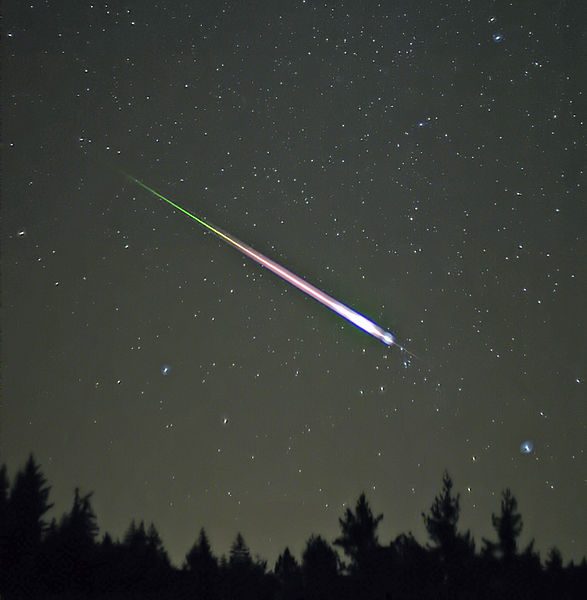
This is a photograph of a falling meteorite. Or else it represents an actual sighting of Lord Russell’s teapot. (Wikimedia Commons public domain image)
In our day, the evidence for meteorites is overwhelming and, so far as I’m aware, no serious person doubts that stones can and do sometimes fall from the sky. In fact, Professor Suppe, writing about Jefferson’s early-nineteenth-century skepticism in 2000, remarked that
It is . . . ironic that nearly 200 years later, convincing evidence has been amassed in Chesapeake Invader by C. Wylie Poag, a paleontologist from the U.S. Geological Survey in Woods Hole, Massachusetts, that a vastly larger meteor impacted south of the Mason-Dixon line, creating a 100-kilometer-wide crater that lies deeply buried under Chesapeake Bay and the shores of Jefferson’s Virginia.
[See John Suppe, “Reports of Stones Falling from the Sky,” Books & Culture: A Christian Review (May/June 2000) (https://www.booksandculture.com/articles/2000/mayjun/14.44.html)]

A NASA artist’s conception of a massive terrestrial meteor impact
(Wikimedia Commons public domain image)
What should we conclude from such stories as that of Jefferson’s reported skepticism about meteorites? What can we learn from the first reactions to John Colter’s discovery of geothermal activity in the area of modern Yellowstone National Park? Surely one lesson to be learned is that, while gullibility is surely a fault to be avoided, closed-minded skepticism can also be a barrier to understanding reality.
All truth, it is said, passes through three stages: First, it is ridiculed. Second, it is passionately and sometimes even violently opposed. Third, it is accepted as self-evident.
Something similar happens, unfortunately, with certain falsehoods.
The reputations of Nicolas Copernicus, Galileo Galilei, and Johannes Kepler don’t rest upon their acceptance of the astronomical consensus of their times. Albert Einstein, accepting the consensus of a static and unchanging cosmos, mistakenly shied away from the expanding universe predicted by his own equations. His reputation rests on his achievements in other regards, where, more characteristically, he didn’t fear to go against commonly held opinion. Unintimidated by consensus, Edwin Hubble and Alexander Friedmann and Father Georges Lemaître gave us the Big Bang and the subsequently expanding universe.
Alfred Russel Wallace and Charles Darwin didn’t originate the theory of evolution by deferring to consensus.
Ignaz Semmelweis argued for the importance of disinfection during surgeries, but his argument did not sit well with his medical colleagues. His life ended in an asylum for the insane, where he died after being beaten by the guards. A few years later, Louis Pasteur confirmed the germ theory of disease and Joseph Lister pioneered improved medical hygiene.
Alfred Wegener’s proposal of “continental drift” directly clashed with the geological consensus of his day, and it didn’t help matters that he was an outsider whose doctorate was actually in astronomy. The American Association of Petroleum Geologists organized an entire symposium specifically devoted to rebutting Wegener’s hypothesis, and George Gaylord Simpson, arguably the most important paleontologist of the twentieth century, went out of his way to oppose it. Nearly a century after Wegener’s premature death during a 1930 expedition in Greenland, continental drift is universally accepted among serious geologists.
So slavish conformity to scientific or other consensus has little if anything to commend it.
On the other hand, unless there are strong reasons to oppose consensus, it’s generally safest in intellectual and other regards to be guided by it. Vaccination is almost certainly useful against COVID-19 and almost certainly does’t cause autism. Petroleum jelly probably doesn’t cure blindness. It’s very unlikely that the Great Pyramid of Giza was built by aliens. A program of repeated enemas most likely won’t cure cancer. Earth almost certainly isn’t flat. You probably shouldn’t take arsenic as a remedy for leukemia or malaria. The Biden administration probably isn’t run by a secret cabal of cannibalistic pedophiles. The white race very likely wasn’t created by a black scientist named Yakub in a laboratory on the Isle of Patmos 6600 years ago. Dr. Pepper isn’t a brain tonic. Dr. Kilmer’s Swamp Root almost certainly won’t cure “internal slime fever,” which almost certainly doesn’t exist. Hitler isn’t living in Brazil. And Bubba Ho-Tep may not be entirely based on fact.
The fact that an idea or theory is overwhelming rejected by a consensus of scientists doesn’t prove it true.
This isn’t rocket science. Heck, it’s not even homeopathy or iridology. Let alone herpetology.
Previous Post

May 20, 2023
Preliminary notes on faith
Next Post

May 22, 2023 Hearts of Darkness
Recent Comments
"Thank you. Many times, on my commute east into Salt Lake City, I've observed the ..."
"What do you think of the Shakespearean authorship problem, noel?"
"How do you handle the pesky Book of Abraham problem. ? The angel with the ..."
"I am thankful for the stir fry my wife made last night and was more ..."
Browse Our Archives
Select a Category Uncategorized
Select a Month November 2026 October 2026 September 2026 August 2026 July 2026 June 2026 May 2026 April 2026 March 2026 February 2026 January 2026 December 2025 November 2025 October 2025 September 2025 August 2025 July 2025 June 2025 May 2025 April 2025 March 2025 February 2025 January 2025 December 2024 November 2024 October 2024 September 2024 August 2024 July 2024 June 2024 May 2024 April 2024 March 2024 February 2024 January 2024 December 2023 November 2023 October 2023 September 2023 August 2023 July 2023 June 2023 May 2023 April 2023 March 2023 February 2023 January 2023 December 2022 November 2022 October 2022 September 2022 August 2022 July 2022 June 2022 May 2022 April 2022 March 2022 February 2022 January 2022 December 2021 November 2021 October 2021 September 2021 August 2021 July 2021 June 2021 May 2021 April 2021 March 2021 February 2021 January 2021 December 2020 November 2020 October 2020 September 2020 August 2020 July 2020 June 2020 May 2020 April 2020 March 2020 February 2020 January 2020 December 2019 November 2019 October 2019 September 2019 August 2019 July 2019 June 2019 May 2019 April 2019 March 2019 February 2019 January 2019 December 2018 November 2018 October 2018 September 2018 August 2018 July 2018 June 2018 May 2018 April 2018 March 2018 February 2018 January 2018 December 2017 November 2017 October 2017 September 2017 August 2017 July 2017 June 2017 May 2017 April 2017 March 2017 February 2017 January 2017 December 2016 November 2016 October 2016 September 2016 August 2016 July 2016 June 2016 May 2016 April 2016 March 2016 February 2016 January 2016 December 2015 November 2015 October 2015 September 2015 August 2015 July 2015 June 2015 May 2015 April 2015 March 2015 February 2015 January 2015 December 2014 November 2014 March 2014 August 2013 February 2012
Follow Us!
TAKE THE
Religious Wisdom Quiz
What Christian group is known for door-to-door evangelism?
Select your answer to see how you score.
Catholics Pentecostals Jehovah’s Witnesses Baptists
Related posts from Sic et Non


Fact and Theory and Extraordinary Claims
Thoughts on the Fourth of July

My first day without employment
TRENDING AT PATHEOS Latter-day Saint

For many years, Catholicism has been caught up in division over the...

'Statements of Faith' never get shorter
Nothing demonstrates a conservative commitment to faith and faithfulness like a "statement...

Michele's Reviews - Future Grace by John Piper
In God's Place, at God's Pace, by Future Grace Impatience is...

Bama Gramma's Blackout Christmas: the Power of Light...
Another Christmas Skit: I have an alter ego: Bama Gramma. She shows...

Thanksgiving as a Way of Life: A Christian...
Each year, Thanksgiving brings families and friends together to share meals, stories,...

Two Women Doctors Who Went Against the Current
Women physicians who transformed healthcare for "Indians" “I shall have an advantage...
view all Latter-day Saint blogs
What Are Your Thoughts?leave a comment
Ad-Free & Subscriber Log-In Subscription Support
- About Us
- 2026 Calendar
- Videos
- Podcasts
- Library of World Religions
- Faith In Media Tracker
- Advertise With Us
- Write for Us
- Privacy Policy
- Terms of Service
- Do Not Sell My Data
- Contact Us
- Radiant Digital
- Manage Newsletter Subscriptions
- Unsubscribe From Notifications
- Sitemap
Copyright 2008-2026, Patheos, part of the Radiant Digital network of media brands. All rights reserved.
Subscription Support Ad-Free & Subscriber Log-In
Follow Patheos