
BuddhistCatholicContemplativeEvangelicalGeneral ChristianHinduJewishLatter-day SaintMuslimNew VisionsProgressive Christian
Beliefs
- Buddhist
- Catholic
- Contemplative
- Evangelical
- General Christian
- Hindu
- Jewish
- Latter-day Saint
- More Voices
- Muslim
- New Visions
- Pagan
- Progressive Christian
Topics
- Religion News
- Food and Religion
- Sports and Religion
- Religious Art
- Religious Music and Entertainment
- Religious Events
- History and Religion
- Style and Religion
- Politics and Religion
- Women in Religion
- Recreation Outdoors and Religion
- Business Finance and Religion
- Careers Workplace and Religion
- Education and Religion
- Family Parenting and Religion
- Health Fitness and Religion
- Home and Religion
- Relationships and Religion
- Technology and Religion
- Travel and Religion
Columnists
- Buddhist Columnists
- Business Finance and Religion Columnists
- Careers Workplace and Religion Columnists
- Catholic Columnists
- Contemplative Columnists
- Education and Religion Columnists
- Evangelists Columnists
- Family Parenting and Religion Columnists
- General Christian Columnists
- Health Fitness and Religion Columnists
- Hindu Columnists
- History and Religion Columnists
- Home and Religion Columnists
- Jewish Columnists
- More Voices Columnists
- Latter Day Columnists
- Muslim Columnists
- New Visions Columnists
- Nonreligious Columnists
- Pagan Columnists
- Politics and Religion Columnists
- Progressive Columnists
- Recreation Outdoors and Religion Columnists
- Relationships and Religion Columnists
- Religion News Columnists
- Religious Art Columnists
- Religious Events Columnists
- Religious Music and Entertainment Columnists
- Sports and Religion Columnists
- Style and Religion Columnists
- Technology and Religion Columnists
- Travel and Religion Columnists
- Women in Religion Columnists
Resource Library
- 2026 Calendar
- Library of World Religions
- The 100 Most Holy Places on Earth
- Patheos Answers
- Podcasts
- Videos
- Faith Leaders Database
- Anglican Episcopalian
- Bahai
- Baptist
- Buddhism
- Christianity
- Confucianism
- Eastern Orthodoxy
- Hinduism
- Holiness and Pentecostal
- ISKCON
- Islam
- Judaism
- Lutheran
- Methodist
- The Church of Jesus Christ of Latter-day Saints
- New Age
- Paganism
- Presbytarian and Reformed
- Protestantism
- Religion Behind the Scenes
- Roman Catholic
- Scientology
- Shia Islam
- Sikhism
- Sufism
- Sunni Islam
- Taoism
- Zen
- See all religions
Research Tools
 Ad-Free & Subscriber Log-In Subscription Support
Ad-Free & Subscriber Log-In Subscription Support
Follow Patheos 

- Trending:
- Forgiveness
- |
- Marriage
- |
- Consciousness
- |
- Death Penalty
- |
- Election
- |
- Halloween

- Home
- Latter-day Saint
- On Being “Perfect” (Part Two)
On Being “Perfect” (Part Two)
Last updated on: April 17, 2023 at 6:34 pm by Dan Peterson
On Being “Perfect” (Part Two) 2023-04-17T18:34:04-06:00 Dan Peterson
Patheos Explore the world's faith through different perspectives on religion and spirituality! Patheos has the views of the prevalent religions and spiritualities of the world.

The Himalayan peaks Shivling and Meru at sunrise (Wikimedia Commons public domain image)
This post, which focuses again on the famous passage in Matthew 5:48 (in the King James Version, “Be ye therefore perfect, even as your Father which is in heaven is perfect”), is a continuation of “On Being ‘Perfect’ (Part One),” which went up on 2 April 2023.
In our effort to understand Matthew 5:48, we should certainly not ignore the verse’s context. That is an all-too-common error in the explication and deployment of quotations from the Bible; we must resist that temptation.
The passage immediately follows an extended discussion of the importance of loving even our enemies (5:43-47, or perhaps 5:38-47 altogether), a passage that specifically refers, as an illustration of what it means by loving even enemies, to “your Father which is in heaven,” who “maketh his sun to rise on the evil and on the good, and sendeth rain on the just and on the unjust.” And there is no clear or explicit division between 5:47 and 5:48, no reason to believe that 5:48 represents an entirely new and unrelated thought.
At a minimum, accordingly, the “perfection” spoken of in Matthew 5:48 must involve a perfection of love — even toward those who are, by just about every earthly standard, unlovable and, sometimes, even hateful. As J. B. Phillips renders Matthew 5:46-48 in his very readable twentieth-century translation (a longtime favorite of mine),
For if you love only those who love you, what credit is that to you? Even tax-collectors do that! And if you exchange greetings only with your own circle, are you doing anything exceptional? Even the pagans do that much. No, you are to be perfect, like your Heavenly Father.
And such perfect love goes far beyond — and is far more difficult than — merely a perfect attendance record at Sunday school or unvarying abstinence from tobacco or the scrupulously accurate payment of tithing. It is, in fact, something that we cannot manage on our own, unaided. It is a spiritual gift that we are commanded to seek. Here are the words of the prophet Mormon, as recorded by his son:
Wherefore, cleave unto charity, which is the greatest of all, for all things must fail—
But charity is the pure love of Christ, and it endureth forever; and whoso is found possessed of it at the last day, it shall be well with him.
Wherefore, my beloved brethren, pray unto the Father with all the energy of heart, that ye may be filled with this love, which he hath bestowed upon all who are true followers of his Son, Jesus Christ; that ye may become the sons of God; that when he shall appear we shall be like him, for we shall see him as he is; that we may have this hope; that we may be purified even as he is pure. Amen. (Moroni 7:46-48)
Moreover, the passage immediately following Matthew 5:48 — and please remember that the chapter and verse divisions are not part of the original biblical text but were introduced long after the original writing of the New Testament, so that we should not imagine that a chapter break necessarily indicates a break in continuity of thought — demands that our “righteousness” or “perfection” not be motivated or muddied by a desire for ego-gratifying public display. (See Matthew 6:1-6.)
It is also essential to understand that, as Norbert Duckwitz recently pointed out in a Facebook response to my earlier post, the first word in the passage is in the future tense. It isn’t, literally, a command. It is the Greek verb εσεσθε, which is translated as “be” (the first word in the English of the King James). It is a second-person plural form of the verb ειμι (“to be”). And the fact that it is in the future tense, and not strictly an imperative command, is significant. The future tense can, of course, be a way of expressing a command. In English, for example, the boss says to the employee “You will organize these files tomorrow,” or “Next week, Bob, you’ll go to Boston and meet with our staff there.” She’s not merely making a prediction, despite her employment of the future tense. She’s issuing an order. But sometimes too, obviously the future tense simply indicates, well, a future action or a future condition. In that light, consider some of these English translations of Matthew 5:48:
- “You shall be perfect.” (roughly or exactly thus in the American Standard Version, the Disciples’ Literal New Testament, the 1599 Geneva Bible, the New American Standard Bible, the New King James Version, the Revised Geneva Translation, the World English Bible, and Young’s Literal Translation)
- “You are to be perfect.” (roughly or exactly thus in the Legacy Standard Bible, the Living Bible, the Mounce Reverse Interlinear New Testament, the New American Standard Bible 1995, and the New Living Translation)
In terms of what Greek grammarians call “voice,” εσεσθε is a “middle deponent verb,” which suggests that the subject of the verb — in this case, the people whom Christ is addressing — performs the action (i.e., of being “perfect”), instead of receiving it. And its “mood” is what grammarians call the “indicative,” which means that it is not referring to a state that might be, or a condition that is merely wished for, or even an action or state that is commanded to be.
So perhaps one way of taking Matthew 5:48 — certainly one way to be considered — is not as an intimidating and even discouraging command to do what seems impossible but, rather, as a simple statement of fact that we will someday be perfect. As a comforting divine promise that, however distant and unattainable perfection may seem to us now, we will (if we continue to strive to follow the Savior, if, to borrow language now closely associated with President Russell M. Nelson, we persist on “the covenant path”) someday attain it. It might be, taken in that sense, an expression of divine confidence in us and in his own plan for us.
.

The Oquirrh Mountain Utah Temple (LDS.org)
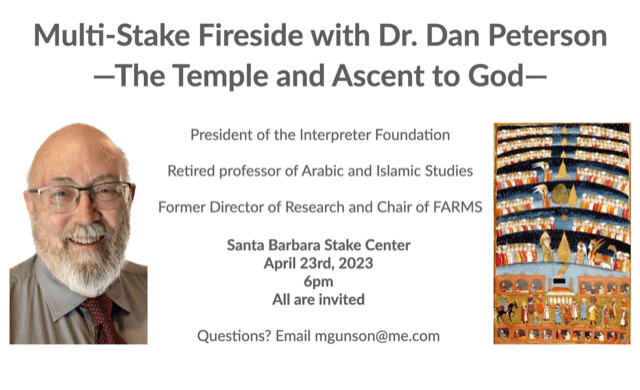
Incidentally, barring unforeseen circumstances I’ll be in Santa Barbara, California, this coming weekend. (Not exactly the worst place in the world!) Among other things, at the invitation of Bishop Michael Gunson there, I’ll be speaking to a fireside audience on Sunday evening. If any of you happen to be in the vicinity at the time, please feel free to drop in:
To be continued.
Church of Jesus Christ of Latter-day Saints
Previous Post
April 15, 2023
If there is no God, is everything permitted?
Next Post
April 17, 2023 A rather strange notion about Earth's fall
Recent Comments
"In a meeting today, I learned another important reason why accurate (or at least as ..."
From Serbia’s “White City,” Belgrade
"PL: "Let's hope he doesn't have your address..."I have to frankly confess that a few ..."
From Serbia’s “White City,” Belgrade
"Let's hope he doesn't have your address..."
From Serbia’s “White City,” Belgrade
"PL: "The layers are peeling back."He appears to be suffering under an odd but powerful ..."
From Serbia’s “White City,” Belgrade
Browse Our Archives
Select a Category Uncategorized
Select a Month October 2026 September 2026 August 2026 July 2026 June 2026 May 2026 April 2026 March 2026 February 2026 January 2026 December 2025 November 2025 October 2025 September 2025 August 2025 July 2025 June 2025 May 2025 April 2025 March 2025 February 2025 January 2025 December 2024 November 2024 October 2024 September 2024 August 2024 July 2024 June 2024 May 2024 April 2024 March 2024 February 2024 January 2024 December 2023 November 2023 October 2023 September 2023 August 2023 July 2023 June 2023 May 2023 April 2023 March 2023 February 2023 January 2023 December 2022 November 2022 October 2022 September 2022 August 2022 July 2022 June 2022 May 2022 April 2022 March 2022 February 2022 January 2022 December 2021 November 2021 October 2021 September 2021 August 2021 July 2021 June 2021 May 2021 April 2021 March 2021 February 2021 January 2021 December 2020 November 2020 October 2020 September 2020 August 2020 July 2020 June 2020 May 2020 April 2020 March 2020 February 2020 January 2020 December 2019 November 2019 October 2019 September 2019 August 2019 July 2019 June 2019 May 2019 April 2019 March 2019 February 2019 January 2019 December 2018 November 2018 October 2018 September 2018 August 2018 July 2018 June 2018 May 2018 April 2018 March 2018 February 2018 January 2018 December 2017 November 2017 October 2017 September 2017 August 2017 July 2017 June 2017 May 2017 April 2017 March 2017 February 2017 January 2017 December 2016 November 2016 October 2016 September 2016 August 2016 July 2016 June 2016 May 2016 April 2016 March 2016 February 2016 January 2016 December 2015 November 2015 October 2015 September 2015 August 2015 July 2015 June 2015 May 2015 April 2015 March 2015 February 2015 January 2015 December 2014 November 2014 March 2014 August 2013 February 2012
Follow Us!
TAKE THE
Religious Wisdom Quiz
Who led the Israelites into the Promised Land?
Select your answer to see how you score.
Aaron Joshua Moses Caleb
Related posts from Sic et Non


Notes on Women, Priesthood, and General Conference

"The Book of Moses as a Temple Text"

TRENDING AT PATHEOS Latter-day Saint

The Sermon on the Mount, Part I: Matthew...
The Sermon on the Mount, Part I (Matthew 4:12-5:12) St. Matthew moves...

What's up from Crossway: Reviewing some of their latest A few weeks...

Janie Learns the Way of the Cross: A...
Teaching children about Jesus' Passion can be challenging. Many parents and educators...

Looking For Good Catholic Writing - October 2026
He alone extends the heavens, and he walks upon the waves of...

In "Irreplaceable," our book on vocation and technology, Trevor Sutton and I...

I was strolling through the top floor of the brand new Parthenon...
view all Latter-day Saint blogs
What Are Your Thoughts?leave a comment
Ad-Free & Subscriber Log-In Subscription Support
- About Us
- 2026 Calendar
- Videos
- Podcasts
- Library of World Religions
- Faith In Media Tracker
- Advertise With Us
- Write for Us
- Privacy Policy
- Terms of Service
- Do Not Sell My Data
- Contact Us
- Radiant Digital
- Manage Newsletter Subscriptions
- Unsubscribe From Notifications
- Sitemap
Copyright 2008-2026, Patheos. All rights reserved.
Subscription Support Ad-Free & Subscriber Log-In
Follow Patheos