
BuddhistCatholicContemplativeEvangelicalGeneral ChristianHinduJewishLatter-day SaintMuslimNew VisionsProgressive Christian
Beliefs
- Buddhist
- Catholic
- Contemplative
- Evangelical
- General Christian
- Hindu
- Jewish
- Latter-day Saint
- More Voices
- Muslim
- New Visions
- Pagan
- Progressive Christian
Topics
- Religion News
- Food and Religion
- Sports and Religion
- Religious Art
- Religious Music and Entertainment
- Religious Events
- History and Religion
- Style and Religion
- Politics and Religion
- Women in Religion
- Recreation Outdoors and Religion
- Business Finance and Religion
- Careers Workplace and Religion
- Education and Religion
- Family Parenting and Religion
- Health Fitness and Religion
- Home and Religion
- Relationships and Religion
- Technology and Religion
- Travel and Religion
Columnists
- Buddhist Columnists
- Business Finance and Religion Columnists
- Careers Workplace and Religion Columnists
- Catholic Columnists
- Contemplative Columnists
- Education and Religion Columnists
- Evangelists Columnists
- Family Parenting and Religion Columnists
- General Christian Columnists
- Health Fitness and Religion Columnists
- Hindu Columnists
- History and Religion Columnists
- Home and Religion Columnists
- Jewish Columnists
- More Voices Columnists
- Latter Day Columnists
- Muslim Columnists
- New Visions Columnists
- Nonreligious Columnists
- Pagan Columnists
- Politics and Religion Columnists
- Progressive Columnists
- Recreation Outdoors and Religion Columnists
- Relationships and Religion Columnists
- Religion News Columnists
- Religious Art Columnists
- Religious Events Columnists
- Religious Music and Entertainment Columnists
- Sports and Religion Columnists
- Style and Religion Columnists
- Technology and Religion Columnists
- Travel and Religion Columnists
- Women in Religion Columnists
Resource Library
- 2026 Calendar
- Library of World Religions
- The 100 Most Holy Places on Earth
- Patheos Answers
- Podcasts
- Videos
- Faith Leaders Database
- Anglican Episcopalian
- Bahai
- Baptist
- Buddhism
- Christianity
- Confucianism
- Eastern Orthodoxy
- Hinduism
- Holiness and Pentecostal
- ISKCON
- Islam
- Judaism
- Lutheran
- Methodist
- The Church of Jesus Christ of Latter-day Saints
- New Age
- Paganism
- Presbytarian and Reformed
- Protestantism
- Religion Behind the Scenes
- Roman Catholic
- Scientology
- Shia Islam
- Sikhism
- Sufism
- Sunni Islam
- Taoism
- Zen
- See all religions
Research Tools
 Ad-Free & Subscriber Log-In Subscription Support
Ad-Free & Subscriber Log-In Subscription Support
Follow Patheos 

- Trending:
- Forgiveness
- |
- Marriage
- |
- Consciousness
- |
- Death Penalty
- |
- Election
- |
- Halloween

- Home
- Latter-day Saint
- Two Very Distinct Prophets
Two Very Distinct Prophets
Last updated on: February 11, 2023 at 5:44 pm by Dan Peterson
Two Very Distinct Prophets 2023-02-11T17:44:40-07:00 Dan Peterson
Patheos Explore the world's faith through different perspectives on religion and spirituality! Patheos has the views of the prevalent religions and spiritualities of the world.
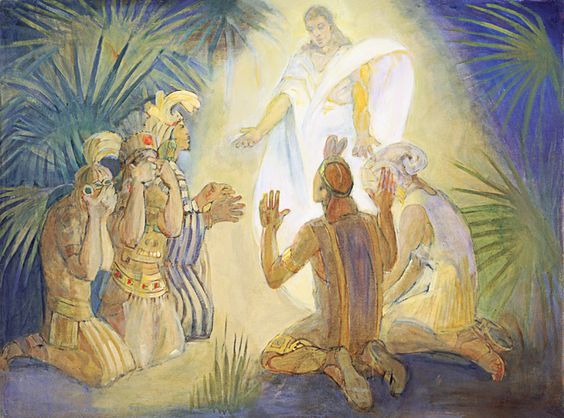
“An angel appears to Alma the Younger and the sons of Mosiah”
(Minerva Teichert, ca 1950-51; LDS.org)
Happy weekend! Two new articles appeared today on the website of the Interpreter Foundation:
““According to the Spirit of Revelation and Prophecy”: Alma2’s Prophetic Warning of Christ’s Coming to the Lehites (and Others),” written by Matthew Scott Stenson
Abstract: Some students of the Book of Mormon have felt that while the coming of the Lord to the Lehites was clearly revealed to and taught by Nephi1, those prophecies having to do with the subject may not have been widely circulated or continuously preserved among the Nephites, while others have argued for continuity of knowledge about Nephi1’s prophecies among writers and their contemporary audiences. Reexamination of the Book of Mormon in light of these issues reveals that the teaching that Christ would appear among the Lehites was actually taught with some consistency by Alma2 and was, it would seem, common knowledge among the Nephites. It appears that the predicted coming was well established, even if the nature of it was not. Specifically, I argue that Alma2 often taught of the coming of Christ to the Lehites but in context with other events such as Jesus’s coming to the Jews and to others not of the known fold. To make this case, I concentrate on Alma2’s writings, especially those in Alma 5 (borrowing liberally also from Alma 7, 13, 16, 39, Helaman 16:4–5, 13–14, and 3 Nephi 8–10). Alma 5 houses many prophetic statements that urgently point to the coming of the Lord to the Nephite church. The value of this approach is to attempt to demonstrate that Alma 5 contains more than has been supposed and, in effect, challenges claims for discontinuity in the middle portion of the Nephite record. This approach should tend to renew our interest in the other nuanced teachings of the prophet Alma2 and others.
“Interpreting Interpreter: The Limitations of Discontinuity”
This post is a summary of the article ““According to the Spirit of Revelation and Prophecy”: Alma2’s Prophetic Warning of Christ’s Coming to the Lehites (and Others)” by Matthew Scott Stenson in Volume 55 of Interpreter: A Journal of Latter-day Saint Faith and Scholarship. An introduction to the Interpreting Interpreter series is available at https://interpreterfoundation.org/interpreting-interpreter-on-abstracting-thought/.
The Takeaway: Stenson uses Alma 5 (among other examples) to argue for a middle ground between those who argue for a continuity in the use and awareness of prophecies of Christ’s coming in the Book of Mormon, and those who argue for a break in that continuity, suggesting that Alma’s allusions to the small plates meant that later Nephites had at least some knowledge of Nephi’s prophetic tradition.
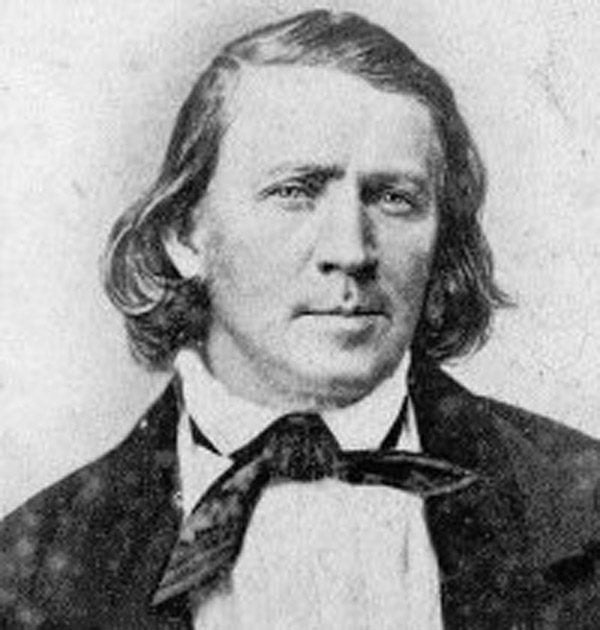
Brigham Young, in an unsourced photograph from ca. 1850
(Wikimedia Commons public domain image)
In connection with the Interpreter Foundation’s “Six Days in August” film project, which is in its very opening phase, I’ve lately begun to re-read Thomas G. Alexander, Brigham Young and the Expansion of the Mormon Faith (Norman: University of Oklahoma Press, 2019). Here is a passage that caught my attention with regard to his integrity. I doubt that anybody potentially decades later and back in New York really expected, or even thought of the possibility, that Brigham Young would remember and seek to pay off his old debts. And, pretty certainly, nobody could realistically have sought to enforce them. Nevertheless, he sought to do the right thing:
Although he worked hard, Young incurred a number of debts while in Port Byron and Mendon, largely in his effort to keep his family afloat. He was unable to repay many of these debts until emigrating to Utah years later, though he did keep track of the notes he had signed. Later in life, he would send his son, John W. Young, and his friend, William W. Riter, at times to repay them with simple interest at 7 percent. Commenting on one such visit from John W. Young, the Auburn Advertiser Union noted: “Brigham is honest in some things, but rather slow.”
Brigham Young and his wife, the former Miriam Angeline Weeks, joined the Church of Jesus Christ of Latter-day Saints on 9 April 1832, just three days past the Church’s second birthday. Unfortunately, Miriam was afflicted with what was then called “consumption” (a wasting disease, most likely pulmonary tuberculosis). It’s pretty much de rigeur in some circles to think of Brigham, and to portray him, as a callous, uncaring misogynist. So this short little passage seems to me worthy of note:
To Brigham’s profound grief, Miriam succumbed to the same disease that had killed his mother and sister. During the last weeks of her life, Young cared for her while he worked to support the family. He reportedly got up early, fixed breakfast for the family, carried Miriam to a seat near the fireplace, and left for work. In the evening, he prepared a meal, cleaned up, and carried her to bed. After her death on September 8, 1832, Brigham, Elizabeth, and Vilate Young moved in with Heber and Vilate Kimball.
Tom Alexander is a friend. He is also a respected historian, a careful and scrupulous scholar, and a believing Latter-day Saint. So I appreciated this passage from
In several previously published articles I have argued that objectivity — as scholars generally use the term — is impossible. Every person carries some cultural baggage that no amount of scholarly detachment or persistence can overcome. Historian Charles Beard called the idea of objectivity a Noble Dream. I believe that those who profess to be objective are self-deluded. . . .
I have argued and still believe that honesty is the most important virtue historians can seek to achieve. Any written history consists of a text written by weaving together evidence found in clearly fragmentary and often messy documents with prose that links the evidence together in a story or narrative. All too often, historians allow rhetoric and supposition to substitute for evidence. . . .
I have tried, as diligently as possible, to write an honest biography. In the text that follows, I have recognized Brigham Young’s failings, especially in his Indian policy, the Mormon Reformation, and the United Orders. Some of his doctrinal views are clearly unorthodox. At the same time, I have also tried to treat his successes as a missionary, family man, businessman, church leader, and colonizer. I would like to have known him personally. Unfortunately, the only paths available to explore his life are documents and narratives.
Brigham Young and the Expansion of the Mormon Faith
Church of Jesus Christ of Latter-day Saints
Previous Post

February 9, 2023
Earthquake in Turkey and Syria: How to Help
Next Post
February 11, 2023 "Local" Planetary Conditions
Recent Comments
"In a meeting today, I learned another important reason why accurate (or at least as ..."
From Serbia’s “White City,” Belgrade
"I've been watching a lot of video interviews of NDErs and researchers. I think in ..."
"PL: "Let's hope he doesn't have your address..."I have to frankly confess that a few ..."
From Serbia’s “White City,” Belgrade
"Let's hope he doesn't have your address..."
From Serbia’s “White City,” Belgrade
Browse Our Archives
Select a Category Uncategorized
Select a Month October 2026 September 2026 August 2026 July 2026 June 2026 May 2026 April 2026 March 2026 February 2026 January 2026 December 2025 November 2025 October 2025 September 2025 August 2025 July 2025 June 2025 May 2025 April 2025 March 2025 February 2025 January 2025 December 2024 November 2024 October 2024 September 2024 August 2024 July 2024 June 2024 May 2024 April 2024 March 2024 February 2024 January 2024 December 2023 November 2023 October 2023 September 2023 August 2023 July 2023 June 2023 May 2023 April 2023 March 2023 February 2023 January 2023 December 2022 November 2022 October 2022 September 2022 August 2022 July 2022 June 2022 May 2022 April 2022 March 2022 February 2022 January 2022 December 2021 November 2021 October 2021 September 2021 August 2021 July 2021 June 2021 May 2021 April 2021 March 2021 February 2021 January 2021 December 2020 November 2020 October 2020 September 2020 August 2020 July 2020 June 2020 May 2020 April 2020 March 2020 February 2020 January 2020 December 2019 November 2019 October 2019 September 2019 August 2019 July 2019 June 2019 May 2019 April 2019 March 2019 February 2019 January 2019 December 2018 November 2018 October 2018 September 2018 August 2018 July 2018 June 2018 May 2018 April 2018 March 2018 February 2018 January 2018 December 2017 November 2017 October 2017 September 2017 August 2017 July 2017 June 2017 May 2017 April 2017 March 2017 February 2017 January 2017 December 2016 November 2016 October 2016 September 2016 August 2016 July 2016 June 2016 May 2016 April 2016 March 2016 February 2016 January 2016 December 2015 November 2015 October 2015 September 2015 August 2015 July 2015 June 2015 May 2015 April 2015 March 2015 February 2015 January 2015 December 2014 November 2014 March 2014 August 2013 February 2012
Follow Us!
TAKE THE
Religious Wisdom Quiz
What did Jesus do before He fed the crowd?
Select your answer to see how you score.
Gave thanks and broke the bread Called down fire Washed His hands Dug a hole
Related posts from Sic et Non


Notes on Women, Priesthood, and General Conference

"The Book of Moses as a Temple Text"

TRENDING AT PATHEOS Latter-day Saint

Janie Learns the Way of the Cross: A...
Teaching children about Jesus' Passion can be challenging. Many parents and educators...

Looking For Good Catholic Writing - October 2026
He alone extends the heavens, and he walks upon the waves of...

In "Irreplaceable," our book on vocation and technology, Trevor Sutton and I...

I was strolling through the top floor of the brand new Parthenon...

What Does Gêvâh Mean For Kimberley Guifoyle &...
This week, a lot of the news is focused on Kimberly Guilfoyle....

INNER CIRCLE: Profound Mystery (Of Christ In All...
Ephesians 5:31-32 “For this reason, a man will leave his father and...
view all Latter-day Saint blogs
What Are Your Thoughts?leave a comment
Ad-Free & Subscriber Log-In Subscription Support
- About Us
- 2026 Calendar
- Videos
- Podcasts
- Library of World Religions
- Faith In Media Tracker
- Advertise With Us
- Write for Us
- Privacy Policy
- Terms of Service
- Do Not Sell My Data
- Contact Us
- Radiant Digital
- Manage Newsletter Subscriptions
- Unsubscribe From Notifications
- Sitemap
Copyright 2008-2026, Patheos. All rights reserved.
Subscription Support Ad-Free & Subscriber Log-In
Follow Patheos