
BuddhistCatholicContemplativeEvangelicalGeneral ChristianHinduJewishLatter-day SaintMuslimNew VisionsProgressive Christian
Beliefs
- Buddhist
- Catholic
- Contemplative
- Evangelical
- General Christian
- Hindu
- Jewish
- Latter-day Saint
- More Voices
- Muslim
- New Visions
- Pagan
- Progressive Christian
Topics
- Religion News
- Food and Religion
- Sports and Religion
- Religious Art
- Religious Music and Entertainment
- Religious Events
- History and Religion
- Style and Religion
- Politics and Religion
- Women in Religion
- Recreation Outdoors and Religion
- Business Finance and Religion
- Careers Workplace and Religion
- Education and Religion
- Family Parenting and Religion
- Health Fitness and Religion
- Home and Religion
- Relationships and Religion
- Technology and Religion
- Travel and Religion
Columnists
- Buddhist Columnists
- Business Finance and Religion Columnists
- Careers Workplace and Religion Columnists
- Catholic Columnists
- Contemplative Columnists
- Education and Religion Columnists
- Evangelists Columnists
- Family Parenting and Religion Columnists
- General Christian Columnists
- Health Fitness and Religion Columnists
- Hindu Columnists
- History and Religion Columnists
- Home and Religion Columnists
- Jewish Columnists
- More Voices Columnists
- Latter Day Columnists
- Muslim Columnists
- New Visions Columnists
- Nonreligious Columnists
- Pagan Columnists
- Politics and Religion Columnists
- Progressive Columnists
- Recreation Outdoors and Religion Columnists
- Relationships and Religion Columnists
- Religion News Columnists
- Religious Art Columnists
- Religious Events Columnists
- Religious Music and Entertainment Columnists
- Sports and Religion Columnists
- Style and Religion Columnists
- Technology and Religion Columnists
- Travel and Religion Columnists
- Women in Religion Columnists
Resource Library
- 2026 Calendar
- Library of World Religions
- The 100 Most Holy Places on Earth
- Patheos Answers
- Podcasts
- Videos
- Faith Leaders Database
- Anglican Episcopalian
- Bahai
- Baptist
- Buddhism
- Christianity
- Confucianism
- Eastern Orthodoxy
- Hinduism
- Holiness and Pentecostal
- ISKCON
- Islam
- Judaism
- Lutheran
- Methodist
- The Church of Jesus Christ of Latter-day Saints
- New Age
- Paganism
- Presbytarian and Reformed
- Protestantism
- Religion Behind the Scenes
- Roman Catholic
- Scientology
- Shia Islam
- Sikhism
- Sufism
- Sunni Islam
- Taoism
- Zen
- See all religions
Research Tools
 Ad-Free & Subscriber Log-In Subscription Support
Ad-Free & Subscriber Log-In Subscription Support
Follow Patheos 

- Trending:
- Forgiveness
- |
- Marriage
- |
- Consciousness
- |
- Death Penalty
- |
- Election
- |
- Halloween

- Home
- Latter-day Saint
- Thinking about “Evolution”
Thinking about “Evolution”
Last updated on: March 2, 2023 at 10:37 pm by Dan Peterson
Thinking about “Evolution” 2023-03-02T22:37:35-07:00 Dan Peterson
Patheos Explore the world's faith through different perspectives on religion and spirituality! Patheos has the views of the prevalent religions and spiritualities of the world.

The Phylogenetic Tree of Life (Wikimedia Commons public domain image)
It seems to me that the term evolution has at least three quite distinct meanings in ordinary lay English conversation, and that these three need to be carefully distinguished during conversation, lest confusion result.
- One meaning is “change over time.” Nobody seriously disputes this. Or, at least nobody should dispute it. People today are taller than they used to be. (Look at King Henry VIII’s armor in the Tower of London if you want to try to dispute this.). Better nutrition, interracial marriages, and any number of other factors can drive multiple kinds of change. Breeders of roses and practitioners of animal husbandry know that changes are not only possible but easily effected. Very slight more controversial, I suppose, are the multiple lines of fossil evidence demonstrating that the animals and plants and regional ecologies were different in the past than they are today. The only real question in this regard is the extent of change over time and the extent of change that is possible. Of course, another relevant question concerns how long the processes of biological change have been underway. Whether creation of the earth was completed in BC 4004, as was calculated by Archbishop James Ussher, or whether the earth is approximately 4.543 billion years old, as most scientists (and, by the way, most if not all Intelligent Design theorists) assume, will significantly impact how one views the origins and development of life. (I, by the way, have been repeatedly characterized — sometimes in communications made directly to me — as a young-earth creationist. That’s always news to me. I’m otherwise strongly inclined to believe that I believe that the earth is, indeed, probably a little bit more than four and a half billion years old.)
- Another meaning is the notion of common origin, presumably from a primordial single-cell organism that arose somehow. It’s interesting to note that Charles Darwin himself apparently never addressed the question of the absolute origin of life in his books. (His famous speculation about life’s possible beginning in some warm tidal pool somewhere or other appears in a letter to a friend, but evidently not in his published writings.) Instead, On the Origin of Species (1859) and The Descent of Man (1871) presume the existence of living organisms upon which evolution then works by means of natural selection. Most modern evolutionary theory presumes common ancestry for all living things — Darwin’s famous “tree of life” — as do most contemporary writers on Intelligent Design. I’m told, however, although I can’t confirm this on my own, that some evolutionary theorists are now expressing doubts about the notion that all living organisms, whether plant or animal or other, derive from a single original, and some Intelligent Design authors also questioning the idea.
- A third meaning of evolution is the idea that all living beings on earth have developed into the variety that we now today and from the fossil record via an unguided process in which the primary factors are random genetic variation or mutation, on the one hand, and, on the other, the principle of natural selection of those fittest for survival. Charles Darwin and his contemporaries knew nothing about genetics, so this is Darwin’s original insight into natural selection coupled with concepts flowing from the insights of Gregor Mendel and others into the heritability of genetic traits. The merger of the two strands of thought is often termed “neo-Darwinism.” It is the insistence that the historical biological process is unguided, produced solely by genetic variations within the constraint of essentially Malthusian population constraints that today’s Intelligent Design authors deny. They are, typically, willing to grant major roles to genetic changes and natural selection, and most of them don’t even remotely deny significant changes over significant lengths of evolutionary time, but they contend that genetic mutability and survival of the fittest — the latter a phrase coined not by Charles Darwin himself but by an enthusiastic follower, the philosopher Herbert Spencer — are inadequate to explain what we see today and the often rather abrupt changes that scientists observe in the fossil record. (The late Harvard paleontologist Stephen Jay Gould [1941-2002], who was also a gifted writer and science popularizer, seemed to have recognized the problem of those abrupt changes with his suggestion of what he called “punctuated equilibrium.” But his explanation for them, which involved small sub-populations becoming isolated and then rejoining the general population, doesn’t really seem to have taken hold among other scientists. Geologically sudden and rapid changes in the fossil record — in, for example, the famous “Cambrian explosion,” but not only there — don’t really seem reconcilable with the gradualism implicit in standard Darwinism or in neo-Darwinism, and there is, at present and so far as I’m aware, no generally accepted explanation for them.
It is the idea of a random and completely unguided process to which many religious people object. And, while I don’t believe that they are intended to give us the scientific details of the process of creation the scriptures — to say nothing of certain elements of Restoration liturgy — seem make a very deliberate point of divine purpose and divine guidance behind it.
Just some thoughts. And here is a related blog entry from two or three years ago:
“On Latter-day Saint Rejection of Evolution”
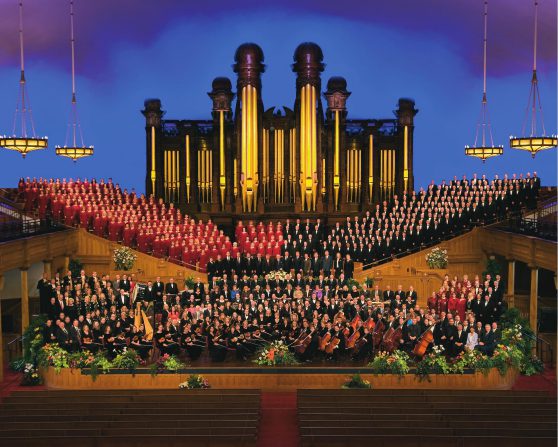
The Tabernacle Choir and the Orchestra at Temple Square, in the Salt Lake Tabernacle
(LDS.org)
We’re just back from the Tabernacle in Salt Lake City. We met friends for dinner at one of our very favorite restaurants, the Market Street Grill in South Jordan — which still, I think, makes the best clam chowder I know — and then drove with them up to a performance of Felix Mendelssohn’s oratorio Elijah by the Tabernacle Choir at Temple Square and the Utah Symphony. Thierry Fischer conducted, and the soloists were Susanna Phillips (soprano), Sasha Cooke (alto), Matthew Polenzani (tenor) and Kyle Ketelsen (bass).
Here, in case your memory is fuzzy, are a trio of familiar pieces from Elijah:
“Cast Thy Burden Upon the Lord”
“He Watching Over Israel Slumbers Not Nor Sleeps”
Such dreck is to be found, obviously, in the Christopher Hitchens Memorial “How Religion Poisons Everything” File©. Perhaps, someday, we can be free of these theistic horrors! Imagine a world without Dante, Milton, Mendelssohn, Michelangelo, Handel, and the like. One can dream, right?
Christopher Hitchens Memorial "How Religion Poisons Everything" File
Church of Jesus Christ of Latter-day Saints
Previous Post

February 17, 2023
Adieu!
Next Post

February 19, 2023 Hungering and Thirsting after Righteousness
Recent Comments
"Sutherland's lecture sounds interesting. He seems to restate the Washington consensus that trade brings peace ..."
Learning more about a region of ..."
"In a meeting today, I learned another important reason why accurate (or at least as ..."
From Serbia’s “White City,” Belgrade
"I've been watching a lot of video interviews of NDErs and researchers. I think in ..."
"PL: "Let's hope he doesn't have your address..."I have to frankly confess that a few ..."
From Serbia’s “White City,” Belgrade
Browse Our Archives
Select a Category Uncategorized
Select a Month October 2026 September 2026 August 2026 July 2026 June 2026 May 2026 April 2026 March 2026 February 2026 January 2026 December 2025 November 2025 October 2025 September 2025 August 2025 July 2025 June 2025 May 2025 April 2025 March 2025 February 2025 January 2025 December 2024 November 2024 October 2024 September 2024 August 2024 July 2024 June 2024 May 2024 April 2024 March 2024 February 2024 January 2024 December 2023 November 2023 October 2023 September 2023 August 2023 July 2023 June 2023 May 2023 April 2023 March 2023 February 2023 January 2023 December 2022 November 2022 October 2022 September 2022 August 2022 July 2022 June 2022 May 2022 April 2022 March 2022 February 2022 January 2022 December 2021 November 2021 October 2021 September 2021 August 2021 July 2021 June 2021 May 2021 April 2021 March 2021 February 2021 January 2021 December 2020 November 2020 October 2020 September 2020 August 2020 July 2020 June 2020 May 2020 April 2020 March 2020 February 2020 January 2020 December 2019 November 2019 October 2019 September 2019 August 2019 July 2019 June 2019 May 2019 April 2019 March 2019 February 2019 January 2019 December 2018 November 2018 October 2018 September 2018 August 2018 July 2018 June 2018 May 2018 April 2018 March 2018 February 2018 January 2018 December 2017 November 2017 October 2017 September 2017 August 2017 July 2017 June 2017 May 2017 April 2017 March 2017 February 2017 January 2017 December 2016 November 2016 October 2016 September 2016 August 2016 July 2016 June 2016 May 2016 April 2016 March 2016 February 2016 January 2016 December 2015 November 2015 October 2015 September 2015 August 2015 July 2015 June 2015 May 2015 April 2015 March 2015 February 2015 January 2015 December 2014 November 2014 March 2014 August 2013 February 2012
Follow Us!
TAKE THE
Religious Wisdom Quiz
What is the Christian teaching about humility?
Select your answer to see how you score.
Value others above yourself Be proud always Demand honor Boast often
Related posts from Sic et Non


Notes on Women, Priesthood, and General Conference

"The Book of Moses as a Temple Text"

TRENDING AT PATHEOS Latter-day Saint

I was strolling through the top floor of the brand new Parthenon...

What Does Gêvâh Mean For Kimberley Guifoyle &...
This week, a lot of the news is focused on Kimberly Guilfoyle....

INNER CIRCLE: Profound Mystery (Of Christ In All...
Ephesians 5:31-32 “For this reason, a man will leave his father and...

Do Not Rejoice When Your Enemy Falls: The...
Turning an execution into a public spectacle is a disturbing expression of...

'The Chosen' S6 Trailer: The Passion Gets Very...
Not many watching 'The Chosen' worry about spoilers, but just because they...

The purpose-driven labor priest
A labor activist reads Rick Warren and it gets me wondering about...
view all Latter-day Saint blogs
What Are Your Thoughts?leave a comment
Ad-Free & Subscriber Log-In Subscription Support
- About Us
- 2026 Calendar
- Videos
- Podcasts
- Library of World Religions
- Faith In Media Tracker
- Advertise With Us
- Write for Us
- Privacy Policy
- Terms of Service
- Do Not Sell My Data
- Contact Us
- Radiant Digital
- Manage Newsletter Subscriptions
- Unsubscribe From Notifications
- Sitemap
Copyright 2008-2026, Patheos. All rights reserved.
Subscription Support Ad-Free & Subscriber Log-In
Follow Patheos