
BuddhistCatholicContemplativeEvangelicalGeneral ChristianHinduJewishLatter-day SaintMuslimNew VisionsProgressive Christian
Beliefs
- Buddhist
- Catholic
- Contemplative
- Evangelical
- General Christian
- Hindu
- Jewish
- Latter-day Saint
- More Voices
- Muslim
- New Visions
- Pagan
- Progressive Christian
Topics
- Religion News
- Food and Religion
- Sports and Religion
- Religious Art
- Religious Music and Entertainment
- Religious Events
- History and Religion
- Style and Religion
- Politics and Religion
- Women in Religion
- Recreation Outdoors and Religion
- Business Finance and Religion
- Careers Workplace and Religion
- Education and Religion
- Family Parenting and Religion
- Health Fitness and Religion
- Home and Religion
- Relationships and Religion
- Technology and Religion
- Travel and Religion
Columnists
- Buddhist Columnists
- Business Finance and Religion Columnists
- Careers Workplace and Religion Columnists
- Catholic Columnists
- Contemplative Columnists
- Education and Religion Columnists
- Evangelists Columnists
- Family Parenting and Religion Columnists
- General Christian Columnists
- Health Fitness and Religion Columnists
- Hindu Columnists
- History and Religion Columnists
- Home and Religion Columnists
- Jewish Columnists
- More Voices Columnists
- Latter Day Columnists
- Muslim Columnists
- New Visions Columnists
- Nonreligious Columnists
- Pagan Columnists
- Politics and Religion Columnists
- Progressive Columnists
- Recreation Outdoors and Religion Columnists
- Relationships and Religion Columnists
- Religion News Columnists
- Religious Art Columnists
- Religious Events Columnists
- Religious Music and Entertainment Columnists
- Sports and Religion Columnists
- Style and Religion Columnists
- Technology and Religion Columnists
- Travel and Religion Columnists
- Women in Religion Columnists
Resource Library
- 2026 Calendar
- Library of World Religions
- The 100 Most Holy Places on Earth
- Patheos Answers
- Podcasts
- Videos
- Faith Leaders Database
- Anglican Episcopalian
- Bahai
- Baptist
- Buddhism
- Christianity
- Confucianism
- Eastern Orthodoxy
- Hinduism
- Holiness and Pentecostal
- ISKCON
- Islam
- Judaism
- Lutheran
- Methodist
- The Church of Jesus Christ of Latter-day Saints
- New Age
- Paganism
- Presbytarian and Reformed
- Protestantism
- Religion Behind the Scenes
- Roman Catholic
- Scientology
- Shia Islam
- Sikhism
- Sufism
- Sunni Islam
- Taoism
- Zen
- See all religions
Research Tools
 Ad-Free & Subscriber Log-In Subscription Support
Ad-Free & Subscriber Log-In Subscription Support
Follow Patheos 

- Trending:
- Forgiveness
- |
- Marriage
- |
- Consciousness
- |
- Death Penalty
- |
- Election
- |
- Halloween

- Home
- Latter-day Saint
- The Resurrection of Christ: Thinking Through the Logical Possibilities
The Resurrection of Christ: Thinking Through the Logical Possibilities
Last updated on: February 28, 2023 at 10:05 am by Dan Peterson
The Resurrection of Christ: Thinking Through the Logical Possibilities 2023-02-28T10:05:56-07:00 Dan Peterson
Patheos Explore the world's faith through different perspectives on religion and spirituality! Patheos has the views of the prevalent religions and spiritualities of the world.
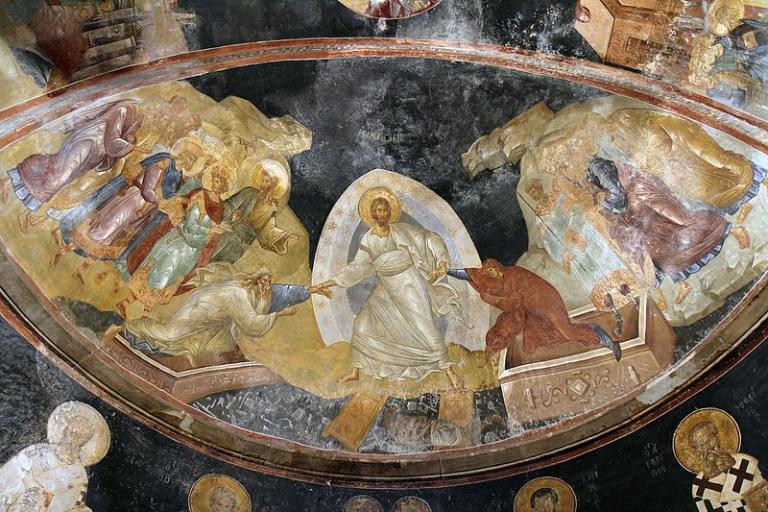
Between his crucifixion and his resurrection, Christ visits the world of spirits and, taking them by the hand, lifts Adam and Eve from their lost state. This fresco –entitled “He Anastasis” (“The Resurrection”) appears in Istanbul’s (Constantinople’s) marvelous “Chora Church,” which is also known as the Kariye Mosque (Turkish: Kariye Camii), or the Church of the Holy Savior in Chora (Greek: Ἐκκλησία τοῦ Ἁγίου Σωτῆρος ἐν τῇ Χώρᾳ), and is located in the Edirnekapı neighborhood of Istanbul, Turkey, outside the city’s great Byzantine walls.
(Wikimedia Commons public domain image)
For the past two or three days, I’ve been spending a few evening minutes on Andrew Loke, Investigating the Resurrection of Jesus Christ: A New Transdisciplinary Approach (Routledge, 2020). The Singaporean Dr. Loke, an Associate Professor at Hong Kong Baptist University, practiced medicine for a while before going back to school in the United States and then on to to earn a doctorate in philosophy and theology at King’s College London. Thus far — I’m just finishing the first chapter — I like his approach. He is admirably systematic and methodical. I’ll offer two specimen examples here
The first is a long outline of reasoning on the question of the resurrection of Christ:
(1) Either (1.1) or (1.2) is true: Note that ‘or’ is taken in the exclusive sense in this syllogism as well as the next.
(1.1) There were no people in mid-first-century (AD 30–70) Palestine who claimed to have witnessed the resurrected Jesus (the New Testament accounts of such people are all legends: call this the legend hypothesis).
(1.2) There were people in mid-first-century Palestine who claimed to have witnessed the resurrected Jesus, in which case either (2.1) or (2.2) is true:
(2.1) All of them did not experience anything which they thought was the resurrected Jesus (no experience hypothesis).
(2.2) At least some (if not all) of them did experience something which they thought was the resurrected Jesus, in which case either (3.1) or (3.2) is true:
(3.1) All of these ‘experiences of Jesus’ were caused intramentally in the absence of appropriate sensory stimulus (call this the intramental hypothesis; examples include hallucinations, ‘subjective vision,’ ‘stimulus,’ ‘religious intoxication,’ ‘enthusiasm,’ and ‘illumination’).
(3.2) At least some (if not all) of these ‘experiences of Jesus’ were caused by an extramental entity, in which case either (4.1) or (4.2) is true:
(4.1) For all these experiences, the extramental entity was not Jesus (for example, they mistook another person for Jesus: mistaken identity hypothesis).
(4.2) For at least some (if not all) of these experiences, the extramental entity was Jesus, in which case either (5.1) or (5.2) is true:
(5.1) Jesus did not die on the cross (swoon/ escape hypothesis: that is, either Jesus swooned on the cross, exited the tomb and showed himself to the disciples later [‘swoon’], or Jesus had secretly escaped prior to the crucifixion, somebody else was crucified, and Jesus showed himself to the disciples later [‘escape’]).
(5.2) Jesus died on the cross (i.e. the extramental entity they experienced was Jesus who rose from the dead), in which case (6) Jesus rose from the dead (resurrection).
Based on the aforementioned syllogism . . . we can know that essentially there are seven and only seven possible categories of explanations concerning the claims of Jesus’ post-mortem appearances, viz. legends, no experience, intramental, mistaken identity, swoon, escape, and resurrection. It should be emphasized that there are essentially no other possibilities apart from the ones listed earlier (although various combinations of these possibilities are possible)
[B]y reducing the myriad of alternative theories that have been (in Ehrman’s phrase) ‘dreamed up’ (or yet undreamed of) to essentially six, it will be demonstrated in the following chapters that, once certain considerations are established, all the alternatives and their combinations can reasonably be excluded. (pages 24-26)
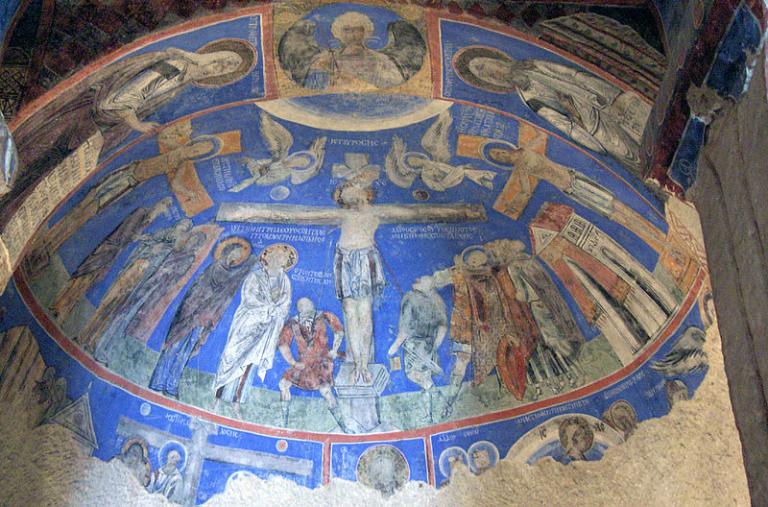
A number of Cappadocian churches — Cappadocia (Greek Καππαδοκία; each “c” is thus pronounced like an English “k”) is a region in central Anatolia, Türkiye — were literally carved into the rock cliffs of the region. This early-tenth-century fresco of the Crucifixion is fairly typical of their ornamentation.
(Wikimedia Commons public domain image)
And here, following close on the heels of the previous outline of possible alternatives, is a second. This one has a slightly different but complementary focus:
(7) Either (7.1), (7.2), or (7.3) is true:
(7.1) Jesus was not crucified (escape hypothesis).
(7.2) Jesus was crucified and he was not buried (unburied hypothesis).
(7.3) Jesus was crucified and he was buried, in which case either (8.1) or (8.2) is true.
(8.1) The body of Jesus remained buried (remain buried hypothesis).
(8.2) The body of Jesus did not remain buried, in which case either (9.1) or (9.2) is true:
(9.1) The body was removed by non-agent(s), e.g. earthquakes . . ., animals, etc. (removal by non-agent hypothesis)
(9.2) The body was removed by agent(s), in which case either (9.2.1) or (9.2.2) is true:
(9.2.1) Others removed the body,
either (9.2.1.1) Friends of Jesus (removal by friends hypothesis),
(9.2.1.2) Enemies of Jesus (removal by enemies hypothesis),
or (9.2.1.3) Neither friends nor enemies, e.g. tomb robbers (removal by neutral party hypothesis).
(9.2.2) Jesus himself removed his body, in which case either (9.2.2.1) or (9.2.2.2) is true:
(9.2.2.1) Jesus did not die on the cross: he swooned on the cross and fell exited the tomb later (swoon hypothesis), or
(9.2.2.2) Jesus died on the cross, rose from the dead, and exited the tomb (resurrection).
This syllogism exhaustively covers all the possibilities. The significance of such a logically exhaustive list of hypotheses is similar to that for the post-mortem appearances.
First, based on the list we can know that essentially there are nine and only nine possible categories of hypotheses concerning the empty tomb, viz. escape, unburied, remain buried, removal by non-agent, removal by friends, removal by enemies, removal by neutral party, swoon, and resurrection..
Second, the list helps to ensure that all possible categories of hypotheses as well as their combinations are considered before the conclusion concerning whether the resurrection is the best explanation [is] reached.
Third, by reducing the myriad of alternative theories to essentially eight, it will be demonstrated in the following chapters that, once certain considerations are established, all the alternatives as well as their combinations can reasonably be excluded. (pages 26-27)
I find Professor Loke’s organized setting forth of the alternatives quite helpful and neat. I share it in the hope that, if there is anything of significance that he has omitted, one of my alert readers here will point it out.
A New Transdisciplinary Approach
Investigating the Resurrection of Jesus Christ
Previous Post

February 26, 2023
"Blessed are the merciful"
Next Post
February 28, 2023 Remembering "missionary bootcamp"
Recent Comments
"About 10 of the BYU medical school faculty are women. One of tgese women gave ..."
The Iron Gates and the Lion ..."
"The BYU School of medicine alreasy has some female faculty members. Having done a complete ..."
The Iron Gates and the Lion ..."
"“Enough and to Spare”I love their closing statement:“Joseph’s revelations related to the issues of scarcity ..."
"Thanks John. You always have so many interesting facts. I could listen to you read ..."
Browse Our Archives
Select a Category Uncategorized
Select a Month October 2026 September 2026 August 2026 July 2026 June 2026 May 2026 April 2026 March 2026 February 2026 January 2026 December 2025 November 2025 October 2025 September 2025 August 2025 July 2025 June 2025 May 2025 April 2025 March 2025 February 2025 January 2025 December 2024 November 2024 October 2024 September 2024 August 2024 July 2024 June 2024 May 2024 April 2024 March 2024 February 2024 January 2024 December 2023 November 2023 October 2023 September 2023 August 2023 July 2023 June 2023 May 2023 April 2023 March 2023 February 2023 January 2023 December 2022 November 2022 October 2022 September 2022 August 2022 July 2022 June 2022 May 2022 April 2022 March 2022 February 2022 January 2022 December 2021 November 2021 October 2021 September 2021 August 2021 July 2021 June 2021 May 2021 April 2021 March 2021 February 2021 January 2021 December 2020 November 2020 October 2020 September 2020 August 2020 July 2020 June 2020 May 2020 April 2020 March 2020 February 2020 January 2020 December 2019 November 2019 October 2019 September 2019 August 2019 July 2019 June 2019 May 2019 April 2019 March 2019 February 2019 January 2019 December 2018 November 2018 October 2018 September 2018 August 2018 July 2018 June 2018 May 2018 April 2018 March 2018 February 2018 January 2018 December 2017 November 2017 October 2017 September 2017 August 2017 July 2017 June 2017 May 2017 April 2017 March 2017 February 2017 January 2017 December 2016 November 2016 October 2016 September 2016 August 2016 July 2016 June 2016 May 2016 April 2016 March 2016 February 2016 January 2016 December 2015 November 2015 October 2015 September 2015 August 2015 July 2015 June 2015 May 2015 April 2015 March 2015 February 2015 January 2015 December 2014 November 2014 March 2014 August 2013 February 2012
Follow Us!
TAKE THE
Religious Wisdom Quiz
What does "Barnabas" mean?
Select your answer to see how you score.
Son of encouragement Son of thunder Gifted one Faithful one
Related posts from Sic et Non

"Out of small things proceedeth that which is...

An action movie and some vacuous theology
"The Appeal of Socialism and the Case Against...
TRENDING AT PATHEOS Latter-day Saint

Emotion in Early Christianity by Andrew Crislip
Andrew Crislip’s Emotion in Early Christianity examines an often overlooked dimension of...

16 Spiritual Touchstones for a More Grounded Life
After decades of spiritual study, here are 16 principles I try...

Catholic Evangelization: Sharing Your Faith Every Day
Welcome back to the Graceful Awakening mini-series called, “From Faith to Mission.” ...

The Pillar of the Boatmen: the Ancient Monument...
The Pillar of the Boatmen is a Romano-Gaulish sculpture that dates from...

In one sense walking into Westminster Abbey is like walking down the...

'Super Scam Me' Exposes AI Jon Bon Jovi...
Leslie Pickett believed she was in a relationship with Jon Bon Jovi....
view all Latter-day Saint blogs
What Are Your Thoughts?leave a comment
Ad-Free & Subscriber Log-In Subscription Support
- About Us
- 2026 Calendar
- Videos
- Podcasts
- Library of World Religions
- Faith In Media Tracker
- Advertise With Us
- Write for Us
- Privacy Policy
- Terms of Service
- Do Not Sell My Data
- Contact Us
- Radiant Digital
- Manage Newsletter Subscriptions
- Unsubscribe From Notifications
- Sitemap
Copyright 2008-2026, Patheos. All rights reserved.
Subscription Support Ad-Free & Subscriber Log-In
Follow Patheos