
BuddhistCatholicContemplativeEvangelicalGeneral ChristianHinduJewishLatter-day SaintMuslimNew VisionsProgressive Christian
Beliefs
- Buddhist
- Catholic
- Contemplative
- Evangelical
- General Christian
- Hindu
- Jewish
- Latter-day Saint
- More Voices
- Muslim
- New Visions
- Pagan
- Progressive Christian
Topics
- Religion News
- Food and Religion
- Sports and Religion
- Religious Art
- Religious Music and Entertainment
- Religious Events
- History and Religion
- Style and Religion
- Politics and Religion
- Women in Religion
- Recreation Outdoors and Religion
- Business Finance and Religion
- Careers Workplace and Religion
- Education and Religion
- Family Parenting and Religion
- Health Fitness and Religion
- Home and Religion
- Relationships and Religion
- Technology and Religion
- Travel and Religion
Columnists
- Buddhist Columnists
- Business Finance and Religion Columnists
- Careers Workplace and Religion Columnists
- Catholic Columnists
- Contemplative Columnists
- Education and Religion Columnists
- Evangelists Columnists
- Family Parenting and Religion Columnists
- General Christian Columnists
- Health Fitness and Religion Columnists
- Hindu Columnists
- History and Religion Columnists
- Home and Religion Columnists
- Jewish Columnists
- More Voices Columnists
- Latter Day Columnists
- Muslim Columnists
- New Visions Columnists
- Nonreligious Columnists
- Pagan Columnists
- Politics and Religion Columnists
- Progressive Columnists
- Recreation Outdoors and Religion Columnists
- Relationships and Religion Columnists
- Religion News Columnists
- Religious Art Columnists
- Religious Events Columnists
- Religious Music and Entertainment Columnists
- Sports and Religion Columnists
- Style and Religion Columnists
- Technology and Religion Columnists
- Travel and Religion Columnists
- Women in Religion Columnists
Resource Library
- 2026 Calendar
- Library of World Religions
- The 100 Most Holy Places on Earth
- Patheos Answers
- Podcasts
- Videos
- Faith Leaders Database
- Anglican Episcopalian
- Bahai
- Baptist
- Buddhism
- Christianity
- Confucianism
- Eastern Orthodoxy
- Hinduism
- Holiness and Pentecostal
- ISKCON
- Islam
- Judaism
- Lutheran
- Methodist
- The Church of Jesus Christ of Latter-day Saints
- New Age
- Paganism
- Presbytarian and Reformed
- Protestantism
- Religion Behind the Scenes
- Roman Catholic
- Scientology
- Shia Islam
- Sikhism
- Sufism
- Sunni Islam
- Taoism
- Zen
- See all religions
Research Tools
 Ad-Free & Subscriber Log-In Subscription Support
Ad-Free & Subscriber Log-In Subscription Support
Follow Patheos 

- Trending:
- Forgiveness
- |
- Marriage
- |
- Consciousness
- |
- Death Penalty
- |
- Election
- |
- Halloween

- Home
- Latter-day Saint
- Introducing a Blog Focus for the Sabbath
Introducing a Blog Focus for the Sabbath
Last updated on: February 4, 2023 at 7:41 pm by Dan Peterson
Introducing a Blog Focus for the Sabbath 2023-02-04T19:41:17-07:00 Dan Peterson
Patheos Explore the world's faith through different perspectives on religion and spirituality! Patheos has the views of the prevalent religions and spiritualities of the world.
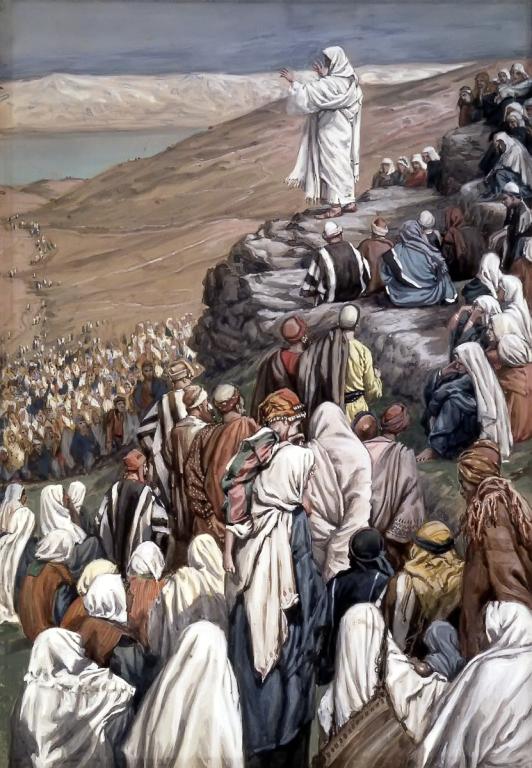
A depiction of Christ delivering the Sermon on the Mount by James Tissot (1836-1902).
Wikimedia Commons public domain image
I’ve long had it in mind to do a brief book on the Beatitudes of the New Testament. I’ve made several starts on it, but — in a triumph of hope over experience — I think I’ll make a running leap at it once again, perhaps making it a special focus for the Sabbath. (Hawai’i very powerfully makes me think of “the Isles of the Blest.”) With that in mind, I share yet again some prefatory remarks on the topic, in very slightly modified form:
The so-called Beatitudes, as they are known to mainstream Christians, are principally found in the fifth chapter of the Gospel of Matthew, as part of the “Sermon on the Mount.” Each is a proverb-like proclamation, without narrative. Four of the blessings also appear in the “Sermon on the Plain” in the Gospel of Luke, followed by four woes that mirror the blessings.
In St. Jerome’s Latin Vulgate translation of the Bible, each Beatitude begins with the three-syllable plural adjective beati, which is rendered in the King James translation of the Bible (and in many, though not all, other translations) with the word blessed. The corresponding and synonymous word in the original Greek is μακάριοι (makarioi). The Latin noun beātitūdō apparently first appears in the writings of the Roman orator, politician, and philosopher Cicero, where it describes a state of blessedness.
I choose the New International Version (NIV) of the Bible for the sake of freshness:
3 “Blessed are the poor in spirit,
for theirs is the kingdom of heaven.
4 Blessed are those who mourn,
for they will be comforted.
5 Blessed are the meek,
for they will inherit the earth.
6 Blessed are those who hunger and thirst for righteousness,
for they will be filled.
7 Blessed are the merciful,
for they will be shown mercy.
8 Blessed are the pure in heart,
for they will see God.
9 Blessed are the peacemakers,
for they will be called children of God.
10 Blessed are those who are persecuted because of righteousness,
for theirs is the kingdom of heaven.
11 “Blessed are you when people insult you, persecute you and falsely say all kinds of evil against you because of me. 12 Rejoice and be glad, because great is your reward in heaven, for in the same way they persecuted the prophets who were before you.
As can be seen in the NIV’s formatting of the verses shown above, most careful readers of Matthew have numbered the Beatitudes as eight. Although 5:11 also begins with the word blessed, 5:11-12 can be easily read as simply expanding upon the beatitude given in 5:10. And that is how I read them.
The Beatitudes are also partially found in the so-called Sermon on the Plain that is located in the Gospel of Luke, at 6:20-26. The relationship at this point between the two texts, Matthew and Luke, has been much discussed, but that discussion is beyond my present purposes. Four of the Beatitudes are plainly present in the same “blessing form” as that in which Matthew gives them, but then those four are given again in what might be called an “anti-Beatitude” form, prefaced by the word woe:
20 Looking at his disciples, he said:
“Blessed are you who are poor,
for yours is the kingdom of God.
21 Blessed are you who hunger now,
for you will be satisfied.
Blessed are you who weep now,
for you will laugh.
22 Blessed are you when people hate you,
when they exclude you and insult you
and reject your name as evil,
because of the Son of Man.23 “Rejoice in that day and leap for joy, because great is your reward in heaven. For that is how their ancestors treated the prophets.
24 “But woe to you who are rich,
for you have already received your comfort.
25 Woe to you who are well fed now,
for you will go hungry.
Woe to you who laugh now,
for you will mourn and weep.
26 Woe to you when everyone speaks well of you,
for that is how their ancestors treated the false prophets.

Wikimedia Commons photo by Christopher Michel
In a series of forthcoming comments on the Beatitudes, I’ll be using Matthew as my primary source, but I’ll also be drawing from the Gospel of Luke and from a source peculiar to the Latter-day Saints: The risen Savior delivers a slightly modified version of the Sermon on the Mount to the Nephites — to distinguish it from the Sermon on the Mount and the Lukan Sermon on the Plain, Jack Welch calls it the “Sermon at the Temple” — that is recorded in the Book of Mormon at 3 Nephi 12-14. In that account, the Matthean Beatitudes occur, with some changes, at 3 Nephi 12:3-12.
More than once, critics of the Church of Jesus Christ of Latter-day Saints have demanded of me to know why we need the Book of Mormon or additional revelation, when we can’t even live up to what we already have in the Bible. But if our own inability to live up to the commandments in the Bible renders additional scripture superfluous, I am tempted to respond that the Beatitudes themselves contain so much, they impose so demanding a standard — a standard so far beyond our ability to live up to it — that all of the rest of the Bible itself, both the Old Testament or Hebrew Bible and the New Testament, must also seem redundant and unnecessary, even something of a cruel joke. In fact, since nobody has ever lived up to the injunction of Matthew 5:48 — “Be ye therefore perfect, even as your Father in Heaven is perfect” — one could argue on the same basis that every other verse of the entire Bible is superfluous.
But let’s return, briefly for now, to the word blessed:
The Greek makar or makarios meant “blessed” or “happy,” and was properly used to refer to the gods. They were the makares, or “blessed ones.” With respect to men, the word meant “supremely blest,” “fortunate,” but also “prosperous,” and “wealthy.” For humans, it was especially the dead who were called “blessed ones,” since they were beyond the reach of pain and death. They dwelt in the abode of the blessed, makaria. The makaron nesoi or “islands of the blest” were, interestingly enough, placed by the later Greeks in the ocean at the extreme West of the world. [See Liddel and Scott, s.v. makar, makaria, and makarios.]
Posted from Waikōloa, Hawai’i Island, Hawai’i
Previous Post

February 4, 2023
“There was no veil.”
Next Post
February 6, 2023 "Blessed are the poor in spirit"
Recent Comments
"I have cpnsidered in my mond if the 4 volume Saints could be made into ..."
From Serbia’s “White City,” Belgrade
"Another class of memories are of individuals who previously lived. Some of these remembered individuals ..."
"Sutherland's lecture sounds interesting. He seems to restate the Washington consensus that trade brings peace ..."
Learning more about a region of ..."
"In a meeting today, I learned another important reason why accurate (or at least as ..."
From Serbia’s “White City,” Belgrade
Browse Our Archives
Select a Category Uncategorized
Select a Month October 2026 September 2026 August 2026 July 2026 June 2026 May 2026 April 2026 March 2026 February 2026 January 2026 December 2025 November 2025 October 2025 September 2025 August 2025 July 2025 June 2025 May 2025 April 2025 March 2025 February 2025 January 2025 December 2024 November 2024 October 2024 September 2024 August 2024 July 2024 June 2024 May 2024 April 2024 March 2024 February 2024 January 2024 December 2023 November 2023 October 2023 September 2023 August 2023 July 2023 June 2023 May 2023 April 2023 March 2023 February 2023 January 2023 December 2022 November 2022 October 2022 September 2022 August 2022 July 2022 June 2022 May 2022 April 2022 March 2022 February 2022 January 2022 December 2021 November 2021 October 2021 September 2021 August 2021 July 2021 June 2021 May 2021 April 2021 March 2021 February 2021 January 2021 December 2020 November 2020 October 2020 September 2020 August 2020 July 2020 June 2020 May 2020 April 2020 March 2020 February 2020 January 2020 December 2019 November 2019 October 2019 September 2019 August 2019 July 2019 June 2019 May 2019 April 2019 March 2019 February 2019 January 2019 December 2018 November 2018 October 2018 September 2018 August 2018 July 2018 June 2018 May 2018 April 2018 March 2018 February 2018 January 2018 December 2017 November 2017 October 2017 September 2017 August 2017 July 2017 June 2017 May 2017 April 2017 March 2017 February 2017 January 2017 December 2016 November 2016 October 2016 September 2016 August 2016 July 2016 June 2016 May 2016 April 2016 March 2016 February 2016 January 2016 December 2015 November 2015 October 2015 September 2015 August 2015 July 2015 June 2015 May 2015 April 2015 March 2015 February 2015 January 2015 December 2014 November 2014 March 2014 August 2013 February 2012
Follow Us!
TAKE THE
Religious Wisdom Quiz
What does "Hosanna" mean?
Select your answer to see how you score.
Praise Hurry Save us Rejoice
Related posts from Sic et Non


Some notes on the archaeology of the Bible

An action movie and some vacuous theology

TRENDING AT PATHEOS Latter-day Saint

57th Dove Awards Honor Dolly Parton, Crown New...
On gospel music’s biggest night, the 57th annual GMA Dove Awards honored...

The First Eucharistic Controversy: Christ’s Real Presence
For Catholics, the Eucharist is the source and summit of the Christian...

What a Stop Sign Can Teach Us About...
How to Make a Decision When You Can't Hear God Main point:...

Archdiocese Hosts Military Marriage Retreat in Germany
RASTATT, Germany — The transient military lifestyle, with its frequent deployments and...

Nearly every morning, I make the drive to Detroit with my high-school-age...

The Real AI Story Is Adoption Without Trust
Artificial intelligence has crossed a political threshold. It is no longer a...
view all Latter-day Saint blogs
What Are Your Thoughts?leave a comment
Ad-Free & Subscriber Log-In Subscription Support
- About Us
- 2026 Calendar
- Videos
- Podcasts
- Library of World Religions
- Faith In Media Tracker
- Advertise With Us
- Write for Us
- Privacy Policy
- Terms of Service
- Do Not Sell My Data
- Contact Us
- Radiant Digital
- Manage Newsletter Subscriptions
- Unsubscribe From Notifications
- Sitemap
Copyright 2008-2026, Patheos. All rights reserved.
Subscription Support Ad-Free & Subscriber Log-In
Follow Patheos