
BuddhistCatholicContemplativeEvangelicalGeneral ChristianHinduJewishLatter-day SaintMuslimNew VisionsProgressive Christian
Beliefs
- Buddhist
- Catholic
- Contemplative
- Evangelical
- General Christian
- Hindu
- Jewish
- Latter-day Saint
- More Voices
- Muslim
- New Visions
- Pagan
- Progressive Christian
Topics
- Religion News
- Food and Religion
- Sports and Religion
- Religious Art
- Religious Music and Entertainment
- Religious Events
- History and Religion
- Style and Religion
- Politics and Religion
- Women in Religion
- Recreation Outdoors and Religion
- Business Finance and Religion
- Careers Workplace and Religion
- Education and Religion
- Family Parenting and Religion
- Health Fitness and Religion
- Home and Religion
- Relationships and Religion
- Technology and Religion
- Travel and Religion
Columnists
- Buddhist Columnists
- Business Finance and Religion Columnists
- Careers Workplace and Religion Columnists
- Catholic Columnists
- Contemplative Columnists
- Education and Religion Columnists
- Evangelists Columnists
- Family Parenting and Religion Columnists
- General Christian Columnists
- Health Fitness and Religion Columnists
- Hindu Columnists
- History and Religion Columnists
- Home and Religion Columnists
- Jewish Columnists
- More Voices Columnists
- Latter Day Columnists
- Muslim Columnists
- New Visions Columnists
- Nonreligious Columnists
- Pagan Columnists
- Politics and Religion Columnists
- Progressive Columnists
- Recreation Outdoors and Religion Columnists
- Relationships and Religion Columnists
- Religion News Columnists
- Religious Art Columnists
- Religious Events Columnists
- Religious Music and Entertainment Columnists
- Sports and Religion Columnists
- Style and Religion Columnists
- Technology and Religion Columnists
- Travel and Religion Columnists
- Women in Religion Columnists
Resource Library
- 2026 Calendar
- Library of World Religions
- The 100 Most Holy Places on Earth
- Patheos Answers
- Podcasts
- Videos
- Faith Leaders Database
- Anglican Episcopalian
- Bahai
- Baptist
- Buddhism
- Christianity
- Confucianism
- Eastern Orthodoxy
- Hinduism
- Holiness and Pentecostal
- ISKCON
- Islam
- Judaism
- Lutheran
- Methodist
- The Church of Jesus Christ of Latter-day Saints
- New Age
- Paganism
- Presbytarian and Reformed
- Protestantism
- Religion Behind the Scenes
- Roman Catholic
- Scientology
- Shia Islam
- Sikhism
- Sufism
- Sunni Islam
- Taoism
- Zen
- See all religions
Research Tools
 Ad-Free & Subscriber Log-In Subscription Support
Ad-Free & Subscriber Log-In Subscription Support
Follow Patheos 

- Trending:
- Forgiveness
- |
- Marriage
- |
- Consciousness
- |
- Death Penalty
- |
- Election
- |
- Halloween

- Home
- Latter-day Saint
- “Initial Conditions and ‘Brute Facts'”
“Initial Conditions and ‘Brute Facts'”
Last updated on: February 2, 2023 at 1:24 pm by Dan Peterson
“Initial Conditions and ‘Brute Facts'” 2023-02-02T13:24:10-07:00 Dan Peterson
Patheos Explore the world's faith through different perspectives on religion and spirituality! Patheos has the views of the prevalent religions and spiritualities of the world.
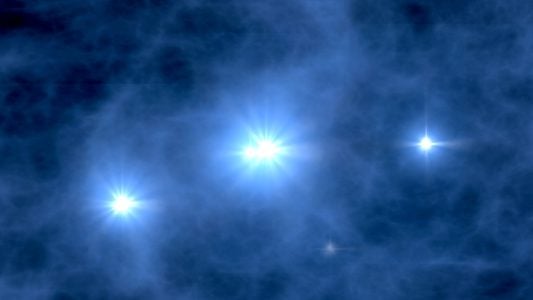
A NASA simulation of the first stars, about 400 million years after the Big Bang
(Wikimedia Commons public domain image)
I carry on now with my loose appropriation, for my own nefarious purposes, of the online “List of Fine-Tuning Parameters” compiled by Jay W. Richards. (My first entry taken from his list and explicitly dependent upon it is this one: “An initial survey of the “four fundamental forces” and the “cosmological constant.””) As I said in that first blog post, I claim no originality here, and I may never claim any (though I’ll eventually rework these notes in successive stages as I draw upon and incorporate materials from other sources for a much larger project that I have in mind). Dr. Richards follows his list of five “Cosmic Constants,” which I briefly discussed in the prior blog entry mentioned just above, with a list of four “Initial Conditions and ‘Brute Facts’.” I’ll discuss them briefly below.
- Initial distribution of mass energy
Initial or boundary conditions are the conditions that were present at the beginning of the universe; they seem to be entirely independent of the physical constants already mentioned. One way of summarizing the initial conditions is to speak of the extremely low entropy (that is, the highly ordered) initial state of the universe. This refers to the initial distribution of mass energy at the very first point at which we can begin to determine what it was. In his book The Road to Reality, the Nobel laureate mathematical physicist Roger Penrose estimates that the odds of the initial low entropy state of our universe occurred by chance alone are on the order of 1 in 1010(123).
To say that this ratio is far beyond mortal human power to comprehend doesn’t begin to do it justice. Most of us don’t even really deal with exponential notation anyway — or, at least, we haven’t since our school days. So maybe a slight refresher is in order:
102 is 10 x 10, which, of course, equals 100. (Note that 102 can be written out as a 1 followed by two zeros.) 103 would be 10 x 10 x 10 = 1000. (That’s a 1 followed by three zeros.) So 1010 would be 10 x 10 x 10 x 10 x 10 x 10 x 10 x 10 x 10 x 10 = 10,000,000,000 — a rather large number. Ten billion. A 1 followed by ten zeroes.) More to the point, one in ten billion would be a very small number. But the number proposed by Roger Penrose is far, far smaller than that. Because it’s 1010(123), which is a fraction in which the numerator is one and the denominator is ten billion multiplied by ten billion one hundred and twenty-three (123) times. To put this into inconceivable perspective, the commonly accepted figure for the number of particles in the observable universe — that is, for the total number of protons, neutrons, neutrinos, and electrons — is 1080. Which can’t even really be said to begin to approach the vast number proposed by Sir Roger.
Now, this ratio should be more than enough in and of itself to raise the question: Why does such a universe exist? “If someone is unmoved by this ratio,” remarks Jay Richards, “then they probably won’t be persuaded by additional examples of fine-tuning.”
But we proceed a bit further, with “brute facts” that just happen to be so but that are essential for life to exist in our universe:
- Ratio of masses for protons and electrons
If this ratio were even slightly different, the building blocks for life (such as DNA) could not have been formed.
- Velocity of light
If the velocity of light were higher than it is, stars would be too luminous. If it were lower than it is, stars would not be luminous enough.
- Mass excess of neutron over proton
If the ratio of the mass of neutrons over protons were greater than it actually is, there would be too few heavy elements in the universe for life to arise. If it were smaller than it is, luminous, life-giving, element-generating stars would quickly collapse into neutron stars or black holes.
Background, as I understand it: Immediately after the Big Bang, which is to say before the first stars in the universe were ever formed, the universe consisted of hydrogen (the first element in the periodic table), helium (the second element in the periodic table), and essentially nothing else. These are the lightest of the elements, and life cannot arise from them alone or survive on the basis of them alone. The early universe made almost nothing else for the simple and sufficient reason that it was so hot and dense in the earliest stages that any elements that it might fuse together it also immediately blasted apart again. Only when the universe had cooled down enough that elements weren’t immediately split apart — perhaps a little more than three minutes into its existence — could other elements of the periodic table begin to appear. Even so, 99.999999% of the elements in the earliest universe were either hydrogen or helium, and not much new began to appear beyond helium until stars commenced to form, several hundred million years after the Big Bang.
Shouldn’t such things make us at least a tad curious?
The Canadian philosopher John Andrew Leslie has created a parable to help us think about this question:
Suppose that you’re about to be executed. Ten skilled marksmen armed with rifles are lined up a few feet away; you’re blindfolded and placed against a wall. You hear the officer say “Fire!” and the rifles roar. However, to your surprise and relief, you’re still alive. Untouched, even.
How do you react?
Do you simply respond that, well, that’s the way it is, and then walk away without any questions? Such a reaction would be remarkably incurious, even extremely strange.
Alternatively, you might reason that even the best riflemen sometimes miss and that, if enough executions happen, there must surely be one, somewhere, sometime, in which all 10 members of the firing squad completely miss their target at close range. You simply happen to be the lucky one. Question disposed of. Move along. There’s nothing more to see.

A humpback whale breaching off of Maui in 2007, in a photography by Vadim Manuylov. This file is licensed under the Creative Commons Attribution-Share Alike 3.0 Unported license.
We went out whale-watching today in the Maui Nui Basin, off Lahaina, between Maui and Lānaʻi. It was one of our best whale-watching experiences ever. Most of our time was spent watching a mother humpback and her baby, along with their male “escort” and another male that was trying to supplant the first in her attention. There was a lot of action, and some real battling. We couldn’t see most of it, of course, as it happened beneath the surface. But they were always close to the top, and when we could see them, there was even a bloody nose on one of the males. We could see them jostling for position, with the one repeatedly blocking the other. And then, later, we watched another baby doing repeated breaches. Loads of fun.
It seems to me quite a challenge to derive the humpback whales of Maui from a random chain of coincidences going back to the Big Bang.
Posted from Ka‘anapali, Maui, Hawai’i
Previous Post

January 31, 2023
A Terrestrial Paradise?
Next Post
February 2, 2023 Why do people leave the Church? A few simple thoughts.
Recent Comments
"You dig out some really interesting information from the background details of the Church."
"The G-20 interreligious summit is happening in Salt Lake City for the first time. President ..."
"Provo High may have some nostalgic value for some folks here--but I have to say ..."
From Serbia’s “White City,” Belgrade
"I have cpnsidered in my mond if the 4 volume Saints could be made into ..."
From Serbia’s “White City,” Belgrade
Browse Our Archives
Select a Category Uncategorized
Select a Month October 2026 September 2026 August 2026 July 2026 June 2026 May 2026 April 2026 March 2026 February 2026 January 2026 December 2025 November 2025 October 2025 September 2025 August 2025 July 2025 June 2025 May 2025 April 2025 March 2025 February 2025 January 2025 December 2024 November 2024 October 2024 September 2024 August 2024 July 2024 June 2024 May 2024 April 2024 March 2024 February 2024 January 2024 December 2023 November 2023 October 2023 September 2023 August 2023 July 2023 June 2023 May 2023 April 2023 March 2023 February 2023 January 2023 December 2022 November 2022 October 2022 September 2022 August 2022 July 2022 June 2022 May 2022 April 2022 March 2022 February 2022 January 2022 December 2021 November 2021 October 2021 September 2021 August 2021 July 2021 June 2021 May 2021 April 2021 March 2021 February 2021 January 2021 December 2020 November 2020 October 2020 September 2020 August 2020 July 2020 June 2020 May 2020 April 2020 March 2020 February 2020 January 2020 December 2019 November 2019 October 2019 September 2019 August 2019 July 2019 June 2019 May 2019 April 2019 March 2019 February 2019 January 2019 December 2018 November 2018 October 2018 September 2018 August 2018 July 2018 June 2018 May 2018 April 2018 March 2018 February 2018 January 2018 December 2017 November 2017 October 2017 September 2017 August 2017 July 2017 June 2017 May 2017 April 2017 March 2017 February 2017 January 2017 December 2016 November 2016 October 2016 September 2016 August 2016 July 2016 June 2016 May 2016 April 2016 March 2016 February 2016 January 2016 December 2015 November 2015 October 2015 September 2015 August 2015 July 2015 June 2015 May 2015 April 2015 March 2015 February 2015 January 2015 December 2014 November 2014 March 2014 August 2013 February 2012
Follow Us!
TAKE THE
Religious Wisdom Quiz
Who was Jephthah's daughter?
Select your answer to see how you score.
Deborah Ruth Miriam Unnamed
Related posts from Sic et Non


Learning more about a region of which I've...

From Serbia's "White City," Belgrade

TRENDING AT PATHEOS Latter-day Saint

Letters on Living the Faith by C.S. Lewis
Most of us met C.S. Lewis as a public intellectual. Mere Christianity....

When Halloween Unmasks Married Hearts
Written by Dr. David K. Ewen from Eternal Truth Bible College Behind...

Aristotle. He’s been called the father of logic, the father of the...

Methodist Central Hall and Westminster Abbey
Situated on the same square is Methodist Central Hall and Westminster Abbey. ...

57th Dove Awards Honor Dolly Parton, Crown New...
On gospel music’s biggest night, the 57th annual GMA Dove Awards honored...

The First Eucharistic Controversy: Christ’s Real Presence
For Catholics, the Eucharist is the source and summit of the Christian...
view all Latter-day Saint blogs
What Are Your Thoughts?leave a comment
Ad-Free & Subscriber Log-In Subscription Support
- About Us
- 2026 Calendar
- Videos
- Podcasts
- Library of World Religions
- Faith In Media Tracker
- Advertise With Us
- Write for Us
- Privacy Policy
- Terms of Service
- Do Not Sell My Data
- Contact Us
- Radiant Digital
- Manage Newsletter Subscriptions
- Unsubscribe From Notifications
- Sitemap
Copyright 2008-2026, Patheos. All rights reserved.
Subscription Support Ad-Free & Subscriber Log-In
Follow Patheos