
BuddhistCatholicContemplativeEvangelicalGeneral ChristianHinduJewishLatter-day SaintMuslimNew VisionsProgressive Christian
Beliefs
- Buddhist
- Catholic
- Contemplative
- Evangelical
- General Christian
- Hindu
- Jewish
- Latter-day Saint
- More Voices
- Muslim
- New Visions
- Pagan
- Progressive Christian
Topics
- Religion News
- Food and Religion
- Sports and Religion
- Religious Art
- Religious Music and Entertainment
- Religious Events
- History and Religion
- Style and Religion
- Politics and Religion
- Women in Religion
- Recreation Outdoors and Religion
- Business Finance and Religion
- Careers Workplace and Religion
- Education and Religion
- Family Parenting and Religion
- Health Fitness and Religion
- Home and Religion
- Relationships and Religion
- Technology and Religion
- Travel and Religion
Columnists
- Buddhist Columnists
- Business Finance and Religion Columnists
- Careers Workplace and Religion Columnists
- Catholic Columnists
- Contemplative Columnists
- Education and Religion Columnists
- Evangelists Columnists
- Family Parenting and Religion Columnists
- General Christian Columnists
- Health Fitness and Religion Columnists
- Hindu Columnists
- History and Religion Columnists
- Home and Religion Columnists
- Jewish Columnists
- More Voices Columnists
- Latter Day Columnists
- Muslim Columnists
- New Visions Columnists
- Nonreligious Columnists
- Pagan Columnists
- Politics and Religion Columnists
- Progressive Columnists
- Recreation Outdoors and Religion Columnists
- Relationships and Religion Columnists
- Religion News Columnists
- Religious Art Columnists
- Religious Events Columnists
- Religious Music and Entertainment Columnists
- Sports and Religion Columnists
- Style and Religion Columnists
- Technology and Religion Columnists
- Travel and Religion Columnists
- Women in Religion Columnists
Resource Library
- 2026 Calendar
- Library of World Religions
- The 100 Most Holy Places on Earth
- Patheos Answers
- Podcasts
- Videos
- Faith Leaders Database
- Anglican Episcopalian
- Bahai
- Baptist
- Buddhism
- Christianity
- Confucianism
- Eastern Orthodoxy
- Hinduism
- Holiness and Pentecostal
- ISKCON
- Islam
- Judaism
- Lutheran
- Methodist
- The Church of Jesus Christ of Latter-day Saints
- New Age
- Paganism
- Presbytarian and Reformed
- Protestantism
- Religion Behind the Scenes
- Roman Catholic
- Scientology
- Shia Islam
- Sikhism
- Sufism
- Sunni Islam
- Taoism
- Zen
- See all religions
Research Tools
 Ad-Free & Subscriber Log-In Subscription Support
Ad-Free & Subscriber Log-In Subscription Support
Follow Patheos 

- Trending:
- Forgiveness
- |
- Marriage
- |
- Consciousness
- |
- Death Penalty
- |
- Election
- |
- Halloween

- Home
- Latter-day Saint
- Hungering and Thirsting after Righteousness
Hungering and Thirsting after Righteousness
Last updated on: March 2, 2023 at 10:23 pm by Dan Peterson
Hungering and Thirsting after Righteousness 2023-03-02T22:23:50-07:00 Dan Peterson
Patheos Explore the world's faith through different perspectives on religion and spirituality! Patheos has the views of the prevalent religions and spiritualities of the world.

A view across Kinneret (the so-called “Sea of Galilee”) from the hill on which, according to tradition, Jesus gave the Sermon on the Mount. The site has been beautifully landscaped and is well cared for by an order of Roman Catholic nuns.
(Wikimedia Commons public domain photo)
I should have said something earlier about the physical setting of the Matthew’s account of the Sermon on the Mount, about its location:
“And seeing the multitudes, he went up into a mountain: and when he was set, his disciples came unto him: And he opened his mouth, and taught them.” (Matthew 5:1-2)
First of all, readers should rid their minds in this context of anything even remotely resembling the mountains of the American West, let alone the Canadian Rockies or the Swiss Alps. No such mountains exist in the relevant area.
Secondly, it might be that the Savior simply climbed up a hill for reasons of acoustics, because he wanted his voice to carry to his audience. In fact, I’m confident that considerations of sound played a role. But there may also be significance in the fact that Jesus spoke downward from a “mountain.”
For one thing, we should perhaps be thinking of the temple associations of “the mountain of the Lord” or “the mountain of the Lord’s house.”
For another, there may be an implicit statement here of Jesus’ divinity and of his unique authority. Moses had ascended Mount Sinai to receive the law from the Lord. Centuries later, Jesus ascended a “mountain” and, from it, handed a new “law” down from on high. Functionally, he seems to have assumed the role of the God of Moses—something that will not altogether surprise most Latter-day Saints.
Please notice, in this regard, the several places in Matthew 5 alone where Jesus says something along the lines of “Ye have heard that it was said of them of old time . . . But I say unto you” (e.g., at verses 21-22, 27-28, 31-32, 33-34, 38-39, 43-44). Jesus doesn’t cite previous authorities. He doesn’t make an argument. He simply declares. The final two verses of Matthew 7, at the very conclusion of the Sermon on the Mount, are worth recalling here:
“And it came to pass, when Jesus had ended these sayings, the people were astonished at his doctrine: For he taught them as one having authority, and not as the scribes.” (Matthew 7:28-29)
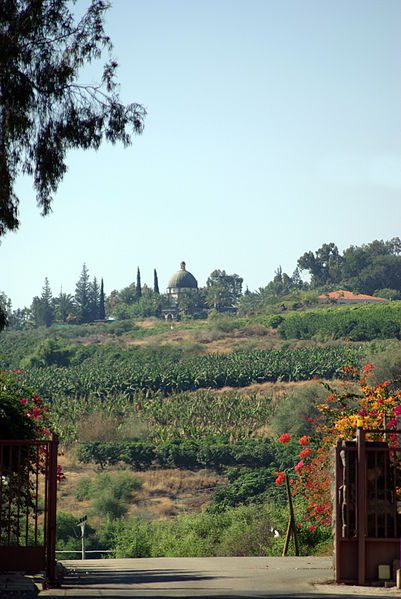
The traditional Mount of Beatitudes, as seen from Capernaum on the shore of the “Sea of Galilee”
(Wikimedia Commons public domain photograph)
“Blessed are they which do hunger and thirst after righteousness,” says the King James Version at Matthew 5:6, “for they shall be filled.”
This beatitude uses some of the most familiar, the most common, of human experiences—hunger and eating, thirst and drinking, followed by satiety—to make an abstract point. The technique is typical of Jesus’ approach to teaching and is perhaps best represented by his parables. Shepherds, sheep, farmers, lost coins, field laborers, stone carving—these and other everyday features of first-century Palestinian life recur throughout his ministry, all in the service of spiritual and ethical lessons. He could simply have issued declarations about faith, devotion, kindness, and the like. Instead, he clothed what he wanted to say in simple but memorable stories that have figured in stained glass windows and sermons and Sunday school lessons and even clichés for two millennia, conveying his message in ways that both attract scholarly commentary and stimulate conversations among rural illiterates in the most remote areas of the globe.
Mention of “hunger and thirst” suggests much more than casual interest. It implies dedication. Devotion. Valiancy. Urgency. I’m reminded of a tale about the great Greek philosopher Socrates that I read or heard many years ago. I can’t recall the source—and, since I’m in the backseat of a car right now, with neither internet nor reference library, I think that I’ll just press on. I’ll find the source later. And it doesn’t really matter much, for my purposes at the moment, whether the story is historically accurate or authentically ancient.
It seems that Socrates used to spend a fair amount of time in and around Piraeus, which was the seaport of the relatively nearby but landlocked city-state of Athens. Socrates was reputedly quite homely, but he was also unusually strong. He had served as a soldier in one of the Athenian wars. One day, supposedly, a man approached him, asking to become one of his disciples. Socrates responded by inviting the somewhat puzzled man to walk with him out into the surf. Once they had reached an area that was deep enough, Socrates suddenly seized the man and pushed his head under the surface of the water. The man flailed and struggled, but Socrates held him down for a fairly long time. Finally, he released his prisoner; the poor man came to the surface gasping for oxygen. “When you are as desperate for wisdom as you were for air,” Socrates told him, “you will be ready to be my disciple.”
I smile to think what the response of a modern collegiate dean of student life might be to Socrates’ reputed teaching method. Fortunately, as both Socrates and the would-be disciple are both long dead, there will probably be no complaint to the university ombudsman and no negative reviews on “Rate My Professor.”
But some sort of urgent hunger and thirst for righteousness is surely required. Believers in the Restoration understand that our eternal goal isn’t simply an unending, pain-free but rather pointless existence in a beautiful garden, or an eternity spent sitting on a fluffy cumulus cloud while plucking a harp. (I once asked a friend who holds a master’s degree in harp performance and who regularly appears on television while pursuing her art whether it doesn’t bother her that musical deadbeats such as I will, if the divine judgment goes our way, instantly become superb harpists at the moment of our deaths.)
Rather, our destiny, if we follow the covenant path, is to become like our Father, to be deified, to be (in some non-trivial and real sense) Gods. Restored in the nineteenth century, this doctrine of human divinization finds ancient echoes in threads of early Christianity that survive not only in the Christian East but, in some regards, in the Catholic and even Protestant traditions of the West.
Think of the magnitude of the goal! Obviously, much more is required of us than merely a vague sentiment that it would be nice to be nice someday.
“It would seem that Our Lord finds our desires not too strong, but too weak. We are half-hearted creatures, fooling about with drink and sex and ambition when infinite joy is offered us, like an ignorant child who wants to go on making mud pies in a slum because he cannot imagine what is meant by the offer of a holiday at the sea. We are far too easily pleased.” (C. S. Lewis, The Weight of Glory, and Other Addresses)
Finally (enough for today!), the additional phrase in the Book of Mormon’s equivalent passage to Matthew 5:6 is, I think, very much worth noting:
“Blessed are all they who do hunger and thirst after righteousness, for they shall be filled with the Holy Ghost.” (3 Nephi 12:6)
Previous Post

February 19, 2023
Thinking about "Evolution"
Next Post

February 20, 2023 Jimmy Carter and I
Recent Comments
"In a meeting today, I learned another important reason why accurate (or at least as ..."
From Serbia’s “White City,” Belgrade
"I've been watching a lot of video interviews of NDErs and researchers. I think in ..."
"PL: "Let's hope he doesn't have your address..."I have to frankly confess that a few ..."
From Serbia’s “White City,” Belgrade
"Let's hope he doesn't have your address..."
From Serbia’s “White City,” Belgrade
Browse Our Archives
Select a Category Uncategorized
Select a Month October 2026 September 2026 August 2026 July 2026 June 2026 May 2026 April 2026 March 2026 February 2026 January 2026 December 2025 November 2025 October 2025 September 2025 August 2025 July 2025 June 2025 May 2025 April 2025 March 2025 February 2025 January 2025 December 2024 November 2024 October 2024 September 2024 August 2024 July 2024 June 2024 May 2024 April 2024 March 2024 February 2024 January 2024 December 2023 November 2023 October 2023 September 2023 August 2023 July 2023 June 2023 May 2023 April 2023 March 2023 February 2023 January 2023 December 2022 November 2022 October 2022 September 2022 August 2022 July 2022 June 2022 May 2022 April 2022 March 2022 February 2022 January 2022 December 2021 November 2021 October 2021 September 2021 August 2021 July 2021 June 2021 May 2021 April 2021 March 2021 February 2021 January 2021 December 2020 November 2020 October 2020 September 2020 August 2020 July 2020 June 2020 May 2020 April 2020 March 2020 February 2020 January 2020 December 2019 November 2019 October 2019 September 2019 August 2019 July 2019 June 2019 May 2019 April 2019 March 2019 February 2019 January 2019 December 2018 November 2018 October 2018 September 2018 August 2018 July 2018 June 2018 May 2018 April 2018 March 2018 February 2018 January 2018 December 2017 November 2017 October 2017 September 2017 August 2017 July 2017 June 2017 May 2017 April 2017 March 2017 February 2017 January 2017 December 2016 November 2016 October 2016 September 2016 August 2016 July 2016 June 2016 May 2016 April 2016 March 2016 February 2016 January 2016 December 2015 November 2015 October 2015 September 2015 August 2015 July 2015 June 2015 May 2015 April 2015 March 2015 February 2015 January 2015 December 2014 November 2014 March 2014 August 2013 February 2012
Follow Us!
TAKE THE
Religious Wisdom Quiz
Who compared himself to a gentle lamb led to the slaughter?
Select your answer to see how you score.
Ezekiel Jeremiah Isaiah Job
Related posts from Sic et Non

"The Book of Moses as a Temple Text"

An action movie and some vacuous theology

"The World's Sixteen Crucified Saviors"?

Entry to the Temple through the Principles of...
TRENDING AT PATHEOS Latter-day Saint

Janie Learns the Way of the Cross: A...
Teaching children about Jesus' Passion can be challenging. Many parents and educators...

Looking For Good Catholic Writing - October 2026
He alone extends the heavens, and he walks upon the waves of...

In "Irreplaceable," our book on vocation and technology, Trevor Sutton and I...

I was strolling through the top floor of the brand new Parthenon...

What Does Gêvâh Mean For Kimberley Guifoyle &...
This week, a lot of the news is focused on Kimberly Guilfoyle....

INNER CIRCLE: Profound Mystery (Of Christ In All...
Ephesians 5:31-32 “For this reason, a man will leave his father and...
view all Latter-day Saint blogs
What Are Your Thoughts?leave a comment
Ad-Free & Subscriber Log-In Subscription Support
- About Us
- 2026 Calendar
- Videos
- Podcasts
- Library of World Religions
- Faith In Media Tracker
- Advertise With Us
- Write for Us
- Privacy Policy
- Terms of Service
- Do Not Sell My Data
- Contact Us
- Radiant Digital
- Manage Newsletter Subscriptions
- Unsubscribe From Notifications
- Sitemap
Copyright 2008-2026, Patheos. All rights reserved.
Subscription Support Ad-Free & Subscriber Log-In
Follow Patheos