
BuddhistCatholicContemplativeEvangelicalGeneral ChristianHinduJewishLatter-day SaintMuslimNew VisionsProgressive Christian
Beliefs
- Buddhist
- Catholic
- Contemplative
- Evangelical
- General Christian
- Hindu
- Jewish
- Latter-day Saint
- More Voices
- Muslim
- New Visions
- Pagan
- Progressive Christian
Topics
- Religion News
- Food and Religion
- Sports and Religion
- Religious Art
- Religious Music and Entertainment
- Religious Events
- History and Religion
- Style and Religion
- Politics and Religion
- Women in Religion
- Recreation Outdoors and Religion
- Business Finance and Religion
- Careers Workplace and Religion
- Education and Religion
- Family Parenting and Religion
- Health Fitness and Religion
- Home and Religion
- Relationships and Religion
- Technology and Religion
- Travel and Religion
Columnists
- Buddhist Columnists
- Business Finance and Religion Columnists
- Careers Workplace and Religion Columnists
- Catholic Columnists
- Contemplative Columnists
- Education and Religion Columnists
- Evangelists Columnists
- Family Parenting and Religion Columnists
- General Christian Columnists
- Health Fitness and Religion Columnists
- Hindu Columnists
- History and Religion Columnists
- Home and Religion Columnists
- Jewish Columnists
- More Voices Columnists
- Latter Day Columnists
- Muslim Columnists
- New Visions Columnists
- Nonreligious Columnists
- Pagan Columnists
- Politics and Religion Columnists
- Progressive Columnists
- Recreation Outdoors and Religion Columnists
- Relationships and Religion Columnists
- Religion News Columnists
- Religious Art Columnists
- Religious Events Columnists
- Religious Music and Entertainment Columnists
- Sports and Religion Columnists
- Style and Religion Columnists
- Technology and Religion Columnists
- Travel and Religion Columnists
- Women in Religion Columnists
Resource Library
- 2026 Calendar
- Library of World Religions
- The 100 Most Holy Places on Earth
- Patheos Answers
- Podcasts
- Videos
- Faith Leaders Database
- Anglican Episcopalian
- Bahai
- Baptist
- Buddhism
- Christianity
- Confucianism
- Eastern Orthodoxy
- Hinduism
- Holiness and Pentecostal
- ISKCON
- Islam
- Judaism
- Lutheran
- Methodist
- The Church of Jesus Christ of Latter-day Saints
- New Age
- Paganism
- Presbytarian and Reformed
- Protestantism
- Religion Behind the Scenes
- Roman Catholic
- Scientology
- Shia Islam
- Sikhism
- Sufism
- Sunni Islam
- Taoism
- Zen
- See all religions
Research Tools
 Ad-Free & Subscriber Log-In Subscription Support
Ad-Free & Subscriber Log-In Subscription Support
Follow Patheos 

- Trending:
- Forgiveness
- |
- Marriage
- |
- Consciousness
- |
- Death Penalty
- |
- Election
- |
- Halloween

- Home
- Latter-day Saint
- “Blessed are the poor in spirit”
“Blessed are the poor in spirit”
Last updated on: February 7, 2023 at 1:18 am by Dan Peterson
“Blessed are the poor in spirit” 2023-02-07T01:18:46-07:00 Dan Peterson
Patheos Explore the world's faith through different perspectives on religion and spirituality! Patheos has the views of the prevalent religions and spiritualities of the world.
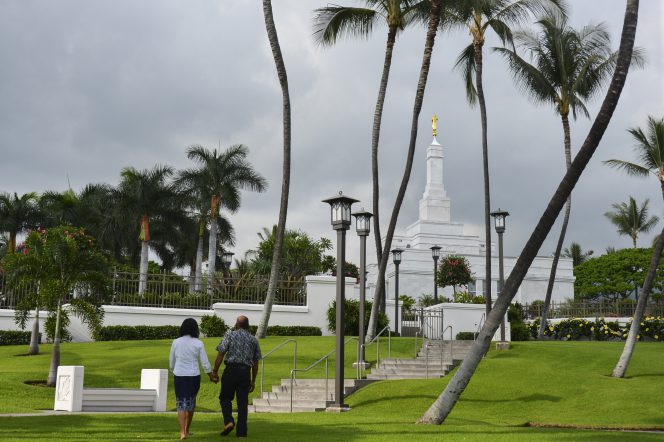
We’ve attended the Kona Hawaii Temple before, but we weren’t able to work in a session on this trip. Next best: We attended sacrament meeting in the very large Latter-day Saint chapel that stands just below the temple, roughly just behind where the person who took this photograph must have been standing. (Photograph from LDS Media Library.)
Herewith, a brief set of preliminary notes toward a chapter in my projected book on the Beatitudes:
“Blessed are the poor in spirit,” reads the first of the Beatitudes (in Matthew 5:3 of the King James Version), “for theirs is the kingdom of heaven.”
By the way, please note that the phrase “for theirs is the kingdom of heaven” also occurs at Matthew 5:10, which, by the traditional reckoning (with which I agree), is the last of the eight Beatitudes. It is significant, I think, that the Beatitudes begin and end with the promised reward of “the kingdom of heaven.”
Notice, too, that the phrase “poor in spirit” seems to refer to a good thing, not to depression or self-deprecation but rather, perhaps, to a sense of humble dependence. To, as Gerhard Kittel’s great (and massive) Theological Dictionary of the New Testament puts it, “the self-awareness . . . of poverty of spirit and perhaps of longing for the [Holy Ghost]”[i]
Consider William Ernest Henley’s justly famous poem “Invictus,” which apparently inspired Nelson Mandela during his long imprisonment under the South African apartheid regime and, accordingly, provided the title for Clint Eastwood’s great 2009 film about Mandela, which starred Morgan Freeman and Matt Damon:
Out of the night that covers me,
Black as the pit from pole to pole,
I thank whatever gods may be
For my unconquerable soul.
In the fell clutch of circumstance
I have not winced nor cried aloud.
Under the bludgeonings of chance
My head is bloody, but unbowed.
Beyond this place of wrath and tears
Looms but the Horror of the shade,
And yet the menace of the years
Finds and shall find me unafraid.
It matters not how strait the gate,
How charged with punishments the scroll,
I am the master of my fate,
I am the captain of my soul.
There is much to be said for the thought expressed in “Invictus,” for resolution and endurance and determination. But there is another important perspective that must be kept in mind: Elder Orson F. Whitney, who served as a member of the Quorum of the Twelve Apostles of the Church of Jesus Christ of Latter-day Saints from 1906 to 1931, responded to Henley’s famous poem with his own verse, which he titled “The Soul’s Captain.” He is responding, of course, to Henley’s stirring declaration “I am the captain of my soul”:
Art thou in truth?
Then what of him who bought thee with his blood?
Who plunged into devouring seas
And snatched thee from the flood
Who bore for all our fallen race
What none but him could bear–
The God who died that man might live
And endless glory share.
Of what avail thy vaunted strength
Apart from his vast might?
Pray that his light may pierce the gloom
That thou mayest see aright.
Men are as bubbles on the wave,
As leaves upon the tree,
Thou, captain of thy soul! Forsooth,
Who gave that place to thee?
Free will is thine–free agency,
To wield for right or wrong;
But thou must answer unto him
To whom all souls belong.
Bend to the dust that “head unbowed”,
Small part of life’s great whole,
And see in him and him alone,
The captain of thy soul.
Surely, “blessed are the poor in spirit” is a warning against hubris, against undue pride and arrogance.
But it is not enough merely to recognize that one is, in and of oneself, inadequate. There are plenty of ersatz substitutes that would like to step in and fill a perceived spiritual void. Some of them are religious, but many are not. A great many of our contemporaries — and, let’s be honest, we ourselves more often than we would like to admit — try to find solace or significance in material things, in the pleasures of food and sex, in power, in sheer speed, and/or in the thoughtless, reckless pursuit of sensation. In the words of T. S. Eliot’s “Four Quartets,” we are “distracted from distraction by distraction.” (T. S. Eliot, “Burnt Norton,” iii.12). C. S. Lewis observed that,
[I]f we consider the unblushing promises of reward and the staggering nature of the rewards promised in the Gospels, it would seem that Our Lord finds our desires, not too strong, but too weak. We are half-hearted creatures, fooling about with drink and sex and ambition when infinite joy is offered us, like an ignorant child who wants to go on making mud pies in a slum because he cannot imagine what is meant by the offer of a holiday at the sea. We are far too easily pleased.[ii]
It is instructive to compare to Matthew 5:3 the equivalent passage in the “Sermon at the Temple,” as it is recorded at 3 Nephi 12:3:
“Blessed are the poor in spirit who come unto me, for theirs is the kingdom of heaven.” (emphasis mine)
The thought is very closely related, I think, to that expressed at the very end of the fourth century A.D. by St. Augustine, in the opening paragraph of his Confessions. He is directly addressing God:
“Our heart is restless until it rests in thee.” — Augustine[iii]
[i] Bammel, “πτωχος,” in Kittel, Theological Dictionary of the New Testament, 6:904, note 171.
[ii] C. S. Lewis, The Weight of Glory and Other Addresses (Grand Rapids: Eerdmans, 1965), 1-2.
[iii] Augustine, Confessions, 1:1.
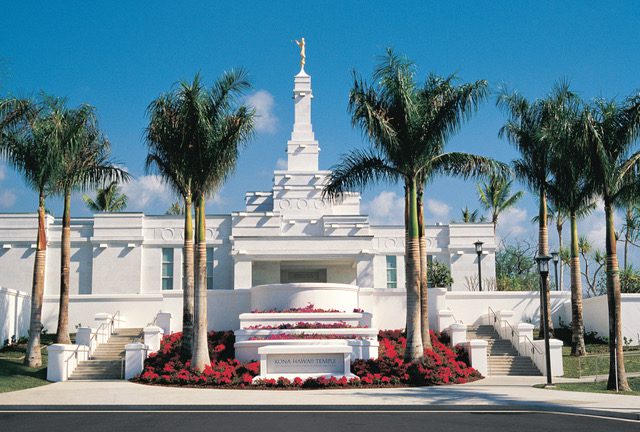
A front-on view of the Kona Hawaii Temple, which is due to close in October 2023 for a major renovation that will, among other things, substantially increase its size.
We had a good day today, trying to do things that were in accord with the sabbath. I have to say that some of the landscapes around Waikola and Mauna Lani here on the Big Island — palm trees and manicured golf courses and ancient lava flows and black sand beaches and the ocean — are just about as beautiful as I can conceive of on this planet. And the sunsets!
Posted from Waikōloa, Hawai’i Island, Hawai’i
ETA: A commenter on this blog who goes by the moniker of “tangata neneva” called my attention to a good quotation: “Elder O Leslie Stone once taught: “What is meant by “poor in spirit”? Is it not humility, which renders us teachable and eager to learn? They who feel themselves spiritually poor approach God, asking him to supply their needs. They who have faith in him, learn his laws and try diligently to obey him.” (The Beatitudes, October 1974 General Conference.)”
Previous Post

February 4, 2023
Introducing a Blog Focus for the Sabbath
Next Post
February 7, 2023 Pu'ukoholā Heiau
Recent Comments
"I have cpnsidered in my mond if the 4 volume Saints could be made into ..."
From Serbia’s “White City,” Belgrade
"DP: “But Mr. Sutherland worries about the fact that our time, when we can communicate ..."
Learning more about a region of ..."
"Another class of memories are of individuals who previously lived. Some of these remembered individuals ..."
"Sutherland's lecture sounds interesting. He seems to restate the Washington consensus that trade brings peace ..."
Learning more about a region of ..."
Browse Our Archives
Select a Category Uncategorized
Select a Month October 2026 September 2026 August 2026 July 2026 June 2026 May 2026 April 2026 March 2026 February 2026 January 2026 December 2025 November 2025 October 2025 September 2025 August 2025 July 2025 June 2025 May 2025 April 2025 March 2025 February 2025 January 2025 December 2024 November 2024 October 2024 September 2024 August 2024 July 2024 June 2024 May 2024 April 2024 March 2024 February 2024 January 2024 December 2023 November 2023 October 2023 September 2023 August 2023 July 2023 June 2023 May 2023 April 2023 March 2023 February 2023 January 2023 December 2022 November 2022 October 2022 September 2022 August 2022 July 2022 June 2022 May 2022 April 2022 March 2022 February 2022 January 2022 December 2021 November 2021 October 2021 September 2021 August 2021 July 2021 June 2021 May 2021 April 2021 March 2021 February 2021 January 2021 December 2020 November 2020 October 2020 September 2020 August 2020 July 2020 June 2020 May 2020 April 2020 March 2020 February 2020 January 2020 December 2019 November 2019 October 2019 September 2019 August 2019 July 2019 June 2019 May 2019 April 2019 March 2019 February 2019 January 2019 December 2018 November 2018 October 2018 September 2018 August 2018 July 2018 June 2018 May 2018 April 2018 March 2018 February 2018 January 2018 December 2017 November 2017 October 2017 September 2017 August 2017 July 2017 June 2017 May 2017 April 2017 March 2017 February 2017 January 2017 December 2016 November 2016 October 2016 September 2016 August 2016 July 2016 June 2016 May 2016 April 2016 March 2016 February 2016 January 2016 December 2015 November 2015 October 2015 September 2015 August 2015 July 2015 June 2015 May 2015 April 2015 March 2015 February 2015 January 2015 December 2014 November 2014 March 2014 August 2013 February 2012
Follow Us!
TAKE THE
Religious Wisdom Quiz
"Thou shalt not..."
Select your answer to see how you score.
Fight Give into the Vainness of Men Have Pride Covet
Related posts from Sic et Non


Learning more about a region of which I've...

From Serbia's "White City," Belgrade

TRENDING AT PATHEOS Latter-day Saint

When Halloween Unmasks Married Hearts
Written by Dr. David K. Ewen from Eternal Truth Bible College Behind...

Aristotle. He’s been called the father of logic, the father of the...

Methodist Central Hall and Westminster Abbey
Situated on the same square is Methodist Central Hall and Westminster Abbey. ...

57th Dove Awards Honor Dolly Parton, Crown New...
On gospel music’s biggest night, the 57th annual GMA Dove Awards honored...

The First Eucharistic Controversy: Christ’s Real Presence
For Catholics, the Eucharist is the source and summit of the Christian...

What a Stop Sign Can Teach Us About...
How to Make a Decision When You Can't Hear God Main point:...
view all Latter-day Saint blogs
What Are Your Thoughts?leave a comment
Ad-Free & Subscriber Log-In Subscription Support
- About Us
- 2026 Calendar
- Videos
- Podcasts
- Library of World Religions
- Faith In Media Tracker
- Advertise With Us
- Write for Us
- Privacy Policy
- Terms of Service
- Do Not Sell My Data
- Contact Us
- Radiant Digital
- Manage Newsletter Subscriptions
- Unsubscribe From Notifications
- Sitemap
Copyright 2008-2026, Patheos. All rights reserved.
Subscription Support Ad-Free & Subscriber Log-In
Follow Patheos