
BuddhistCatholicContemplativeEvangelicalGeneral ChristianHinduJewishLatter-day SaintMuslimNew VisionsProgressive Christian
Beliefs
- Buddhist
- Catholic
- Contemplative
- Evangelical
- General Christian
- Hindu
- Jewish
- Latter-day Saint
- More Voices
- Muslim
- New Visions
- Pagan
- Progressive Christian
Topics
- Religion News
- Food and Religion
- Sports and Religion
- Religious Art
- Religious Music and Entertainment
- Religious Events
- History and Religion
- Style and Religion
- Politics and Religion
- Women in Religion
- Recreation Outdoors and Religion
- Business Finance and Religion
- Careers Workplace and Religion
- Education and Religion
- Family Parenting and Religion
- Health Fitness and Religion
- Home and Religion
- Relationships and Religion
- Technology and Religion
- Travel and Religion
Columnists
- Buddhist Columnists
- Business Finance and Religion Columnists
- Careers Workplace and Religion Columnists
- Catholic Columnists
- Contemplative Columnists
- Education and Religion Columnists
- Evangelists Columnists
- Family Parenting and Religion Columnists
- General Christian Columnists
- Health Fitness and Religion Columnists
- Hindu Columnists
- History and Religion Columnists
- Home and Religion Columnists
- Jewish Columnists
- More Voices Columnists
- Latter Day Columnists
- Muslim Columnists
- New Visions Columnists
- Nonreligious Columnists
- Pagan Columnists
- Politics and Religion Columnists
- Progressive Columnists
- Recreation Outdoors and Religion Columnists
- Relationships and Religion Columnists
- Religion News Columnists
- Religious Art Columnists
- Religious Events Columnists
- Religious Music and Entertainment Columnists
- Sports and Religion Columnists
- Style and Religion Columnists
- Technology and Religion Columnists
- Travel and Religion Columnists
- Women in Religion Columnists
Resource Library
- 2026 Calendar
- Library of World Religions
- The 100 Most Holy Places on Earth
- Patheos Answers
- Podcasts
- Videos
- Faith Leaders Database
- Anglican Episcopalian
- Bahai
- Baptist
- Buddhism
- Christianity
- Confucianism
- Eastern Orthodoxy
- Hinduism
- Holiness and Pentecostal
- ISKCON
- Islam
- Judaism
- Lutheran
- Methodist
- The Church of Jesus Christ of Latter-day Saints
- New Age
- Paganism
- Presbytarian and Reformed
- Protestantism
- Religion Behind the Scenes
- Roman Catholic
- Scientology
- Shia Islam
- Sikhism
- Sufism
- Sunni Islam
- Taoism
- Zen
- See all religions
Research Tools
 Ad-Free & Subscriber Log-In Subscription Support
Ad-Free & Subscriber Log-In Subscription Support
Follow Patheos 

- Trending:
- Forgiveness
- |
- Marriage
- |
- Consciousness
- |
- Death Penalty
- |
- Election
- |
- Halloween

- Home
- Latter-day Saint
- Incomprehensibly Old, but Not Infinitely So
Incomprehensibly Old, but Not Infinitely So
Last updated on: January 2, 2023 at 5:16 pm by Dan Peterson
Incomprehensibly Old, but Not Infinitely So 2023-01-02T17:16:04-07:00 Dan Peterson
Patheos Explore the world's faith through different perspectives on religion and spirituality! Patheos has the views of the prevalent religions and spiritualities of the world.
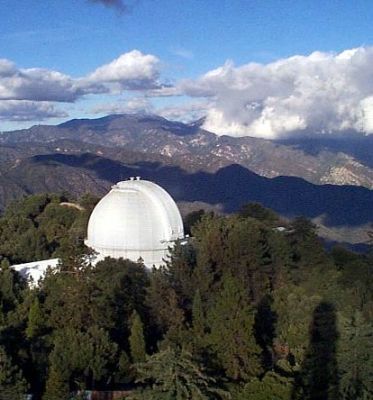
This dome atop Mount Wilson houses the telescope used by Edwin Hubble when he discovered the general expansion of the universe. Along with Mount Palomar to the south, it was one of the principal places where Hubble’s great student and my longtime San Gabriel neighbor Allen Sandage did much of his work. Located (as I was located) not terribly far from the Rose Bowl, Mount Wilson was perhaps the principal and most familiar feature of my natural environment. I saw it nearly every day of my childhood and youth. I visited it (and Mount Palomar) multiple times with my family, on school field trips, and even on dates. For many years, though, I didn’t really comprehend how important the place was.
(NASA public domain photograph)
Gotcha. Its title notwithstanding, this is not an autobiographical essay.
In the writing project for which these preliminary notes are intended, I need to do a fair amount of “setting up,” which, in this portion of the project, means that I need to lay out some general background on certain issues of physics, astronomy, cell biology, paleontology, and the like. Therefore, not being a scientist myself, I’ll be drawing for those general discussions on actual scientists and science popularizers in whom I have confidence. For my first pass on some of these matters, I’m drawing on Michael Guillen’s Believing is Seeing: A Physicist Explains How Science Shattered His Atheism and Revealed the Necessity of Faith (Carol Stream, IL: Tyndale Refresh, 2021). Herewith, I continue with my rough drafts from Dr. Guillen:
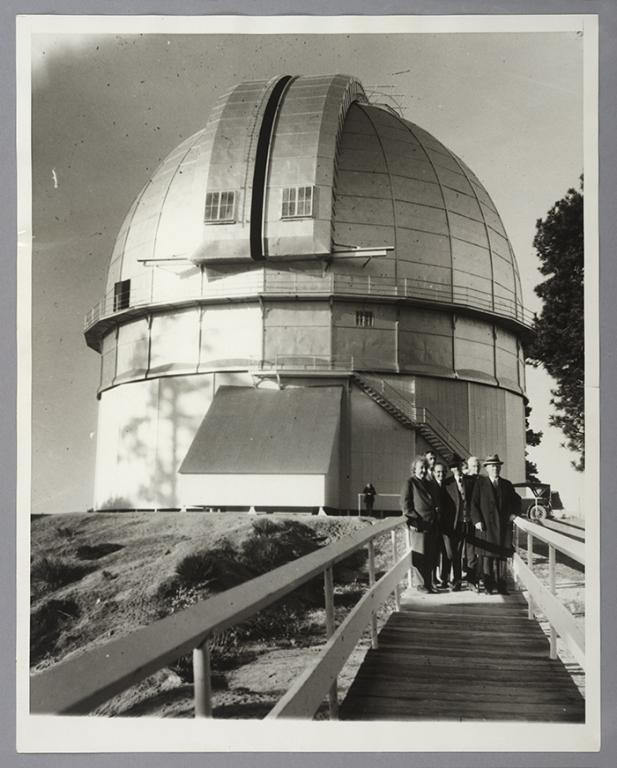
Left to right: Albert Einstein, Edwin Hubble, Walther Mayer, Walter S. Adams, Arthur S. King, and William W. Campbell pose in front of the 100-inch telescope dome at Mount Wilson Observatory on 29 January 1931 (The Huntington Library, Art Collections, and Botanical Gardens)
When Albert Einstein published his theory of general relativity in 1915, he expected it to confirm the generally accepted notion of an ageless and static universe. To his horror, however, it didn’t. Instead, it seemed to suggest that the universe is actually expanding.
Einstein disliked this suggestion, and thought it false. So he inserted “a fudge factor called lambda, the cosmological constant” (144)
With lambda in place, he re-restablished an ageless, static universe, and all seemed to be well.
Sort of. In 1927, a Belgian Roman Catholic priest named Georges Lemaître — who happened to hold a doctorate in mathematics from the Catholic University of Louvain and a doctorate in physics from MIT, the Massachusetts Institute of Technology — published a paper in which he argued that the universe had hatched from what he termed a “cosmic egg” or a “primeval atom.”
In October of that same year, Father Lemaître traveled to Brussels for the Fifth Solvay Conference, where he found Albert Einstein and explained his idea to him. “Your calculations are correct,” Einstein responded, “but your grasp of physics is abominable.” (147)
And then, in 1929, the American astronomer Edwin Hubble, using the big telescope atop Mount Wilson in California’s San Gabriel Mountains, published data appearing to show that galaxies are moving rapidly away from each other, rather in the manner of pieces of shrapnel after the explosion of a bomb. He summarized what his data showed in what is now called Hubble’s Law: v=H x d. where v represents the velocity at which a galaxy is moving away from us, H represents something called the “Hubble constant” and d represents the galaxy’s distance from us. What this implied was that, the further away from us a galaxy is located, the faster it is moving away.
In other words, Einstein’s original theory, before the introduction of his fudge factor, lambda, was actually right. And the implication was clear: If the universe is expanding, it must once have been smaller. It must once have exploded into existence.
So the notion of an ageless, static universe was jettisoned by most scientists in the early 1930s, although there were holdouts. Einstein apparently still disliked the notion of an expanding universe. Said the prominent British astronomer Sir Arthur Stanley Eddington,
Philosophically, the notion of a beginning of the present order of Nature is repugnant to me. . . . I see no way found it; but . . . I should like to find a genuine loophole. (147)
Even in 1949, the great British astronomer and astrophysicist Sir Fred Hoyle, argued for an ageless and stable universe, denouncing Lemaître’s idea of a primordial explosion as
the hypothesis that all the matter in the universe was created in one big bang at a particular time in the remote past. (147)
And hence, using what Hoyle intended as a pejorative dismissal, we still speak today of the “big bang.” As far as I knew when I was in high school, Hoyle’s proposed alternative to “the big bang theory” continued as a live and plausible option, and it still had defenders. At some point, though, that stopped. One factor, of course, was the 1964 discovery, by the American physicist Arno Penzias and the American radio astronomer Robert Wilson, of cosmic microwave background radiation, which is understood as important evidence for a hot early universe and, thus, for the “big bang” (of which it seems to be something like an “echo”). In 1978, Penzias and Wilson were awarded the Nobel Prize for Physics for their discovery. While I was in high school, though, I don’t think that the news had quite filtered down to us.
There is virtually universal consensus today that the universe that we know, including all matter and even time itself, originated in a primeval event beyond which we cannot see.
So the question now looms of how old it is.
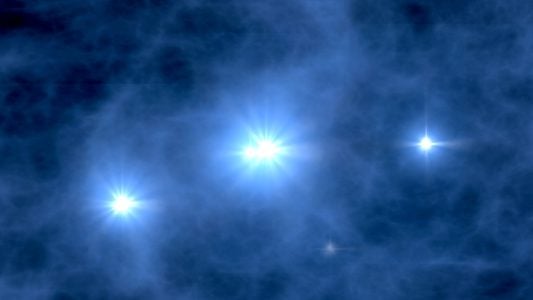
A NASA simulation of the first stars, about 400 million years after the Big Bang
(Wikimedia Commons public domain image)
In order to arrive at an answer, science has to pin down the value of Hubble’s constant, H. A bigger H will mean that the velocity of observable galaxies is relatively high, indicating that they reached their current distance from us quite rapidly. This would seem to indicate that the universe is relatively young. On the other hand, a smaller H will suggest that the universe has taken a longer time to reach its current size — meaning that it’s comparatively old.
But H is difficult to pin down. In 2013, one group of astronomers, arguing that H = 70, calculated an age for the universe of 13.8 billion years. In 2019, an American group published a paper suggesting that H = 76, putting the age of the universe at slightly less than 13 billion years. More recently still, adopting a value of H = 82.4, a European group has pegged the universe at 11.4 billion years old.
“The discrepancy,” remarks Adam Riess, Nobel Prize-winning astronomer at the Space Telescope Science Institute, in Baltimore, “suggests that there’s something in the cosmological model that we’re not understanding right.” (146)
One problem with H is that it doesn’t appear to be consistent over time. Hence the importance of attempts to peer into the most distant parts of the universe, which, since the speed of light is finite and since they are so astoundingly far away, is rather like looking back into the incomprehensibly distant past.
[drawn from and/or inspired by Guillen, pages 144-148]
cosmic microwave background radiation
Previous Post

January 1, 2023
"Rejoice, the Lord is King!"
Next Post
January 3, 2023 Benedictus est
Recent Comments
"DP: “But Mr. Sutherland worries about the fact that our time, when we can communicate ..."
Learning more about a region of ..."
"Another class of memories are of individuals who previously lived. Some of these remembered individuals ..."
"Sutherland's lecture sounds interesting. He seems to restate the Washington consensus that trade brings peace ..."
Learning more about a region of ..."
"In a meeting today, I learned another important reason why accurate (or at least as ..."
From Serbia’s “White City,” Belgrade
Browse Our Archives
Select a Category Uncategorized
Select a Month October 2026 September 2026 August 2026 July 2026 June 2026 May 2026 April 2026 March 2026 February 2026 January 2026 December 2025 November 2025 October 2025 September 2025 August 2025 July 2025 June 2025 May 2025 April 2025 March 2025 February 2025 January 2025 December 2024 November 2024 October 2024 September 2024 August 2024 July 2024 June 2024 May 2024 April 2024 March 2024 February 2024 January 2024 December 2023 November 2023 October 2023 September 2023 August 2023 July 2023 June 2023 May 2023 April 2023 March 2023 February 2023 January 2023 December 2022 November 2022 October 2022 September 2022 August 2022 July 2022 June 2022 May 2022 April 2022 March 2022 February 2022 January 2022 December 2021 November 2021 October 2021 September 2021 August 2021 July 2021 June 2021 May 2021 April 2021 March 2021 February 2021 January 2021 December 2020 November 2020 October 2020 September 2020 August 2020 July 2020 June 2020 May 2020 April 2020 March 2020 February 2020 January 2020 December 2019 November 2019 October 2019 September 2019 August 2019 July 2019 June 2019 May 2019 April 2019 March 2019 February 2019 January 2019 December 2018 November 2018 October 2018 September 2018 August 2018 July 2018 June 2018 May 2018 April 2018 March 2018 February 2018 January 2018 December 2017 November 2017 October 2017 September 2017 August 2017 July 2017 June 2017 May 2017 April 2017 March 2017 February 2017 January 2017 December 2016 November 2016 October 2016 September 2016 August 2016 July 2016 June 2016 May 2016 April 2016 March 2016 February 2016 January 2016 December 2015 November 2015 October 2015 September 2015 August 2015 July 2015 June 2015 May 2015 April 2015 March 2015 February 2015 January 2015 December 2014 November 2014 March 2014 August 2013 February 2012
Follow Us!
TAKE THE
Religious Wisdom Quiz
What animal is mentioned in Proverbs as having little strength but great wisdom?
Select your answer to see how you score.
Ant Ox Bear Lion
Related posts from Sic et Non
It's older (and far bigger) than we can...

Cosmology and Cosmic Design, Again
TRENDING AT PATHEOS Latter-day Saint

Nearly every morning, I make the drive to Detroit with my high-school-age...

The Real AI Story Is Adoption Without Trust
Artificial intelligence has crossed a political threshold. It is no longer a...

A new article, written by Jeff Lindsay and Gale L. Pooley,...

Swimfan: Forgotten Aughts Pleasures
This is a recovery effort. In 2002, My Big Fat Greek Wedding...

Top Three Anti-Catholic Lies About Catholicism
This is my initial transcript for the video, "THE 3 WORST...

Pope Leo Celebrates Mass for Nurses & Docs...
I don't have any idea how he did it, but Pope Leo...
view all Latter-day Saint blogs
What Are Your Thoughts?leave a comment
Ad-Free & Subscriber Log-In Subscription Support
- About Us
- 2026 Calendar
- Videos
- Podcasts
- Library of World Religions
- Faith In Media Tracker
- Advertise With Us
- Write for Us
- Privacy Policy
- Terms of Service
- Do Not Sell My Data
- Contact Us
- Radiant Digital
- Manage Newsletter Subscriptions
- Unsubscribe From Notifications
- Sitemap
Copyright 2008-2026, Patheos. All rights reserved.
Subscription Support Ad-Free & Subscriber Log-In
Follow Patheos